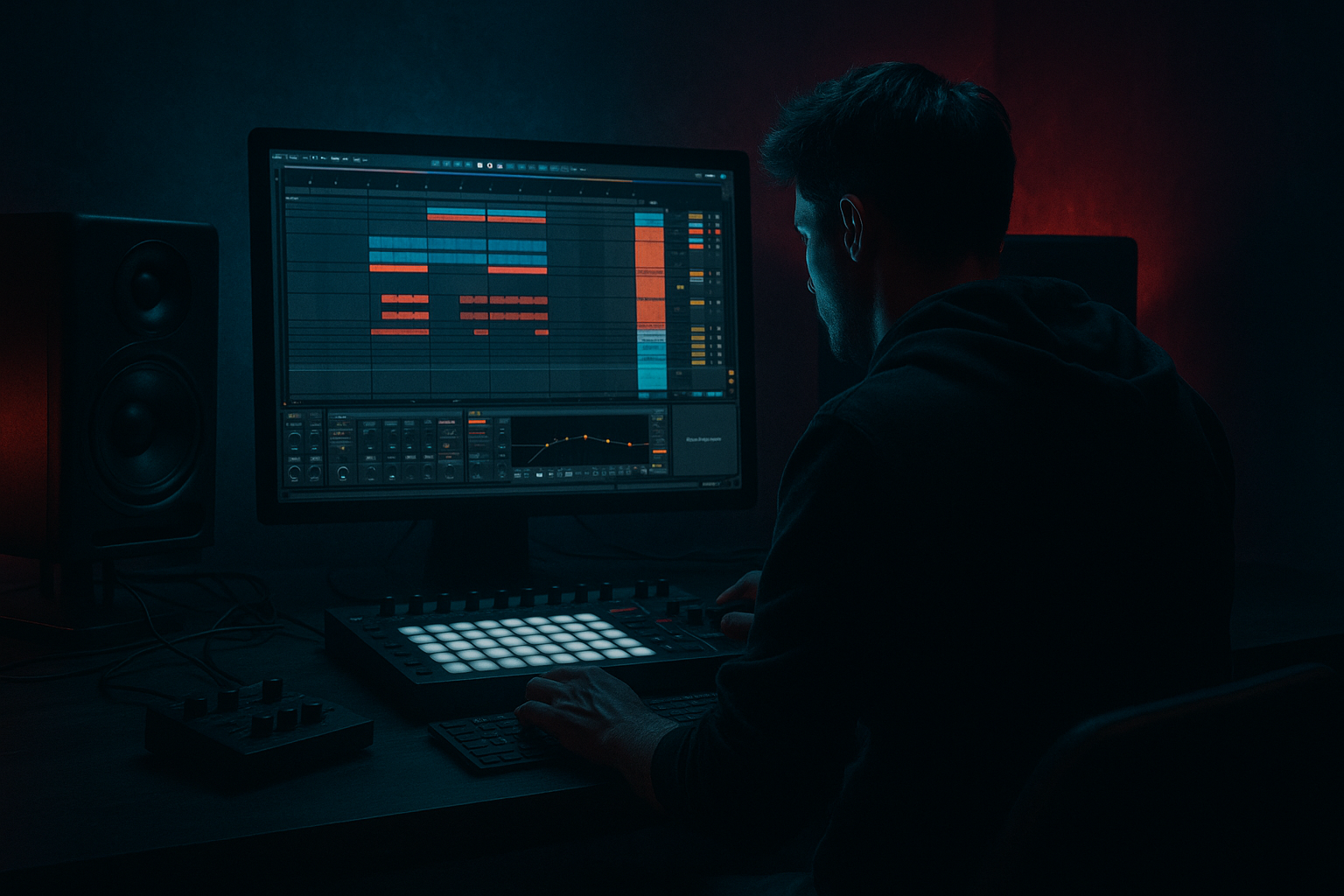
Main tutorial
Lesson Overview
A wobbling, saturated bassline is one of the fastest ways to inject that pirate-radio, oldskool jungle / DnB urgency into a track. The goal here is not just “make bass sound dirty” — it’s to build a bass part that moves rhythmically with the break, hits hard in mono, and feels like it’s being pushed through a small, overdriven radio system without losing low-end control.
In a DnB context, this technique usually sits in the main drop, but it also matters in:
- Builds: tease the bass movement before the drop
- 8/16-bar switch-ups: change wobble rate or saturation intensity
- DJ-friendly intros/outros: keep the bass implied, then strip it down
- Breakdown-to-drop transitions: automate grime, filter, and drive for tension
- keeps the sub solid
- adds wobble movement in the mids
- gets more aggressive through saturation automation
- stays mixable and mono-safe
- works in a rollers, jungle, or dark DnB arrangement
- a clean low sine or triangle foundation
- a midrange wobble layer
- automated saturation drive for intensity changes
- filter movement that opens and closes like a live performance
- enough call-and-response space to lock with breakbeats and ghost notes
- root note sub hits supporting the kick
- syncopated wobble accents answering snare placements
- a dark, tension-heavy phrase that works in a half-time drop or classic jungle bounce
- a sound that can be brought in and out across 8-bar phrases without sounding repetitive
- mostly root notes
- one or two passing notes for tension
- short note lengths to leave air between hits
- bass note on 1
- another on the “and” of 2
- a push into 3
- a syncopated answer before 4
- Osc 1 level: high
- Unison: off for the sub layer
- Voices: mono
- Glide/Portamento: 20–60 ms if you want a slight oldschool slide feel
- Width: 0% for the sub portion
- check Mono behavior by keeping the bass centered
- keep the lowest notes around F1–A1 if your arrangement allows
- avoid stacking too much information below 40–50 Hz
- choose a more harmonically rich wavetable, like a saw-ish or reese-friendly shape
- set Unison to 2–4 voices
- keep Detune moderate, around 5–15%
- low-pass filter the top end so it doesn’t get brittle
- Filter Type: Low-Pass 24
- Frequency: start around 150–400 Hz for darker movement
- Resonance: low to moderate, around 5–20%
- Drive: add a little if needed
- create an LFO-style automation with the Arrangement view envelope
- or use Max for Live LFO if available in your setup, but stock automation is totally fine and more universally useful
- one bar with slow opening movement
- one bar with faster wobble accents
- one bar of partial closure for tension
- filter open positions around 300–900 Hz
- filter closed positions around 120–250 Hz
- Drive: +2 to +6 dB
- Soft Clip: On
- Output: trim so you don’t get fooled by louder volume
- Color: use if it helps shape the high harmonics, but don’t overcook it
- verse or intro tension: lower drive
- pre-drop or drop impact: raise drive
- fill bars: momentary drive boost
- switch-up section: increase drive + filter open together
- Overdrive for a harsher edge
- Redux for lo-fi bite, but use carefully
- Dynamic Tube for warmer midrange thickness
- Sub chain
- Mid wobble chain
- keep it mostly dry
- use EQ Eight with a low-pass if needed, around 120–150 Hz
- keep it mono with Utility
- put Saturator
- Auto Filter
- maybe Amp for character, with Drive kept under control
- use EQ to cut unnecessary low end, usually below 80–120 Hz
- sub chain should carry the weight
- mid chain should carry the character
- land just before or after the snare for push/pull
- leave space on busy break fill moments
- hit harder on the downbeat of each 2-bar phrase
- In a 168–174 BPM drop, place a bass stab on bar 1, another syncopated hit after the second snare, then a longer note into bar 2.
- In bar 4, reduce the bass density and let the drums breathe, then reintroduce the wobble in bar 5 with extra drive.
- bass note attacks can line up after ghost notes to make the groove feel “locked”
- or slightly delay the bass notes to create a lazy, rolling feel
- Auto Filter cutoff
- Saturator Drive
- Wavetable position or macro if you’ve mapped it
- Utility width on the mid layer only
- Dry/Wet of a subtle Phaser-Flanger if you want a metallic reese edge
- Bars 1–4: moderate wobble, lower drive
- Bars 5–8: open filter slightly, add 1–2 dB more saturation
- Bars 9–12: narrow the bass, cut some highs, create tension
- Bars 13–16: full aggression, strongest wobble, slightly louder mid layer
- short noise risers
- reversed break slices
- vinyl-style atmosphere
- filtered impacts
- Collision or Drum Rack for percussion accents
- Echo with very short feedback for dub-style tails
- Reverb on a send for atmosphere, but keep it filtered
- Auto Pan on noise textures for motion
- put EQ Eight after the saturation
- cut any unpleasant resonance with narrow notches if needed
- gently reduce harsh upper mids if the bass bites too much
- keep the sub layer mono and centered
- use Utility to check mono compatibility
- Use note slides sparingly: a short slide into the root note can add that classic grimy tension, especially at the start of a bar.
- Layer a quiet noise or buzz oscillator under the mid bass: it gives the bass a “wired” edge without needing extreme distortion.
- Sidechain the mid layer lightly to the kick/snare using Ableton’s Compressor or Glue Compressor so the groove breathes without pumping the sub too much.
- Try saturation before and after the filter: pre-filter drive creates thicker harmonics; post-filter drive gives a more focused, weaponized edge.
- Use break edits as call-and-response triggers: let the bass answer after a snare roll, reverse break, or chopped amen fill.
- Automate a tiny filter dip before the drop: closing the filter just before impact makes the open section hit harder.
- Resample the bass to audio if the movement feels good. Then chop, reverse, or re-edit the audio for a more authentic jungle feel.
- Keep headroom: if you’re building a heavy drop, leave the master comfortable rather than chasing loudness too early.
- Build the bass in layers: clean sub first, gritty wobble second.
- Use automation on filter cutoff and saturation drive to create pirate-radio energy.
- Keep the low end mono, controlled, and uncluttered.
- Let the bass respond to the breakbeat instead of fighting it.
- Shape the energy across 4-, 8-, and 16-bar phrases so the arrangement evolves.
- In DnB, the best heavy bass is not just loud — it’s rhythmically intelligent, harmonically gritty, and mix-aware.
Why it matters: in jungle and older DnB, energy often comes from a combination of sub pressure, reese midrange movement, and imperfect harmonic grit. A static bassline can feel too modern, too clean, or too safe. A well-automated wobble with saturation creates that “speaker is working hard” feeling that makes pirate-radio / ravier DnB feel alive 🔥
You’ll be using Ableton Live 12 stock devices to create a bass sound that:
---
What You Will Build
By the end of this lesson, you’ll have a 2- or 4-bar bass phrase that sounds like a rolling reese/sub hybrid with:
Musically, think:
You’re not building a huge cinematic bass patch. You’re building a practical DnB drop tool that feels like it belongs on a dubplate or pirate set.
---
Step-by-Step Walkthrough
1) Start with a simple bass MIDI phrase that leaves space for the break
Open a new MIDI track and load Wavetable or Operator. For this lesson, Wavetable gives you a fast route to a reese-style movement, while Operator gives you a clean sub if you want to layer later.
Write a 2-bar MIDI loop with:
A strong starting rhythm for oldskool DnB is:
Keep note lengths around 1/8 to 1/4 so the bass can “speak” rather than drone.
Why this works in DnB: the breakbeat already carries a lot of rhythmic detail. If the bass is too busy, it fights the drums. If it’s too sparse, the drop loses propulsion. The sweet spot is phrase-based movement with gaps for snare ghosts, hats, and break edits.
2) Build the low-end foundation first
If you’re using Wavetable, set Oscillator 1 to a sine or triangle-like waveform for the sub base. Keep it simple:
If you’re in Operator, use a pure sine on one oscillator and keep it clean. Then turn on Mono and optionally Legato for tighter note transitions.
Add Utility after the synth:
Set the bass note range wisely:
If you want a split-layer approach, use Audio Effect Rack later to separate sub and mid bass. For now, establish the fundamental first.
3) Create the wobble movement in the mid layer
Now duplicate the instrument track or use a second layer inside an Instrument Rack.
For the wobble layer in Wavetable:
Use Auto Filter after the synth:
Now automate the filter frequency or modulation amount so the bass “wobbles.” In Ableton Live 12, the easiest way is to:
For a manual wobble feel, draw automation that cycles over 1/8 notes or triplet pulses. Try:
A good starting range:
4) Add saturation as a performance tool, not just a sound-shaper
This is the core of the lesson. Insert Saturator after the bass synth or after the filter on the mid layer.
Start subtle:
Then automate saturation for energy changes:
A powerful move is to automate Saturator Drive over 8 bars so the bass slowly gets “more rude” as the arrangement develops. That gives the impression of a system being pushed harder — very pirate-radio.
Alternative stock devices for different flavours:
Keep in mind: saturation should add audible movement in the mids, not destroy the sub. If the low end starts wobbling too much, keep the saturation on the mid layer only.
5) Shape the bass with a rack split so sub stays clean
This is where the lesson gets properly usable in a real mix. Create an Audio Effect Rack or Instrument Rack with two chains:
On the sub chain:
On the mid chain:
Set the balance:
This split is one of the most practical DnB workflows because you can automate the mid chain aggressively while protecting the foundational low end.
6) Program the wobble to answer the drums
Now make the bass respond to the break rather than sit on top of it.
In oldskool jungle and rollers, the bass often feels like it’s talking to the snare or ducking around the kick/break accents. Edit your MIDI so the bass notes:
A practical musical context:
If your break has strong ghost notes, use them as a guide:
Use Note Length and Velocity to vary the phrase. Velocity is especially useful if you’re triggering a sampler bass or a synth with velocity mapping.
7) Automate motion in phrases, not randomly
This is where the track starts sounding intentional. In the Arrangement view, build automation over 4-, 8-, and 16-bar phrases.
Useful automation targets:
Example arrangement arc:
A useful trick is to automate one parameter per phrase and avoid changing everything at once. That way each section feels distinct and the listener hears the drop evolving instead of just getting louder.
8) Add subtle transition FX to enhance the pirate-radio feel
To sell the energy between sections, add lightweight transition detail:
In Ableton Live, use stock devices like:
If you’re going for authentic oldskool tension, use a short break fill before the bass re-enters. Then automate the bass saturation up during the fill so the drop feels like it slams back in harder.
9) Check the mix in mono and trim the harshness
Because saturation creates harmonics, it can easily get too sharp between 1.5 kHz and 6 kHz.
Do this:
If the bass feels huge solo but weak with drums, reduce the mid-bass volume a bit and let the drums breathe. In DnB, a bass that sounds slightly smaller solo often works better in the full mix.
---
Common Mistakes
1. Saturating the sub too hard
- Fix: keep distortion on the mid layer, not the pure low-end layer.
2. Making the wobble too fast and too random
- Fix: base movement on 1/8 or triplet phrasing that locks to the break.
3. Using too much stereo width on low bass
- Fix: keep everything below roughly 120 Hz centered and mono.
4. Letting saturation create harsh fizz
- Fix: use EQ after saturation and trim the 2–6 kHz range if needed.
5. Ignoring drum/bass relationship
- Fix: carve MIDI space for snare hits and break fills; don’t crowd the groove.
6. Automating everything at once
- Fix: automate one or two key parameters per section so the arrangement feels musical.
7. No level compensation
- Fix: use Utility or device output trim so louder saturation doesn’t trick your ears.
---
Pro Tips for Darker / Heavier DnB
---
Mini Practice Exercise
Spend 15 minutes making a 4-bar pirate-radio-style bass phrase.
1. Load Wavetable and write a simple 2-note or 3-note MIDI loop.
2. Duplicate it to 4 bars and vary the note lengths slightly.
3. Add Auto Filter and automate the cutoff so bar 1 is darker, bar 4 is more open.
4. Insert Saturator and automate the Drive from low in bar 1 to higher in bar 4.
5. Create a second chain or second track for a clean mono sub.
6. Drop in a basic breakbeat or jungle loop and listen for how the bass answers the snare.
7. Make one fix only: either tighten timing, reduce harshness, or simplify the rhythm.
Goal: by the end, you should have a loop that feels like it could sit in the first drop of a dark roller or oldskool jungle tune.
---

