Main tutorial
```markdown
Beginner Bass Automation for Club Mixes (DnB) — Ableton Live 🎛️🔊
1) Lesson overview
Bass automation is one of the fastest ways to make a drum & bass track feel alive in a club mix. Instead of changing your whole bass patch every 8 bars, you’ll automate a few key parameters (filter, distortion, volume, width, reverb sends, etc.) to create movement, tension, and impact—while keeping the low-end consistent and mix-friendly.
In this lesson you’ll learn:
- What to automate (and what not to) for club-ready low end
- How to automate in Ableton Live (Arrangement + Clip automation)
- Practical automation moves for rolling / jungle / deep / heavier DnB
- A simple device chain using Ableton stock devices that works in real tracks ✅
- Sub layer (clean, mono, stable)
- Mid bass layer (character + movement)
- LP filter sweeps into drops
- Distortion/drive ramps for energy
- Utility width automation (mids widen, sub stays mono)
- Reverb send “throw” on a single note (classic tension trick)
- Volume micro-ducks for groove control (without wrecking the sub)
- 1-bar loop: F1 (1/8 notes) with a couple of rests for groove.
- Keep it simple; the movement will come from the mid layer + automation.
- Add occasional 16th-note pickups before snare hits
- Example vibe: a “rolling” pattern where the bass answers the drums
- Add Spectrum to visually confirm sub energy is stable.
- Small dip around 2.5–4.5 kHz (1–3 dB) if it gets spitty.
- Keep Width at 0% always.
- Bars 1–8: drums + sub only (mid filtered low, quiet)
- Bars 9–16: introduce mid bass, small movement, occasional reverb throw
- Bars 17–24 (build): filter opens + drive ramps + width increases
- Bars 25–32 (drop): filter resets, drive stable, width controlled, micro-mutes
- Automate a band-pass “telephone” moment on the MID for 1 bar before the drop:
- Use Erosion (subtle!) on MID only:
- Add a Phaser-Flanger on MID for movement, but automate Dry/Wet:
- Sidechain the MID more than the SUB
- Automate a “darken” EQ tilt in the drop
- Keep the sub steady, mono, and boring (that’s a compliment in club mixing).
- Put the movement in the mid layer via filter, drive, and width automation.
- Use reverb throws and micro-mutes for tension and DJ-friendly phrasing.
- Reset automation at the drop so impact stays punchy.
---
2) What you will build
You’ll build a basic rolling DnB bassline with two layers:
Then you’ll add club-focused automation:
---
3) Step-by-step walkthrough
Step 0 — Project setup (fast and correct)
1. Set tempo to 174 BPM (typical DnB range).
2. Turn on Arrangement View (press `Tab` if you’re in Session).
3. Create 2 MIDI tracks:
- `SUB`
- `MID BASS`
4. Group them (`Cmd/Ctrl + G`) into a group called BASS BUS.
Why: This keeps your automation organized and makes “one knob” changes on the bus easy.
---
Step 1 — Build a clean sub (don’t overthink it)
On the `SUB` track:
1. Drop Operator (stock synth).
2. In Operator:
- Oscillator A: Sine
- Level: around -12 dB to leave headroom
3. Add Auto Filter after Operator:
- Filter type: Lowpass
- Frequency: 120 Hz
- Resonance: 0.0–0.2
4. Add Utility:
- Width: 0% (force mono)
- Gain: adjust later
MIDI: Program a simple rolling pattern in F or G (club-friendly keys), for example:
---
Step 2 — Create a mid bass that can move
On the `MID BASS` track:
1. Add Wavetable (or Operator if you don’t have Suite).
2. Quick Wavetable starter settings:
- Osc 1: Basic Shapes (saw-ish)
- Unison: 2–4 voices
- Detune: low (5–15%)
3. Add Auto Filter:
- Lowpass 24 dB
- Frequency: start around 250–600 Hz (you’ll automate this)
- Resonance: 0.3–0.6 (for a bit of bite)
4. Add Saturator:
- Mode: Analog Clip
- Drive: 2–6 dB (you’ll automate Drive later)
- Soft Clip: On
5. Add EQ Eight:
- High-pass (low cut) around 120–150 Hz
- This keeps the mid layer out of your sub space.
MIDI: Copy the sub MIDI to MID BASS, then modify:
---
Step 3 — Glue the layers on a Bass Bus
On the BASS BUS (group):
1. Add Glue Compressor (light control):
- Attack: 10 ms
- Release: Auto
- Ratio: 2:1
- Aim for 1–2 dB gain reduction max
2. Add Limiter (safety, not loudness):
- Leave default; just catch peaks
Optional but useful:
---
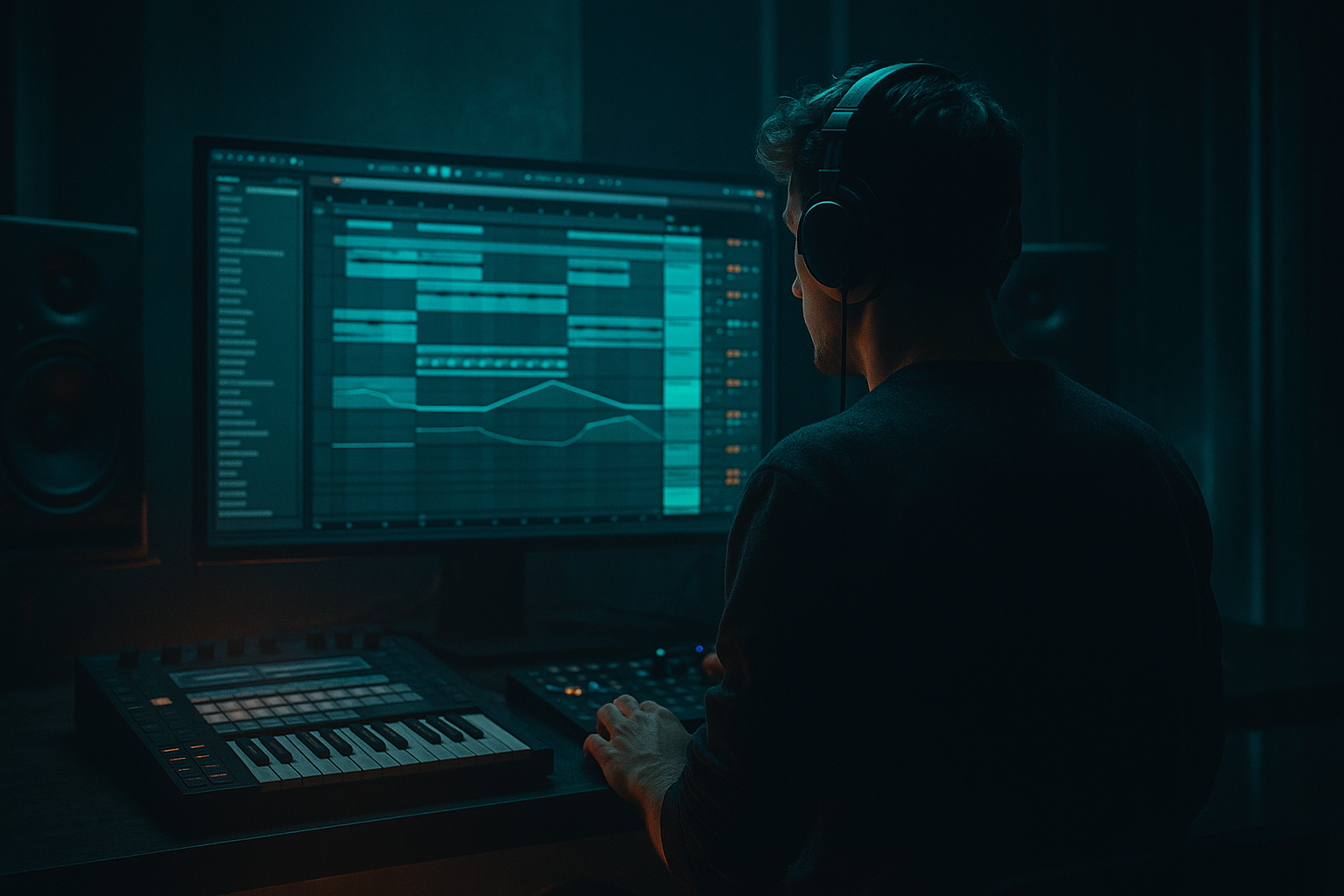
Step 4 — Automation move #1: Filter “open” into the drop (classic DnB tension) 🔥
Goal: Make the pre-drop feel like it’s “unmasking” the bass.
1. Go to Arrangement View.
2. Press `A` to show Automation Mode.
3. On `MID BASS`, choose automation for:
- Auto Filter → Frequency
4. Create an 8-bar build section before your drop.
5. Draw a gentle ramp:
- Bar -8: ~250 Hz
- Bar -1: ~1.2–2.0 kHz
6. At the drop, snap back to a tighter value (club-friendly):
- Drop bar 1: back down to ~400–700 Hz
Why it works: You increase perceived energy without changing the sub. The drop hits harder because the mid resets to a focused tone.
---
Step 5 — Automation move #2: Distortion/Drive ramp for “push” (without turning up volume)
1. Automate Saturator → Drive on `MID BASS`.
2. Over the last 2 bars before the drop:
- Start: 2 dB
- End: 6–9 dB (depending on taste)
3. At drop: return to a stable setting:
- 3–6 dB is often enough
Tip: If Drive adds too much harshness, tame it with EQ Eight:
---
Step 6 — Automation move #3: Width automation (wide mids, mono sub) 🎯
Club systems punish wide sub. So we widen only the mid character.
On `MID BASS`:
1. Add Utility at the end.
2. Automate Width:
- Verses: 80–100%
- Builds: ramp to 120–140% (careful—check mono)
- Drop: back to 90–110% for punch and stability
On `SUB`:
Check: Use Utility’s Mono toggle on the master occasionally. If the bass disappears, you’ve over-widened.
---
Step 7 — Automation move #4: Reverb “throw” on a single bass note (jungle tension trick) 🌫️
Instead of drowning your bass in reverb, you’ll “throw” reverb on one note in a phrase.
1. Create a Return Track with Hybrid Reverb:
- Mode: Convolution or Algorithm
- Decay: 1.2–2.5 s
- High Cut: 3–6 kHz
- Low Cut: 200–400 Hz (important!)
2. Send only the `MID BASS` to this return.
3. Automate the Send amount (e.g., Send A) so it spikes on one note:
- Most of the time: -inf (off)
- On one note at end of 4/8 bars: -12 to -6 dB
4. Optional: Automate Hybrid Reverb Dry/Wet slightly up for that moment too.
Result: Space and tension without washing out the drop’s low end.
---
Step 8 — Automation move #5: “Micro-mutes” and groove edits for club phrasing ✂️
DnB often hits hardest when the bass stops for a fraction.
1. On the `BASS BUS`, automate Utility → Gain (or use track volume).
2. Create short cuts:
- 1/8 or 1/16 bar mute right before a drop or snare hit
- Example: last 1/16 before bar 33 drop = dip -inf quickly then back
3. Keep it tight—this is a club punctuation move.
Alternative: Use MIDI note length edits on MID BASS only, so sub stays consistent.
---
Step 9 — Arrange it like real DnB (simple template)
Try this practical 32-bar loop idea:
This creates “DJ-friendly” energy without rewriting your bassline.
---
4) Common mistakes
1. Automating the sub filter too much
- Your low end becomes inconsistent and weak on big systems.
2. Wide sub
- Sounds cool on headphones, collapses in mono in clubs.
3. Too much Drive automation
- You’ll get volume jumps and harshness instead of energy.
4. Reverb on the whole bass constantly
- Low-end smear = mix falls apart fast.
5. Automation ramps that aren’t reset
- If the drop starts with an “open build” setting, it won’t hit.
---
5) Pro tips for darker/heavier DnB 🖤
- Auto Filter → Bandpass, freq sweep downward, res around 0.5–0.8.
- Mode: Wide Noise
- Freq: 4–8 kHz
- Amount: tiny (0.2–1.0)
Automate Amount up briefly for gritty transitions.
- Keep Dry/Wet 0–10% most of the time, spike to 20–35% for fills.
- Use Compressor with sidechain from the kick (or kick+snare group).
- SUB: light (1–2 dB GR), MID: stronger (2–5 dB GR) for clarity.
- Use EQ Eight high shelf on MID: -1 to -3 dB above 6–10 kHz if it’s too bright.
---
6) Mini practice exercise (15–20 minutes) ⏱️
1. Make a 16-bar loop at 174 BPM with drums (any DnB loop is fine).
2. Build SUB + MID using the chain above.
3. Add exactly these automations:
- MID Auto Filter Frequency: 8-bar ramp up into bar 9, reset at bar 9
- Saturator Drive: ramp last 2 bars before bar 9, reset at bar 9
- MID Utility Width: increase in build, tighten at drop
- One reverb send throw on the last note of bar 8
4. Bounce/export a rough mix and listen on:
- headphones
- phone speaker (you should still “feel” the mid movement even if sub disappears)
Goal: Drop should feel noticeably bigger without turning the bass up.
---
7) Recap
If you tell me what sub style you’re aiming for (deep liquid roll, jump-up wobble, neuro grit, jungle reese), I can suggest a matching Ableton stock bass patch and 3 automation lanes that fit that vibe.
```

