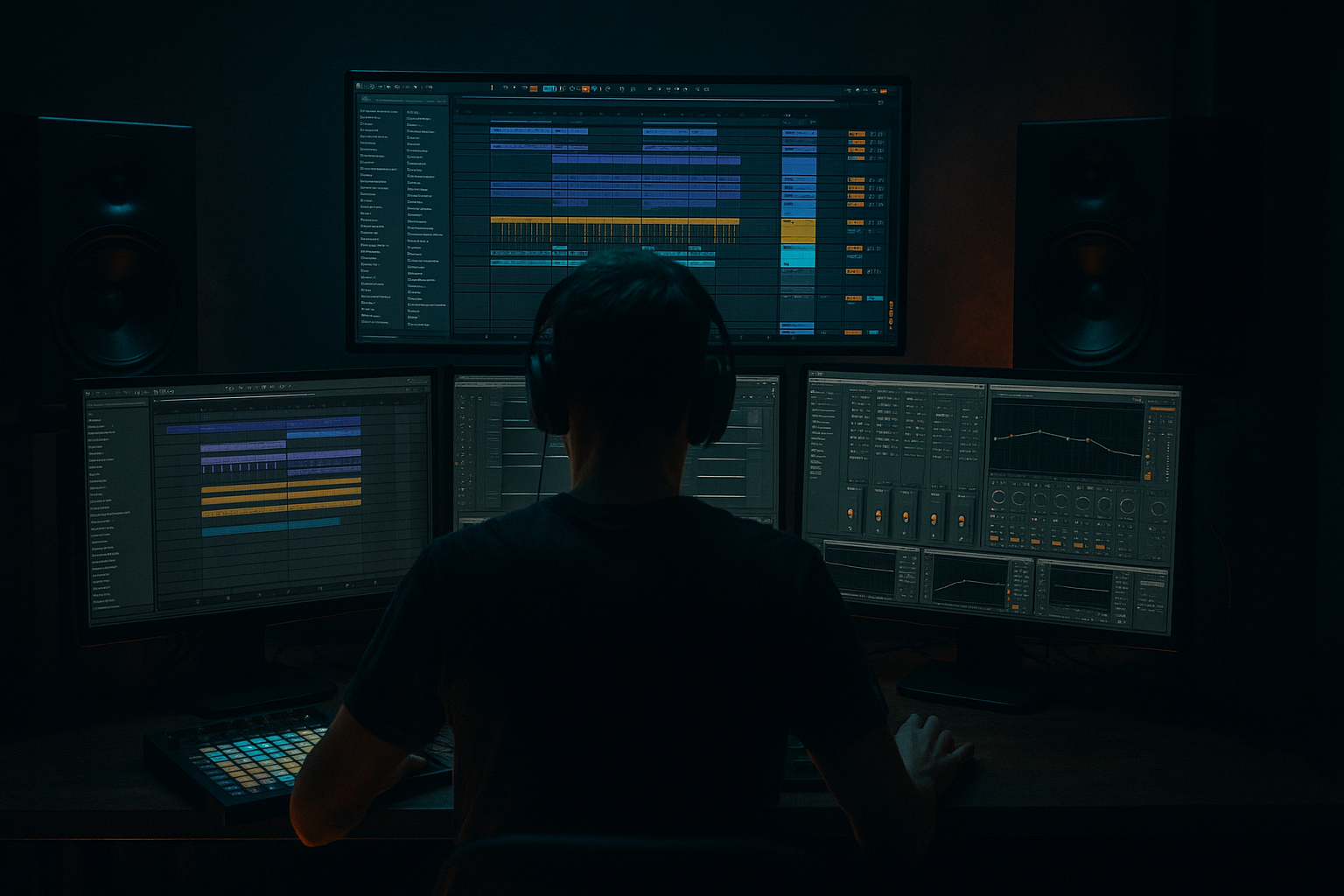
Main tutorial
Lesson Overview
This lesson is about building a DJ intro that actually works in a real Jungle / oldskool DnB context inside Ableton Live 12 — not a generic “intro vibe,” but a section a DJ can mix from, a listener can lock into, and your track can later explode out of with real impact.
In DnB, the intro lives in a very specific job description: it sets key, mood, and groove while leaving low-end space for an incoming record. For jungle and oldskool-flavoured DnB, that usually means break energy, atmosphere, sampled musical fragments, and just enough rhythmic identity to feel alive without giving away the drop too early. The intro is also where you establish whether the track is rough, dusty, serious, and crate-digging in character — or polished and modern with an oldskool shell.
Technically, this matters because a DJ intro has to be mixable, readable, and low-end disciplined. Musically, it matters because jungle and oldskool DnB often rely on the intro to sell the sample source, break feel, and subtext before the main bassline arrives. If you get it right, the intro doesn’t feel like “waiting time”; it feels like a statement.
By the end, you should be able to hear a 12–32 bar DJ intro that carries grimey jungle atmosphere, break-based movement, and clear phrasing, while still leaving enough room for the drop to slam in cleanly. A successful result should sound like it could be dropped into a set tomorrow: dark, functional, and musical without overcrowding the low end.
What You Will Build
You will build a DJ-friendly oldskool jungle intro in Ableton Live 12 with:
- a filtered or partially exposed break-led foundation
- sampled atmospheres or vinyl-style fragments
- controlled tension automation
- a clear phrasing arc over 16 or 32 bars
- enough drum identity to feel like the tune, but not enough low-end to compromise the mix
- a transition path into the first drop that feels intentional, not pasted on
- dusty but controlled
- rhythmic rather than ambient
- shadowy, with selective reveal
- energetic enough for a rave intro, but sparse enough to mix over
- hint at the main break language of the tune
- use ghost hits, filtered slices, or top-end break motion
- avoid cluttering the bar with full-strength kick/sub content
- a DJ mix-in section
- a mood setter
- a tension ramp toward the first drop
- a place to introduce the identity of the track before the bass line takes over
- clean enough that the intro doesn’t sound unfinished
- rough enough that it still feels like jungle / oldskool DnB, not a glossy EDM opening
- Use break dust as a rhythmic glue, not as noise filler. A faint vinyl hiss or room tone can unify chopped breaks and atmospheric samples, but keep it low enough that it doesn’t mask ghost notes or hi-hat detail.
- Resample your intro movement. Print a bar or two of filtered break + FX motion into audio, then cut and rearrange it. This often sounds more coherent than maintaining five live automation lanes.
- Let one element carry menace. If the break is already savage, keep the atmosphere minimal. If the atmosphere is grim enough, let the break stay more functional. Heavy intros get stronger when one layer is dominant and the others support.
- Use controlled dissonance in stabs or samples. A short sampled chord fragment or dusty stab that leans slightly tense can create underground character without turning into harmony soup. Keep it brief and place it rhythmically, not constantly.
- Bias the energy upward before the drop. Open the top end on the break or a filtered texture in the final bars so the drop feels like a heavy compression release. This is especially effective in neuro-influenced or darker roller material.
- Keep the sub absent or almost abstract until the last moment. In heavy DnB, the power of the first drop often comes from restraint. The intro should imply weight, not spend it.
- If the intro needs more pressure, automate density, not volume. More ghost hits, shorter echoes, a slightly busier top break, or a narrower filter opening usually feels heavier than simply turning things up.
- Use only one break loop, one atmospheric bed, and one transition effect.
- No full bassline allowed.
- Keep all non-essential elements high-passed.
- Make the intro work with the drums muted and then again with the drop immediately after it.
- a 16-bar intro with clear 4-bar phrasing
- one automation-driven tension curve
- one final transition bar
- a rendered rough bounce
- Can you hear the groove without the sub?
- Does the intro leave room for the drop?
- Does the last bar clearly signal a change without overcrowding it?
- Does the center still feel solid in mono?
Sonically, the result should feel:
Rhythmically, it should:
Role-wise, it should function as:
Polish level:
In normal terms: it should sound like a proper opening section that a DJ could ride for a clean mix, while the listener still hears the track’s personality before the drop.
Step-by-Step Walkthrough
1. Set the intro architecture first: choose 16 or 32 bars, and decide what the DJ needs.
Before adding sounds, decide the intro’s job. For a club-ready jungle/DnB tune, a 16-bar intro is usually tighter and more functional if the tune comes in hot; a 32-bar intro gives more room for atmosphere, break development, and DJ mixing safety.
In Ableton Live, lay out empty MIDI or audio clips across your intro length and mark the phrasing points: bar 1, 5, 9, 13 for a 16-bar intro, or bar 1, 9, 17, 25 for a 32-bar one. This isn’t theory for theory’s sake — it keeps your automation and edits aligned to DJ-readable phrases.
Why this works in DnB: DJs mix in long phrases. If your intro change happens off-grid or too frequently, the blend becomes awkward. Jungle especially benefits from clear section shifts because the break energy can feel chaotic fast if the arrangement lacks structure.
Decide now whether this intro is:
- Option A: Break-led and raw — more drum focus, more DJ tool energy, darker and more aggressive
- Option B: Atmosphere-led and moody — more sampled texture, longer tension, more cinematic, slightly less upfront
Both are valid. If the track is roller-heavy or club functional, choose A. If it’s darker and more narrative, choose B.
2. Build a skeletal drum bed with a break loop, but don’t let it become the full tune too early.
Start with a break loop from your track’s main source material or a complementary jungle break. Put it on an audio track, warp it only as much as needed so the groove stays natural, then slice or duplicate to create a 4-bar loop.
Use the Clip Envelopes or simple volume automation to thin the break:
- pull down kick-heavy hits if they fight the future drop
- keep hats, shuffles, and ghosted snare tails alive
- leave some syncopation in the tops so it feels active
If the break is too dense, use EQ Eight to high-pass around 120–180 Hz on the intro version, depending on the sample. You want movement, not low-end ownership.
A useful chain for the break intro:
- EQ Eight: high-pass low end, maybe a small dip around 300–500 Hz if the break sounds boxy
- Drum Buss: drive lightly, around 5–15%, with boom either off or very restrained
- Saturator: soft clip or gentle drive around 1–4 dB for grit
What to listen for: the break should still groove when the sub is gone. If the loop only feels good because of its kick weight, it won’t hold as an intro.
3. Add one atmospheric bed that tells the story, not three competing ones.
Jungle intros often collapse when producers stack too many ambiences. Choose one main bed: a vinyl noise layer, distant pad, jungle field recording, or a sampled musical fragment. Then commit to making it evolve over the section.
In Ableton, use Simpler or Sampler for a chopped ambient one-shot or tonal fragment, then shape it with:
- Auto Filter: low-pass around 1–4 kHz to start
- Reverb: keep decay moderate, often 2–6 seconds depending on density
- Echo: short rhythmic throws if you want movement without adding more notes
Keep the bed low in the mix. If it starts sounding like a soundtrack intro instead of a DnB intro, it’s too loud or too wide.
Mono compatibility note: if the atmosphere is wide, check it in mono. A huge stereo pad can be fine, but if the intro depends on side-only detail that disappears in mono, the blend into a club system can feel hollow. Keep the core of the intro readable in the center.
4. Create the intro’s rhythmic signature with ghosted edits, not a full bassline.
Oldskool DnB intros often tease the groove before the bass arrives. You can do this with edited break hits, ghost snares, or tiny cut-up percussion accents that suggest the pattern to come.
In Ableton, duplicate a few break slices and:
- shift a ghost hit slightly early or late by a few milliseconds to humanize it
- mute the heavy kick on selected bars
- keep snare backbeats implied, not always fully stated
A good pattern is to build tension in 4-bar cells:
- bars 1–4: filtered break + atmosphere
- bars 5–8: introduce more top-end break detail
- bars 9–12: hint at the snare pressure or a chopped vocal stab
- bars 13–16: open the filter, add a fill, or prepare a transition
This is where Ableton’s Simpler is useful if you want to play sliced break accents from MIDI. Keep notes sparse — you’re building identity, not a full drum performance.
What to listen for: does the groove make you nod even without the bass? If yes, the intro has enough rhythmic intent. If not, you’ve made an atmosphere, not a DnB opening.
5. Choose your main intro bass policy: tease the low end or keep it absent until the drop.
This is a major creative decision point.
- Option A: No bass until the drop
- Best for maximum impact
- Leaves the DJ intro clean
- Makes the drop feel larger and more violent
- Option B: Sub tease or low-register hint
- Best for darker, more musical, or more modern intros
- Can foreshadow the main motif
- Risks muddying the blend if it sits too long or too wide
If you choose B, keep it very controlled:
- use a simple sine or filtered sub hint
- high-pass anything that isn’t true low-end control
- keep mono below roughly 120 Hz
- keep the movement subtle, not “bassline-like”
In DnB, this works because the ear is primed by the drum pattern and atmosphere. A tiny sub tease can create anticipation. But if you let it behave like a full bassline, the intro stops being DJ-friendly.
Stop here if the intro already works as a mix-in tool. If a DJ could blend this under another tune without clashing, you’ve built the skeleton correctly. Now only add what improves tension, not what fills space.
6. Shape the tension curve with automation instead of adding more layers.
The best DJ intros usually evolve through automation, not endless new sounds. Use automation lanes on:
- Auto Filter cutoff
- Reverb dry/wet
- Echo feedback or send amount
- Utility width
- EQ Eight high-pass frequency
- Drum Buss drive
Practical ranges:
- open a low-pass from around 800 Hz up to 5–8 kHz across the intro, depending on how dusty you want it
- raise reverb slightly in the first half, then pull it back before the transition so the drop is less smeared
- automate Utility width from narrower to wider, but keep the low end centered
This creates the sense of motion without overcrowding the arrangement. In jungle, the listener is already hearing motion in the break; your automation should support that motion, not fight it.
Why this works in DnB: bass music needs low-end discipline. Automation gives you perceived progression without forcing more notes into the range where kick and sub need to dominate later.
7. Build a transition bar that feels like a DJ tool, not a random fill.
The bar before the drop or section change should be purposeful. In Ableton, create a final phrase that signals release:
- a reverse cymbal or reversed break slice
- a short snare fill
- a tape-stop style effect if it suits the track, but use it sparingly
- a filtered stab that opens right before the drop
A classic oldskool-style move is to make bars 13–16 progressively busier:
- bar 13: atmosphere and break
- bar 14: add a snare pickup
- bar 15: add a small fill or riser
- bar 16: full stop, brake, or short pre-drop hit
Keep the final transition tight. If the fill is too long, DJs lose the mix point. If it’s too abrupt, the intro feels unfinished. The sweet spot is a transition that says, “this track is about to hit,” without stealing the impact from the drop.
What to listen for: on the last two bars, does your ear automatically lean forward? That is the signal you want. If it feels like the track simply keeps looping, the transition needs more narrative.
8. Check the intro against the drop in context, not in isolation.
This is where advanced producers separate a loop from a record. Place the intro directly before your first drop and listen from at least 8 bars before the change through to 8 bars after.
Ask:
- does the intro leave enough space for the kick and sub to appear with force?
- does any top-end cymbal or break tail mask the drop transient?
- does the first drop feel like a payoff, or just the next loop?
If the drop feels small, the intro may be too dense. If the intro feels too empty, the drop may not have enough contrast. The right balance is that the intro feels like a complete section, but the drop still lands as a separate event.
Workflow efficiency tip: once the intro works, commit key audio elements to audio by flattening complex break edits or printed effect returns into audio clips. That makes arrangement decisions faster and avoids revisiting tiny automation details every time you adjust the drop.
9. Do a mix pass that protects headroom and the center channel.
A DJ intro often gets a free pass from casual listening, but it still needs to mix cleanly. Use Utility to control width on non-essential layers, and use EQ Eight to remove low-end clutter from atmospheres and effects.
Practical targets:
- keep non-bass intro elements high-passed around 120–250 Hz where appropriate
- avoid stacking wide stereo on multiple elements at once
- keep the kickless intro from sounding hollow by preserving midrange presence in the break or chopped sample
If the intro is “big” but the center is weak, the club system may make it feel thin. The center is where the DJ mix lives. Keep enough information there that the tune still exists when summed or when played on a sound system with a strong mono core.
If your intro starts eating too much headroom, tame it now. A polished intro should sit comfortably under the future drop, not already be using drop-level loudness.
10. Finish with a version choice: raw DJ tool or more cinematic opening.
This is your final A/B decision.
- A: Raw club tool
- tighter break loop
- less reverb tail
- more direct drum function
- best for rewinds, blends, and harder sets
- B: Cinematic jungle opener
- more atmosphere
- more automation movement
- longer tension lead-in
- best for track-led listening or deeper sets
Both are valid. The trick is to commit to one identity. A DJ intro that tries to be both often ends up vague: too atmospheric to mix cleanly, too drum-heavy to feel like a proper opening.
Before you move on, bounce or consolidate the intro section so you can hear it as a finished block. If it works as a self-contained opening and still leaves the drop hungry, you’re done.
Common Mistakes
1. Making the intro sound like a half-finished drop
- Why it hurts: the DJ loses a clean mix point, and the listener gets the bassline too early.
- Fix: high-pass or mute the real low-end content until the drop, and keep bass teases very restrained.
2. Using too many atmosphere layers
- Why it hurts: the intro becomes cloudy and stops reading as a single idea.
- Fix: choose one main atmospheric bed, then evolve it with automation instead of stacking more tracks.
3. Leaving the break too full-range
- Why it hurts: kick energy in the intro competes with the incoming drop and eats mix headroom.
- Fix: shape the break with EQ Eight and Drum Buss; thin the low end and keep only the rhythm-bearing elements prominent.
4. Over-processing the break until it loses swing
- Why it hurts: jungle energy depends on the break’s natural push-pull and transient character.
- Fix: keep compression and saturation controlled; if the break feels flattened, reduce processing and print a cleaner version.
5. Making the transition bar too dramatic
- Why it hurts: the intro becomes a trailer instead of a functional DJ section.
- Fix: simplify the final bars. Use one fill, one reverse, or one snare pickup rather than a pile of FX.
6. Wide stereo on everything
- Why it hurts: the intro feels huge in headphones but collapses on a club system and can muddy the center.
- Fix: keep the low end mono, narrow some atmospheric elements with Utility, and let only one or two textures own width.
7. Ignoring the drop while designing the intro
- Why it hurts: the intro may sound cool alone but fail to create contrast with the main section.
- Fix: keep flipping between intro and drop every few changes. If the drop doesn’t feel bigger, strip the intro back.
Pro Tips for Darker / Heavier DnB
Mini Practice Exercise
Goal: Build a 16-bar jungle DJ intro that can cleanly mix into a first drop.
Time box: 15 minutes.
Constraints:
Deliverable:
Quick self-check:
Recap
A strong DJ intro in jungle / oldskool DnB is about function first, vibe second, and contrast always. Build the phrase length deliberately, keep the break alive but not full-range, use one atmosphere that evolves, and let automation do more work than extra layers.
The winning formula is simple: make the intro mixable, make it recognizable, and leave the drop with something to prove.

