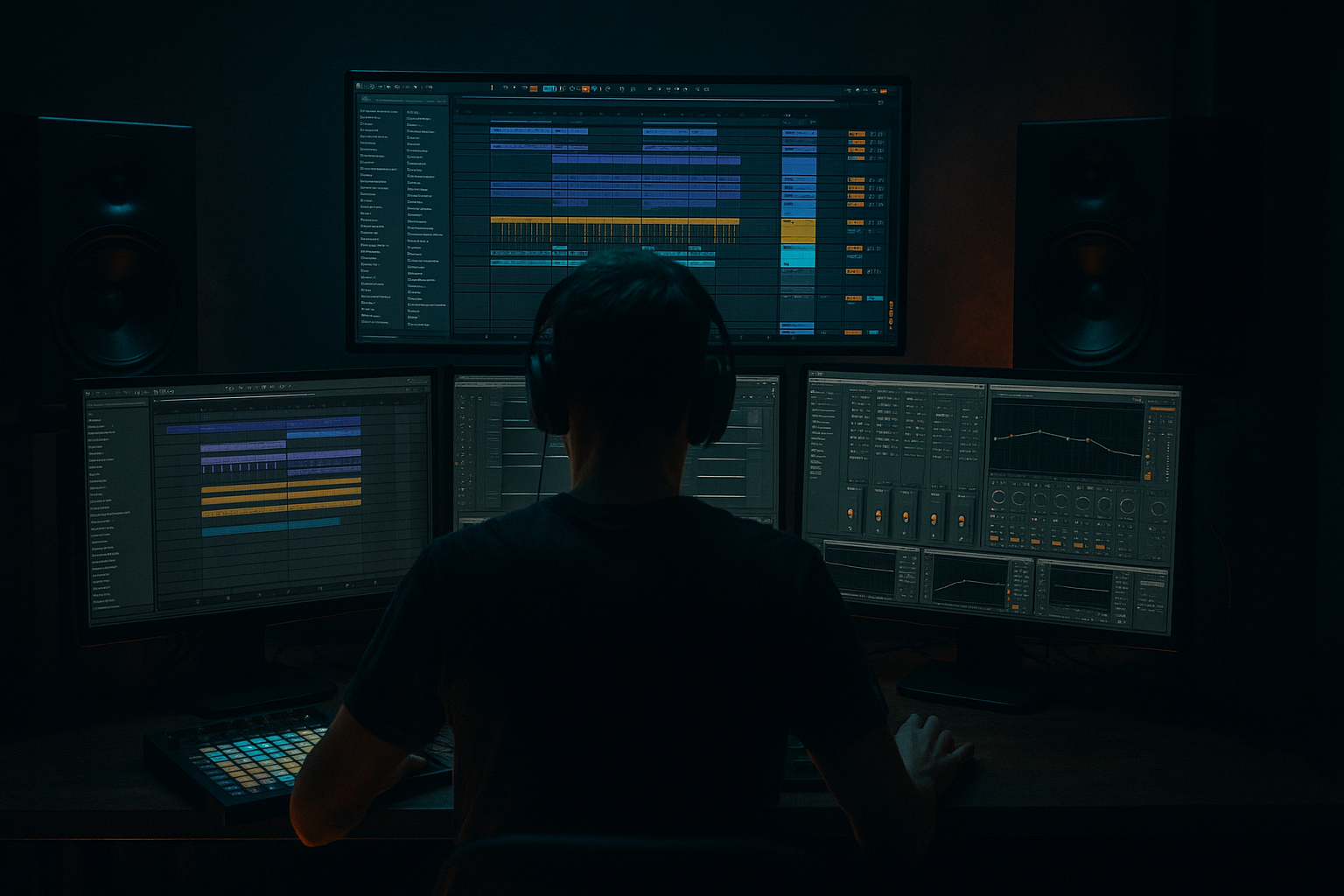
Main tutorial
Lesson Overview
This lesson is about building a bassline that does three jobs at once: carries sub weight, hits with modern punch, and still has a vintage soul in the midrange. In Drum & Bass, that usually lives in the main drop bassline or a strong B-section variation — especially in rollers, deep halftime-inflected switches, darker dancefloor tracks, and jungle-leaning modern DnB where the bass has to feel both old-school and current.
The musical goal is simple: the bass should sit under the drums like a heavy engine, but still have enough movement and attitude to feel alive on a club system. Technically, that means controlling the sub, shaping a punchy transient, giving the mids some harmonically rich character, and keeping the whole thing mono-safe where it matters. In Ableton Live 12, you can do this cleanly with stock devices and a sensible printing workflow.
By the end, you should be able to hear a bassline that feels like it could live under a clean break edit and still drive a room: deep in the low end, aggressive enough to cut through snares and hats, and tasteful enough to feel “soulful” rather than overprocessed. A successful result should sound like a bassline that rolls forward with authority, has a human, slightly worn character in the midrange, and never falls apart when the kick and snare hit.
What You Will Build
You’re going to build a two-layer bass system in Ableton Live 12:
- a pure, weighty sub layer that stays stable and mono
- a mid layer with punch, saturation, and vintage-style movement
- bar 1: short note on the “and” of 1, longer note into beat 3
- bar 2: repeat with a small variation at the end
- leave space around the snare hits
- Does the bass phrase feel like it’s leaning forward into the next bar?
- Does it leave enough space for the snare to speak clearly?
- Sub layer: Wavetable or Operator with a sine or very clean triangle-like source
- Mid layer: Wavetable, Drift, or Analog for character and movement
- keep it basically clean
- low-pass it hard, around 100–140 Hz or even lower depending on the note range
- avoid stereo widening
- use only enough level to anchor the track
- use a saw, square, or slightly detuned waveform
- keep the pitch in the same octave or an octave above the sub
- shape it for punch and soul, not full-range thickness
- Utility: set to mono if needed
- EQ Eight: remove any unnecessary low-mid buildup; usually don’t over-cut the fundamental unless there’s a problem
- Saturator: very light drive, around 1–3 dB, if you need a touch more visibility on smaller systems
- Compressor: only if the envelope is uneven, with gentle settings
- Does the sub sound like one stable pressure wave?
- Or does it wobble and smear when the note changes?
- Wavetable/Drift/Analog: choose a raw oscillator tone with some bite
- Auto Filter: low-pass or band-pass depending on the flavour
- Saturator: add harmonic grit
- Overdrive or Drum Buss: if you want more edge and forward pressure
- EQ Eight: clear out mud or harshness after distortion
- softer saturation
- a slightly muted filter opening
- less hard distortion
- a warm, rounded envelope
- sharper filter attack
- stronger transient-like envelope movement
- a touch of Drum Buss drive
- tighter note lengths
- A: soulful roller — smoother attack, warmer filter, more sustain
- B: modern punch — sharper transient, more bite, tighter decay
- Saturator: Drive around 2–6 dB, then reduce output gain so it doesn’t just get louder
- Drum Buss: use a moderate drive setting and a little transient emphasis if the bass needs more attack
- Auto Filter: map cutoff to an envelope or automate it so notes open fast then close slightly
- The note should speak immediately, then settle
- The attack should cut through the kick/snare without sounding clicky or brittle
- LFO-style filter motion if your synth supports it
- Automated cutoff every 2 or 4 bars
- Subtle pitch envelope on the attack of the mid layer
- Resampling and re-editing one phrase with slight variation
- Auto Pan very gently on the mid layer only, if the stereo motion is controlled and not low-end heavy
- Does the kick punch through, or is the bass masking it?
- Does the snare still crack, or does the bass fill the same space?
- Does the break top stay readable, or does the mid layer cloud the groove?
- trim the bass note length
- move the bass phrase slightly off the kick transient
- cut a small area around the kick’s fundamental in the mid layer using EQ Eight
- reduce midrange density around the snare impact
- shorten notes landing on the backbeat
- make the bass answer the snare instead of stepping on it
- reverse little bits
- cut breath spaces
- slice a tail into a pickup
- pitch a phrase for a switch-up
- trim note tails
- leave micro gaps for groove
- chop a 2-bar version into a 4-bar phrase with variation
- bars 1–2: main statement
- bar 3: same idea with one note altered
- bar 4: response or pickup into the next phrase
- bars 1–2: held note + short answer
- bar 3: same, but one note goes up an octave briefly
- bar 4: a shorter, more empty response that sets up the snare fill
- intro: filtered hint of the bass for 8 bars
- drop 1: full 4-bar bass phrase
- breakdown: remove the sub, leave a ghost of the mid texture
- drop 2: same bass, but with a brighter or more distorted answer phrase in bars 3–4
- lower the mid layer until the sub feels dominant
- keep the sub centered and controlled
- use EQ Eight to remove obvious mud around the low mids if needed
- avoid over-compressing the bass into a flat block
- sub fundamental: usually somewhere around 40–60 Hz depending on key and note choice
- low-mid clutter: watch the 120–300 Hz zone
- aggressive character: often sits in the 700 Hz–3 kHz area
- Let the sub stay boring on purpose. In darker DnB, the power often comes from restraint. A stable sub under a menacing mid layer feels bigger than a constantly moving low end.
- Use phrase tension, not just tone tension. A note held for one extra beat before a bar line can create more menace than another distortion pass.
- Resample the mid layer and slice silence into it. Short cuts between notes can make the line feel more predatory and less synthetic, especially in jungle-leaning rollers.
- Use tiny octave lifts as punctuation. One note jumping up an octave for a single hit can create a strong second-half-of-the-bar payoff without weakening the drop.
- Shape the front edge, not the whole note. In heavy DnB, the first 30–80 ms of the bass note often defines whether it feels punchy or flat. Let the attack carry the identity; don’t overinflate the sustain.
- Keep the low-mid region intentional. A little 150–250 Hz weight can make the bass feel chesty, but too much there will swallow the snare and make the track feel slower than it is.
- If the bass feels too clean, add grime in the harmonics, not the sub. A touch of Saturator, Drum Buss, or Overdrive on the mid layer can make the whole drop feel more underground without wrecking translation.
- Use only Ableton stock devices
- Keep the sub and mid layers separate
- Limit yourself to one main bass sound and one variation
- No more than two saturation stages total
- a 4-bar bass loop that works against a kick/snare/break groove
- one printed audio version of the mid layer
- one alternate ending for the fourth bar
- Does the sub stay stable in mono?
- Can you clearly hear the note shapes without the bass sounding messy?
- Does the phrase leave space for the snare to hit cleanly?
- If you mute the drums, does the bass still have character, but not so much movement that it feels unfocused?
The final sound will be a subweight roller with modern attack and a smoky, soulful edge. Rhythmically, it should lock to a DnB grid but leave enough space for the drums to breathe — think tight offbeat stabs, held notes that swell into bar endings, and small phrase changes every 2 or 4 bars so it doesn’t feel looped.
The role in the track is to be the main low-end identity of the drop: powerful enough for the floor, controlled enough for DJs, and interesting enough to survive repeated listening. Mix-ready doesn’t mean finished mastering polish; it means the bass should already be balanced, mono-compatible, and clear enough that a kick/snare/break stack can sit on top without fighting it.
In plain terms: you should end up with a bassline that feels deep, tense, and musical, not just loud.
Step-by-Step Walkthrough
1. Start with a rhythm first, not the synth
Before designing the sound, program a 2-bar bass rhythm in MIDI that fits a DnB drop context. Keep the first version simple: one or two notes per bar, with one longer sustain and one shorter response note. In a roller context, a good starting point is often a bass note that lands just after the snare, or a held note that resolves into the next beat.
A strong starting shape could be:
Why this works in DnB: the drums already carry a huge amount of motion. If the bass is rhythmically busy from the start, it often blurs the pocket. A simple skeleton gives you room to design weight and movement without losing the groove.
What to listen for:
If the bass feels too static, add a small pickup note before the bar line. If it feels too crowded, remove anything that lands directly on the snare transient unless that clash is deliberate.
2. Split the sound into sub and character layers
Make two MIDI tracks or two chains inside one Instrument Rack:
For the sub:
For the mid layer:
This split matters because DnB low end needs discipline. The sub should be stable enough to survive club playback, while the mid layer can carry personality without destabilizing the floor energy.
A useful Ableton workflow tip: if you’re building this inside one track, use an Instrument Rack with two chains and label them clearly. That makes resampling and later editing much faster.
3. Build the sub so it feels expensive, not noisy
On the sub layer, keep the chain brutally simple:
Keep the envelope short and controlled. In many DnB rolls, a sub note decay around 120–300 ms feels tight and useful; longer notes are fine if they’re the whole point of the phrase, but they must be tested against the kick and snare.
What to listen for:
If the sub is muddy, shorten the note lengths first before reaching for EQ. If it’s too thin, don’t immediately boost it — check the MIDI note range and whether the oscillator is actually generating enough fundamental.
4. Design the mid layer with punch and vintage soul
The mid layer is where the character lives. Start with a waveform that has harmonic density: a saw, square, or blended wavetable shape. Then shape it with Ableton stock devices:
A practical chain:
1. Wavetable or Drift
2. Auto Filter
3. Saturator
4. EQ Eight
5. Drum Buss or Overdrive, if needed
Set the filter cutoff somewhere in the rough range of 150 Hz to 1.2 kHz depending on how nasal or open you want it. Add a small amount of envelope movement so each note opens slightly on attack and then settles. That gives you the “modern punch” while keeping the tone soulful rather than static.
If you want a more vintage soul character, lean toward:
If you want a more modern punch character, lean toward:
This is your first decision point:
Both are valid. Choose A if the track is deep, smoky, and groove-led. Choose B if the drums are already sparse and you need the bass to hit harder in the drop.
5. Shape the transient without killing the sub
The mistake many intermediate producers make is trying to make the whole bass “punchy” with one distortion move. In DnB, punch usually belongs in the mid layer, not the sub.
Try this on the mid layer:
What to listen for:
If the mid layer gets harsh, back off the saturation before cutting highs. If it gets dull, the filter may be closing too much or the wave source may be too smooth.
6. Add movement that feels alive, not wobbly
This lesson is about blending weight and soul, so movement should feel musical — not like an obvious wobble bass.
Use one or two of these, not all of them at once:
A good rule: let movement live mostly in the upper harmonics, while the sub stays rock solid. In the club, that keeps the bass from collapsing when the system sums to mono.
A mono-compatibility note: if your character layer gets wider, keep anything below roughly 120 Hz locked down. In practice, that means the sub stays centered, and the stereo interest lives above it.
7. Check the bass against drums early
Now put the bass against your actual drum loop or drop kit. Don’t wait until later. In DnB, the bass is only useful if it works with the snare, kick, break chops, and hats.
Loop a solid 4-bar section and listen for:
If the bass is fighting the kick:
If the bass is fighting the snare:
This is where the phrase becomes a track element instead of a sound design exercise.
8. Commit the mid layer to audio if the movement is right
Once the mid layer has a good phrase and tone, commit this to audio if you’re starting to audition variations. That’s the workflow move that keeps you finishing instead of endlessly tweaking.
Why commit? Because in DnB, the most usable bass ideas often emerge after resampling. Once printed, you can:
Use Ableton’s resampling or just record the bass track to audio. Then edit the clip like a drum performance:
This is especially effective if you want a second-drop evolution later. Print the core bass now, then create a more aggressive or more stripped version for the final section.
9. Build a 4-bar phrase with call-and-response
A strong DnB bassline rarely just loops unchanged. Make a 4-bar phrase from your 2-bar idea:
For example:
This works because DnB needs forward momentum, not endless repetition. The variation keeps dancers locked in while giving the arrangement a sense of progression.
A practical arrangement example:
10. Final mix check: make it loud enough to matter, clean enough to breathe
Finish with a focused balance pass:
A useful range check:
Successful result should feel like the bass is physically pushing the track forward while still leaving air for drums and FX.
If you lose punch after mixing, don’t just turn the bass up. First check whether the mid layer is masking the transient or whether the note lengths are too long. A bassline can be huge and still feel tight if the phrase is disciplined.
Common Mistakes
1. Making the sub layer too expressive
- Why it hurts: the low end starts moving around, which weakens club translation and smears the groove.
- Fix: keep the sub simple, mono, and mostly unmodulated. Use the mid layer for movement instead.
2. Distorting the whole bass instead of only the character layer
- Why it hurts: the sub loses clarity and the track gets muddy fast.
- Fix: split the sound. Put saturation and grit on the mid layer, keep the sub clean or only lightly saturated.
3. Overlapping bass notes with the snare
- Why it hurts: the snare loses impact, especially in rollers where the backbeat has to feel authoritative.
- Fix: shorten note tails or shift the phrase so the bass answers the snare instead of sitting on top of it.
4. Using too much stereo width in the low end
- Why it hurts: mono compatibility falls apart, and the bass can vanish or wobble on large systems.
- Fix: keep everything below roughly 120 Hz centered. Use stereo interest only in the upper harmonics.
5. Letting the mid layer get harsh after saturation
- Why it hurts: the bass becomes tiring and fights hats, rides, and snare crack.
- Fix: use EQ Eight to tame the 1.5–4 kHz zone if needed, and reduce drive before making broad EQ cuts.
6. Designing the sound before locking the rhythm
- Why it hurts: you end up with a cool tone that doesn’t function in the drop.
- Fix: program the bass pattern first, then build the sound around that groove in context with drums.
7. Not checking the bass against the full drum loop
- Why it hurts: the bass may sound huge solo but collapse the groove once the break, kick, and snare are all playing.
- Fix: audition the bass against the actual drum section every time you change the tone or note lengths.
Pro Tips for Darker / Heavier DnB
Mini Practice Exercise
Goal: Build a 4-bar DnB bass phrase that blends sub weight, punch, and vintage soul.
Time box: 15 minutes
Constraints:
Deliverable:
Quick self-check:
Recap
Build the bass in two layers: clean sub, expressive mid. Start with the rhythm, then shape the tone around the drum pocket. Use saturation and filtering for modern punch, but keep the low end centered and disciplined. Resample when the idea starts working, and turn the loop into a phrase with call-and-response so it actually behaves like a DnB drop element. If the bass feels huge, clear, and slightly dangerous without smothering the drums, you’ve nailed it.

