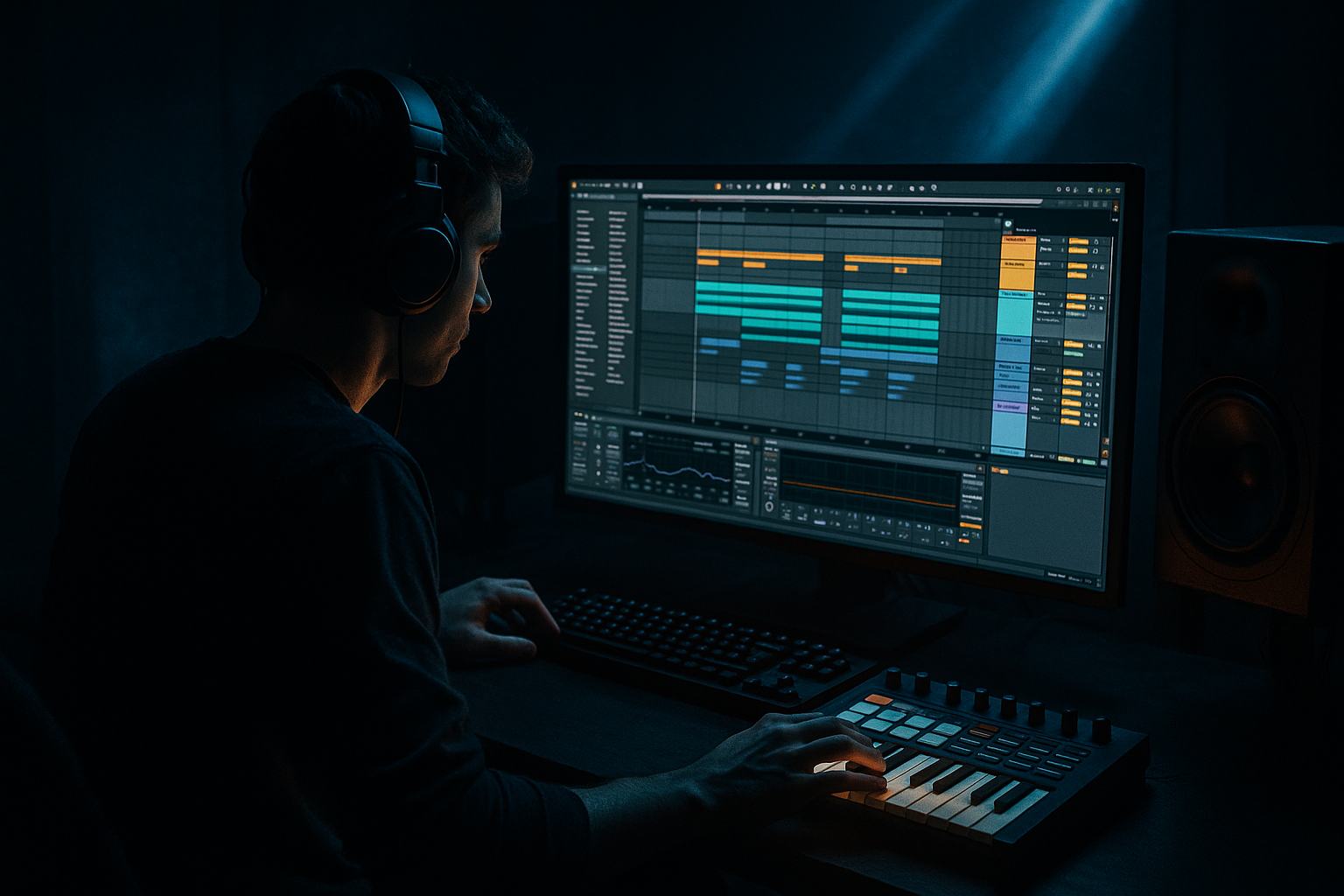
Main tutorial
```markdown
Blueprint: Ghost Notes from Session View ➜ Arrangement View (Ableton Live 12)
Jungle / oldskool DnB vibe, intermediate level, with a mastering-aware workflow 🔥🥁
---
1. Lesson overview
Ghost notes are the “invisible hands” that make jungle and oldskool DnB drums feel alive: tiny hits (usually snare, rim, hat, or shaker) tucked under the main accents to create forward momentum and swing.
In this lesson you’ll build a Session View drum clip system (variations + fills), then print it into Arrangement View with intent—so your groove translates cleanly into a solid, controlled master. 🎛️
We’ll focus on:
- Where ghost notes live in the groove (classic jungle placement)
- How to program them quickly in Session View
- How to commit to Arrangement View without losing vibe
- How to gain-stage + control peaks for louder masters
- A Drum Rack with:
- 3–5 Session clips:
- A clean Arrangement with:
- A mastering-aware drum bus:
- Work at 1/16 for hats/ghosts.
- Temporarily switch to 1/32 when you do snare drags.
- Simpler (One-Shot)
- EQ Eight (clean)
- Saturator (tiny drive if needed)
- In Simpler:
- In EQ Eight:
- Length: 2 bars
- Time signature: 4/4
- Kick: 1.1 and sometimes 1.3.3 (or vary)
- Snare: 1.2 and 1.4 (backbeats)
- Closed hats: 1/16 pattern, but remove a few hits to breathe.
- Open hat: occasional on offbeats (like 1.1.3, 1.3.3, etc.)
- Before 1.2: add at 1.1.4 (16th before)
- Before 1.4: add at 1.3.4
- Start around 20–45 (assuming main snare is ~90–115)
- After 1.2: at 1.2.2
- After 1.4: at 1.4.2
- Put two 1/32 ghosts leading into the snare:
- Then the main snare on 1.4
- Main snare: 100–115
- Ghost notes: 15–45
- Hats: vary 40–80 with a repeating pattern (not fully random)
- Clip 1: “Main” (your baseline)
- Clip 2: “Ghost+” (add more pre-snare ghosts + one drag)
- Clip 3: “Hat swap” (change hat rhythm, maybe ride-ish pattern)
- Clip 4: “Fill 1 bar” (snare drag + kick turn-around)
- Clip 5: “Drop sparse” (remove some hats for contrast)
- Duplicate clips (`Cmd/Ctrl + D`) and change only one idea per clip.
- Rename clips with clear labels: `A_MAIN`, `B_GHOST+`, `C_HAT`, `FILL_1`.
- Go into Arrangement and consolidate sections (`Cmd/Ctrl + J`) every 8–16 bars so it’s easy to manage.
- Intro (16–32 bars): fewer ghosts, more space (tease groove)
- First drop (32 bars): full ghost system + hat momentum
- Mid-section (16 bars): strip hats, keep ghosts (creates “rolling but empty” tension)
- Second drop: bring back hats + add one extra ghost pattern for perceived speed
- Every 8 or 16 bars: 1-bar fill with a drag into the snare on bar 8/16
- Parallel crush (but keep ghosts clean):
- Midrange control for “steel” snares:
- Stereo discipline:
- Clip gain staging in Session View:
- Use Roar (Live 12) carefully:
- Ghost notes = micro-dynamics that create jungle roll and swing.
- Best placements: pre-snare (1.1.4 / 1.3.4) + occasional after-hits.
- Build clip variations in Session View, then perform-record into Arrangement for natural structure.
- Keep ghosts alive through mastering by controlled compression, clean gain staging, and avoiding over-limiting.
- Use Ableton stock tools: EQ Eight, Glue Compressor, Drum Buss, Utility, Limiter (and Roar for grit).
---
2. What you will build
You will create:
- Kick, snare, break layer, hats
- Dedicated Ghost Snare/Rim lane
- Main 2-bar loop
- Variation A (extra ghosts)
- Variation B (hat switch / snare drag)
- Fill (1-bar)
- 16–32 bar intro groove
- Main drop drum progression (A/B call-and-response)
- Fills every 8 or 16 bars
- Controlled transient peaks
- Stable loudness without flattening the groove
---
3. Step-by-step walkthrough
Step 0 — Set the jungle foundation (tempo + grid)
1. Set tempo to 165–172 BPM (classic jungle sweet spot: 168 BPM).
2. Turn on Groove Pool (hit `Cmd/Ctrl + Alt + G`).
3. Set clip loop length to 2 bars to start—oldskool patterns love 2-bar phrasing.
Grid tips:
---
Step 1 — Build a Drum Rack designed for ghost notes
1. Create a MIDI track → load Drum Rack.
2. Load samples (or Simpler) into pads:
- Kick (short + punchy)
- Main Snare (crack)
- Ghost Snare or Rim (lighter, shorter, woody)
- Closed Hat, Open Hat
- Optional: Break slice layer (Amen-ish top or texture)
Drum Rack chain suggestion (per pad):
Ghost pad settings (important):
- Volume: start -10 to -18 dB compared to main snare
- Filter: HP around 200–400 Hz (keep it light)
- Decay: short so it doesn’t smear
- Cut a bit around 200–300 Hz if it sounds boxy
- Gentle dip around 2–4 kHz if it competes with your main snare crack
Why: ghost notes should add motion, not steal attention. 👌
---
Step 2 — Program the core oldskool skeleton (Session View clip)
In Session View, create a MIDI clip on your Drum Rack track:
Classic DnB skeleton:
Now add hats:
---
Step 3 — Place ghost notes like a jungle producer (the blueprint)
Now the good stuff. Add your Ghost Snare/Rim notes at low velocities.
#### A) “Push into the backbeat” ghosts (most common)
Place quiet hits just before the main snare:
Velocity range:
This creates that rolling anticipation—very jungle. 🏃♂️
#### B) “After-hit” ghosts (adds shuffle)
Place quiet hits just after the snare:
Keep these even quieter (e.g., 15–35) so they feel like stick bounce.
#### C) Snare drag (use sparingly, 1/32 grid)
For a drag into the snare at 1.4:
- 1.3.4.3 and 1.3.4.4 (depending on grid display)
Velocity ramp: 18 → 28 → (main snare 105)
That ramp is the “hand” of the drummer.
---
Step 4 — Humanize the groove (without killing punch)
You want feel, but you also want master-friendly consistency.
Method 1: Velocity shaping (recommended)
Method 2: Groove Pool (tastefully)
1. Drop a groove like Swing 16 (or any subtle swing) into Groove Pool.
2. Apply to your drum clip:
- Timing: 10–25%
- Velocity: 0–10% (don’t let it flatten your intentional ghost dynamics)
- Random: 0–5% (tiny!)
Oldskool jungle often has swing, but the snare still lands strong.
---
Step 5 — Session View clip system (variations that arrange themselves)
Create multiple clips in Session View:
Workflow tip:
This is how you get arrangement momentum fast. 🚀
---
Step 6 — Commit to Arrangement View (the clean way)
Now we print your performance.
1. Hit Record in the top transport.
2. Trigger clips in Session View as if DJ’ing your own set:
- 16 bars: A_MAIN
- 16 bars: B_GHOST+
- 8 bars: C_HAT
- 1 bar: FILL_1 into next section
3. Stop recording. You now have an Arrangement that breathes.
Key editing move:
---
Step 7 — Mastering-aware drum control (so ghosts survive loudness)
Ghost notes often disappear when you push loudness. So we manage transients and density.
#### Drum bus chain (Ableton stock)
Group your drum tracks (or your Drum Rack) into a Drum BUS and try:
1. EQ Eight
- HP filter around 25–35 Hz (remove sub rumble)
- Tiny dip 250–400 Hz if muddy
2. Glue Compressor
- Attack: 3–10 ms
- Release: Auto or 0.1–0.3s
- Ratio: 2:1
- Aim: 1–3 dB gain reduction on peaks
3. Drum Buss
- Drive: 2–8 (taste)
- Transients: +5 to +20 if you lost snap
- Boom: 0–15 (careful in jungle; boom can mask ghosts)
4. Limiter (gentle safety, not smashing)
- Ceiling: -0.8 dB
- Only catching occasional peaks (1–2 dB)
Critical tip:
If your drum bus is being crushed, the first thing to die is ghost detail. Keep compression controlled, not aggressive.
---
Step 8 — Arrangement ideas rooted in jungle / rolling DnB
Use ghosts as “energy automation”:
Oldskool vibe trick: switch between tight programmed ghosts and break-layer ghosts (Amen texture) to get that lived-in feel.
---
4. Common mistakes
1. Ghost notes too loud
If you hear them as separate hits, they’re not ghosts—they’re extra snares.
2. Too many ghosts everywhere
Constant ghosting reduces contrast. Use them to shape sections.
3. Over-swinging the backbeat
Swing is great, but if your main snare drifts, the track loses impact.
4. Compression killing micro-dynamics
Heavy bus compression can erase the groove. Use lighter GR and let transients breathe.
5. Ghost notes fighting the snare transient
If ghosts are too close and too bright, you’ll get flammy harshness. Keep them quieter and/or darker.
---
5. Pro tips for darker/heavier DnB 🖤
Duplicate drum bus or use a return:
- Return chain: Saturator (Drive 6–12) → Glue (4:1, fast attack) → EQ Eight (HP 120 Hz)
- Blend in quietly (5–20%) so the groove thickens without flattening your main bus.
On the main snare, use EQ Eight:
- Small boost 180–220 Hz for body (careful)
- Presence around 3–5 kHz
- Air shelf 8–10 kHz if needed
Keep the ghost channel darker so it doesn’t build harshness.
Keep kick + main snare mostly mono-ish. Let hats and break textures provide width (e.g., Utility width on hat group).
Balance there first so Arrangement recording “prints” a mix that’s already close.
On a drum texture layer (not your main snare):
- Light drive, filter the lows out, and blend. Great for gritty jungle edge.
---
6. Mini practice exercise (15 minutes)
1. Build a 2-bar drum loop with kick + snare + hats.
2. Add only two ghost notes:
- One at 1.1.4
- One at 1.3.4
3. Duplicate the clip twice:
- Clip B: add after-hit ghosts at 1.2.2 and 1.4.2
- Clip C: add a 1/32 drag into 1.4
4. Record a 32-bar arrangement:
- 8 bars A → 8 bars B → 8 bars A → 7 bars A + 1 bar C
5. Add Drum BUS chain and check:
- Can you still feel the ghost movement when the bus is louder?
---
7. Recap ✅
If you want, tell me your current drum samples (clean one-shots vs break slices) and your tempo, and I’ll suggest a specific 2-bar ghost pattern and bus settings tailored to that vibe.
```

