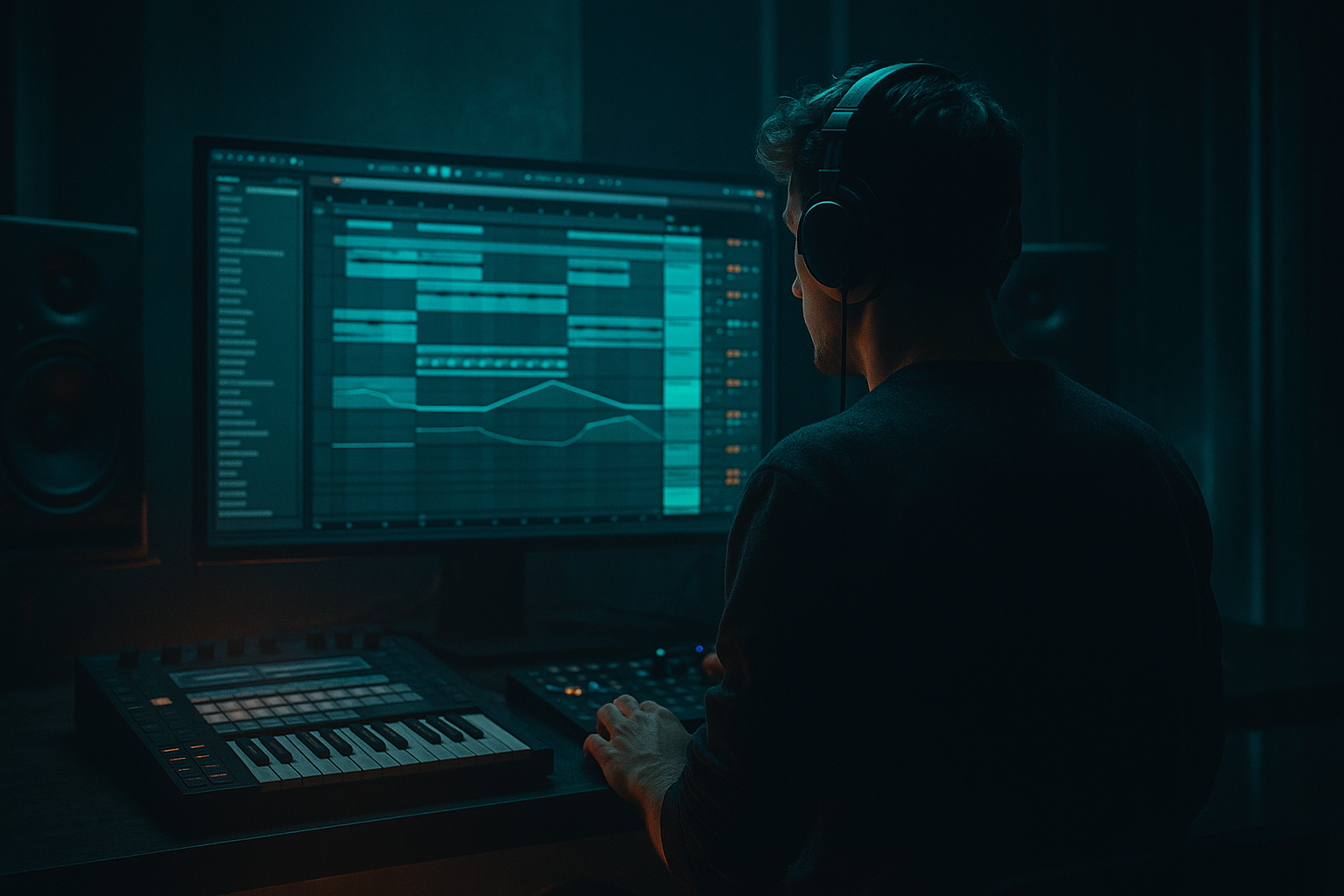
Main tutorial
```markdown
Bounce a Switch‑Up for Timeless Roller Momentum (Ableton Live 12) 🥁⚡
Skill level: Intermediate
Category: Vocals (jungle/DnB switches using vocal chops, phrases, and ear‑candy)
---
1. Lesson overview
A classic jungle/oldskool DnB roller doesn’t stay the same—small switch‑ups keep momentum without killing the groove. In this lesson you’ll create a vocal-led switch-up, then bounce it to audio so it hits consistently, saves CPU, and feels “printed” like the old records.
We’ll focus on:
- Making tight vocal chops that sit like an instrument
- Building a 4/8/16-bar switch-up that keeps the roller moving
- Bouncing/Resampling in Ableton Live 12 for reliable impact
- Locking the vocal switch to the drums + bass pocket (no messy timing)
- A rolling DnB loop (think 170–174 BPM) with a clean, repeatable switch-up
- A printed (bounced) vocal switch layer you can drop into arrangement quickly
- A workflow you can reuse for intros, pre-drops, and 2nd drops (oldskool energy)
- A spoken phrase, reggae snippet, old rave MC one-liner, or a single word (“rewind”, “listen”, “inside”, etc.)
- Even a non-lyrical vocal texture works (breaths, shouts, ad-libs)
- Drag the sample to an Audio Track called `VOX SRC`.
- Turn on Warp
- Mode:
- Set the 1.1.1 start marker correctly if you want it to loop cleanly.
- Classic mode
- Trigger for one-shots
- Snap ON
- Fade In/Out small values (2–10 ms) to avoid clicks
- Adds movement, not chaos
- Hits on offbeats and call/response with snare
- Respects the kick/snare backbone
- Keep vocals minimal: maybe 1–2 chops at the end of bar 4.
- Bar 4: a short chop on 4& leading back to bar 1
- Use a 2-step rhythm: chops on 1&, 2a, 3&, 4&
- Add a pickup into the snare (snare is usually on 2 and 4)
- Echo Mix: ramp from `8% → 18%` in the last half bar
- Reverb Mix: quick spike on the final word (momentary wash)
- EQ Eight HP cutoff: rise slightly (e.g., `120 → 250 Hz`) in the last bar for a “telephone lift”
- Warp: ON
- Mode: Beats (often best for chopped phrases)
- Consolidate (`Cmd/Ctrl+J`) to clean the clip start/end
- Tighten the start: make sure the first transient lands exactly where it should
- 16-bar phrase:
- Every 4 bars: one recognizable “tag” chop (keeps identity)
- 2nd drop: reuse the same print but:
- Make the vocal “meaner” with Roar (stock)
- Sidechain the vocal to the snare (subtle)
- Print a “dark” alt version
- Add a single “dub siren” style pitch drop
- You built a vocal switch-up that supports a roller groove instead of distracting from it.
- You processed it with stock Ableton tools (EQ Eight, Glue, Saturator, Echo/Reverb).
- You bounced/printed the switch-up using Resampling or Freeze/Flatten for consistent impact.
- You arranged it in phrase-based blocks (4/8/16 bars) to keep that timeless jungle momentum.
---
2. What you will build
You’ll end with:
Vibe target: timeless roller momentum (sub stays driving, drums consistent, vocal adds movement).
---
3. Step-by-step walkthrough
Step 0 — Session setup (the “don’t fight the grid” part)
1. Tempo: `172 BPM` (classic jungle/DnB sweet spot)
2. Set your loop bracket to `16 bars` for arrangement thinking.
3. Make sure your drum groove is already rolling (Amen/Think/2-step).
- If your drums are MIDI, consider bouncing them later too—but today we’re focusing on vocals.
---
Step 1 — Choose a vocal source that suits jungle/DnB
Good switch-up vocals are short, rhythmic, and characterful. Options:
Import into Ableton:
Warp settings (important):
- Beats for rhythmic phrases (try `Transient Loop`, Preserve: `1/16`)
- Complex Pro for melodic/longer phrases (Formants around `0–20`, Envelope `128`)
🎯 Goal: a vocal that stays tight against 172 BPM without weird smearing.
---
Step 2 — Chop the vocal into playable switch material
You’ll turn the vocal into “hits” you can sequence like drums.
Method A: Slice to MIDI (fast + classic)
1. Right-click the vocal clip → Slice to New MIDI Track
2. Slicing preset:
- Slice by: Transients
- Create one slice per transient
- Use: Simpler
3. You’ll get a Drum Rack with vocal slices.
Simpler settings (per slice feel):
Quick cleanup tip:
In Drum Rack, group slices you actually use and delete the rest to keep it lean.
---
Step 3 — Build a switch-up pattern that keeps roller momentum
A timeless roller switch-up usually:
#### A. Write a 4-bar “A” loop (steady)
Example idea (at 172 BPM):
#### B. Create a 4-bar “B” switch-up loop
Duplicate the clip and make it busier:
Practical sequencing tip:
In MIDI, nudge some chops slightly late (`5–15 ms`) for swing, but keep the ones that answer the snare very tight.
---
Step 4 — Make the vocal sit like an oldskool record (processing chain) 🎛️
Create a VOX BUS Audio Track (or group the Drum Rack) and put this chain:
1. EQ Eight
- HP filter: `120–180 Hz` (24 dB/oct)
- Dip harshness: `2.5–5 kHz` (try -2 to -5 dB, Q ~1.5)
- Gentle air if needed: +1 to +2 dB at `10 kHz` (wide)
2. Glue Compressor
- Attack: `3 ms`
- Release: `Auto`
- Ratio: `2:1`
- Aim: `1–3 dB` gain reduction
- Soft Clip: On (subtle thickening)
3. Saturator (for that “printed” edge)
- Mode: Analog Clip
- Drive: `2–6 dB`
- Soft Clip: On
- Output: trim to match level
4. Echo (tempo-synced movement)
- Mode: Repitch or Noise (taste)
- Time: `1/8` or `1/4 dotted`
- Feedback: `15–30%`
- Filter: HP around `300 Hz`, LP around `6–8 kHz`
- Mix: `8–18%` (keep it subtle on a roller)
5. Reverb (short + dark)
- Decay: `0.6–1.2s`
- Pre-delay: `10–25 ms`
- Low Cut: `250–400 Hz`
- High Cut: `6–8 kHz`
- Mix: `6–12%`
✅ You want the vocal to feel “in the room with the drums,” not floating on top.
---
Step 5 — Automate a switch-up moment (energy without losing weight) 🔥
In DnB, the switch-up often happens in the last 2 bars before a phrase resets.
Try these automations on the VOX BUS:
Classic jungle move:
Add a tiny tape-stop style moment using Delay automation or a quick Repitch warp segment—but keep it short (1/8–1/4 bar), otherwise the roller loses drive.
---
Step 6 — Bounce (print) the switch-up to audio in Live 12 ✅
This is where you lock it in like an old record and make arranging faster.
#### Option A: Resample (fast + creative)
1. Create a new Audio Track named `VOX PRINT`
2. Set track input to Resampling
3. Arm `VOX PRINT`
4. Solo the VOX BUS (and any return effects you want printed)
5. Record the 4 or 8 bars of the switch-up
Now you have an audio “performance” of your vocal switch including effects.
#### Option B: Freeze + Flatten (clean + recallable)
1. Right-click the VOX track/group → Freeze Track
2. Right-click again → Flatten
This commits processing and saves CPU. Great when you’re confident.
#### Option C: Export stems (arrangement-ready)
1. File → Export Audio/Video
2. Rendered Track: Selected Tracks Only
3. Include Return and Master Effects: choose based on whether you want it “mastered” or raw
4. Render as: WAV, 24-bit (typical)
---
Step 7 — Make the bounce hit in the pocket (post-bounce editing)
On `VOX PRINT`:
Micro-groove tip:
If the vocal feels like it’s fighting the snare, nudge the printed clip later by 5–10 ms (Track Delay in the mixer is perfect for this).
---
Step 8 — Arrangement ideas (timeless roller structure) 🧱
Use your printed switch-up to create predictable movement:
- Bars 1–8: minimal vocal touches
- Bars 9–16: switch-up printed layer gets busier
- slightly different EQ (less top)
- or different Echo timing (`1/8 → 1/4 dotted`) for variation
---
4. Common mistakes
1. Too much vocal density
- If the vocal chops are constant, the roller loses its hypnotic drive. Leave space.
2. Warp mode mismatch
- Complex Pro on sharp chops can smear transients. Use Beats for rhythmic bits.
3. Effects not printed consistently
- If you rely on live FX with random modulation, your switch-up changes every loop (sometimes cool, often messy). Print it when it’s right.
4. Vocal clashes with snare presence
- A vocal with lots of 2–5 kHz will fight your snare crack. Carve with EQ Eight.
5. Stereo mess in the vocal
- Too-wide vocals can weaken the center groove. Consider keeping the main chop more mono.
---
5. Pro tips for darker/heavier DnB 🌑
- Use Roar lightly on the VOX BUS:
- Drive low, mix ~`10–30%`
- Filter the distortion band to focus around `300 Hz–4 kHz`
- Use Compressor on VOX BUS:
- Sidechain input: Snare track
- Ratio `2:1`, fast attack, medium release
- Just `1–2 dB` duck so the snare stays king
- Duplicate VOX PRINT
- Add Auto Filter (LP around `4–7 kHz`) + a bit more Saturator
- Use it in breakdowns or under heavier reese sections
- On the printed vocal, automate Transpose (clip envelope) down `-2 to -7 st` for one hit only.
---
6. Mini practice exercise (15–20 minutes) 🎯
1. Pick a 1–3 second vocal phrase.
2. Slice to MIDI and make:
- 4-bar “A” (minimal)
- 4-bar “B” (switch-up)
3. Process on a VOX BUS with:
- EQ Eight → Glue → Saturator → Echo
4. Resample 8 bars (A then B) into `VOX PRINT`.
5. In arrangement, place the print:
- Every 16 bars, use “B” for bars 15–16 to push momentum into the reset.
Success check:
When the loop returns to bar 1, it should feel more inevitable, not more confusing.
---
7. Recap ✅
If you want, tell me your drum backbone (Amen-heavy vs 2-step) and the kind of vocal (MC phrase vs airy chant), and I’ll suggest a switch-up rhythm pattern that matches it perfectly.
```

