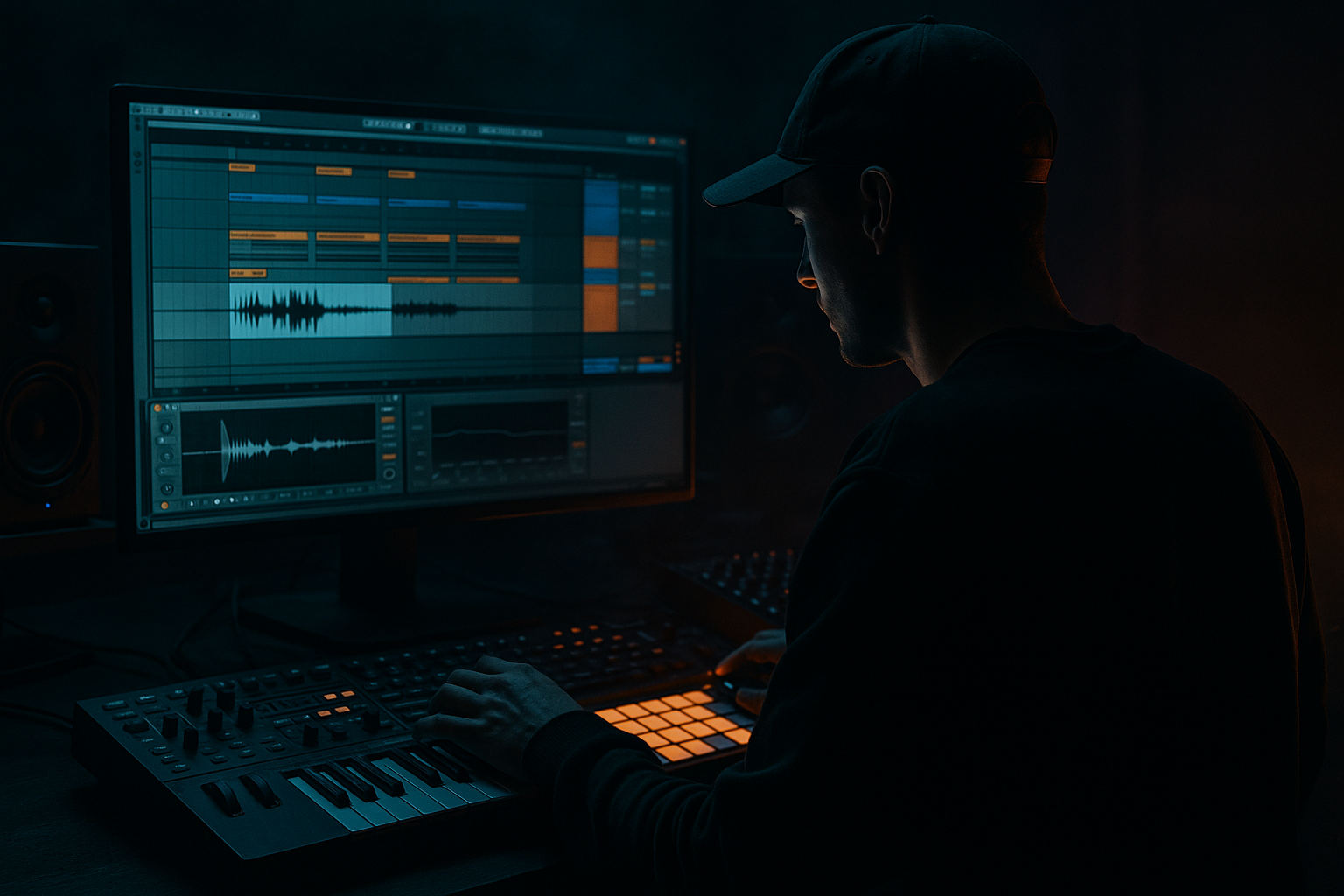
Main tutorial
Bounce an Amen-style Pad for Deep Jungle Atmosphere in Ableton Live 12
1. Lesson overview
In this lesson, you’ll build a bouncy Amen-style pad that sits behind the drums and bass and gives your track that deep jungle / dark DnB atmosphere 🌲🥁
We’re not talking about a lush, static synth pad. We’re talking about a rhythmic, chopped, filtered, swung atmospheric layer that feels like it was sampled from an old record, then reshaped for modern bass music.
This is an advanced groove-focused workflow in Ableton Live 12. You’ll learn how to:
- create a pad sound with movement and grit
- bounce it into audio for tighter groove control
- chop and re-space it in true jungle style
- process it so it sits behind Amen breaks and subs
- arrange it like a proper DnB atmospheric layer
- a dark minor chord source
- grainy, lo-fi texture
- timed rhythmic chops that complement the Amen
- filter motion and stereo width
- sidechain-like breathing so it doesn’t fight the kick/snare/bass
- a version that can be used as:
- Set to 165–174 BPM for jungle / DnB territory
- For a classic deeper feel, try 170 BPM
- Keep at 4/4
- Drums
- Bass
- Atmos / Pads
- Osc 1: basic saw or pulse
- Osc 2: slightly detuned saw, -7 semitones or +12 semitones if you want richness
- Unison: 2–4 voices, low detune
- Filter: Low-pass 24 dB
- Cutoff: around 1–3 kHz
- Drive: moderate
- Use two saw oscillators
- Detune slightly
- Filter cutoff fairly low
- Add a touch of envelope movement, but keep it restrained
- D minor
- Bb major
- C minor
- A minor
- Dm(add9)
- Bbmaj7
- Csus2
- Am(add9)
- D2
- A2
- C3
- F3
- A3
- Auto Filter
- Chorus-Ensemble
- Redux or Saturator
- Reverb
- Type: LP24
- Cutoff: automate between 500 Hz and 4 kHz
- Resonance: low to medium
- LFO: very subtle if used
- Amount: moderate
- Rate: slow
- Width: high enough to create space, but not so wide it becomes blurry
- Drive: 2–6 dB
- Soft Clip: ON
- Color: slightly darker if needed
- Decay: 2.5–6 s
- Pre-delay: 10–30 ms
- Low Cut: around 200–400 Hz
- High Cut: around 5–8 kHz
- Right-click the MIDI track
- Choose Freeze Track
- Then Flatten
- chop transients
- warp rhythmically
- reverse segments
- pitch sections
- use fades and clip envelopes
- process it like a jungle sample
- Set clip loop to 4 bars
- Warp ON
- Use Complex Pro or Beats depending on texture
- Use Complex Pro
- Preserve formants if needed
- Adjust grain size subtly
- Use Beats mode
- Transients can be great if the pad has swelling attacks
- Use Cmd/Ctrl + E to cut at key rhythmic points
- Re-space slices to create offbeat movement
- Right-click audio clip
- Choose Slice to New MIDI Track
- Slice by transients or beat divisions
- long slice on beat 1
- shorter answer on the “and” of 2
- reverse tail before beat 3
- broken fragments around beat 4
- Track Volume
- Filter frequency if using Auto Filter on the track
- Transpose for small pitch dips if desired
- Bar 1: full chord hit on beat 1, filtered tail after
- Bar 2: chopped offbeat swell on “and” of 2
- Bar 3: low-pass opens slightly for lift
- Bar 4: reverse or shorter tail to transition back to the break
- High-pass around 120–250 Hz depending on bass weight
- Cut muddy area around 250–500 Hz if needed
- If harsh, notch around 2–4 kHz
- Gentle shelf down top end if it’s too modern
- Use subtle cutoff automation
- Add a small resonance bump for tension
- Consider a band-pass sweep for breakdown sections
- Drive a little to bring forward texture
- Use Soft Clip
- Great for giving sampled ambience a more “broken tape” edge
- Try Ping Pong Delay
- Low feedback
- Filtered repeats
- Sync to 1/8 or 3/16 for rolling movement
- Keep it dark
- High cut the reverb
- Blend carefully so it doesn’t wash over the snare
- Narrow the low end if necessary
- Use Bass Mono below around 120 Hz if the pad is too wide
- Increase width on higher frequencies only if needed
- Avoid big pad hits directly on the snare unless intentional
- Let pad swells breathe between snare accents
- Use rhythmic gaps that make the Amen feel more alive
- If the pad has a strong attack, place it as a pickup into the snare or bass phrase
- Beat 1: pad starts softly
- Beat 2 “and”: chopped accent
- Beat 3: filtered sustain or reverse swell
- Beat 4 “and”: short tail that leads back to bar 1
- Sidechain: Drums or Kick/Snare
- Ratio: 2:1 to 4:1
- Attack: 5–30 ms
- Release: 80–200 ms
- Gain reduction: just enough to feel it breathing
- Start with just the pad and filtered noise
- Low-pass heavily
- Let the rhythm emerge slowly
- Open the filter
- Increase stereo width
- Add more slices or repeats
- Bring in a low-pass Amen ghost rhythm underneath
- Keep the pad more restrained
- Use chopped fragments only
- Leave room for bass and drums
- Let the pad flicker in gaps between break hits
- Bring back the longer, more emotional pad phrase
- Add delay throws
- Reverse sections into re-entry
- Use a pad tail or reverse swell into fills
- Automation of filter cutoff and reverb send can make transitions feel cinematic
- vinyl crackle
- field recording
- tape hiss
- a chopped movie texture
- filtered noise bursts
- pad swell before a snare roll
- reverse pad into a drum fill
- short stab after a break variation
- Redux for sample-rate grit
- Saturator for edge
- Erosion for harsh texture
- Vinyl distortion-style treatment using careful EQ + saturation
- let the pad live around 500 Hz–2 kHz
- carve a pocket in the bass harmonics around the same region
- then automate the pad filter to open only during breakdowns
- offbeats
- bar-end pickups
- pre-snare ghosts
- 2-bar cycle variations
- A: short dark room
- B: long dubby space
- Full minor pad chord
- Low-pass at around 1.5 kHz
- Slight saturation
- Cut the pad into two slices
- Place one slice on beat 2 “and”
- Another on beat 4
- Reverse a chopped tail into beat 1
- Open filter slightly
- Add a delay throw on the last slice
- Reduce volume
- Leave a gap before the loop repeats
- Add a reverb swell into bar 1
- sidechain to the drum bus
- high-pass around 180 Hz
- listen against an Amen break and a sub bass
- Start with a dark, wide minor chord source
- Add movement before bouncing
- Render to audio for chop control
- Use manual slicing, warp, and clip envelopes to create bounce
- Process with EQ Eight, Auto Filter, Saturator, Delay, Reverb, Utility
- Keep space for the Amen break and sub
- Arrange the pad so it evolves across the track
- a device-by-device Ableton chain template
- a MIDI chord progression pack for jungle atmos
- or a companion lesson on chopping an Amen break around the pad
We’ll use mainly stock Ableton devices, so you can apply this immediately.
---
2. What you will build
By the end, you’ll have a 4-bar bounced atmospheric pad loop with:
- intro atmosphere
- breakdown bed
- underlay behind the drop
- transition wash into fills
Think of it as a “ghost pad” that adds weight and tension without sounding like a cheesy sustained synth. In jungle, that kind of texture helps glue the drums and bass into one rolling ecosystem.
---
3. Step-by-step walkthrough
Step 1: Set up the project for jungle feel
Start with a clean Live 12 set.
Tempo:
Meter:
Workflow tip:
Create three groups early:
This keeps your atmospheric layer in its lane and makes it easier to automate later.
---
Step 2: Build a simple dark chord source
You can use either MIDI or audio as the source. For a bounce-style pad, start with MIDI.
#### Option A: Use a stock instrument chain
On a MIDI track, add:
1. Wavetable or Analog
2. EQ Eight
3. Chorus-Ensemble
4. Reverb
5. Utility
#### Suggested sound design
Wavetable
Analog
#### Chord voicing
For deep jungle atmosphere, keep it minor, ambiguous, and spacious.
Try a progression like:
Or keep it even more atmospheric with:
Important:
Use wide voicings. Don’t stack the chords too neatly in root position. Spread notes across octaves so the pad feels cinematic and haunted.
Example voicing in D minor:
This gives you thickness without clogging the midrange.
---
Step 3: Add movement before bouncing
Before you bounce, make the pad feel alive.
#### Insert these devices:
#### Suggested settings
Auto Filter
Chorus-Ensemble
Saturator
Reverb
You’re aiming for a pad that feels like it already came from a broken sampler or dubby jungle record.
---
Step 4: Record or print the pad to audio
Now bounce it.
You have two good options in Ableton Live 12:
#### Option A: Freeze and Flatten
This gives you a clean rendered audio version.
#### Option B: Resample to a new audio track
Best for more control.
1. Create a new Audio Track
2. Set Audio From to your pad track or Resampling
3. Arm the track and record 4 or 8 bars
Why resample?
Because once the pad is audio, you can:
That’s where the “bounce” in the lesson really comes alive.
---
Step 5: Chop the audio into a jungle-style rhythmic phrase
Drag the recorded pad audio into a new audio clip view.
Now we’re going to make it bounce, not just drone.
#### Basic chop approach
If the pad is smooth and sustained:
If you want a more percussive chopped result:
#### Create groove with slicing
You can slice the pad clip in several ways:
Method 1: Split the clip manually
Method 2: Use Slice to New MIDI Track
This lets you trigger slices in a drum rack, which is excellent for jungle-style rearrangement.
#### Recommended slice strategy
For deep jungle atmosphere, don’t over-grid it. Try:
This creates call-and-response with the Amen break.
---
Step 6: Shape the bounce with clip envelopes
This is where the groove gets more intelligent.
Open the Clip Envelopes for the audio clip and automate:
#### Rhythm idea
Create a pattern like:
Use volume dips so the pad breathes around the kick/snare.
Rule of thumb:
The pad should support the groove, not flatten it.
---
Step 7: Add jungle-style processing on the audio track
Now process the bounced pad as an atmospheric sample.
#### Suggested stock device chain
1. EQ Eight
2. Auto Filter
3. Saturator
4. Delay
5. Reverb
6. Utility
#### EQ Eight
#### Auto Filter
#### Saturator
#### Delay
#### Reverb
#### Utility
---
Step 8: Make the pad groove with the drums
This is the heart of the exercise.
Load or program an Amen-style break and listen to where the snare lands. The pad should interact with it.
#### Alignment principles
#### Practical groove strategy
Try this pattern:
That creates a rolling, haunted pulse behind the drums.
---
Step 9: Sidechain the pad to the drum groove
Even though this is atmospheric, it still needs space.
Use Compressor or Glue Compressor sidechained from the kick/snare bus or drum bus.
#### Suggested compressor setup
If the pad is too crowded, use Volume automation instead of over-compressing.
Advanced trick:
Use Envelope Follower or clip automation for more musical ducking on specific hits, especially if your break is busy.
---
Step 10: Arrange it like a real DnB record
A bounced Amen-style pad works best when it evolves across the track.
#### Intro
#### Build
#### Drop
#### Breakdown
#### Transition
---
4. Common mistakes
1. Making the pad too bright
If the pad has too much high end, it will fight the hats, shakers, and snare top layers.
Fix:
Low-pass it, soften the top, or use a darker reverb.
---
2. Leaving too much low end in the pad
In DnB, the sub and bass are sacred.
Fix:
High-pass the pad aggressively enough that it doesn’t interfere with the bassline. Usually 120–250 Hz, sometimes higher.
---
3. Over-widening the stereo image
Huge stereo pads can sound impressive solo but collapse the mix.
Fix:
Keep low frequencies mono and manage width carefully with Utility or EQ Eight M/S work.
---
4. Too much reverb wash
A jungle atmosphere should feel deep, not blurry.
Fix:
Use shorter or darker reverb, and automate send amounts rather than leaving it wide open all the time.
---
5. Quantizing everything too hard
If the chops are locked to the grid with no nuance, the groove feels mechanical.
Fix:
Use slight timing offsets, groove pool, or manually nudge slices for a more humanized jungle swing.
---
6. Not bouncing to audio early enough
Staying in MIDI too long can tempt you into endlessly tweaking the synth instead of shaping the groove.
Fix:
Print the pad to audio once the source tone is solid. Then work rhythmically.
---
5. Pro tips for darker/heavier DnB
Use sampled character, not just clean synths
Layer your synth pad with:
Then process as one atmosphere.
---
Make the pad answer the break
Try arranging the pad to respond to Amen fills.
For example:
That “call and response” is very jungle.
---
Add controlled degradation
Stock devices that help:
Be subtle. Dark doesn’t mean broken beyond use.
---
Use frequency masking on purpose
A little masking can be musical if controlled.
For example:
This gives the drop room while preserving atmosphere.
---
Try ghost rhythms with long reverb tails
Bounce a pad chord, then slice the tail and re-trigger it rhythmically like a ghost percussion layer.
Great spots:
---
Use return tracks for cohesion
Create two return tracks:
Send the pad, break tops, and FX into the same returns lightly.
That helps the whole arrangement sound like one environment.
---
6. Mini practice exercise
Exercise: 4-bar jungle atmosphere loop
Create a 4-bar clip with this structure:
#### Bar 1
#### Bar 2
#### Bar 3
#### Bar 4
Then:
Goal:
Make the pad feel like it’s breathing with the break, not sitting on top of it.
---
7. Recap
You’ve now built a bounced Amen-style pad that works as a deep jungle atmosphere layer in Ableton Live 12.
Key takeaways:
If you do this well, the pad won’t just “fill space” — it’ll drive the mood of the tune. That’s the difference between a generic ambient layer and a proper jungle atmosphere 🌫️🔥
If you want, I can also give you:

