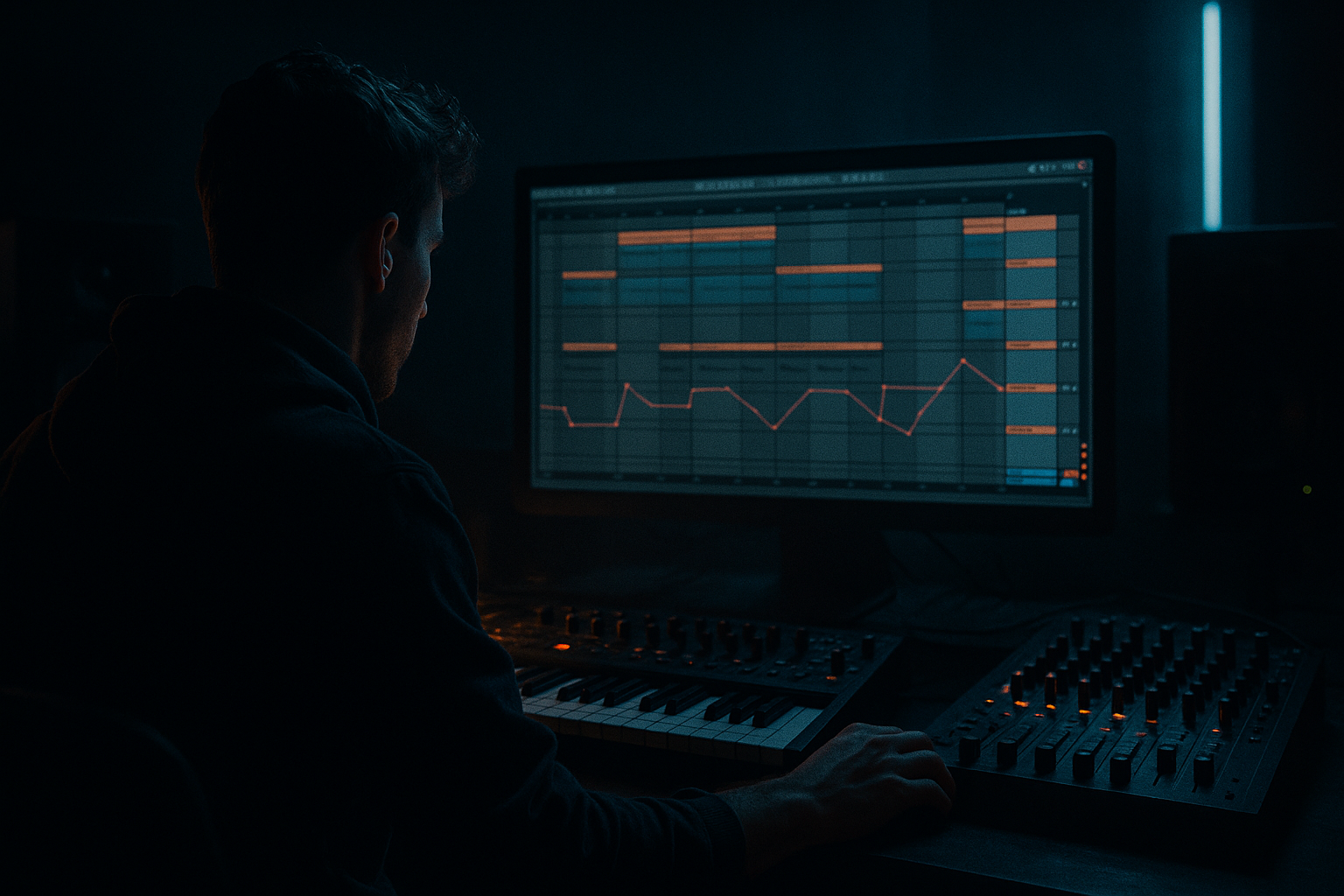
Main tutorial
Break Bus Mutes for Tension (Pirate-Radio Energy) 🔊🚨
Ableton Live • Drum & Bass • Automation (Intermediate)
---
1. Lesson overview
Break bus mutes are one of the fastest ways to inject pirate-radio urgency into rolling DnB/jungle: that feeling of the DJ yanking the fader, the transmission glitching, then the beat slamming back in. The key is doing it musically (timed to groove), cleanly (no clicks), and with attitude (reverbs/dubs, filter sweeps, noise bursts).
In this lesson you’ll build a dedicated Break BUS in Ableton Live and automate mutes + “dub-style” send throws to create tight, hype transitions without losing your low-end stability.
---
2. What you will build
You’ll end up with:
- A Break BUS group (all break layers routed together)
- A simple device chain designed for mute moments:
- A set of repeatable arrangement patterns:
- Automation lanes for:
- A workflow that stays tight at 170–175 BPM and translates on a big system.
- Automate Utility → Gain down to -inf dB (or around -40 dB) with 2–10 ms ramps.
- Fast and “DJ-like,” but can click and can cut reverb tails in weird ways. Use if you want brutality.
- More complex; great for rhythmic stutter but less “fader slam.”
- Mute the break for 1/8 on beat 2-and, then again on 4-and
- Cut break for 1/2 bar (beats 3–4)
- Keep sub rolling (or keep kick/snare one-shots) so the floor doesn’t lose the count.
- Throw on the snare or on a vocal stab right before the mute.
- Automate Frequency from 12 kHz → 1.2 kHz over 1/8–1/4 bar
- Add resonance ~1.1
- Then snap it back open at the drop
- Downsample: 2–6
- Bit Reduction: 10–14
- Drive: 0.5–2
- Tracing Model: very low
- Cut ONLY breaks: keeps punch from kick/snare layers, more modern roller feel.
- Cut breaks + hats: stronger contrast.
- Cut ALL drums (including one-shots): maximum void, but risk losing groove count.
- Cut BREAK BUS
- Keep kick + snare one-shots playing
- Throw reverb/delay from break into the space
- Hard clicks at the cut points
- Cutting the sub by accident
- Reverb mud during the silence
- Overusing mutes every 2 bars
- Mutes not landing on groove points
- Let the bass “answer” the mute
- Add a super-short room to the snare only
- Use transient emphasis so the “last hit” slaps
- Automate a noise burst into the mute
- Make the return FX distort slightly
- Build a BREAK BUS so you can cut break energy without wrecking your whole drum mix.
- Use Utility Gain automation with tiny ramps for clean, click-free “fader slams.”
- Add dub verb + echo throws so the silence still feels loud and intentional.
- Place mutes at snare-led groove moments (classic jungle punctuation).
- For darker/heavier DnB, let bass + distorted returns carry the void.
- Click-free gating/muting
- Optional “pirate radio” treatment (filter/drive/bitcrush)
- 1/8, 1/4, 1/2-bar cuts
- “Last-hit” cuts (classic jungle move)
- Call-and-response cuts against bass
- Break BUS volume/gate
- Reverb/delay send throws
- Filter sweeps (optional)
---
3. Step-by-step walkthrough
Step 0 — Prep your session (DnB-friendly routing)
1. Set tempo to 172 BPM (or your track tempo).
2. Make sure your drums are layered like a modern DnB session:
- Break Top (Amen/Think tops)
- Break Mid (body)
- Kick (one-shot)
- Snare (one-shot)
- Hats / Perc
3. Select all break layers (not your kick/snare one-shots unless you want them cut too) → Cmd/Ctrl + G to Group.
Rename group: BREAK BUS.
Why this matters: You’ll mute the break energy while keeping your sub + key one-shots stable (or you’ll choose to cut everything for maximum shock).
---
Step 1 — Build a “click-free mute” device chain ✅
On BREAK BUS, add devices in this order:
1. Utility (Ableton stock)
- Turn DC on (if available in your version).
- You’ll automate Gain or Mute (we’ll choose the best method below).
2. Auto Filter (optional but recommended for pirate-radio vibe)
- Mode: Lowpass (12 dB) to start
- Frequency: ~9–12 kHz (open)
- Resonance: ~0.80–1.20
- Drive: 1–3 dB (subtle crunch)
3. Saturator (optional)
- Mode: Analog Clip
- Drive: 2–6 dB
- Soft Clip: On
- This keeps the break feeling loud even when you do short cuts.
#### Choosing the mute method (important)
You have three solid options:
Option A (best for clean, no click): Automate Utility Gain with tiny ramps
Option B: Automate Track/Group Activator (the on/off button)
Option C: Gate with sidechain tricks
For pirate-radio energy, Option A is the sweet spot: precise, repeatable, clean.
---
Step 2 — Create a “Dub Throw” return for the cuts 🌫️
The secret sauce is that when you mute the break, you often want the room/echo to keep speaking.
1. Create Return A → rename: DUB VERB
- Add Hybrid Reverb (stock)
- Mode: Plate or Chamber
- Decay: 1.2–2.8 s
- Pre-delay: 10–25 ms
- High Cut: 6–9 kHz
- Low Cut: 150–250 Hz (important so your reverb doesn’t mud the mix)
- Add EQ Eight after it
- Cut around 250–400 Hz if boxy
- Optional gentle high shelf down if harsh
2. Create Return B → rename: DUB DELAY
- Add Echo (stock)
- Sync: On
- Time: 1/8 or 1/4 (start with 1/8 for rollers)
- Feedback: 25–45%
- Filter: HP around 200 Hz, LP around 6–8 kHz
- Modulation: low (subtle movement)
Now on the BREAK BUS, set Send A/B to 0 for now—we’ll automate throws.
---
Step 3 — Program classic DnB break mute patterns (arrangement-ready) 🥁
Go to Arrangement View. Work on an 8-bar phrase (typical DnB structure).
#### Pattern 1: “Last hit then void” (super jungle)
At the end of bar 8 (right before the drop or before a phrase change):
1. Make sure the last snare hit is strong.
2. Automate Utility Gain:
- Cut the break immediately after the snare transient
- Duration: 1/8 or 1/4 bar silence
3. Add a tiny ramp:
- From 0 dB to -inf in ~5 ms
- Back to 0 dB in ~5–10 ms
Result: It feels like the DJ grabbed the fader right after the crack—massive tension.
#### Pattern 2: “Two-step tease” (rolling hype)
In bar 4 of an 8-bar loop:
This creates a syncopated stutter without turning into glitch music.
#### Pattern 3: “Half-bar blackout” (big-system intimidation)
Right before a drop:
DnB tip: If you cut too long with no sub, the crowd loses the forward push. If you want full blackout, add a riser/noise or vocal chop to keep momentum.
---
Step 4 — Add send throws to keep the air moving during mutes 🎛️
This is where “pirate radio” comes alive.
During each mute region:
1. Automate BREAK BUS → Send A (DUB VERB) up quickly:
- Jump from 0 → -6 dB (or even 0 dB if you’re brave) just before the mute
- Then back to 0 right after the mute
2. Automate BREAK BUS → Send B (DUB DELAY) for extra hype:
- Push to -9 to -3 dB right before the cut
- Let the delay tail fill the silence
Timing trick:
That’s the classic dub cue—your ear still hears “signal” even when the break drops out.
---
Step 5 — Optional “transmission” color on the mute moments 📻
To make it feel like a dodgy FM broadcast (in a good way), automate one of these during the cut:
#### Option A: Auto Filter “radio sweep”
On BREAK BUS Auto Filter:
#### Option B: Redux for grit (use sparingly)
Add Redux after Saturator (or before, experiment):
Automate device On/Off only during the mute moment (or micro-section).
#### Option C: Vinyl Distortion (subtle noise + crunch)
Automate Drive up during the cut for “broadcast strain”.
---
Step 6 — Make it tight: group vs. full drum mute decisions
Decide what gets cut:
A great compromise for rollers:
That gives you tension without losing impact.
---
4. Common mistakes
Fix: use Utility Gain ramps (2–10 ms), don’t just draw square automation with no fades.
Fix: keep sub on a separate track/bus. If you want full blackout, add a cue (noise, vocal, impact) so the listener doesn’t lose time.
Fix: on returns, high-pass at 150–250 Hz, and keep sends sensible. Long verb + low mids = swamp.
Fix: think in 8/16-bar phrases. Use mutes like punctuation, not like a nervous tic.
Fix: aim cuts after snare transients or just before a phrase turn. Jungle energy relies on call-and-response with the snare.
---
5. Pro tips for darker/heavier DnB 🖤
During the break cut, automate the bass up +0.5 to +1.5 dB (or open a lowpass slightly) so the low end becomes the “broadcast signal.”
Keep a tight room (0.3–0.6 s) on snare so when breaks drop out, the snare still feels physical.
On BREAK BUS (or break top), try Drum Buss:
- Drive: 2–8
- Crunch: 0–15
- Transients: +5 to +20
Automate Transients slightly up right before the cut.
Create a white noise audio track with Auto Filter bandpass. Quick 1/16–1/8 burst before the cut feels very “system / pirate.”
Put Saturator on the return tracks (after reverb/delay):
- Drive: 1–4 dB
- Soft Clip: On
Dark DnB loves abused FX returns.
---
6. Mini practice exercise (15 minutes) ⏱️
1. Grab a classic Amen/Think break loop and layer it into BREAK BUS.
2. Over an 8-bar drum section, create:
- One 1/8-bar cut (bar 2)
- One 1/4-bar cut (bar 4)
- One 1/2-bar blackout (end of bar 8)
3. For each cut:
- Automate Utility Gain down with 5 ms ramps
- Automate Send A (DUB VERB) to spike on the snare before the cut
4. Bounce/export a quick preview and listen:
- Do the cuts feel intentional?
- Any clicks?
- Does the groove still “pull” forward?
Bonus: Try one version where the kick/snare one-shots keep playing, and one version where everything mutes. Compare which feels more “rolling” vs. more “shutdown.”
---
7. Recap
If you tell me your BPM and whether you’re going for roller, techstep, or jungle, I can suggest 3–4 specific mute placements that fit that substyle’s phrasing.

