Main tutorial
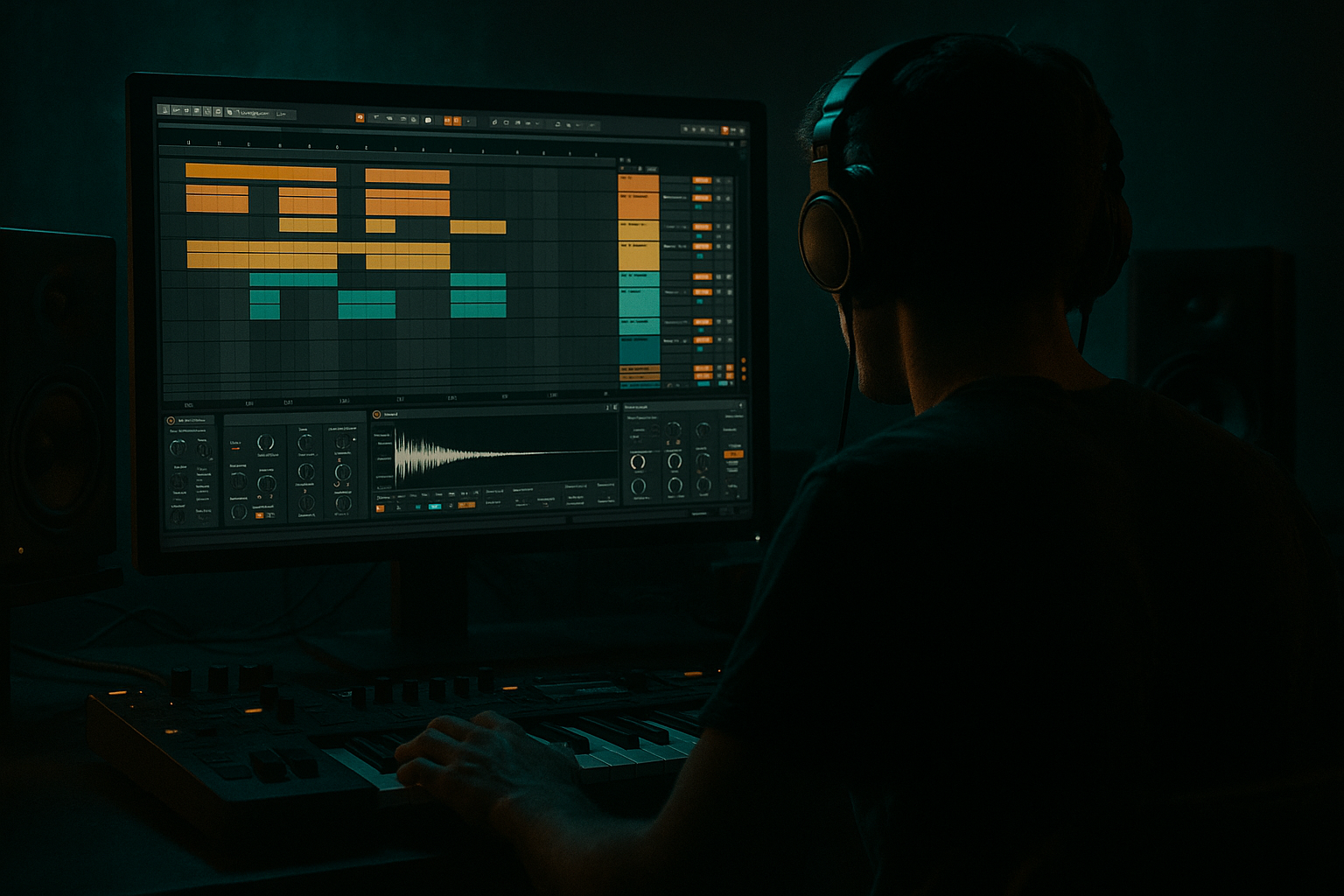
Break Lab: Ableton Live 12 Air Horn Hit Masterclass
From Scratch for Jungle / Oldskool DnB Vibes 🎺🔥
---
1. Lesson overview
In this lesson, you’ll build a classic ragga air horn hit in Ableton Live 12, designed specifically for jungle, oldskool DnB, and ragga-influenced drum & bass.
This is not just “sample an air horn and drop it in.” We’re going to make a hit that has:
- Character: rude, bright, and in-your-face
- Impact: cuts through fast breakbeats and basslines
- Movement: a little pitch, filter, and space motion
- Mix readiness: so it sits properly in a DnB arrangement without sounding amateur
- Drop intros
- Call-and-response phrases
- Ragga-style fills
- Transition impacts
- Layered with breaks and vocal shouts
- Short and punchy
- Slightly distorted
- Wide enough to feel big, but not so wide it loses focus
- Able to sit over a Amen break, Think break, or rolling half-time section
- Oscillator 1: Saw wave
- Oscillator 2: Saw wave
- Detune Osc 2 slightly, around +8 to +15 cents
- Turn the oscillator levels up so both are audible, but not clipping hard yet
- Choose a low-pass filter
- Set cutoff around 1.5 kHz to 4 kHz
- Add a bit of resonance, around 10–25%
- Attack: 0–5 ms
- Decay: 200–450 ms
- Sustain: low to medium
- Release: 50–150 ms
- Program a MIDI note around C3 to G3
- Duplicate the note and make a second note a few semitones higher for variation
- Or automate a very quick pitch bend:
- Start slightly higher
- Fall quickly into the main note over 50–100 ms
- Drive: +3 to +8 dB
- Soft Clip: On
- Output: adjust to avoid clipping
- Drive: 5–15%
- Crunch: low to medium
- Boom: usually off or very low
- Transients: slightly up if needed
- High-pass around 120–200 Hz
- Boost carefully around 800 Hz – 2.5 kHz
- If harsh, cut a little around 3–5 kHz
- Add a slight shelf above 8–10 kHz if you want more shine
- Filter type: Low-pass
- Cutoff: automate from open to slightly closed during the hit
- Resonance: light
- Start cutoff at 8–12 kHz
- Drop to 3–6 kHz very quickly over the first part of the sound
- Sync time: 1/8 or 1/4
- Feedback: 10–25%
- Dry/Wet: 5–15%
- Decay: 0.5–1.5 sec
- Dry/Wet: 5–12%
- High cut: lower if the reverb is too bright
- Transients: a bit up
- Drive: moderate
- Keep the sound short and aggressive
- Easier to edit
- Easier to cut into stabs
- Easier to reverse, chop, or pitch in arrangements
- Better workflow for classic jungle-style sample manipulation
- Bar 1: short horn hit
- Bar 2: same hit, pitched down 2 semitones
- Bar 3: hit with delay throw
- Bar 4: reverse horn into the drop
- Use the horn in the last 2 bars before the drop
- Layer it with:
- A short vocal stab like “Yeah!” or “Ragga!”
- A noise burst
- A reverse cymbal
- A break slice
- Add Saturator
- Boost mids carefully
- Reduce competing frequencies in other instruments
- Soften with EQ
- Use a low-pass on Auto Filter
- Reduce excessive 3–5 kHz buildup
- Add a square wave quietly under the saws
- Or detune two saws more aggressively
- Light Saturator
- Then Drum Buss
- Then maybe Pedal or Overdrive very subtly
- Kick
- Or a drum bus
- Ratio: 2:1 to 4:1
- Fast attack
- Medium release
- C2–G2
- Or sample it and pitch it down slightly
- Filter cutoff closing before the drop
- Then open instantly on the hit
- Bright saw-based horn
- Short decay
- Light delay
- Lower pitch
- More saturation
- Less reverb
- Slight low-pass filtering
- Wider stereo delay
- Slightly longer release
- Reverse tail leading into the hit
- A breakbeat pattern
- A sub bass line
- A snare fill every 4 or 8 bars
- Start with a simple synth patch
- Shape it with filter, envelope, and pitch
- Add Saturator, Drum Buss, and EQ Eight
- Use controlled delay and reverb
- Bounce to audio for classic jungle-style editing
- Place it strategically in your arrangement for call-and-response energy
- a rack chain preset recipe for this horn,
- a MIDI clip example for a jungle intro,
- or a full ragga DnB arrangement template in Ableton Live 12.
You’ll learn how to build the sound using stock Ableton devices, then process it so it feels like it belongs in a 1990s jungle sound system session or a modern heavyweight roll-out.
---
2. What you will build
By the end, you’ll create a single-shot air horn stab that can be used in:
Your final sound will be:
We’ll make it from a simple synth patch, then shape it into a proper DnB horn hit 🎺
---
3. Step-by-step walkthrough
Step 1: Start a clean Ableton project
1. Open Ableton Live 12.
2. Create a new MIDI track.
3. Load Wavetable or Analog.
For beginners, Analog is easy and solid.
For a slightly sharper, more modern horn tone, Wavetable is great too.
We’ll use Analog in this walkthrough because it’s straightforward.
---
Step 2: Build the raw horn tone
#### In Analog:
Set up:
Why saw waves?
Because air horn style sounds usually have a bright, brassy, aggressive edge, and saw waves give you a strong harmonic base.
#### Filter section:
#### Amp envelope:
You want the sound to hit fast and punch out like a stab, not smear like a pad.
---
Step 3: Add the “horn” character with pitch shaping
A lot of classic horn hits have a tiny pitch gesture at the front.
In Analog, use the pitch envelope if available, or simulate it with a MIDI note and automation later.
#### Simple beginner method:
Suggested pitch bend move:
This gives the hit that rude blaring launch often heard in ragga and jungle samples.
If you’re using Wavetable, you can also slightly modulate wavetable position for extra movement, but keep it subtle.
---
Step 4: Make it louder and more aggressive with saturation
Now we process it.
Add these stock devices after the instrument:
#### 1) Saturator
Settings to start with:
This helps the horn feel more forward and slightly dirty — very useful for jungle aesthetics.
#### 2) Drum Buss
Yes, even on a horn. In DnB, this is a secret weapon for impact.
Suggested settings:
This adds bite and density. Don’t overdo the Boom unless you want a more subby impact.
---
Step 5: Shape it with EQ
Add EQ Eight after saturation.
Suggested EQ move:
- Horns do not need low end in most DnB arrangements
- This is where the “voice” of the horn lives
- Only if needed
The goal is to make it cut through breaks without fighting the kick and sub.
---
Step 6: Add movement with Auto Filter
Add Auto Filter after EQ.
Suggested approach:
For example:
This creates a more animated “talking horn” feeling, especially useful in ragga-style fills.
You can also automate the filter manually in arrangement view for more expression.
---
Step 7: Add space with Delay and Reverb
Air horns in DnB are often used as short callouts, so space must be controlled.
#### Use Delay
Add Echo or Delay:
Try using Ping Pong Delay for wide, exciting throws, but keep it subtle so the mix doesn’t get messy.
#### Use Reverb
Add Reverb or Hybrid Reverb:
If the horn is for a big drop moment, a little reverb can make it feel huge.
If it’s in a busy break section, keep it tighter.
---
Step 8: Make it hit harder with transient emphasis
If the sound feels too smooth, use:
#### Transient Shaper if available in your device set, or
#### Drum Buss with Transients, or
#### Compressor with a very fast attack/release setup
For beginners, Drum Buss is easiest.
Try:
You want the horn to snap, not wash.
---
Step 9: Bounce it to audio for easier arrangement
Once the horn feels good:
1. Right-click the MIDI track
2. Choose Freeze Track
3. Then Flatten it
Or simply resample/bounce it to audio.
Why do this?
Now you can edit the horn like a sample, which is very on-brand for ragga DnB workflows.
---
Step 10: Build a mini horn phrase
A single hit is good. A phrase is better.
Try this in your arrangement:
This creates a proper call-and-response intro that feels like a sound system selection moment.
#### Practical arrangement idea:
- a riser
- a vocal shout
- snare fill
- break turnaround
This is a classic jungle move 🎛️
---
Step 11: Layer it with a vocal or noise hit
To make it feel more authentic, layer the horn with:
You can use Simpler to trigger a vocal sample and stack it with the horn.
This gives it more personality and helps it feel less like a plain synth patch.
---
4. Common mistakes
1) Too much low end
Air horns don’t need bass.
If you leave too much low frequency content, it will clash with your sub bass and kick.
Fix: High-pass with EQ Eight around 120–200 Hz.
---
2) Too much reverb
A huge wash might sound cool solo, but in a fast DnB mix it will blur the groove.
Fix: Keep reverb short and use a lower wet amount.
---
3) Horn is too soft
If the horn doesn’t cut, it will disappear behind the break.
Fix:
---
4) Overly harsh top end
Too much brightness can make the horn painful, especially on club systems.
Fix:
---
5) Too long a note
A long horn note can sound cheesy or messy in jungle arrangements.
Fix: Keep it short and intentional.
Think stab, not trumpet solo.
---
5. Pro tips for darker/heavier DnB
If you want the horn to work in a darker, heavier DnB context, here’s how to tweak it:
Tip 1: Use a more brutal waveform stack
Instead of just saw waves:
This creates a tougher, more industrial edge.
---
Tip 2: Distort in stages
Instead of one huge distortion, use:
This often sounds more controlled and powerful.
---
Tip 3: Sidechain the horn to the kick/snare
In heavier DnB, let the drum groove breathe.
Use Compressor with sidechain input from:
Keep it light:
This can help the horn sit in the groove without masking the drums.
---
Tip 4: Pitch it lower for menace
Try horn notes in:
This can make the sound feel more dangerous and less playful.
---
Tip 5: Filter automation for tension
Automate:
This creates a great pre-drop tension release, which works brilliantly in rolling or darker arrangements.
---
Tip 6: Use frequency slots wisely
If your bass has a lot of energy around 1–3 kHz, carve a small space there for the horn.
Use EQ Eight on the bass or music bus if needed.
That way the horn can speak without turning the mix muddy.
---
6. Mini practice exercise
Try this 10-minute drill:
Exercise: Make 3 air horn variations
Create three versions of the same horn:
#### Version A: Classic ragga hit
#### Version B: Darker jungle stab
#### Version C: Big drop impact
Then do this:
Place them in a 16-bar loop with:
Listen to which one cuts best in the mix.
That’s how you start making production choices like a DnB artist, not just a sound designer.
---
7. Recap
You’ve now built a jungle-ready air horn hit in Ableton Live 12 from scratch using stock tools.
Key takeaways:
Final mindset:
In DnB and jungle, the air horn is not just a sound — it’s a statement.
Use it to create hype, tension, and attitude. Keep it bold, keep it clean enough to hit hard, and always make room for the break and bass 🔥🎺
If you want, I can also give you:

