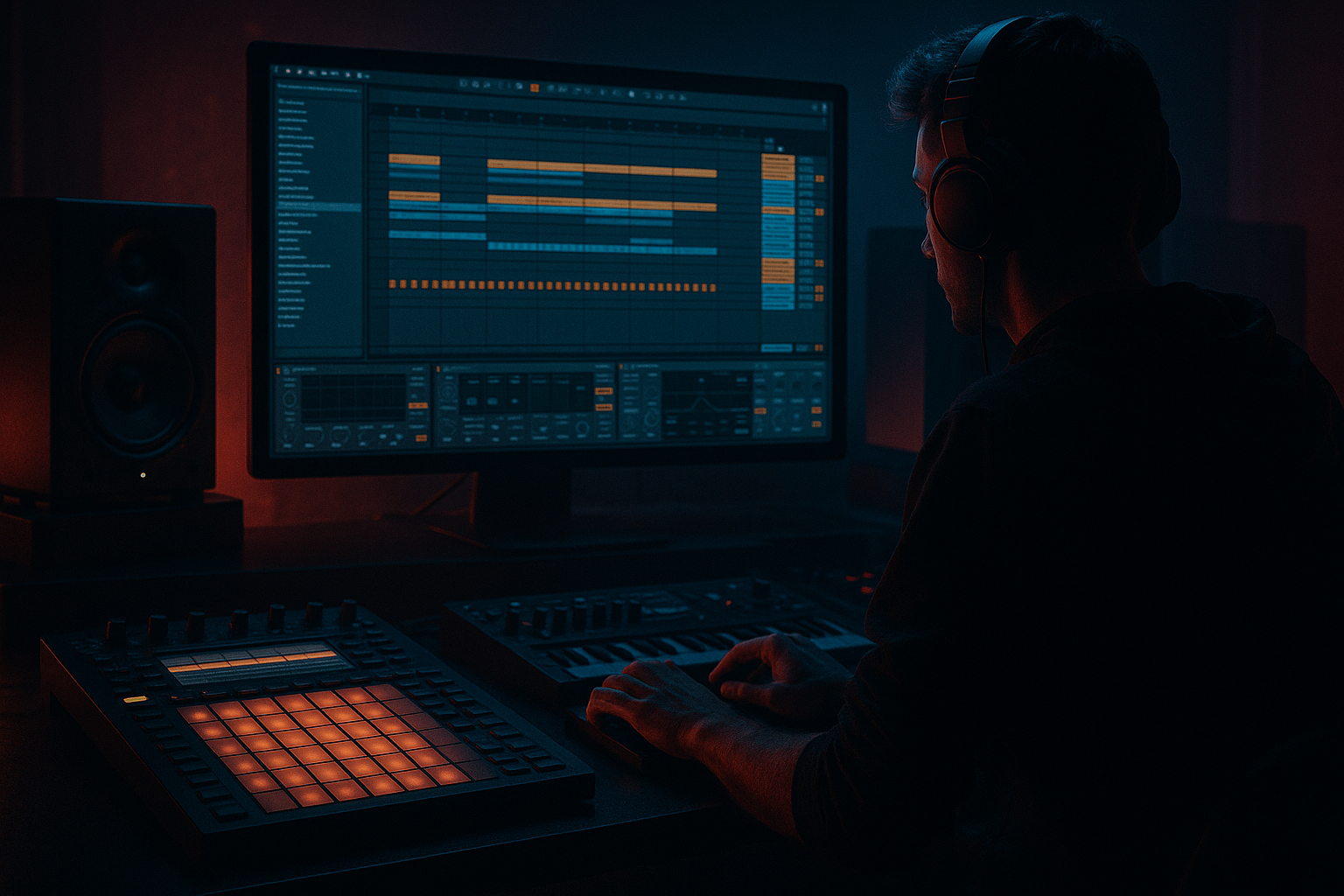
Main tutorial
Break Lab: Ableton Live 12 Ragga Cut Blueprint with Modern Punch and Vintage Soul
> Genre focus: Drum & Bass / Jungle / Rolling Bass
> Skill level: Advanced
> Core idea: Build a ragga-infused break toolkit in Ableton Live 12 that feels dusty and soulful, but still hits with modern DnB punch. 🔥
---
1. Lesson overview
This lesson is about designing a signature chopped break from a ragga/vintage source and turning it into a performance-ready drum and bass loop. The goal is not just to “sample a break,” but to create a flexible break system you can use across intros, drops, fills, and switch-ups.
You’ll learn how to:
- Source and prep a ragga break or vocal-drums fragment
- Slice it in a way that preserves groove and attitude
- Rebuild it into a rolling DnB pattern
- Add punch, grit, and width without killing the original soul
- Make it arrangement-ready with variations and fills
- Use Ableton Live 12 stock devices to keep the workflow fast and clean
- Jungle-style chopped breaks
- Ragga DnB rollers
- Half-time intro sections that explode into 174 BPM
- Heavier modern bass music with old-school swing
- ragga percussion energy
- dusty amen-style movement
- tight 2025 drum transient control
- gritty but not mushy low-mids
- enough swing to feel human, enough processing to hit like a weapon
- a ragga break loop
- a drum-heavy reggae sample
- a vocal + drum phrase from a roots/ragga record
- an old percussion-heavy funk or soul break with Jamaican vibe
- a classic jungle-adjacent break with vocal bleed or tape noise
- clear snare transients
- ghost notes or shuffles
- a natural room sound
- some imperfections
- one or two strong accents that can become your anchors
- Warp Mode: Beats
- Preserve: Transients
- Transient Envelope: 6–20 ms
- Start with 1/16 or 1/8 segment length depending on density
- use Complex Pro for previewing
- then commit once you’ve chosen your chop points
- kick-only hits
- snare hits
- ghost note clusters
- tiny vocal fragments
- percussive gaps
- Slice to New MIDI Track
- Slicing preset: Transient
- Or Warp Marker if the sample has unstable timing
- reprogram the rhythm
- layer hits
- mute weak slices
- repeat ghost notes
- build fills from the same source
- turn Filter on if needed
- shorten Release for tighter hits
- adjust Start Offset to remove clicks or silence
- use Fade if some slices are too sharp
- Attack: 0 ms
- Release: 30–80 ms for one-shots, 120–200 ms for longer break slices
- Voices: 1 if you want tight one-shot behavior
- snare on 2 and 4
- kick variations around the snare
- ghost notes before or after the backbeat
- small fills at the end of the bar
- Bar 1: establish the pocket
- Bar 2: add ghost hits, stabs, or a turnaround
- a strong snare body
- a short kick before beat 2
- a syncopated ghost hit between 2 and 3
- a little shuffle on the hats or top break
- Velocity variation
- slight note nudging
- micro-swing
- off-grid placement for selected ghost hits
- High-pass at 25–35 Hz
- Small cut around 250–400 Hz if it gets boxy
- Gentle dip around 600–900 Hz if the break sounds papery
- Keep it subtle; don’t over-EQ the soul out
- Drive: 10–25%
- Crunch: 5–15%
- Transient: +10 to +25
- Boom: off or very low unless you need extra weight
- Damp: adjust if it gets brittle
- Attack: 10 ms
- Release: Auto or 0.3 s
- Ratio: 2:1
- Aim for 1–3 dB gain reduction
- Drive: 2–6 dB
- Soft Clip: On
- Output: compensate gain
- a dusty room-tone break
- a vinyl crackle texture
- a chopped vocal breath or shouter
- a mono percussion phrase
- a filtered snare tail from an old record
- Low-pass around 4–8 kHz
- Modulate slightly with automation or LFO if needed
- Very subtle reduction for grit
- Try 8–12 bit and low mix
- Use carefully—this can get ugly fast
- Short delay, very low feedback
- Filtered repeats can add depth without clutter
- Small room or plate
- Keep decay short: 0.4–1.2 s
- High-pass the reverb return to avoid mud
- Groove Pool
- MPC-style swing grooves
- subtle manual offsets in MIDI editor
- 55–62% for a noticeable swing
- 50–54% if you want it tighter and more modern
- top percussion gets more swing
- snares stay more anchored
- ghost notes can lag slightly behind the grid
- short decay
- strong mid punch around 180–220 Hz
- crisp top around 3–7 kHz
- keep it short
- high-pass if needed to avoid sub rumble clashes
- align phase carefully
- Main loop
- Busy loop
- Fill loop
- Sparse loop
- Intro version with low-pass and less top
- Drop version with extra transients
- low-pass filter
- reduced drums
- more texture and space
- snare roll or chopped vocal lift
- filter opening
- short delay throws
- full punch chain
- full top end
- added kick/snare reinforcement
- remove one kick
- add extra ghost hits
- introduce a reverse chop or fill
- print your processing
- simplify the session
- chop the best moments again
- make new fills and transitions from your own result
- Route the break bus to a new audio track
- Record 1–4 bars
- Consolidate the best take
- Slice again if needed
- filtered break
- sparse vocal chops
- hint of bass
- FX risers and tape stop or delay throws
- add top loop
- introduce snare layer
- open filter gradually
- full break
- bassline enters
- variation every 4 bars
- strip drums
- leave vocal fragments or ambient soul layer
- heavier version
- extra fills
- more aggressive saturation
- alternate chop pattern
- remove a hat
- add a reversed chop
- swap snare layer
- open the filter slightly
- insert a single-bar fill
- Keep it very quiet
- Use it to add depth and menace
- vinyl noise
- room tone
- imperfect timing
- chopped tails
- rough transient texture
- darker and heavier
- and one version that is more ragga and loose
- vintage soul
- modern punch
- jungle swing
- sampling creativity
- arrangement flexibility
- choose a strong source
- warp lightly and slice intelligently
- rebuild the groove with intention
- process with a controlled drum chain
- add soul layers without mud
- resample and re-chop for variation
- arrange like a living DnB record, not a static loop
- a device-chain cheat sheet
- an Ableton rack preset blueprint
- or a bar-by-bar MIDI pattern example for the break.
This blueprint works especially well for:
---
2. What you will build
By the end, you’ll have:
1. A sampled break chop rack in Simpler or Drum Rack
2. A main 1- or 2-bar DnB loop with ragga swing
3. A punch chain that tightens kick/snare impact
4. A vintage soul layer for texture and personality
5. A modern drum bus for loud, controlled output
6. A set of arrangement variations for fills and drop transitions
Target sonic result
Think:
---
3. Step-by-step walkthrough
Step 1: Choose the right source material
Start with one of these:
What to look for
Pick a sample with:
If the sample has a vocal shout, conga, rim, or tambourine, even better. That gives you ragga identity immediately.
Prepare the project
Set your tempo to 172–174 BPM for standard DnB.
If the sample feels better slightly slower in audition, don’t worry—time-stretch after slicing.
---
Step 2: Warp and audition with intent
Drag the sample into Ableton’s Arrangement View or a new audio track.
Warp settings
For breaks, try:
If the source is more tonal or has smear:
Practical move
Listen for:
Set warp markers loosely. Don’t over-quantize yet—your personality lives in the micro-timing.
---
Step 3: Slice the break into a Drum Rack
This is the fastest way to turn source material into a playable DnB break lab.
Use Simpler or Slice to New MIDI Track
Right-click the sample and choose:
Ableton will build a Drum Rack with each chop mapped to pads.
Why this matters
Now you can:
Cleanup
Inside each Simpler:
A good starting point:
---
Step 4: Rebuild the core break pattern
Now sequence a new groove using the sliced pads.
A classic DnB foundation
Build around:
Example 2-bar rhythmic thinking
Instead of copying the original loop, think like this:
A solid ragga DnB loop often uses:
MIDI programming tips
Use:
If you want more jungle feel, avoid making every note perfectly even. A bit of human drift is part of the soul.
---
Step 5: Add modern punch with a tight drum chain
Now we make it hit harder without flattening the sample’s character.
Suggested drum chain on the break bus
Place these on the Drum Group or break bus:
#### 1. EQ Eight
#### 2. Drum Buss
Great for modern DnB bite.
Starting point:
This device is a secret weapon for tightening chopped breaks fast.
#### 3. Glue Compressor
For cohesion, not destruction.
Starting point:
If you want more snap, slow the attack slightly.
If you want more glue, shorten the release.
#### 4. Saturator
Use very lightly for harmonics.
Starting point:
This is especially useful if the break feels too polite.
#### 5. Limiter or Clipper approach
For final safety only. Don’t over-limit the groove.
---
Step 6: Build a vintage soul layer
This is where the ragga cut stops sounding like just a drum loop and starts sounding like a record.
What to layer
Use one or more of these:
Processing chain for the soul layer
On a separate audio track or return:
#### Auto Filter
#### Redux
#### Echo
#### Reverb
Blend it
Keep the soul layer lower than the main break.
You want to feel it more than clearly hear it.
---
Step 7: Shape the groove with swing and micro-timing
DnB lives in the pocket. A rigid chop loses the vibe immediately.
In Ableton
Use one of these:
Good starting point
Try a groove amount around:
Apply groove selectively:
That contrast is what makes the break breathe.
---
Step 8: Layer a modern snare and kick for impact
If the break source is vibey but not hard enough, reinforce it.
Snare layer
Add a clean snare sample on another track:
Kick layer
Add a low, tight kick:
Phase check
Flip polarity or move the layer by a few samples if the combined hit gets weaker.
A bad layer can remove punch instead of adding it.
---
Step 9: Create variation clips
A great DnB break lab always has different versions.
Create at least:
Arrangement idea
Use the same source but different processing:
#### Intro
#### Pre-drop
#### Drop
#### Second drop variation
This keeps the track evolving without needing entirely new samples.
---
Step 10: Use resampling for one-shot enhancement
Once the break feels right, resample it.
Why resample?
Because you can then:
How
This is classic jungle workflow: build, print, re-chop, mutate.
---
Step 11: Build the arrangement like a DnB record
A ragga cut should not loop endlessly without development.
Suggested structure
#### Intro (8–16 bars)
#### Build (8 bars)
#### Drop 1 (16 bars)
#### Breakdown (8 bars)
#### Drop 2 (16 bars)
Arrangement trick
Every 4 bars, change one element:
In DnB, tiny changes keep the energy moving.
---
4. Common mistakes
1. Over-quantizing the break
If every chop lands perfectly on the grid, the break loses its swagger.
Fix: leave selected ghost notes slightly late or early.
2. Too much processing on the source
A ragga break can die quickly under heavy compression and EQ.
Fix: process in stages and keep the original character alive.
3. Ignoring phase when layering
Kick and snare layers can cancel each other out.
Fix: check polarity and sample alignment.
4. Muddy low-mids
Breaks plus bass plus vocals can pile up around 200–500 Hz.
Fix: carve space with EQ Eight and keep layers disciplined.
5. Using too much stereo width on drums
Wide breaks can sound exciting solo but unstable in the mix.
Fix: keep core drums fairly mono, add width mostly to texture layers and effects.
6. Making the groove too busy
Advanced doesn’t mean crowded.
Fix: leave air between key hits so the rhythm can breathe.
---
5. Pro tips for darker/heavier DnB
Tip 1: Keep the kick short and the snare authoritative
For darker rollers, the drum kit should feel lean and aggressive.
Shorter kick tails leave room for bass movement.
Tip 2: Use saturation before compression sometimes
A slightly driven break often compresses better than a clean one.
Try Saturator → Glue Compressor instead of the other way around.
Tip 3: Make a “shadow layer”
Duplicate the break, low-pass it hard, and distort it subtly.
Tip 4: Use transient shaping with Drum Buss
That Transient control can bring the snare forward without making the whole bus louder.
Tip 5: Automate filter movement on fills
A quick low-pass open into the drop adds tension and release.
This works especially well with ragga vocal chops.
Tip 6: Resample distortion states
Print a version with more grit for drops and a cleaner one for verses.
Switching between them creates arrangement contrast fast.
Tip 7: Don’t over-polish the soul
The vintage feel comes from edges:
If you clean everything, you lose the identity.
---
6. Mini practice exercise
Goal
Create a 2-bar ragga DnB break with one soul layer and one modern punch layer.
Instructions
1. Find a ragga-inflected drum sample or break.
2. Slice it to a Drum Rack.
3. Program a 2-bar loop at 174 BPM.
4. Add:
- one extra kick layer
- one snare layer
- one filtered texture layer
5. Put this chain on the drum bus:
- EQ Eight
- Drum Buss
- Glue Compressor
- Saturator
6. Make 3 variations:
- intro
- main drop
- fill version
7. Print one version with resampling and slice it again for a fill.
Challenge
Try making one version:
Compare them side by side. Notice how groove and tone change the emotional impact.
---
7. Recap
You now have a practical blueprint for making a ragga cut drum and bass break in Ableton Live 12 that balances:
Core workflow
The magic is in the contrast:
raw source + precise engineering = heavyweight personality 🎛️🥁
If you want, I can also turn this into:

