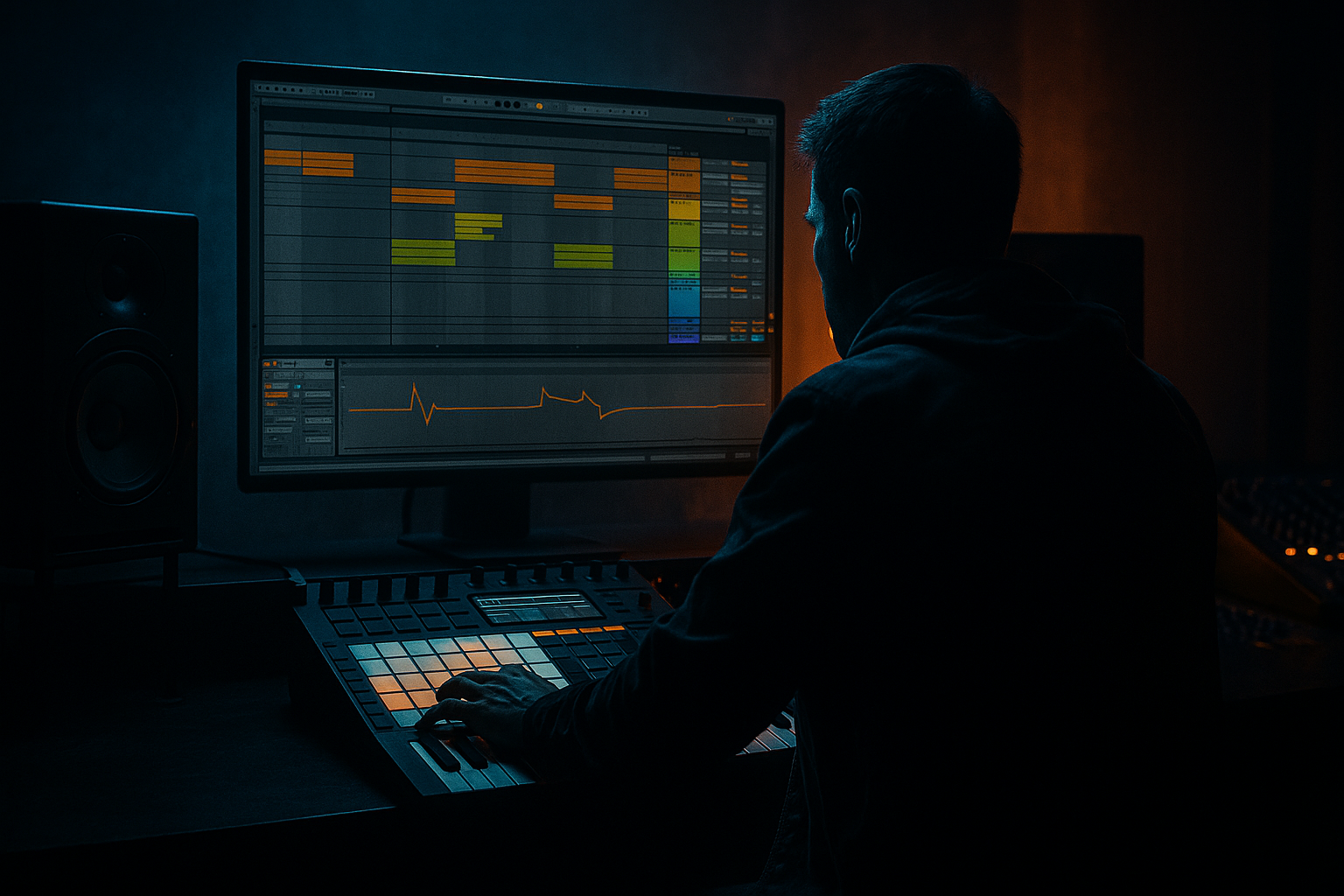
Main tutorial
Lesson Overview
In this lesson, you’re building a floor-shaking low-end system for oldskool jungle / DnB inside Ableton Live 12 using Break Lab thinking: chopped break energy on top, sub-first bass foundation underneath, and automation-driven movement that keeps the track alive without muddying the drop.
The goal is not just “make a big bass.” It’s to create a DJ-ready, club-safe low end that works in a real DnB arrangement: cold intro, tension build, hard drop, switch-up, and a clean outro. This matters because in jungle and older DnB styles, the bassline has to feel physical while the breaks stay aggressive and readable. If the sub is too static, the groove dies. If it’s too wild, the kick and break lose authority. The sweet spot comes from automation, careful routing, and controlled modulation.
We’ll focus on Ableton stock tools like Operator, Wavetable, Serum-free style workflows using stock devices, Saturator, Utility, EQ Eight, Auto Filter, Envelope Follower, Drum Buss, Glue Compressor, and Rack macro automation. The aim is to make a bass layer that can shift between sub weight, reese grit, and automated movement while staying tight with chopped breaks and classic DnB phrasing.
Why this technique matters in DnB: oldskool and jungle-derived low end often works because the sub is simple, but the motion around it is not. The drum edit and bassline need to talk to each other. That “conversation” is what makes the track feel urgent, dangerous, and dancefloor-ready.
What You Will Build
You’ll build a 3-part bass system for a jungle / oldskool DnB drop:
1. Mono sub layer with clean sine weight that follows the bassline notes.
2. Mid bass/reese layer with controlled movement and distortion for character.
3. Automation lane that changes filter tone, distortion drive, and ambience across the intro, drop, and switch-up.
By the end, you’ll have a drop-ready bass setup with:
- A solid 30–60 Hz foundation
- A midrange growl/reese layer that can open up for impact
- Automation that adds tension and release without sounding random
- A break-friendly low end that leaves space for the kick, snare, and ghost notes
- A mix that stays coherent in mono
- 4-bar intro with chopped break tease
- 8-bar drop with a one-note or two-note sub phrase
- 4-bar turnaround with automation sweep
- 8-bar second drop with a small variation or call-and-response bass answer
- Making the sub too complex
- Letting the reese own the low end
- Too much stereo width in the bass
- Over-automating everything
- Ignoring the break
- Excessive saturation before balance
- No headroom
- Use note length as a tone control: short notes feel more aggressive; longer notes feel deeper and more ominous.
- Automate filter cutoff in tiny amounts: even a movement from 180 Hz to 260 Hz on a reese can create life without sounding obvious.
- Resample your bass once it feels good: freeze/flatten or resample the output, then chop it like a break. This is excellent for jungle-style switch-ups.
- Layer ghost bass responses: after the main note, add a quieter answer one octave higher or a distorted mid jab. Great for call-and-response.
- Use delays on mids, not sub: keep delay throws filtered so the groove gets width without low-end smear.
- Introduce distortion on the second 8 bars: a slight Saturator drive increase in later sections creates progression and intensity.
- Let the break drive the energy: if the drums are already hectic, keep the bassline more minimal and let the automation do the work.
- Check mono often: oldskool and heavy DnB must survive club playback. If the groove collapses in mono, simplify the stereo elements.
- Build the low end in layers: clean mono sub plus controlled reese/mid character.
- Use automation to create movement, tension, and section changes.
- Keep the sub simple and mono, and let the mids provide grit and emotion.
- Write bass with the break, not against it.
- Shape the drop like a DJ-friendly DnB arrangement: intro, impact, variation, release.
- Use Ableton stock devices like Operator, Wavetable, EQ Eight, Utility, Saturator, Glue Compressor, Drum Buss, Auto Filter, and Echo to keep the workflow fast and authentic.
Musically, this is ideal for a pattern like:
Step-by-Step Walkthrough
1. Set up your drum-and-bass skeleton first
Start with a clean Ableton project at your target BPM, usually 170–174 BPM for this kind of jungle/DnB vibe. Drop in your break loop or chopped break pattern first, then add a kick/snare anchor if needed. For oldskool energy, the snare on 2 and 4 should still feel like the spine, even if the break is doing most of the movement.
In Ableton Live 12, keep your drums grouped:
- Breaks group
- Kick/snare support group
- Bass group
- FX/atmospheres group
Add Utility on the drum group and set the low-end workflow early:
- Keep the master drum bus at a comfortable level
- Avoid clipping before the bass is even written
- Leave headroom for the sub
Why this works in DnB: if the break is already balanced, you’ll hear whether the bass is fighting the groove or locking into it. DnB low end is judged by the relationship between drum transient and bass sustain, not by bass alone.
2. Build the sub layer with Operator
Create a MIDI track and load Operator. Use it as a pure sub generator.
Suggested Operator starting point:
- Oscillator A: Sine wave
- No FM, no extra harmonics at first
- Filter off or fully open
- Amp envelope: fast attack, short decay if you want stabs, or long release for smoother notes
Good sub settings:
- Attack: 0–5 ms
- Release: 60–140 ms for tighter patterns, 180–300 ms for longer glide notes
- Glide/portamento: subtle, around 20–50 ms if you want that oldskool sliding feel
- Velocity: keep it controlled; don’t let note velocity wildly alter sub level unless intentional
Program a bass phrase with simple note choices. In jungle and early DnB, the sub often works best with:
- Root note
- Octave jumps
- Occasional flattened 5th or 7th for tension
- Short two-note answers to the main phrase
Keep the MIDI pattern sparse. Let the break breathe. A bassline that hits on the “and” of 1, then holds, often feels heavy because it creates room for the snare to punch through.
3. Add a reese/mid layer for movement
Duplicate the MIDI track or create a second instrument rack. Load Wavetable or another Operator instance and design a mid bass layer.
For a classic reese-style texture:
- Use two detuned saws or a saw/square blend
- Detune lightly, not excessively
- Low-pass the top so the sound stays dark
- Add movement with LFO or filter modulation inside Wavetable
Suggested Wavetable settings:
- Oscillator: saw-based table
- Unison: 2–4 voices
- Detune: low to moderate
- Filter: Low-pass 12 or 24 dB
- Cutoff: start around 150–400 Hz depending on how dark you want it
- Drive: moderate, around 10–25%
- LFO rate: sync to 1/8 or 1/16 for pulse movement, or free-rate for more organic wobble
This layer should not replace the sub. Its job is to add audible midrange tension so the bass speaks on smaller systems. Keep it quieter than you think at first.
4. Separate sub and mid bass with clean routing
Put the sub and reese layers into a Bass Group. On the group, add:
- EQ Eight to high-pass the mid layer if needed
- Utility for mono management
- Saturator for gentle glue
- Compressor or Glue Compressor only if needed for consistency
Practical routing idea:
- Sub track: fully mono, no widening
- Reese track: stereo allowed only above the low bass region
- Use EQ Eight on the reese to cut below around 70–120 Hz so it doesn’t cloud the sub
- Use Utility on the sub track set to Width 0% for absolute mono discipline
Concrete parameter guidance:
- EQ Eight high-pass on reese: around 80–120 Hz, 12 or 24 dB slope
- Saturator drive on bass group: 1–4 dB for warmth, more if the mix can handle it
- Utility gain: adjust for balance rather than pushing the master
This is where the sound starts becoming “floor-shaking” instead of just “big.” The sub occupies the physical zone, while the reese occupies the emotional/grit zone.
5. Use automation to make the bass breathe
This is the main automation lesson. Add automation lanes to shape the bass over time instead of relying on static sound design.
Automate these parameters:
- Filter cutoff on the reese
- Saturator drive on the bass group
- Auto Filter resonance for occasional tension
- Reverb send on transitions only
- Utility gain for drop emphasis or pre-drop dip
- Send levels to delay/echo for fills
Practical automation moves:
- In the 4-bar intro, keep the reese low-passed and darker
- In the last 1 bar before the drop, open the filter slightly and add a short delay throw
- On the first bar of the drop, snap the filter back darker for impact, then open it gradually over 2–4 bars
- On a switch-up, automate a quick saturation boost of 1–3 dB to create aggression
A strong DnB arrangement choice: automate the bass tone so the drop starts more focused and then evolves. That gives the ear a reason to stay locked in after the initial impact.
6. Shape the bass rhythm to work with the break
Don’t write bass notes in isolation. Solo the drums and bass together and listen for call-and-response. The break already has syncopation, so your bassline should either:
- Lock to the kick/snare pillars
- Or answer the break in the gaps
Try this phrasing approach:
- Bass note on beat 1
- Rest or short gap
- Bass accent after the snare
- Held note into the next bar
- Occasional pickup note into bar 2 or bar 4
For an oldskool jungle feel, use short rhythmic cells rather than busy 16th-note bass everywhere. If you want more neuro/modern pressure, introduce a small repeated motif in the second half of the drop, but keep the sub more stable than the mids.
A useful arrangement example:
- Bars 1–4: main bass motif, mostly restrained
- Bars 5–8: slight variation, more filter opening
- Bars 9–12: drum fill and bass drop-out for tension
- Bars 13–16: return with a higher-energy reese or octave answer
7. Add transient control and bus shaping
On the Bass Group, use Saturator and Glue Compressor lightly to help the layers feel like one system.
Suggested Glue Compressor settings:
- Attack: 10–30 ms
- Release: Auto or around 0.1–0.3 s
- Ratio: 2:1 or 4:1
- Gain reduction: aim for just 1–2 dB on peaks
If the mid bass is too spiky, use Drum Buss carefully:
- Drive: subtle
- Crunch: very low or off if the break is already gritty
- Boom: usually avoid on the bass group unless you know exactly what you want
- Transients: small positive adjustment can help the bass speak, but too much can get clicky
Why this works in DnB: the bass and drums need to feel like they’re from the same record. Gentle bus shaping helps the low end translate as one powerful event, not layered mush.
8. Automate transitions and space for DJ-friendly arrangement
In DnB, arrangement is part of the low-end design. Use automation to create clear section changes:
- 8-bar intro with filtered break and no full sub
- 16-bar drop with gradual bass opening
- 4-bar break or drum fill before a switch-up
- DJ-friendly outro with bass thinning out
Add Echo or Delay throw automation on the last note of a phrase. Keep it subtle:
- Echo time synced to 1/8 or 1/4
- Feedback low to moderate
- Filtered delay so it doesn’t smear the sub region
You can also automate the reese filter cutoff upward for 1–2 bars before a drop, then bring it back down on impact. That contrast is a classic way to make the drop feel bigger without adding more layers.
Common Mistakes
- Fix: keep the sub mostly sine-based and rhythmically simple. Let the reese provide personality.
- Fix: high-pass the mid bass around 80–120 Hz and keep the true sub separate.
- Fix: keep sub mono, and only widen mids/high mids if needed. Check with Utility and mono playback.
- Fix: automate only a few key parameters per section. In DnB, clarity beats constant motion.
- Fix: write bass against the break’s groove, not in a vacuum. If the break already has a busy snare fill, simplify the bass there.
- Fix: get the levels right first. Then add saturation for character, not compensation.
- Fix: keep the master and group buses clean. DnB low end needs space to hit hard.
Pro Tips for Darker / Heavier DnB
Mini Practice Exercise
Spend 15 minutes making a bass drop loop:
1. Set your project to 172 BPM.
2. Load a chopped break and build a basic 2-step/snare anchor.
3. Create a sub with Operator using a sine wave only.
4. Program a 4-bar bass phrase with no more than 4 different note lengths.
5. Add a reese layer with Wavetable and high-pass it so the sub stays clean.
6. Automate the reese filter to open slightly over the 4 bars.
7. Add one transition automation: a short delay throw or filter sweep in bar 4.
8. Loop it and test in mono using Utility.
9. Adjust until the bass feels heavy but the kick/snare still cut through.
10. Resample one pass if possible, then chop one new fill from it.
Goal: by the end, you should have a loop that feels like a real DnB drop fragment, not just a sound design exercise.
Recap
If you can make the sub hit hard, stay clean, and evolve over time, you’ve got the core of a serious jungle / oldskool DnB low-end system.

