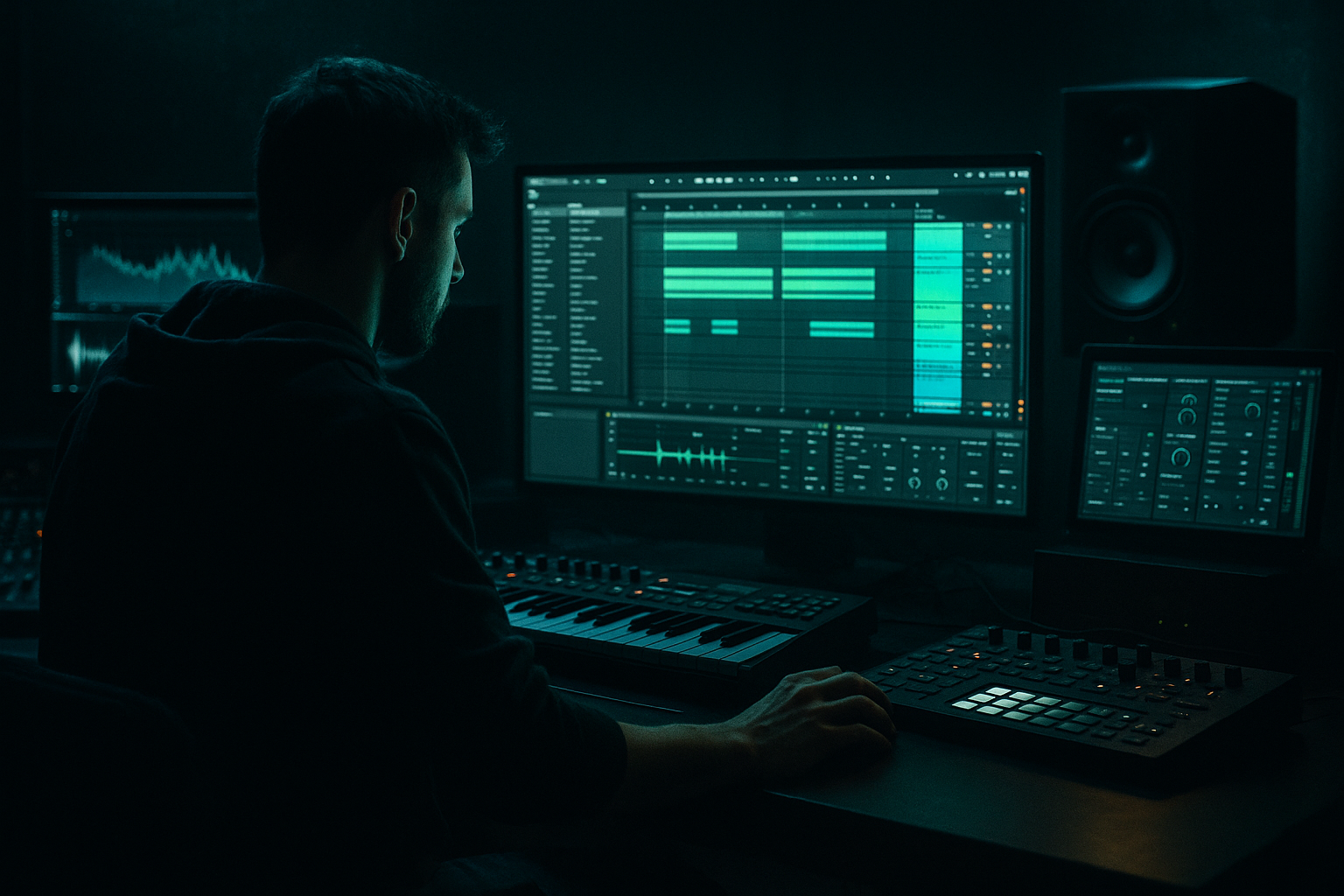
Main tutorial
Break Lab (Ableton Live 12): SubSine Deep Dive + Chopped‑Vinyl Character for Jungle / Oldskool DnB 🥁🧪
1) Lesson overview
In this lesson you’ll build a Break Lab workflow in Ableton Live 12 that combines:
- SubSine (deep, controlled sub fundamentals)
- Chopped-vinyl break character (dusty crunch, time smear, MPC-ish bite)
- Jungle / oldskool DnB arrangement habits (fast edits, ghost notes, fills, drop switches)
- A Break Rack that turns any classic break (Amen, Think, Hot Pants, Funky Drummer, etc.) into a rollable, chopped jungle kit.
- A SubSine layer that locks to the break and keeps your low-end solid.
- A resampling pipeline so you can print “vinyl-chopped” loops and rearrange them like old sampler workflows.
- A 16–32 bar oldskool arrangement with drop, switch-up, and fills.
- DRUMS (Break Lab)
- SUB
- MUSIC / FX
- MIX BUS (optional)
- Macro 1: Vinyl LP Cutoff (Auto Filter cutoff in Chain B)
- Macro 2: Crunch Amount (Redux downsample + bit depth)
- Macro 3: Smash Level (Chain C volume)
- Macro 4: Transient Bite (Drum Buss Transients)
- Macro 5: Top Air (small EQ shelf or Auto Filter)
- Macro 6: Break Width (Utility width on Chains B/C only)
- Put snares on 2 and 4 (DnB time)
- Add ghost snares before the main snare (1/16 or 1/32)
- Use kicks to create that rolling push (syncopation > straight)
- Program sub notes to answer the kick pattern (not just the bassline root).
- Use short notes (1/8 to 1/4) with small gaps—lets the break breathe.
- Consider occasional pitch drops (1–2 semitones) into snare hits for menace.
- Try Warp Mode: Repitch for sections (like fills), or:
- Keep Warp on, and use:
- Hybrid Reverb
- Filtered break (Macro LP down)
- Occasional crash/ride hits
- Tease a fill in bar 8
- Full break
- Sub enters (simple pattern)
- Add a second break layer only in bars 15–16 for lift
- Print loop variation or alternate chop pattern
- Bring in Smash chain a bit more
- Add half-bar stop/start (classic tension)
- Add extra ghost snares / hats
- Short reese stab or dark pad
- Big fill into bar 33 (reverse + snare flam)
- Mono low-end: put Utility on SUB
- Break low control: EQ Eight on Break Lab
- Phase check: toggle polarity with Utility (rarely needed, but test)
- Limiter: keep on master only for safety while producing (not your final loudness plan)
- Controlled nastiness: Put Roar (if you want extra grime) only on the parallel chain and high-pass it. Automate Drive for fills.
- Snare weight trick: Add a short sine “thump” (Operator) layered under snare hits at 150–220 Hz, very quiet, gated tight.
- Tension edits: Use 1/8 bar mutes right before snares. Silence is a weapon.
- Reese-friendly space: Carve a small dip in break around 200–350 Hz when heavy bass comes in.
- Print & re-chop twice: Resample your printed break again through your rack with slightly different settings. The “generation loss” adds authenticity 📼.
- You built a Break Lab rack with Clean Punch, Vinyl Chop Character, and Parallel Smash chains. 🥁
- You used resampling to get that authentic chopped-vinyl “generation” vibe. 📼
- You designed a SubSine (Operator sine) that’s sidechained and disciplined, locking to the break. 🫧
- You arranged it using oldskool jungle dynamics: intros, drops, switches, and fills. ⚡
We’ll focus on advanced drum craft: transient management, micro‑timing, parallel distortion, resampling, and break “movement” without losing weight.
---
2) What you will build
By the end you’ll have:
---
3) Step-by-step walkthrough
Step 0 — Session setup (fast but important)
1. Tempo: set 168–174 BPM (try 172).
2. Warp mode preferences (audio):
- For breaks: start with Beats mode, Transient Loop, Preserve: Transients.
- For “vinyl smear”: later we’ll intentionally use Texture or Repitch in spots.
3. Create groups:
---
Step 1 — Pick and prep a break (the “truth source”)
1. Drag in a break (e.g. Amen).
2. In Clip View:
- Warp: ON
- Seg. BPM: let Live detect, then set to your project tempo.
- Try Warp Mode: Beats
- Preserve: Transients
- Transient Loop: 1/16 (or 1/32 for faster “buzz”)
- Envelope → Clip → Transposition: keep at 0 for now.
3. Gain staging: aim your break clip peak around -9 to -6 dBFS before heavy processing.
---
Step 2 — Build the Break Lab rack (stock devices, jungle mindset) 🧰
Create an Audio Effect Rack on the break track. Build 3 parallel chains:
#### Chain A: Clean Punch (Transient control)
Order:
1. EQ Eight
- HP at 25–35 Hz (24 dB/oct)
- Dip 250–400 Hz if boxy (-2 to -4 dB, Q ~1.2)
- Tiny shelf +1 dB at 7–10 kHz if needed
2. Drum Buss
- Drive: 2–6
- Crunch: 0–10% (keep subtle here)
- Transients: +10 to +25
- Boom: OFF (we’re doing dedicated sub)
3. Glue Compressor
- Attack: 3 ms
- Release: Auto
- Ratio: 2:1
- GR: 1–2 dB max
Goal: Keep the break snappy and stable.
#### Chain B: Vinyl Chop Character (the “old sampler” vibe) 📼
Order:
1. Redux
- Downsample: 10–22 kHz (start 16 kHz)
- Bit Reduction: 10–14 bits
- Soft: ON (often smoother)
2. Saturator
- Type: Soft Sine or Analog Clip
- Drive: 3–8 dB
- Soft Clip: ON
3. Auto Filter
- Mode: LP 12
- Cutoff: 8–14 kHz (map to Macro)
- Drive: 2–5
- Envelope: small +5–10 for movement
4. Vinyl Distortion (stock!)
- Tracing Model: ON
- Drive: 0.5–2.5
- Pinch: 0–2
- Play with Hi/Lo to taste
Goal: Dusty mid/high attitude without flattening the punch.
#### Chain C: Parallel Smash (energy + glue in the mids) 💥
Order:
1. Pedal
- Mode: Overdrive or Fuzz
- Drive: 20–40% (yes, big)
- Tone: adjust to avoid harshness
2. Compressor
- Attack: 10–30 ms (let transients through)
- Release: 50–120 ms
- Ratio: 4:1 to 8:1
- Aim GR: 6–12 dB
3. EQ Eight
- HP at 120–180 Hz (important!)
- Optional dip 3–5 kHz if harsh
Goal: Aggressive midrange density that you blend quietly.
#### Rack Macros (recommended)
Map these:
Blend chains: Start with A = 0 dB, B = -10 dB, C = -14 dB, then bring up until it growls but stays clear.
---
Step 3 — Chop it like it’s 1995 (but with Live 12 precision) ✂️
You have two great approaches—use both.
#### Approach 1: Clip-based slicing (fast arrangement)
1. Duplicate your break clip to a new lane.
2. Consolidate to 1–2 bar loops (Cmd/Ctrl+J).
3. Add warp markers at key transients (kick, snare, ghost).
4. Create micro-edits:
- Stutter a snare tail (duplicate last 1/32–1/16)
- Reverse a tiny slice before a snare (classic jungle lift)
- Nudge ghost hits slightly late/early (±5–15 ms) for swing
#### Approach 2: Slice to Drum Rack (classic jungle reprogramming)
1. Right-click the break clip → Slice to New MIDI Track
2. Slicing preset:
- By Transients (best start)
- Or 1/16 for grid-chops
- Built-in: choose Built-in → Slicing (then customize)
3. In the new Drum Rack:
- Group kick/snares to separate pads if needed
- Add Simpler settings per pad:
- Classic mode
- Snap: ON
- Adjust Start for tighter hits
- Add tiny Fade In (0.5–2 ms) to remove clicks
Now write a new MIDI pattern:
---
Step 4 — SubSine deep dive: weight that follows the break 🫧
We’ll build sub that’s simple, phase-stable, and break-aware.
#### Option A (Stock): Operator as SubSine
1. Create a MIDI track: SUB
2. Add Operator
- Oscillator A: Sine
- Level: 0 dB
- Filter: OFF
- Pitch: -1 or -2 oct if needed
3. Amp envelope:
- Attack: 0–5 ms
- Decay: 200–500 ms
- Sustain: -inf (or low) for plucky subs, OR sustain for held notes
- Release: 50–120 ms
#### Sub “Sine Weight” chain (stock)
On the SUB track:
1. EQ Eight
- HP at 20–25 Hz
- Gentle dip around 200–300 Hz if muddy
2. Saturator
- Drive: 1–4 dB
- Soft Clip: ON
- (This helps translate on smaller systems)
3. Compressor (Sidechain from break/snare or full break)
- Sidechain input: Break Lab track
- Attack: 1–5 ms
- Release: 60–140 ms
- Ratio: 4:1
- Aim for 2–6 dB ducking on snare hits (oldskool pump)
#### Make it “break-aware” (classic jungle movement)
> Pro move: if your kick has low-end, HP the break at 80–120 Hz and let sub own below that. If the break’s low is part of the vibe, keep some at 120–200 Hz but stay disciplined.
---
Step 5 — “Chopped vinyl” realism: resampling + wear 🧷
Old jungle often feels like it’s been sampled, re-sampled, and pushed.
#### A) Print a “vinyl generation” loop
1. Create a new audio track: BREAK PRINT
2. Set Audio From: Break Lab track
3. Arm and record 4–8 bars of your loop while you perform Macro moves:
- Slight cutoff sweeps
- Crunch changes on fills
- Bring in Smash for hype
Now you’ve got a performance-printed break—very authentic.
#### B) Add subtle “turntable wobble” (stock)
On the printed break clip:
- Clip Envelopes → Transposition: draw tiny variations ±5 to ±15 cents
- Or Frequency Shifter (very subtle):
- Fine: 0.02–0.10 Hz (LFO) with tiny depth
- Mix low (this is seasoning)
#### C) Room/air like old rave tapes (don’t drown it)
Send break to a Return track:
- Algo: Room or Ambience
- Decay: 0.3–0.8 s
- HP in reverb: 250–500 Hz
- Wet: return controls it (keep subtle)
---
Step 6 — Arrangement ideas (oldskool structure that hits) 🧱
Aim for 32 bars:
Bars 1–8 (Intro drums):
Bars 9–16 (Drop 1):
Bars 17–24 (Switch):
Bars 25–32 (Drop 2 / Peak):
---
Step 7 — Quick mix discipline (so it bangs on a rig) 🎛️
- Width: 0%
- If sub is strong: HP break 70–120 Hz
---
4) Common mistakes
1. Too much bit reduction → turns into fizzy mush. Keep Redux tasteful; let transients stay readable.
2. Smash chain has sub → instant mud. High-pass parallel distortion at 120–180 Hz.
3. Over-warping breaks → transient smear. Don’t add warp markers everywhere; use only where timing truly needs it.
4. Sub fights the snare → snare loses chest. Sidechain or leave micro-gaps in sub notes.
5. Everything is “full-on” all the time → no contrast. Use macros for dynamics across 32 bars.
---
5) Pro tips for darker/heavier DnB 🌑
---
6) Mini practice exercise (20 minutes) ⏱️
1. Choose one break and build the 3-chain rack (A/B/C).
2. Create two 2-bar loops:
- Loop 1: clean + mild vinyl
- Loop 2: heavier smash + lower LP cutoff
3. Resample both into BREAK PRINT.
4. Arrange 16 bars:
- Bars 1–8: Loop 1 filtered
- Bars 9–16: Loop 2 full + subline
5. Add one fill using:
- reverse slice + snare flam + quick cutoff sweep
Deliverable: a 16-bar sketch that feels like a real jungle drop.
---
7) Recap
If you tell me which break you’re using (Amen/Think/etc.) and whether your sub is more held notes or plucky steps, I can suggest exact chop patterns and a sub MIDI template for that specific vibe.

