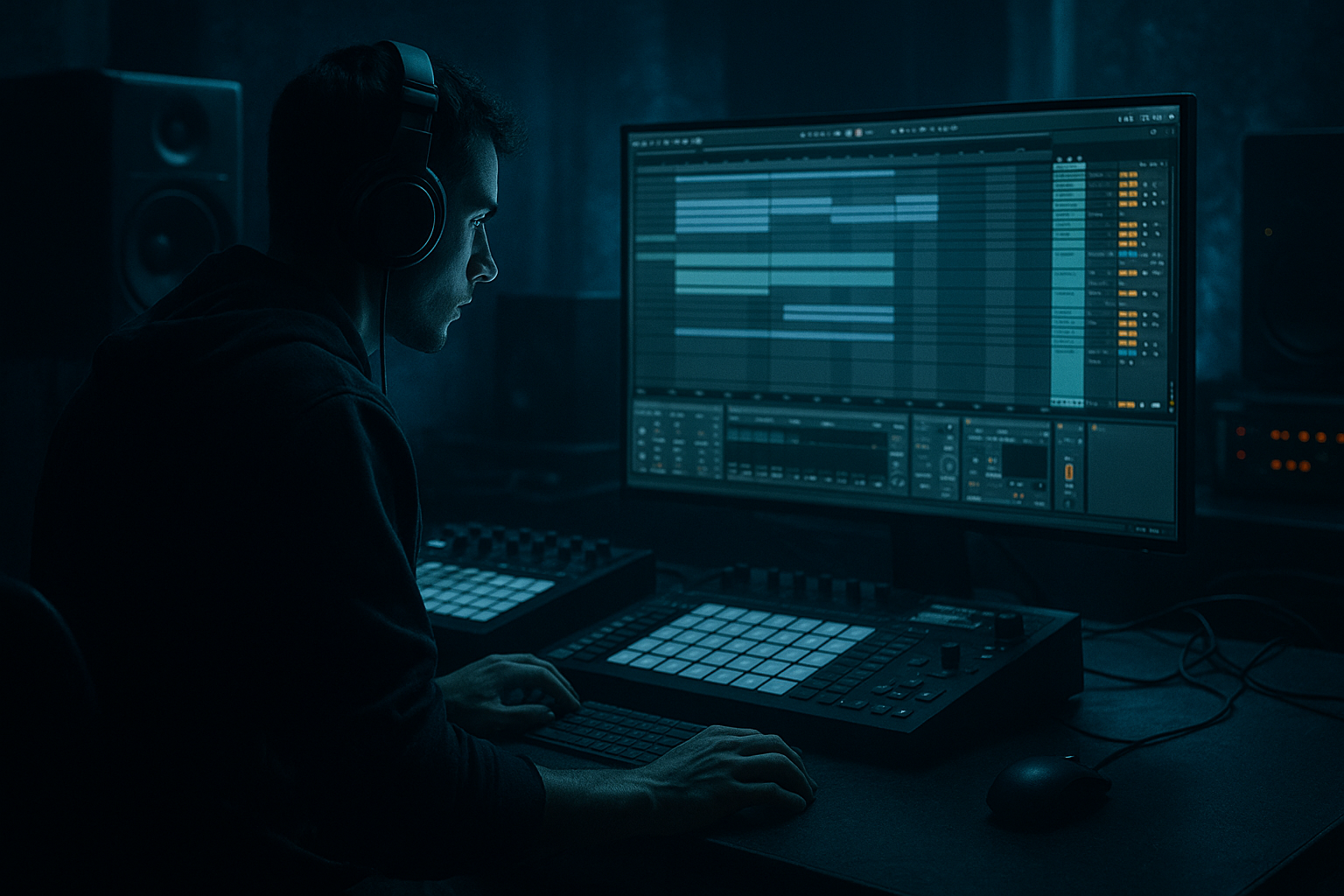
Main tutorial
Lesson Overview
In this lesson, you’ll build a classic Break Lab-style fill saturate move in Ableton Live 12 for oldskool jungle / DnB vibes. The goal is simple: take a breakbeat phrase, create a short fill or switch-up at the end of a 4-bar or 8-bar section, and make it feel more exciting, heavier, and more “finished” using saturation, resampling, and smart drum editing.
This technique matters because in Drum & Bass, the listener is always tracking energy. A good drop is only as strong as the phrases that lead into it. If your drums repeat too cleanly, the groove can feel flat. A fill saturate gives you that gritty, DJ-friendly lift:
- a break cut that feels more urgent
- a bit of harmonic dirt so the drums feel louder without just turning them up
- a transition that works in both rollers and oldskool jungle contexts
- a strong “reset” before the next loop or drop section
- a chopped break or drum loop
- added grit from Saturator or Drum Buss
- controlled punch using EQ Eight and compressor-style shaping
- a short automated build or transition
- optional resampled variation for a more authentic oldskool feel
- a clean DJ-friendly structure that can lead into the next phrase
- Bars 1–6: main loop / roller groove
- Bars 7–8: fill or drum turnaround
- Next phrase: drop back into the full bassline or switch to a variation
- Over-saturating the whole drum loop
- Making the fill too long
- Letting saturation destroy the snare transient
- Ignoring the sub-bass relationship
- Too much stereo width on the drums
- No arrangement purpose
- Print the fill with resampling to get a more authentic grimey texture. This is especially good for jungle and raw rollers.
- Layer a quiet reverse hit before the final snare for tension. Keep it low in the mix so it feels like a shadow, not a trance riser.
- Use Soft Clip in Saturator to shave the top of the break gently. This can make the drum bus feel louder without obvious distortion.
- Pair saturation with a small low-mid cut around 300 Hz to stop the fill from sounding cloudy.
- Use call-and-response with the bassline: let the drums do the fill, then answer with a short bass stab or reese movement on the next bar.
- In darker DnB, less is often more. A simple saturated snare turn with good timing can sound harder than a busy FX chain.
- If the fill needs more weight, automate a tiny volume rise of around 0.5 to 1.5 dB on the drum bus instead of adding more distortion.
- For a more underground feel, keep the dynamics alive. Don’t fully squash the break — leave some movement in the ghost notes and hat tails.
- Build the fill at the end of a clear DnB phrase, usually 1 bar or less
- Use Saturator, Drum Buss, and EQ Eight to add grit while keeping control
- Keep the bass/sub relationship clean so the fill works in a real mix
- Resample the fill if you want a more authentic jungle-style texture
- Use automation sparingly for tension and movement
- Think like a DJ tool maker: the fill should improve flow, not just add noise
This is especially useful in DJ tools thinking: you’re building a loop that can mix well in a set, while still giving the track enough movement to avoid sounding like a plain 2-step loop. The result should feel like something you could actually hear in a club intro, a breakdown fill, or the last bar before the drop.
We’ll keep everything beginner-friendly and use Ableton stock devices only. The emphasis is on practical decision-making: where to place the fill, how to saturate it, how to keep the low end solid, and how to make it sit like authentic DnB rather than random distortion.
What You Will Build
By the end of this lesson, you’ll have a short breakbeat fill chain that you can drop into the end of an 8-bar section. It will sound like a saturated jungle fill with:
Musically, this could be used in a pattern like:
You’ll learn how to make that final bar feel like a proper jungle turn, with enough saturation and movement to feel alive, but not so much that it ruins mix clarity.
Step-by-Step Walkthrough
1. Start with a simple drum loop or break
Open Ableton Live and place a breakbeat on an audio track. For a beginner workflow, use a loop around 160–170 BPM if you want oldskool jungle energy, or around 172–174 BPM for modern DnB. If you don’t have a break loop ready, you can build one from stock drum hits:
- kick
- snare
- hats
- a ghost note or two
If you have a break sample, drag it into Arrangement or a Clip Slot. The goal is not perfection yet — just something with enough rhythmic detail to edit. For this lesson, choose a loop with clear snare hits and some natural swing.
Why this works in DnB: breaks are the backbone of jungle and early DnB. Even when bass design gets modern and heavy, the drum energy still carries the groove and identity.
2. Set up the fill point at the end of the phrase
In Arrangement View, find the last bar of an 8-bar loop and mark a spot where the fill will happen. For example:
- Bars 1–6: repeat your core groove
- Bar 7: small variation
- Bar 8: fill and transition
Keep the fill short. For beginner workflow, think in 1 bar or 2 beats rather than a full complicated edit. A good fill often uses:
- a snare roll
- a break chop
- a reverse hit
- a final crash or impact into the next section
If you’re making a DJ tool, this section should still loop cleanly. That means the fill should feel like a repeatable phrase, not a one-off effect mess.
3. Split the break into editable chunks
Select the break clip and use Cmd/Ctrl + E to split it at the grid points where you want control. Focus on:
- the snare before the fill
- the last 1/2 bar
- the final hit before the loop resets
If the break has a strong snare, try pulling one or two hits into a tighter rhythm. A simple beginner approach is:
- keep the main groove untouched
- duplicate the final snare
- shift one hit slightly earlier for urgency
- add one extra ghost hit before the loop ends
Don’t over-edit the whole break. In jungle and DnB, the power often comes from a few strategic changes rather than total rearrangement.
4. Add Saturator to the fill section
Put Saturator on the break track, or if you want more control, duplicate the track and apply saturation only to the fill layer.
Good starting settings:
- Drive: +3 dB to +8 dB
- Soft Clip: On
- Output: reduce to match level after driving
- Curve: leave default at first
If the break gets too sharp, keep the drive moderate and use output gain to compare with bypass. If you want more oldskool grime, try slightly more drive and softer output compensation.
A useful beginner move is to automate Saturator only on the fill:
- keep the main loop cleaner
- push Drive higher on the last bar
- drop it back to normal after the fill
That gives you a clear sense of lift without ruining the whole drum bus.
5. Shape the drums with Drum Buss or light compression
After Saturator, add Drum Buss if you want extra body and attitude. Keep it subtle first.
Try these starting points:
- Drive: 5–15%
- Crunch: low to medium
- Boom: off or very low for break-focused fills
- Transient: slightly up if the fill needs more snap
If you prefer a cleaner route, use Compressor or Glue Compressor on the drum bus:
- Ratio around 2:1
- Attack around 10–30 ms
- Release around Auto or 100 ms
- Aim for light gain reduction, around 1–3 dB
This keeps the fill punchy while letting the break breathe. For oldskool jungle, you generally want the drums to feel energetic and a little unstable — not flattened.
6. Use EQ Eight to control harshness and low-end clutter
Add EQ Eight after saturation and drum shaping. This is crucial because saturation often creates extra high-frequency bite and low-end mud.
Start with:
- High-pass around 25–35 Hz to clean sub-rumble
- Gentle cut around 250–400 Hz if the fill sounds boxy
- Small dip around 3–6 kHz if the saturation gets harsh
- Optional tiny boost around 8–10 kHz if you want more air on hats
If your break has a strong kick in it, be careful not to boost low end too much. In DnB, the sub often comes from the bassline, not the break itself. Keep the break punchy, but make space for the bass.
For a DJ tool, this is extra important: clean low-end separation means your loop can mix better with other tracks and won’t overload the club system.
7. Add a resampled fill for texture and authenticity
One of the best oldskool tricks is to resample your break fill so it feels like a real performance rather than a sterile edit.
In Ableton:
- create a new audio track
- set its input to Resampling
- record the last 1 bar of your fill with the saturation and EQ already on it
Then chop the recorded audio into a new clip. You can:
- reverse one hit
- time-stretch a snare tail slightly
- fade the end into the next bar
- copy the best 1/2 bar back into the arrangement
This gives the fill more character because the saturation becomes “printed” into the audio. That’s very useful in jungle workflows, where resampling is part of the sound.
8. Automate a final energy lift
Now make the fill feel intentional. Use automation on one or two parameters only. Good beginner choices:
- Saturator Drive
- EQ Eight high-cut or high shelf
- Reverb send
- Filter frequency on a utility effect or Auto Filter
- Track volume for a small lift
Example automation idea:
- Bars 7–8: increase Saturator Drive from +3 dB to +7 dB
- Add a tiny high-pass sweep or short reverb send on the final snare
- Return everything to normal on the downbeat
If you use Auto Filter, try a gentle low-pass opening on the fill:
- start around 8–10 kHz
- open slightly toward the end
- keep resonance low to avoid harshness
This kind of automation is perfect for dark DnB because it creates tension without needing huge FX chains.
9. Build the arrangement like a real DnB phrase
Place your fill inside a proper musical context. A strong beginner arrangement could be:
- Intro: DJ-friendly drums + atmospheres
- Build: add bass hint or percussion
- Drop: main groove
- End of 8 bars: fill saturate
- Next section: new drum variation or bass response
Example arrangement use:
- In a roller, the fill can act like a subtle phrase reset every 8 bars
- In oldskool jungle, the fill can lead into a chopped-up break switch or a bass stab
- In darker neuro-influenced DnB, the fill can act as a tension bridge before a heavy bass re-entry
If you’re making a DJ tool, keep the intro and outro simple enough to mix. That means your fill should feel exciting, but the track should still be easy to blend.
10. Check the mix in context
Soloing the fill is not enough. Test it with the bassline and the rest of the track. Focus on:
- does the kick still hit?
- is the snare too bright?
- does the sub disappear when the fill comes in?
- does the saturation make the drums louder or just dirtier?
Use Utility on the bass to keep sub focused in mono if needed. If the fill feels too wide or messy, reduce stereo width on the drum track or keep the bass more centered.
A useful beginner rule: if the fill sounds exciting alone but weak in context, reduce the processing slightly and simplify the edit. In DnB, impact often comes from contrast, not from maxing every parameter.
Common Mistakes
Fix: automate saturation only on the fill or duplicate a separate fill track.
Fix: keep it tight. One bar or even half a bar is often enough.
Fix: use less Drive, or use Drum Buss/Compressor to restore punch.
Fix: high-pass the break lightly and check the fill with the bassline playing.
Fix: keep the main drum energy centered; use width only for FX or atmospheres.
Fix: place the fill at the end of an 8-bar phrase so it actually helps the track move forward.
Pro Tips for Darker / Heavier DnB
Mini Practice Exercise
Spend 10–20 minutes making a fill saturate loop in Ableton Live:
1. Load a breakbeat loop at 170–174 BPM.
2. Make it an 8-bar loop in Arrangement View.
3. Split the final bar and create a simple fill using one extra snare hit or break chop.
4. Add Saturator with +4 to +6 dB Drive and Soft Clip On.
5. Add EQ Eight and high-pass around 30 Hz.
6. Automate the Saturator Drive to rise only on the last bar.
7. Resample the fill for one pass and compare it to the original.
8. Bounce or loop the result and test it with a bassline or sub drone.
Goal: by the end, you should have one clean, repeatable DnB fill that feels gritty, musical, and mix-ready.
Recap
If you can make one strong saturated break fill, you’ve got a powerful building block for oldskool jungle, rollers, and darker DnB arrangement flow.

