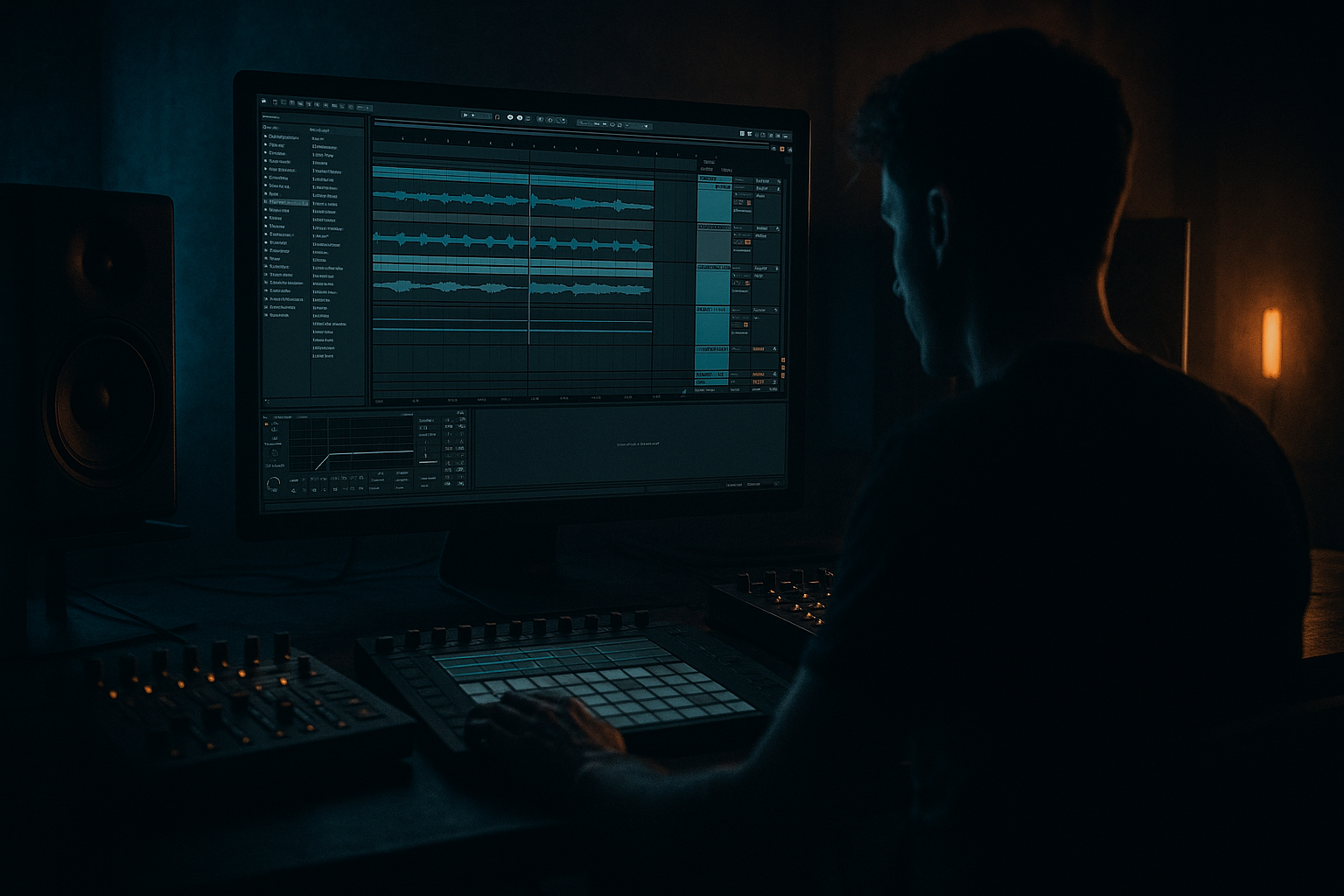
Main tutorial
Break Lab Blueprint: Percussion Layer Composition in Ableton Live 12 (Jungle / Oldskool DnB) 🥁🔥
Skill level: Intermediate
Category: Mastering (translation: we’ll build percussion layers that already sound mix-ready and loud-safe)
---
1. Lesson overview
This lesson is a practical blueprint for building jungle / oldskool DnB percussion layers around a break (Amen-style vibes) in Ableton Live 12, with a focus on tight groove, punch, stereo control, and “master-ready” headroom.
We’ll create a percussion bus that:
- Adds weight and clarity without washing out the break
- Hits hard while keeping transients clean
- Keeps sub/low-end mono and controlled (so your master doesn’t fold)
- Feels authentic: rolling, syncopated, slightly messy—but intentional 😈
- A Break Core track (your main break)
- A Percussion Layer Group with:
- A Drum Bus “Mastering-style” chain designed for loudness without destroying groove
- A 16–32 bar arrangement template with fills, drops, and variations
- Turn on the Groove Pool and apply a classic swing (MPC-ish, or any 16 swing).
- Start with Groove Amount ~20–35% and Timing 100%, Velocity 0–10%.
- Commit later once you like it.
- In MIDI editor, set velocities like a drummer:
- Apply the same Groove Pool groove used on the break.
- Hybrid Reverb
- Echo
- Optional after Echo: Saturator (Drive 2–5 dB)
- Bars 1–8 (Intro):
- Bars 9–16 (Drop 1):
- Bars 17–24 (Variation):
- Bars 25–32 (Drop 2 / Peak):
- Duplicate last 1/2 bar → slice a few hits → reverse 1 snare → add dub echo → re-enter on the 1.
- Layering without phase checking: Your kick layer can cancel the break’s low punch. If it gets thinner when you add the layer, flip polarity (try Utility phase invert) or nudge timing by a few ms.
- Over-widening drums: Wide hats are fine; wide low-mids are not. Keep lows mono via Utility.
- Too much Drum Buss Boom: It can sound sick solo but wrecks your master limiter later.
- Ignoring velocity: Jungle groove is velocity storytelling. Flat 127 hats = fake.
- Over-compressing the group: If the groove stops breathing, you’ve “modernized” it into a pancake.
- Parallel crush (controlled):
- Tune your kick layer to the bass key:
- Make the snare feel “taller”:
- Use gated room on snare (old rave vibe):
- Automate transient intensity:
- Build around a break core, then reinforce with focused layers (kick/snare/ghosts/rides/foley).
- Treat the percussion group like a pre-master: controlled lows, modest glue, safe limiting.
- Jungle energy comes from micro-timing + velocity + tasteful dirt, not brute-force compression.
- Arrange in phrases (8/16/32 bars) with fills and send automation for authentic oldskool motion.
---
2. What you will build
By the end you’ll have:
- Kick reinforcement (low punch + optional click)
- Snare/clap reinforcement (body + snap)
- Ghost hat/shaker grid (movement and swing)
- Ride/crash accents (oldskool energy)
- Foley/noise layer (texture + glue)
---
3. Step-by-step walkthrough
Step 0 — Project setup (so the groove lands right) ⚙️
1. Tempo: 160–170 BPM (classic jungle often 165–170). Start at 165 BPM.
2. Set Global Quantization to 1/16 (top bar).
3. Create these tracks:
- Audio Track: `BREAK_CORE`
- Group Track: `PERC_LAYERS (GROUP)`
- Inside: `KICK_LYR`, `SNARE_LYR`, `HATS_GHOST`, `RIDES`, `FOLEY`
- Return Tracks: `A - ROOM`, `B - DUB` (we’ll set these up later)
Workflow note: Put your break and all percussion into a Drum Group early. It makes bus processing and automation clean.
---
Step 1 — Choose and prep your break core (the “record DNA”) 🧬
1. Drop a classic break (Amen, Think, Hot Pants, Apache… or your own chop) onto `BREAK_CORE`.
2. Right-click the clip → Warp on.
3. In Clip view:
- Warp Mode: Complex Pro can smear transients. For breaks, try:
- Beats mode
- Preserve: Transients
- Envelope: Start around 20–40
- If it gets too clicky, move envelope down; too mushy, move it up.
4. Set Loop to 1–2 bars.
Micro timing (the secret sauce):
---
Step 2 — Build the kick layer (reinforce, don’t fight) 👊
Goal: Add consistent low punch under the break without double-kicking weirdly.
1. On `KICK_LYR`, add a Drum Rack. Load:
- One clean punchy kick (short tail), ideally tuned-ish to your track.
2. Write MIDI that follows the break’s main kick hits, but keep it simple:
- Usually 2-step skeleton works: hits on 1 and 3 (or jungle variations).
Device chain (Kick Layer):
1. EQ Eight
- HP filter at 25–35 Hz (24 dB/oct)
- Gentle cut if boxy: 200–350 Hz (–2 to –4 dB, Q ~1.2)
- Optional: tiny boost around 60–90 Hz if it needs chest
2. Drum Buss
- Drive: 3–8%
- Boom: 0–20% (be careful; boom can destabilize the master)
- Damp: to taste (often 10–30%)
- Transients: +5 to +20 for snap
3. Saturator
- Mode: Soft Sine or Analog Clip
- Drive: 1–4 dB
- Turn on Soft Clip
4. Utility
- Bass Mono: enable, set around 120 Hz
- Gain trim as needed
Mastering-minded rule: Your kick layer should be felt more than heard. If you mute it and the track collapses, great. If you mute it and nothing changes, it’s too quiet. If you mute it and suddenly it sounds cleaner, it was too loud. 🎯
---
Step 3 — Snare layer (body + crack + oldskool bite) 🧨
Old jungle snares often have mid body plus top snap, sometimes layered with a clap.
1. On `SNARE_LYR`, use a Drum Rack with:
- Snare Body (200 Hz–1.5 kHz weight)
- Snare Snap (2–8 kHz transient)
- Optional clap or rim for character
2. Program hits to follow the break’s main backbeat (usually on 2 and 4 in half-time feel).
Device chain (Snare Layer):
1. EQ Eight
- HP at 120–180 Hz
- If harsh, notch 3–5 kHz slightly
- Add air: gentle shelf 8–12 kHz (+1–3 dB)
2. Drum Buss
- Drive: 2–6%
- Transients: +10–25
- Crunch: 0–10% (optional)
3. Glue Compressor
- Attack: 3 ms
- Release: Auto
- Ratio: 2:1
- Aim for 1–2 dB GR on the loudest snare hits
4. Utility
- Keep this mostly mono-ish: Width 70–100% depending on your break
Tip: If the break snare is already perfect, use your layer purely as presence—high-passed snap with light saturation.
---
Step 4 — Ghost hats / shakers (rolling motion without stealing transients) 🌀
This is where the “jungle treadmill” comes from—quiet 16ths with velocity movement.
1. On `HATS_GHOST`, load a Drum Rack with:
- Closed hat
- Short shaker
- Optional tiny perc tick
2. Create a 1-bar MIDI loop of mostly 1/16 notes, but remove a few steps to breathe.
Groove + Velocity shaping:
- Strong on offbeats, softer between
- Try: 40–70 velocity range
Device chain (Hats):
1. Auto Filter
- HP mode, cutoff 400–800 Hz
- Add subtle movement: LFO amount small (optional)
2. Redux (tiny!)
- Downsample slightly for grit: 2–8 (keep subtle)
3. Echo
- Time: 1/8 or 1/16
- Feedback: 10–20%
- Filter: keep lows out (HP around 500 Hz)
- Mix: 5–12%
4. Utility
- Width: 120–160% (careful—don’t widen your whole drum bus, just hats)
---
Step 5 — Rides/crashes (oldskool hype + transitions) 🚀
Jungle often uses rides that feel slightly “too much” in a good way—especially in drops.
1. On `RIDES`, add:
- Ride loop or one-shot ride
- Occasional crash on phrase starts (bar 1, 9, 17…)
2. Make rides rhythmically consistent but automate their level per section.
Device chain (Rides):
1. EQ Eight
- HP at 300–600 Hz
- If harsh: dip 6–9 kHz
2. Compressor
- Fast-ish attack 1–3 ms, release 50–120 ms
- Just tame peaks 1–3 dB GR
3. Send to ROOM return (next step)
---
Step 6 — Add foley/noise texture (glue + vibe) 🎛️
This layer makes it feel like a sampled record / pirate radio tape.
1. On `FOLEY`, use:
- Vinyl noise, room tone, cassette hiss, crowd, rain, metal ticks
2. Loop it low in the mix.
Device chain (Foley):
1. EQ Eight
- Band-pass it: HP 200–500 Hz, LP 6–10 kHz
2. Saturator (very light)
- Drive 1–3 dB, Soft Clip on
3. Auto Pan
- Rate: 1/2 or 1 bar
- Amount: 10–25%
4. Utility
- Keep lows mono (Bass Mono ~150 Hz)
---
Step 7 — Set up returns (space without washing the break) 🏚️
Create two Return tracks:
#### Return A: `ROOM` (tight drum space)
- Algorithmic / Room (or small plate)
- Decay: 0.4–0.9s
- Pre-delay: 5–20 ms
- HP: 300–600 Hz, LP: 7–10 kHz
- Mix 100% (since it’s a return)
Use on hats, rides, maybe a touch of snare.
#### Return B: `DUB` (jungle echo stabs)
- Sync: 1/8 Dotted or 1/4
- Feedback: 20–40%
- Filter: HP around 400–800 Hz, LP around 5–8 kHz
Automate sends for fills and phrase ends (classic jungle move).
---
Step 8 — The Perc Layer Group “mastering-style” bus chain (clean loudness) 📈
On the `PERC_LAYERS (GROUP)` channel, add:
1. EQ Eight (cleanup)
- HP at 20–30 Hz (gentle)
- If it’s muddy, small dip 250–450 Hz
2. Glue Compressor
- Ratio: 2:1
- Attack: 10 ms (let transients through)
- Release: Auto (or 0.1–0.3s)
- Aim 1–3 dB GR max
3. Drum Buss
- Drive: 2–5%
- Transients: +5–15
- Crunch: 0–5%
4. Limiter (safety, not loudness)
- Ceiling: -1.0 dB
- Only catching occasional peaks (1 dB max)
Critical: Keep the drum bus peaking around -6 to -3 dB before your full track mastering chain. Jungle needs transient room.
---
Step 9 — Arrange like jungle (16–32 bar blueprint) 🧱
Here’s a practical 32-bar sketch:
Break core filtered + foley + sparse hats
Automate filter opening and send a few dub echoes
Full break + kick/snare layers + rides (low)
Add small 1-bar fill at bar 16
Remove kick layer for 2 bars → bring back
Add extra ghost notes and a crash at 17
Slightly louder hats, more ride, a touch more room
Big echo throw on final snare at bar 32
Fill recipe (classic):
---
4. Common mistakes 🚫
---
5. Pro tips for darker/heavier DnB 🖤
Create a return `CRUSH` with Drum Buss (heavy) + Saturator + Compressor, then send snare/hats lightly. Keep it subtle; it adds menace.
Even slight tuning helps the low end feel intentional (especially at 165–175).
Add a tiny top layer (8–12 kHz) + short room. Darkness isn’t only low end—contrast matters.
Hybrid Reverb short room → then Gate after it (fast release). Send snare into it.
In loud sections, reduce Transients a bit on Drum Buss to keep the master stable; in sparse sections, push transients forward.
---
6. Mini practice exercise 🎯
Goal: Build a 16-bar loop that evolves every 4 bars without adding new samples.
1. Start with break core only.
2. Add kick + snare layers (simple).
3. Add ghost hats with velocity variation.
4. Bars 5–8: automate a small increase in ROOM send on hats.
5. Bars 9–12: remove kick layer for 1 bar, then reintroduce with a fill.
6. Bars 13–16: add a dub echo throw on the last snare hit (Send to DUB only on that hit).
7. Export and A/B:
- With percussion group bypassed vs enabled
- Check if it’s better, not just louder
---
7. Recap ✅
If you want, tell me your BPM + which break you’re using (Amen/Think/etc.), and I’ll suggest an exact kick/snare layer rhythm grid and a bus chain tuned to that style.

