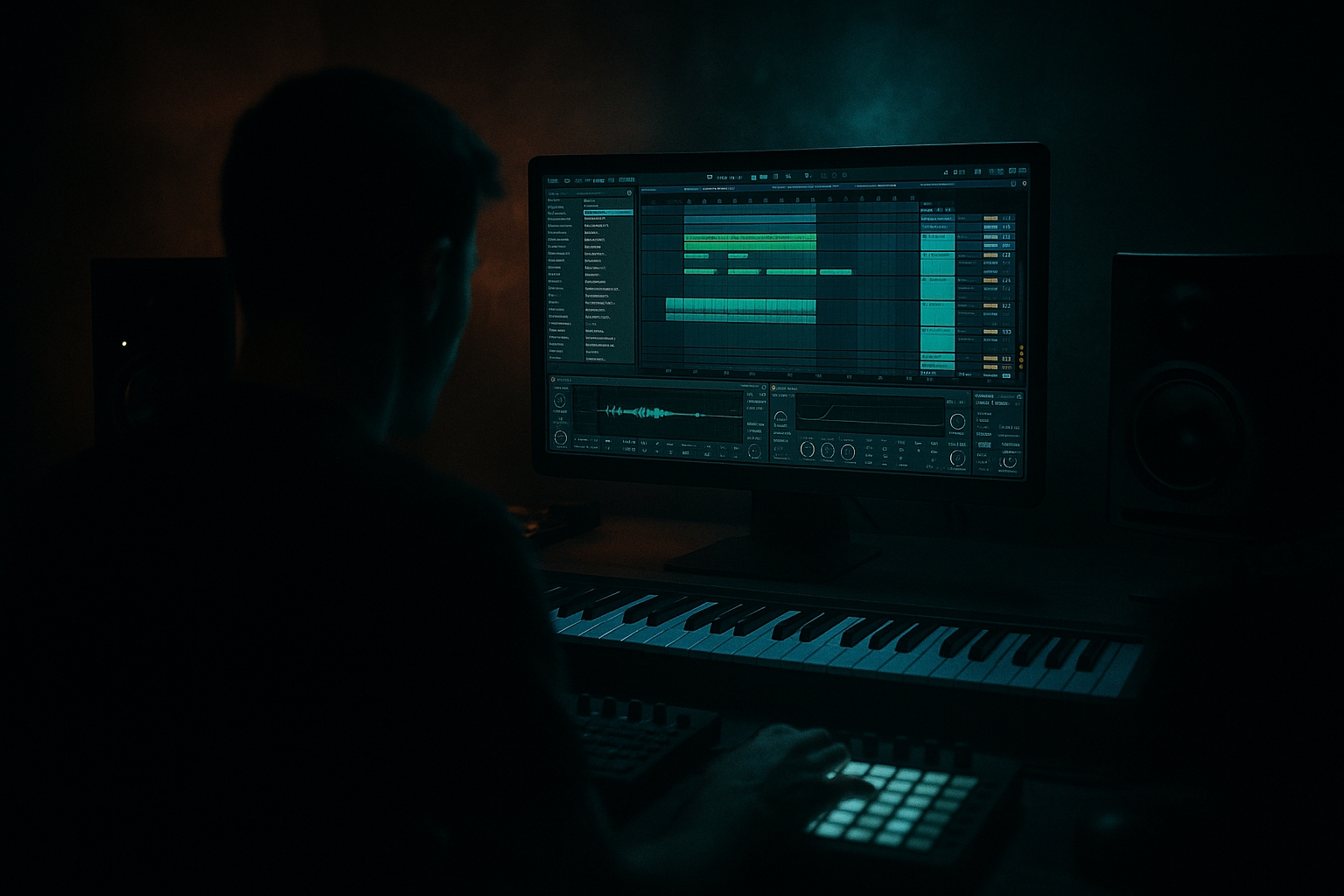
Main tutorial
```markdown
Break Lab: Break Roll + Saturate Deep Dive (Macro Control Creativity)
Ableton Live 12 • Beginner • Mixing • Jungle / Oldskool DnB vibes 🥁⚡
---
1. Lesson overview
In jungle and oldskool DnB, the break isn’t just a drum loop—it’s a living, rolling texture. This lesson teaches you how to take a breakbeat and push it into that rolling, crunchy, “tape-meets-rave” zone using Ableton Live 12 stock devices, while controlling everything from a few Macros so you can perform/automate energy like a pro. 🎛️
We’ll focus on two signature ingredients:
- Break rolls (fast fills, stutters, tiny repeats that build hype)
- Saturation (harmonic grit, weight, and glue—without destroying the transients)
- Macro 1: Roll Amount
- Macro 2: Roll Rate
- Keep Roll Amount low during grooves (0–15%)
- Push it into fills (25–45%) before transitions
- Map to Roar Drive: 5% → 35%
- Map to Roar Mix: 40% → 100%
- Map to Roar Tone (if available): subtle movement (a small range only)
- Map Redux Dry/Wet: 0% → 25%
- Map Redux Downsample: 1.0 → 4.5 (small but noticeable)
- Map Drum Buss Transients: 0 → +25
- Map Drum Buss Drive: 0% → 20% (light range)
- Map EQ Eight shelf gain: 0 → +5 dB
- Map Hybrid Reverb Dry/Wet: 0% → 12%
- (Optional) Map Decay: 0.4 → 1.2s
- Beat Repeat Mix: 0 → 35%
- Roar Drive (or Saturator Drive): 10 → 30%
- Drum Buss Transients: +5 → +20
- EQ Air shelf: +1 → +4 dB
- (Optional) Slight output trim down via Utility: 0 → -2 dB (prevents overload when hyping)
- Roll Amount: 0–10%
- Dirt: 10–20%
- Punch: 10–15
- Air: tasteful
- Slowly raise Dirt and Air
- Add a touch of Space (2–6%)
- Automate Hype up in the last 1–2 bars
- Momentary Roll Amount spikes on the last 1/2 bar
- Cut everything for 1 beat before the drop (classic rave tension)
- Parallel grime: Duplicate the break track. On the duplicate, go heavier:
- Midrange aggression: On EQ Eight, try a gentle boost around 700 Hz–1.5 kHz (small moves) for that “cardboard crack” presence.
- Controlled clipping: Put Limiter at the end of the rack ONLY as protection, not as a crutch.
- Mono the low mids slightly: Utility width down to 80–90% can make breaks feel denser and more centered.
- Dark hat control: If the break’s hats get nasty, try Auto Filter low-pass around 14–16 kHz with a tiny resonance.
- Controlled break rolls (Beat Repeat macros)
- Authentic grit and density (Roar/Saturator + Redux)
- Punch preservation (Drum Buss transient control)
- Mix-ready brightness and space (EQ + tight reverb)
- A performance-ready Hype macro for fills and transitions 🎚️
---
2. What you will build
You’ll build a Break Lab Rack (an Audio Effect Rack) that turns any break loop into a controllable jungle engine:
Macro-controlled features:
1. Roll Amount (stutter intensity)
2. Roll Rate (1/8 → 1/64 feel)
3. Dirt (saturation drive + tone)
4. Crunch (bit/clip edge)
5. Punch (transient emphasis / parallel)
6. Air / Hats (top-end lift)
7. Space (tiny room / dubby tail)
8. Hype (macro that boosts multiple things at once for drops/fills)
You’ll also get arrangement ideas (where to automate macros for authentic jungle movement).
---
3. Step-by-step walkthrough
Step 0 — Session setup (DnB-friendly)
1. Set tempo to 165–175 BPM (try 170 BPM).
2. Drag in a classic break (Amen, Think, Funky Drummer, or any chopped break loop).
3. Warp settings:
- Click the clip → Warp: ON
- Warp Mode: Beats
- Preserve: Transients
- Envelope: start around 40–60
- Turn Loop ON and ensure it loops cleanly at 1 bar or 2 bars
Why Beats mode? It keeps the transient snap while we do micro repeats.
---
Step 1 — Clean and gain-stage the break (important for saturation)
On the break track:
1. Add Utility
- Gain: aim so the break peaks around -10 to -6 dB (rough target)
- If the break is super wide/phasey, try:
- Width: 90–100% (optional)
2. Add EQ Eight
- High-pass around 25–35 Hz (remove useless sub rumble)
- If it’s muddy: cut 250–400 Hz by -2 to -4 dB
- If harsh: dip 3–6 kHz slightly
Keep it basic—this is just prep.
---
Step 2 — Create the “Break Lab” Audio Effect Rack 🎛️
Select your devices (Utility + EQ Eight) → Cmd/Ctrl + G to group into an Audio Effect Rack. Rename the rack: BREAK LAB.
Now we’ll add devices inside the rack and map macros.
---
Step 3 — Build the Roll engine (stutter/repeat feel)
Goal: get that jungle “rrr-rrr-rrr” roll without complicated slicing.
1. Add Beat Repeat after EQ Eight.
2. Set Beat Repeat like this (starter settings):
- Interval: 1 Bar
- Offset: 0
- Grid: 1/16
- Variation: 0
- Gate: 70–90%
- Chance: 0% (we’ll control it)
- Mix: 0% (we’ll macro this)
- Filter: OFF (for now)
Map Macros:
- Map to Beat Repeat Mix: 0% → 50%
- Map to Beat Repeat Chance: 0% → 35%
- (Optional) Map to Beat Repeat Gate: 90% → 60% (tighter rolls as you push it)
- Map to Beat Repeat Grid: set range from 1/8 → 1/32
- If you want crazier: expand to 1/64 for “machine-gun” fills
Usage tip:
---
Step 4 — Add saturation (weight + vibe without wrecking transients)
We’ll use Roar (Live 12) and/or Saturator. Roar is amazing for character; Saturator is clean and controllable.
#### Option A (recommended): Roar
1. Add Roar after Beat Repeat.
2. Starter settings:
- Style: try Tape or Warm
- Drive: start around 10–20%
- Tone: slightly darker if it gets fizzy
- Mix: 50–80% (parallel feel)
Map Macro 3: Dirt
#### Option B: Saturator (classic jungle crunch)
1. Add Saturator
2. Settings:
- Mode: Soft Clip ON
- Drive: 2 to 6 dB
- Output: reduce to match level (avoid louder = “better” trick)
Map Macro 3 to Drive (and optionally Output down a bit).
---
Step 5 — Add controlled “Crunch” (edge, oldskool bite)
1. Add Redux
2. Starter settings:
- Downsample: 1.5 → 4.0 (keep it subtle)
- Bit Reduction: 12 → 8 (optional—be careful)
- Dry/Wet: start 0%
Map Macro 4: Crunch
This is where you get that rave-era grit, but don’t overdo it unless you want full-on distorted jungle.
---
Step 6 — Keep it punchy (don’t lose the snap)
We’ll use Drum Buss as a simple “glue + transient” shaper.
1. Add Drum Buss
2. Settings:
- Drive: 5–15%
- Crunch: 0–10%
- Boom: OFF (for breaks it can get weird; use later if desired)
- Transients: +5 to +20 depending on how much saturation flattened things
Map Macro 5: Punch
---
Step 7 — Add top-end control (jungle hats + air)
1. Add EQ Eight
2. Create:
- A gentle high shelf at 8–10 kHz
- Gain: start +1 to +4 dB
- Q: 0.7–1.0
Map Macro 6: Air / Hats
This macro helps your break cut through the mix without always boosting the entire track’s brightness.
---
Step 8 — Add “Space” (small room or dub tail)
Classic jungle often uses small spaces on breaks, then bigger sends for dubby moments.
1. Add Hybrid Reverb (or Reverb)
2. Settings (tight room):
- Type: Convolution
- Choose a Small Room / Studio
- Decay: 0.4–0.9 s
- Predelay: 5–15 ms
- Dry/Wet: 0–12%
Map Macro 7: Space
Keep it subtle—space on breaks is about vibe, not washing out the groove.
---
Step 9 — Create a “Hype” macro that boosts multiple parameters 🚀
This is where macros become performance controls.
Map Macro 8: Hype to multiple destinations:
Now you can automate one macro for fills and transitions.
---
Step 10 — Arrangement ideas (how to use it like jungle)
Try this on a 16-bar phrase:
Bars 1–8 (Groove):
Bars 9–12 (Energy lift):
Bars 13–16 (Fill + Drop):
- Use Utility automation: mute for a beat, or automate volume down quickly
Oldskool trick: Put a quick roll on the last 1/8 or 1/16 before the snare hit that leads into the drop.
---
4. Common mistakes
1. Saturation too early + too hot
If you drive Roar/Saturator hard while the break is already peaking near 0 dB, it’ll get brittle and flat. Gain-stage first.
2. Rolls everywhere
Constant Beat Repeat kills groove. Use rolls like spices: short, intentional moments.
3. Over-bright “Air” boosts
Jungle breaks can get harsh fast. If you boost highs, consider a small cut around 3–6 kHz first.
4. No level matching
If your rack gets louder when you turn macros up, you’ll think it sounds better even if it’s worse. Use Utility to keep output controlled.
5. Too much reverb on breaks
Washy breaks = weak drums. Keep Space tight and use sends for bigger dub moments.
---
5. Pro tips for darker/heavier DnB 🌑
- Roar Drive higher, Redux more, EQ out lows below 150 Hz
- Blend quietly under the clean break (10–25%)
---
6. Mini practice exercise (10 minutes) ✅
1. Load a break and build the Break Lab rack.
2. Create two 8-bar loops in Arrangement View:
- Loop A: minimal movement (just groove)
- Loop B: high energy (fills + hype)
3. Automate:
- Roll Amount: spikes on bar 8 and 16
- Hype: ramp up over 2 bars before bar 9
- Space: tiny bump in the last bar only
4. Export both loops and compare:
- Does Loop B feel more exciting without losing punch?
- If not, reduce Crunch/Space and increase Punch slightly.
---
7. Recap
You built a DnB-focused Break Lab rack in Ableton Live 12 that gives you:
If you want, tell me what break you’re using (Amen/Think/other) and your BPM, and I’ll suggest a tighter macro mapping range so it feels exactly right for that oldskool roll.
```

