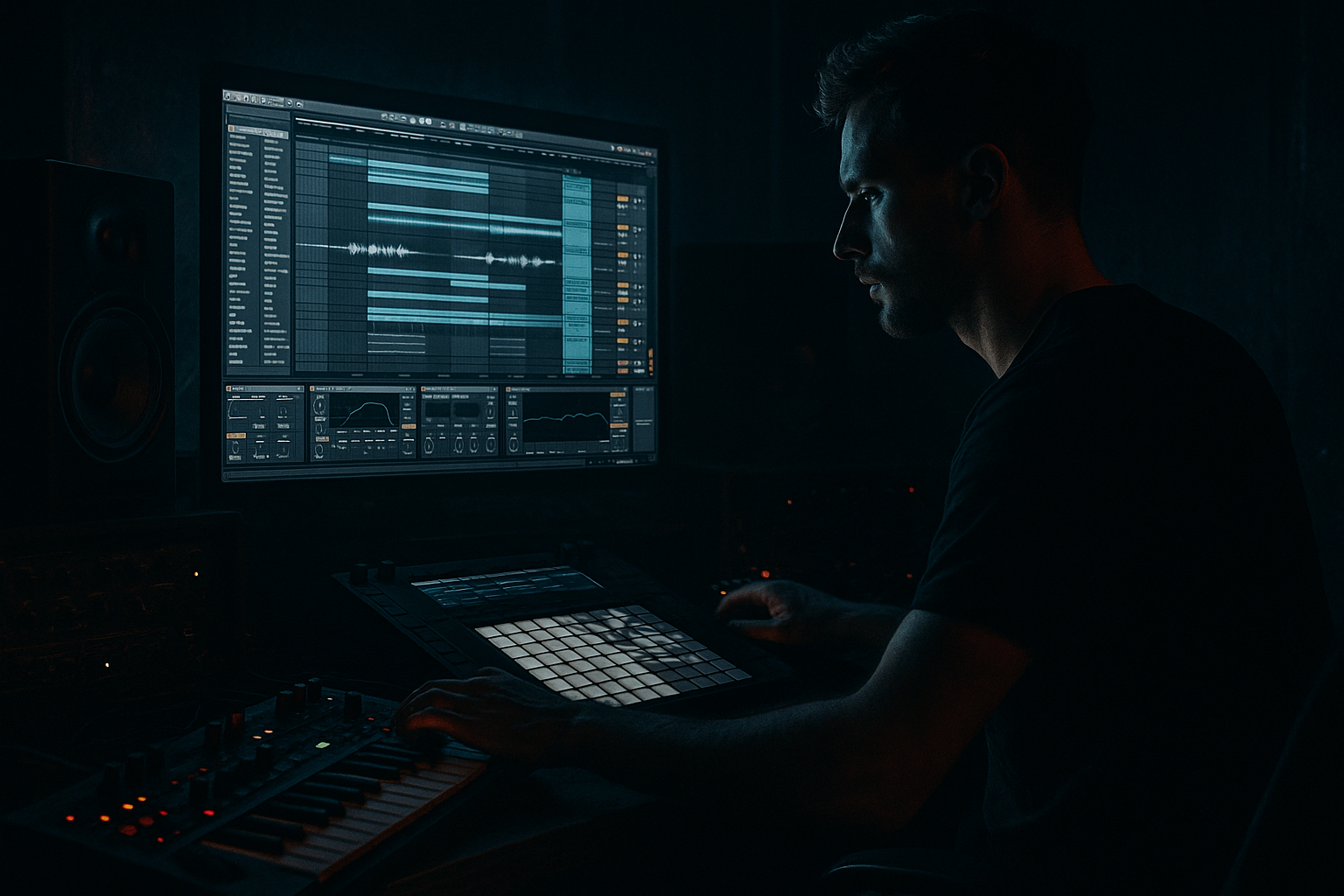
Main tutorial
Lesson Overview
In this lesson, you’ll build a 90s-inspired dark Reese bass patch, resample it into a gritty, playable audio instrument, and turn it into something that feels at home in oldskool jungle, moody rollers, and darker DnB. The focus is not just on sound design, but on the full resampling workflow inside Ableton Live 12: synth it, automate it, print it, chop it, and shape it like a producer making a serious bassline for a real track.
Why this matters in DnB: a Reese is often the emotional core of the tune. It carries the tension, the movement, and that “pressure in the room” feeling. But in classic 90s-inspired bass music, the most interesting sounds usually happen after the synth stage. The resample process lets you capture accidental harmonics, unstable movement, and texture that would be too clean if you left it as a live MIDI instrument.
This technique fits especially well in:
- Drop sections where the bass needs menace and variation
- Breakdowns where you want filtered dread before the drop
- Switch-ups that answer the drums with short bass hits
- Arrangement transitions where a resampled bass tail can glue sections together
- A thick, detuned Reese patch with a dark 90s character
- A resampled audio phrase with movement, distortion, and stereo interest
- A loopable bass riff that works in a jungle or oldskool DnB drop
- A set of chopped one-shot bass hits for fills, call-and-response, and arrangement variation
- A mix-safe low-end layer that keeps sub stable while the midrange gets dirty
- A final bass element that can work against:
- Putting too much sub inside the Reese patch
- Resampling too early
- Making the bassline too busy
- Ignoring mono compatibility
- Overdriving the resample into harshness
- Letting bass and kick/snare occupy the same timing
- Not editing tails
- Use small pitch automation moves on the Reese before resampling for unstable tension. Even subtle shifts can make the line feel haunted.
- Try a short filter envelope with a relatively low amount, then resample the result so the attack stays aggressive without becoming synthetic.
- Add very light chorus-style width only on the mid layer, never on the sub. Keep the bottom centered and the character wide.
- For a proper oldskool feel, keep the bassline short, repetitive, and hypnotic rather than flashy.
- Use ghost-note drum edits before bass hits to make the drop feel more alive.
- If the bass feels too modern or polished, reduce brightness and lean into midrange grime, tape-like saturation, and rough edits.
- Use a one-bar bass answer phrase after every two-bar main phrase. That call-and-response shape keeps the track moving like a classic DnB roller.
- If you want more underground character, print the resample with a little intentional imperfection: slight filter wobble, note overlap, or a touch of aliasy edge from aggressive resampling.
- one as a smoother loop
- one as a chopped, darker, more aggressive variation
- Keep the sub separate and clean
- Let the Reese carry movement and grit
- Use resampling to capture the best accidents
- Edit the audio into phrases, fills, and responses
- Keep the arrangement DJ-friendly and tension-driven
- Always check mono, headroom, and drum/bass balance
You’ll be using Ableton stock tools like Wavetable, Simpler, Auto Filter, Saturator, Drum Buss, Glue Compressor, EQ Eight, Corpus, and of course Resampling on an audio track. The result should feel like something made from hardware-era instincts, but built cleanly in Live 12.
What You Will Build
By the end, you’ll have:
- a chopped Amen or Think break
- dusty ride patterns
- sparse kick/snare rollers
- ghost-note drum edits and atmosphere beds
Musically, imagine a tune in the 170–174 BPM zone with a 2-bar intro, a stripped-back drum pickup, then a drop where the bass answers the break in a call-and-response phrase. The Reese will open up in the midrange, then duck back into darkness with filter motion and resampled grit.
Step-by-Step Walkthrough
1. Set up a focused DnB resampling template
Start at 170–174 BPM and create a simple session or arrangement view layout with:
- One MIDI track for the Reese synth
- One audio track set to Resampling
- One audio track for chopped resample edits
- One drum rack or break track
- One return track for delay or reverb if needed
Keep your project organized from the start. Rename tracks clearly:
- “REES SYNTH”
- “REES RESAMP”
- “BASS CHOPS”
- “BREAKS”
Put EQ Eight on the master early, just for checking, not “fixing.” Set a low-cut only if your monitoring is muddy, but don’t overdo it. The goal is to work with enough headroom so the resampled bass doesn’t clip the whole session. Aim to keep the master peaking around -6 dB to -3 dB while building.
2. Build the Reese patch in Wavetable with 90s darkness in mind
Load Wavetable on the MIDI track. Choose a waveform that gives a harmonically rich base, such as a saw-style or spectral wave. The goal is a wide, unstable midrange that can later be destroyed and reshaped.
A solid starting point:
- Osc 1: saw-type wavetable, unison 2–4 voices
- Osc 2: slightly detuned copy or a second saw-based source
- Detune: modest, around 5–15 cents
- Sub oscillator: sine or basic sub one octave down, low in level for now
- Filter: low-pass, with cutoff around 200–800 Hz to start, resonance low to moderate
Add movement:
- Use an LFO to lightly modulate filter cutoff or wavetable position
- Keep rate slow at first, around 1/2 or 1 bar
- Try subtle phase modulation or unison drift if it helps the sound feel unstable
Now add a little grit inside the synth:
- Turn on Drive in Wavetable if needed
- Add Saturator after Wavetable with Drive around 2–6 dB
- Use Soft Clip if the bass needs more edge without harsh peaks
Why this works in DnB: the Reese thrives on movement in the low mids. That motion creates tension against static drum breaks, which is a huge part of jungle and oldskool energy. The ear hears “constant motion” even when the riff is simple.
3. Program a short, gritty MIDI phrase, not a full bassline yet
Don’t write the final line immediately. Create a 2-bar MIDI phrase with room for resampling decisions. Think like an arranger, not just a sound designer.
Start with:
- Mostly short notes
- A few overlapping notes for tension
- A simple call-and-response rhythm with the drums
- Occasional syncopation to leave space for the break
Try a phrase where:
- Bar 1 has two low hits and one rising answer
- Bar 2 leaves a gap, then hits harder on the offbeat
- Use notes around the root plus one or two neighboring tones for movement
If you’re aiming for a darker jungle vibe, keep the line minimal and repetitive, then let texture do the work. A simple root note plus octave jumps can feel more powerful than a busy melody.
Use velocity shaping to create attitude. Even with a synth bass, note velocity changes can help the line feel human and less grid-locked. If your MIDI clip feels too stiff, slightly shift one or two notes off the exact grid, but keep the low end tight.
4. Shape the synth with modulation and pre-resample processing
Before you print anything, make the synth do a little “performance.” Automation is crucial here because the resample will capture it forever.
Automate:
- Filter cutoff sweeping between roughly 250 Hz and 2 kHz
- Filter resonance in a controlled range, maybe 0.10–0.35
- Wavetable position for timbral motion
- Saturator Drive moving between 2 dB and 8 dB
- LFO depth increasing slightly in the second half of the phrase
Add Auto Filter after Wavetable if you want a more obvious movement curve. Use a low-pass or band-pass depending on how nasal or dark you want the sound. In dark DnB, a band-pass sweep can create a great “emergence from fog” effect before the drop.
Optional extra:
- Add Drum Buss after Saturator for a more aggressive push
- Keep Drive moderate
- Add a touch of Transients if the note attacks need more bite
- Use Boom very carefully; too much will blur the sub
Your goal here is not perfection. It’s to create a reactive synth tone that becomes interesting when printed.
5. Resample the Reese into audio
Arm the audio track set to Resampling and record the MIDI performance in real time, or bounce the section to audio. In DnB, real-time resampling often catches little tone shifts, note tails, and gain movement that feel more alive than a purely rendered file.
As you record:
- Perform any filter automation live if you can
- Let notes ring out naturally
- Capture a few extra bars beyond the main phrase so you have tails to edit
After recording, listen for moments where the sound blooms, snarls, or collapses into a great texture. Those accidental transitions are often the best parts.
Then consolidate the best section into a clean audio clip. You now have a bass source that is no longer “just a synth patch” — it’s a printed performance you can cut into material.
6. Edit the resampled audio into playable bass phrases
Move the resampled clip to BASS CHOPS or duplicate it on the same track for editing. Use Ableton’s clip tools to slice the audio into useful shapes.
Useful edit targets:
- Start of note attacks
- Filter sweep tails
- Distorted midrange bursts
- Small gaps that can become rhythmic rests
Try these approaches:
- Chop the clip into 1/4-bar or 1/8-bar fragments
- Reverse one fragment for a transition
- Shorten a tail so it becomes a punchy answer to the snare
- Crossfade edits to avoid clicks
Add Simpler only if you want to turn the resample into a playable instrument. In one-shot mode, Simpler can let you trigger your favorite bass hit across the MIDI keyboard. Keep it tight:
- Start/end trimmed carefully
- Filter low-pass if the sample is too bright
- Glide/portamento only if you want sliding note behavior
This is where the resample becomes a composition tool, not just a texture. You can now write a bassline using the printed audio’s natural character.
7. Lock in sub weight separately for mix clarity
Dark Reese sounds often lose impact if the sub is trapped inside the same messy patch. For proper DnB low end, separate the sub from the dirty mid layer.
Create a dedicated sub layer:
- Use a clean Operator sine or a simple Wavetable sine
- Keep it mono
- Keep it simple and stable
- Follow the root notes of your bassline
Mix tips:
- Low-pass the Reese layer so the sub area stays cleaner
- High-pass the resampled mid layer around 80–120 Hz if needed
- Keep the sub mostly centered
- Use Utility on the bass bus to force mono below the low end if the stereo image gets messy
If the bass line is too wide or unfocused, the sub can disappear in club playback. The classic fix is simple: let the sub do sub work, and let the resampled Reese do attitude work.
8. Shape the bass-and-break relationship
Now pair the bass with your breakbeat. Use a chopped break, preferably something with clear snare accents and ghost notes. In jungle and oldskool DnB, the bass often feels stronger when it leaves room for the break to speak.
Arrange the interaction so:
- Bass hits answer the snare
- Longer bass notes avoid masking important break transients
- Short fills happen between drum phrases
- One bass tail can overlap a break transition for tension
Try a musical context example:
- A 2-bar Amen loop plays with a dark pad drone
- On bar 2, the Reese resample hits a rising, filtered note
- The drop lands with the bass chopped into two stabs, leaving the snare exposed
- A reverse bass tail leads into the next 4-bar phrase
Use EQ Eight on the bass bus to carve a small pocket around the snare fundamental if needed, and use Glue Compressor lightly if the bass and breaks feel disconnected. Keep the compression subtle; in DnB, too much glue can flatten groove.
9. Automate the resampled audio for arrangement movement
Once the core loop works, turn the resample into an arrangement tool. This is where you make the track feel like a proper tune instead of a loop.
Good automation targets:
- Filter cutoff opening in the 4 bars before the drop
- Reverb send rising briefly on the final pre-drop bass tail
- Delay throw on one chop only
- Volume automation for drop switch-ups
- Reverse a tail into the downbeat of a new section
Structure idea:
- Intro: filtered version of the Reese with break fragments and atmosphere
- Build: bass chops become shorter and more syncopated
- Drop 1: full resampled riff with sub support
- Switch-up: half-time or stripped drum moment with one isolated Reese hit
- Drop 2: same bass material, but reordered or resampled again for variation
This is a classic DnB arrangement move: reuse the same sonic DNA, but present it differently so the tune stays DJ-friendly and coherent.
10. Print a second generation resample for extra grime
If the first resample is strong, make a second pass. Route the resampled bass through another audio chain and print again with a different tone.
For round two:
- Add Saturator or Drum Buss
- Add Auto Filter with more aggressive movement
- Try Corpus very lightly for resonant body or metallic growl
- Resample again into a new audio clip
Keep the second-generation print more extreme than the first:
- More texture
- Less clean low-end responsibility
- More character for fills, risers, or mid-bass emphasis
This layering approach is powerful in darker DnB because one sample can handle the pure function, while the second sample handles the attitude. That makes the mix feel bigger without relying on one over-processed source.
Common Mistakes
- Fix: split the sub into a separate clean layer and keep the Reese focused on low mids and harmonics.
- Fix: make the synth move first. Capture automation, modulation, and performance gestures before printing.
- Fix: simplify the MIDI rhythm. In DnB, space often hits harder than density.
- Fix: check the bass in mono and use Utility to reduce width below the low end.
- Fix: use saturation in stages. One controlled saturator is better than several clipping stages fighting each other.
- Fix: shift note lengths, leave gaps around snare hits, and use call-and-response phrasing.
- Fix: the magic is often in the tail. Shorten, reverse, or re-trigger tails to create transitions.
Pro Tips for Darker / Heavier DnB
Mini Practice Exercise
Spend 10–20 minutes and do this:
1. Build a simple Reese in Wavetable with two detuned saw-style layers and a sine sub.
2. Write a 2-bar MIDI phrase using only 3–5 notes.
3. Automate filter cutoff and saturation over the phrase.
4. Resample the performance to audio.
5. Chop the audio into 4–6 pieces.
6. Reorder the chops into a new 2-bar riff.
7. Add a clean sub layer underneath.
8. Check the result in mono and make one fix for low-end clarity.
Goal: create two versions of the same idea:
If you finish early, do a second resample pass with more distortion and use it as a fill or switch-up.
Recap
The core idea is simple: design a dark Reese, perform it with automation, resample it into audio, then chop and reshape it into a DnB-ready bass part. That workflow gives you more character than a static synth patch and works especially well for 90s-inspired jungle and oldskool darkness.
Remember the essentials:
If you do this well, you’ll end up with bass that feels less like a preset and more like a record.

