Main tutorial
Lesson Overview
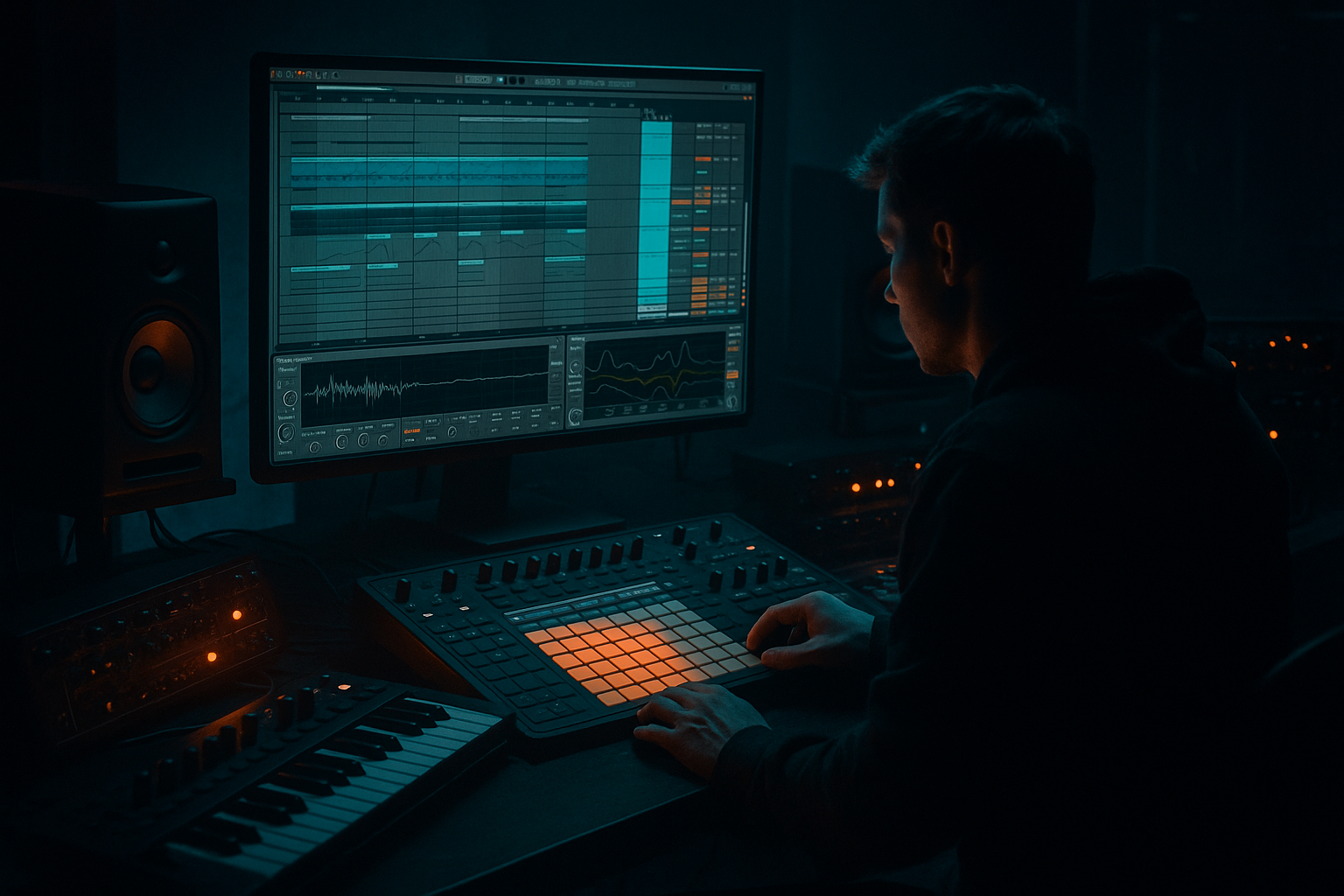
In this lesson, you’re building a Break Lab system for kick weight arrangement in Ableton Live 12 — specifically for oldskool jungle / DnB and darker roller energy. The goal is not just “make a kick hit harder,” but to arrange kick weight so the break feels alive, driving, and DJ-friendly while still leaving room for the sub and reese.
In DnB, the kick is rarely just a clean 4/4 anchor. In jungle and oldskool-influenced tracks, the kick often acts like a weight event inside a break ecosystem: it can reinforce a chop, answer the snare, punch through a fill, or create forward motion without flattening the groove. That’s why this technique matters: it helps you make breaks feel intentional, not random.
We’ll use Ableton Live stock tools like Drum Rack, Simpler, Saturator, EQ Eight, Glue Compressor, Drum Buss, Utility, and Auto Filter to build a system you can reuse across multiple tracks. The focus is on a practical arrangement workflow: selecting the right kick accents, placing them in relation to the break, shaping their envelope, and automating their impact so the loop evolves across the intro, build, and drop. 🔥
What You Will Build
By the end, you’ll have a Break Lab drum rack and arrangement method that gives you:
- A tight break loop with selected kick hits reinforced for oldskool weight
- A secondary kick-weight layer that can be automated in and out for arrangement movement
- A low-end-safe drum bus that preserves sub space
- A jungle-style fill and switch-up section using kick emphasis, ghost hits, and filtered variation
- A template-like workflow for building intro → drop → variation → reset without losing groove
- A rolling 170 BPM jungle / DnB break
- Kick accents that can sit under a chopped Amen, Think, or Funky Drummer-style loop
- Enough weight for a dark warehouse roller, but still with the swing and instability of oldskool breakbeat culture
- Making the kick too long
- Layering too many kick samples
- Over-compressing the drum bus
- Ignoring the break’s natural phrasing
- Too much sub overlap with the kick
- No variation across 8 or 16 bars
- Use Saturator with Soft Clip to make kick weight feel denser without adding huge peak levels.
- Try Drum Buss Crunch before EQ if you want a rougher, more underground edge.
- For a darker warehouse feel, keep the kick transient short and let the reese or sub carry the sustained low tension.
- Automate a tiny amount of Auto Filter resonance on the kick layer during transitions for pressure, but keep it subtle.
- Resample your drum bus and build a “kick impact” audio lane for fills. This is great for breakdown hits and drop leads.
- If the track is more neuro-influenced, use micro-variation in kick placement rather than bigger kick samples. Precision creates power.
- For jungle authenticity, let one or two kick hits feel slightly raw or imperfect. Over-editing can remove character fast.
- Check your drum bus in mono often. Darker DnB loses impact quickly when the low end gets wide or phasey.
- Use kick weight as a structural rhythm element, not just a louder kick.
- Keep the main break and kick layer separate so you can control groove and arrangement.
- Shape the kick with Simpler, Saturator, EQ Eight, Drum Buss, Glue Compressor, and Utility.
- Place kicks selectively around the break for oldskool jungle movement.
- Automate density, filtering, and mute points to create real DnB arrangement energy.
- Always check mono compatibility, sub overlap, and headroom so the track stays heavy and clean.
Musically, this should feel like:
Think of it as a system for making the kick act like a structural device inside the drum arrangement, not just a transient.
Step-by-Step Walkthrough
1. Set up the Break Lab foundation at the right tempo and grid
Start with a fresh Ableton Live 12 set at 170 BPM. That tempo is a sweet spot for oldskool jungle and modern DnB phrasing, especially when you want the break to feel fast but still readable.
Create three MIDI tracks:
- Track 1: Main Break
- Track 2: Kick Weight Layer
- Track 3: Drum Bus
On Track 1, load a Drum Rack and place your main break chops in Simpler instances or audio clips if you prefer to slice manually. For the kick weight lesson, you want the break to be your rhythmic skeleton, not a fully pre-baked loop. This gives you control over where the weight lands.
Why this works in DnB: at 170 BPM, even small placement changes can massively affect energy. A kick that lands a few milliseconds early or late can change the whole feel of the bar. The tighter your system, the easier it is to shape that momentum.
2. Slice or map the break so the kick events are easy to edit
Drag a break into Simpler and use Slice to New MIDI Track if you want a flexible chop workflow. Set slicing to:
- Transient for natural break hits
- Or 1/16 if you want a more grid-based oldskool cut-up
Now identify the kick-containing slices and assign them to a dedicated MIDI note lane inside the Drum Rack. The goal is to separate:
- Original break groove
- Kick weight reinforcement
- Ghost or fill kicks
If you’re working in audio, warp the break lightly using Beats mode with transient preservation. Use Transient Loop Mode only if needed; avoid over-processing the break into a rigid loop.
Practical tip: keep the main break slightly imperfect. For jungle feel, don’t quantize everything 100%. Leave a bit of micro-swing in the source. The kick weight layer will provide the “center.”
3. Build a dedicated kick weight sample chain
On Track 2, create a second Drum Rack pad for kick weight. Load a short, clean kick sample or resample one from your break. If you need a working source, grab a kick from the same break and resample it into a new audio clip.
Inside the kick chain, use:
- Simpler with a short sample
- Decay around 120–220 ms for punchy jungle weight
- Warp off if it’s a one-shot and already tight
- Filter very slightly if the sample has too much top
Then add:
- Saturator with Soft Clip on
- Drive around 2–5 dB
- EQ Eight with a small boost around 50–80 Hz if the kick needs more body
- A gentle cut around 200–400 Hz if the kick sounds boxy
If the kick needs more snap, add a second transient layer:
- A very short click or top from another kick
- High-pass it aggressively
- Keep it quiet, just enough to help the kick translate on smaller systems
Don’t overbuild this. In DnB, the kick weight layer should feel like support, not a separate oversized kick.
4. Place kick weight around the break, not on top of every beat
Now the fun part: arrange kick weight as a rhythmic answer to the break. In oldskool jungle, weight often works best when it’s selective.
Try these placement ideas inside the MIDI clip:
- Reinforce the first kick of the bar
- Add a kick before a snare to create a pull into the backbeat
- Use a double-kick pickup before a phrase change
- Leave one bar with fewer kicks so the next bar feels stronger
Example 2-bar context:
- Bar 1: kick on beat 1, light ghost kick near the end of beat 2
- Bar 2: kick on beat 1, extra kick before the snare hit, then a short rest
This creates movement without turning the loop into a flat stomp. In jungle, the relationship between kick and snare matters more than sheer kick density. A well-placed kick can make the break feel heavier than three extra kicks everywhere.
Keep the main break and kick weight layer separate enough that you can mute either one independently. That gives you arrangement control later.
5. Use velocity and timing to create oldskool swing
Open the MIDI clip and shape the kick velocities deliberately. A good starting range:
- Primary kick hits: 110–127
- Support kicks: 75–100
- Ghost kicks: 35–65
Then nudge a few support hits slightly off the grid using Ableton’s note position or groove. For an oldskool feel, you want some notes to push forward and others to relax.
Add a groove using Ableton’s Groove Pool:
- Try a subtle swing template at 54–58%
- Keep Timing around 10–25%
- Keep Random low, around 0–5%
This is especially effective on kick-weight layers because it lets you “humanize” the reinforcement without making the whole loop unstable.
Why this works in DnB: the break already has natural swing and texture. If your kick layer is too rigid, it fights the loop. If it follows the break’s phrasing but with slightly stronger intent, the groove sounds intentional and powerful.
6. Shape the kick weight with drum bus processing
Route both the main break and the kick layer into Drum Bus. This is where the whole system starts feeling like one kit.
On Drum Bus, use:
- Drum Buss device
- Drive: 5–15%
- Crunch: light, around 5–20%
- Boom: use carefully, around 0–15% depending on sub overlap
- Transients: slightly up if the kick needs more front edge
Follow with Glue Compressor:
- Ratio: 2:1
- Attack: 10–30 ms
- Release: Auto or around 0.3–0.6 s
- Gain reduction: keep it subtle, around 1–3 dB
Then add Utility and turn the bass region mono if needed. If the kick weight is causing low-end spread, use Utility’s width control to narrow the bus slightly. You can also use EQ Eight to high-pass everything above the break’s unwanted rumble or low-end mess elsewhere, but avoid thinning the actual kick body.
The key move: don’t squash the drum bus into uniformity. You want glue, not flattening.
7. Automate kick weight across arrangement sections
Now treat kick weight as an arrangement tool. In a DnB track, the drum energy should evolve between sections:
- Intro: filtered break + sparse kick weight
- Build: more kick emphasis and tension
- Drop: full break + reinforced weight
- Variation: reduce kick density or shift its pattern
- Outro: strip the weight back out for DJ mixability
Use Auto Filter on the kick weight layer:
- Intro high-pass around 120–180 Hz
- Build automation down to 60–90 Hz
- Drop back to full range
You can also automate:
- Saturator drive up slightly in the build
- Drum Buss Crunch to increase pressure before the drop
- Utility gain for a half-bar kick-lift moment
- Mute the kick weight layer for one bar before the drop to make the return hit harder
A strong arrangement move: in bar 8 or 16, pull the kick weight out for half a bar and let the break breathe. Then bring it back with a fill. That contrast makes the drop feel bigger without adding new sounds.
8. Create a fill and switch-up using resampling
Once the basic groove works, resample 1–2 bars of the drum bus to audio. This gives you a single performance file you can chop for fills, reverses, and switch-ups.
In the resampled clip, look for:
- A kick hit with nice transient character
- A short break gap after a strong kick
- A clean pre-drop pickup
Now make a fill by:
- Duplicating the kick transient
- Reversing a tiny section before the hit
- Filtering the fill with Auto Filter
- Adding Redux very lightly if you want a harsher, darker texture
- Or using Beat Repeat sparingly for a glitchy roller-style turn
Keep fills short and functional. In jungle, fills often work best when they feel like part of the drum conversation, not a separate drum solo.
Arrangement suggestion: use a switch-up at the end of every 8 or 16 bars, but keep the kick weight identity consistent. That way the listener hears variation without losing the tune’s backbone.
9. Balance the kick against the sub and bassline
This is critical. If your track has a sub or reese underneath, the kick weight must have a place to live.
Set a Utility on the sub/bass bus and check mono compatibility. Use EQ Eight to carve a tiny pocket if necessary:
- Kick body around 50–80 Hz
- Sub fundamental may sit lower or overlap depending on key
- If they fight, reduce the kick a bit around the exact fundamental rather than boosting blindly
For darker DnB, it’s often better to let the kick punch in the upper bass region while the sub holds the true lowest end. A kick that’s too huge can make the mix cloudy and reduce headroom fast.
Quick mix check:
- Turn the bass down and confirm the kick still reads
- Turn the kick down and confirm the groove still lives
- Sum to mono and make sure the low-end doesn’t vanish
If the kick disappears in mono, your layer may be too dependent on stereo top or phasey processing.
Common Mistakes
Fix: shorten the kick envelope in Simpler or trim the sample. Oldskool DnB needs punch and space, not a long low bloom.
Fix: keep one main weight source and one optional transient layer. Too many layers create phase clutter and kill groove.
Fix: reduce Glue Compressor gain reduction to 1–3 dB. If the break loses snap, back off.
Fix: arrange kick weight around the break’s accents instead of forcing a rigid pattern.
Fix: carve a small EQ pocket or reduce kick boom. Leave the deepest energy for the sub.
Fix: automate density, filter, or mute one kick accent so the loop evolves.
Pro Tips for Darker / Heavier DnB
Mini Practice Exercise
Set a timer for 15 minutes and do this:
1. Load a break into Ableton and slice it into a Drum Rack.
2. Create a separate kick weight layer using one kick extracted from the break or a clean kick one-shot.
3. Build a 2-bar MIDI pattern with:
- 2 strong kick accents
- 2 lighter support hits
- 1 ghost kick or pickup
4. Apply a subtle Groove Pool swing.
5. Add Saturator and EQ Eight to shape the kick weight.
6. Route the break and kick layer into a Drum Bus with light Glue compression.
7. Duplicate the 2-bar loop and make a variation where you remove one kick and automate an Auto Filter sweep.
8. Listen in mono and adjust until the groove feels heavy but not muddy.
Goal: finish with a loop that sounds like the start of a real jungle/DnB arrangement, not just a drum practice file.

