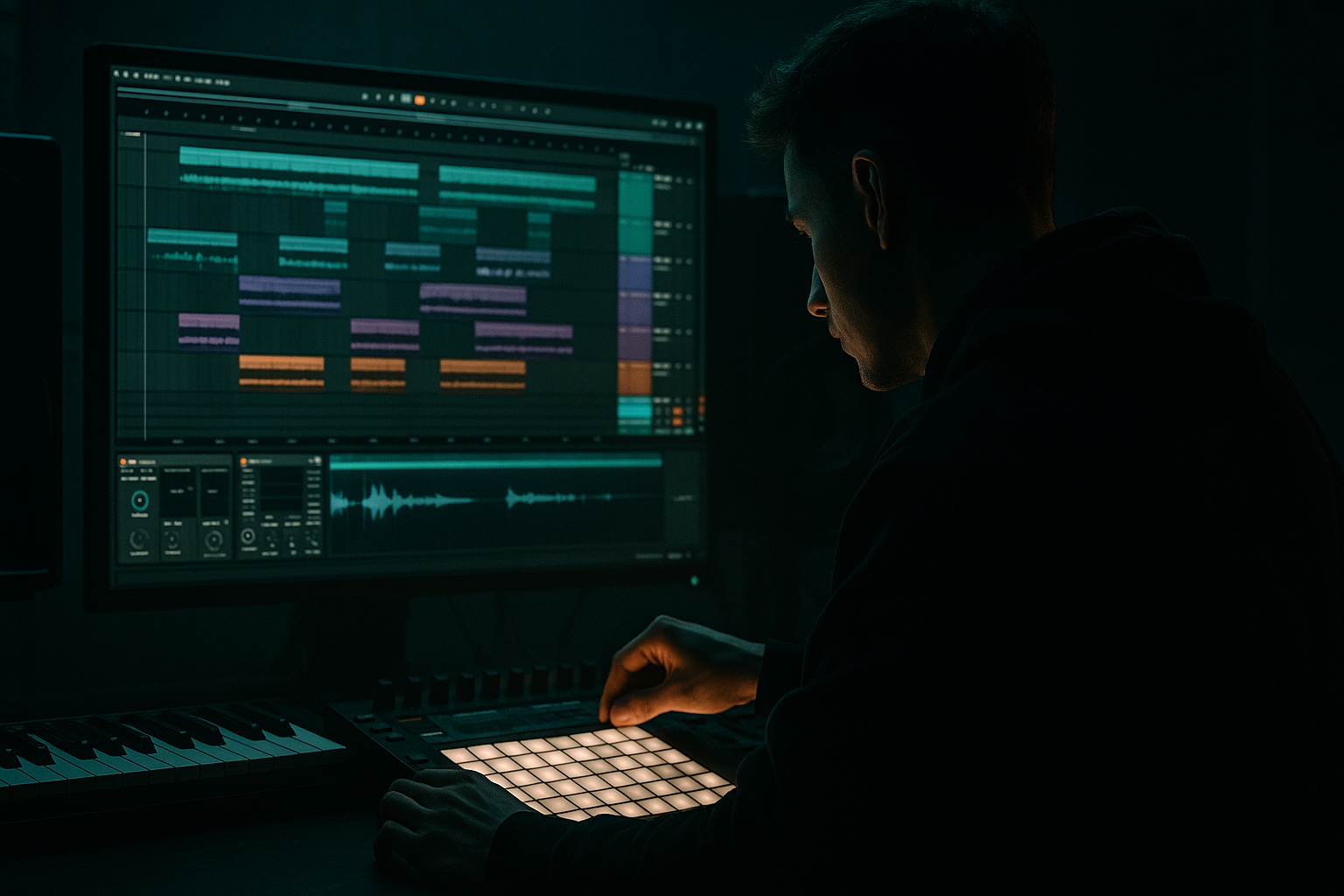
Main tutorial
Break Tail Cleanup Masterclass (Oldskool DnB Vibes) 🥁🔥
Advanced • Drums • Ableton Live
---
1. Lesson overview
Classic jungle/DnB breaks (Amen, Think, Hot Pants, Funky Drummer) are full of tail chaos: room tone, cymbal wash, snare ring, vinyl noise, and “ghost energy” that smears your groove. The oldskool vibe comes from keeping some of that grit—but controlling it so the break hits hard, loops clean, and sits with a rolling bassline.
In this lesson you’ll learn how to surgically clean and shape break tails in Ableton Live using mostly stock devices: Gate, EQ Eight, Compressor, Drum Buss, Saturator, Drum Rack/Simpler, Utility, plus smart editing and resampling workflows.
---
2. What you will build
By the end you’ll have:
- A tight, looping break with controlled tails (no messy wash on every 16th)
- A snare that cracks without long ring fighting your bass
- A hi-hat/cymbal layer that breathes but doesn’t dominate
- A resampled “clean break” you can rearrange oldskool-style (edits, repeats, fills)
- Two tail flavors:
- Snare tail ringing into the next hit
- Kick tail / sub thump muddying the low end
- Cymbal wash blurring shuffle/swing
- Noise floor / vinyl building up over repeats
- Snare tail: 180–400 Hz (box), 700–1.5k (ring), 7–12k (splash)
- Kick tail: 40–120 Hz (sub/boom), 120–250 Hz (mud)
- Kick, Snare, Hat, Ghost, Perc, Crash
- One-Shot mode ✅
- Fade Out: 5–25 ms (removes clicky chop edges)
- Release: start around 40–120 ms for snare slices
- If the tail is too long, shorten Length (or use Sustain off if available in your Live version)
- Release: 20–70 ms (tighter)
- Keep enough tail to feel weight, but not so much it smears doubles.
- Often leave longer, but control build-up later with a bus gate/EQ.
- HPF: 24 dB/oct at 25–35 Hz (remove rumble)
- Low mud cut: -2 to -5 dB around 180–260 Hz (Q ~1.2)
- Ring notch (snare-dependent): narrow cut around 700–1.2 kHz if it “boings”
- High wash control: gentle shelf -1 to -3 dB from 9–12 kHz if cymbals smear
- Cut low end in Side below 120 Hz to keep subs mono and clean.
- Bars 1–16: main break loop (1–2 bar)
- Bars 17–24: introduce 2-step variation (remove some tails for space)
- Bars 25–32: bring back full tail energy + crash layer
- Every 8 bars: 1/2 bar drop (tail gated hard) to create contrast
- EQ Eight: HPF 120 Hz (optional), boost presence if needed
- Gate: tighter settings (short release)
- Drum Buss: more drive
- Gate: slower release, higher floor
- EQ Eight: remove harsh highs, reduce low mud
- Utility: turn down 6–12 dB and blend in
- Duplicate the break track (or use Audio Effect Rack with two chains)
- On the Tail chain, remove transient punch by:
- Mono your low break energy:
- Make space for the reese/sub by “ducking tails,” not hits:
- Crunch the tails, keep transients clean:
- Reintroduce controlled hiss for era-authentic glue:
- Fast fill trick:
- Break tail cleanup in DnB is about control, not sterilization.
- Best workflow: Slice to Drum Rack → shape tails in Simpler → gate/EQ on the bus → glue with compression/saturation → resample.
- Use Gate Release + Floor as your “vibe” knobs: tight modern vs dusty 90s.
- For darker/heavier rollers, split into Transient vs Tail layers and duck the tails around bass.
- Clean + punchy (for modern loud mixes)
- Dusty + controlled (for authentic 90s bounce)
---
3. Step-by-step walkthrough
Step 0 — Prep: get the break in time (without ruining it)
1. Drop your break sample on an audio track.
2. Warp Mode:
- Try Complex Pro if the break has lots of cymbals
- Try Beats if you want sharper transient behavior
3. Set the loop to 1 or 2 bars.
4. Right-click the clip → Warp From Here (Straight) only if needed.
5. Advanced move: if it starts sounding “bendy,” reduce warp markers and rely more on transient slicing later.
Goal: clean timing, minimal warp artifacts.
---
Step 1 — Identify what “tail” is actually hurting you
Solo the break and listen for:
Now zoom in and locate the problem zones. Most often:
---
Step 2 — Slice to Drum Rack (the pro “tail control” foundation)
This is the most powerful way to manage tails while keeping oldskool character.
1. Select the break clip → Right-click → Slice to New MIDI Track
2. Slice Preset: Built-in
3. Slicing: Transients (usually best)
4. Ableton creates a Drum Rack with each slice in a Simpler.
Now you can treat snare slices differently from hats/kicks.
Workflow tip: Rename pads:
---
Step 3 — Clean tails per slice inside Simpler (fast + musical)
Open the snare slice Simpler:
#### A) Use Simpler’s amplitude envelope
Do the same for kick:
For hats/cymbals:
DnB mindset: You’re not deleting character—you’re choosing where the mess is allowed.
---
Step 4 — Add a “Tail Gate” on the Drum Rack return or group (classic jungle move) 🚪
Instead of gating each slice, you can gate the whole break after slicing (or even the original audio loop).
On the Drum Rack chain (after the rack), insert:
1. Gate
- Threshold: set so tails close but ghost hits still pass
- Typical: -25 to -12 dB (depends on sample)
- Attack: 0.2–1.5 ms (fast but not clicky)
- Hold: 10–30 ms (keeps body)
- Release: 60–160 ms (this is your “tail length” knob)
- Floor: -inf for tight modern, or -18 to -24 dB for dusty oldskool leakage
2. (Optional) Sidechain the Gate
- Use Sidechain so the gate opens from the break itself or a clean ghost trigger.
- Pro trick: use a ghost MIDI “hat pulse” to open the gate rhythmically for a controlled “chattery” break.
Oldskool vibe setting: Slightly higher Floor (not fully closed) = that subtle room/noise persists.
---
Step 5 — EQ tails so they don’t fight the bass (without sterilizing)
Add EQ Eight right after the Gate:
Suggested moves (starting points):
Workflow suggestion:
Use Mid/Side mode (EQ Eight) if your break is wide:
---
Step 6 — Glue the cleanup so it still feels like one break (not chopped)
Once you start truncating tails, the break can feel “too separate.”
Add on the drum bus (after EQ):
1. Compressor or Glue Compressor
- Attack: 3–10 ms (let transients snap)
- Release: 80–200 ms (musical rebound)
- Aim 1–3 dB gain reduction on peaks
2. Drum Buss
- Drive: 3–10 (taste)
- Crunch: 0–20% (don’t overdo)
- Boom: 0–20% at 50–80 Hz only if you’re not stacking a sub kick
- Damp: tweak to tame top-end splash
3. Saturator (subtle)
- Soft Clip: ON
- Drive: 1–4 dB
- This helps tails feel “taped” rather than chopped.
---
Step 7 — Resample a “clean break print” (arrangement power move) 🎛️
Now print your processed break so you can do classic edits with confidence.
1. Create a new audio track named BREAK_PRINT
2. Set its input to Resampling
3. Arm and record 4–8 bars of your break groove
4. Consolidate (Cmd/Ctrl+J), then create:
- A 1-bar loop
- A 2-bar loop
- A few edit shots (snare fill, hat roll, stop)
Arrangement idea (oldskool roller):
---
Step 8 — Advanced: Separate “Transient” vs “Tail” into two layers
For maximum control and authenticity, do a parallel split:
Chain A: Transients (punch layer)
Chain B: Tails (grit layer)
How to set it up:
- Using Compressor with slower attack? (not ideal)
- Better: Transient shaping via Drum Buss (reduce Transients slightly)
- Or simply low-pass and reduce presence so it reads as ambience/grime.
Blend until you get that “break is alive” feeling without washing the groove.
---
4. Common mistakes
1. Gating too hard with zero floor
Kills the jungle vibe. Try a slightly leaky floor for authenticity.
2. Cutting tails per slice but not re-gluing
If you don’t add gentle bus compression/saturation, it sounds like chopped MIDI drums.
3. Over-warping the break
Too many warp markers = phasey hats, smeared snare tails. Slice instead.
4. Ignoring low-end tails
Breaks often have hidden low boom that wrecks your sub headroom.
5. Cleaning everything
Oldskool is controlled dirt, not surgical silence.
---
5. Pro tips for darker/heavier DnB 🖤
Use Utility after EQ:
- Bass Mono: 120 Hz (or manually mid/side EQ)
Sidechain a Compressor on the Tail chain keyed from your bass (or a ghost kick).
- Ratio 2:1–4:1, fast-ish release (60–120 ms), GR 1–3 dB.
Saturate only the Tail layer. This gives “dirty room” around crisp hits.
If cleanup made it too sterile, add a tiny bit of noise (very low) and gate it with the break so it breathes.
For a 1-beat fill, shorten tail release suddenly (automation on Gate release) right before the drop → makes the next bar hit feel bigger.
---
6. Mini practice exercise (15–25 min)
1. Pick an Amen-style break and warp it to 170–174 BPM.
2. Slice to Drum Rack by transients.
3. On snare slices:
- Set Simpler Release to 60–100 ms
- Add a small Fade Out 10–15 ms
4. On the Drum Rack output:
- Gate: Threshold ~ -18 dB, Hold 20 ms, Release 120 ms, Floor -20 dB
- EQ Eight: HPF 30 Hz, dip 220 Hz -3 dB
- Glue: 2 dB GR max
5. Resample 8 bars and create:
- Main 2-bar loop
- A 1-bar “tight tail” version (Gate release automated down to ~60 ms)
6. Arrange 32 bars alternating the two versions every 8 bars.
Deliverable: a 32-bar drum loop that feels oldskool and lively, but never washes out.
---
7. Recap
If you want, tell me which break you’re using (Amen/Think/etc.) and your target vibe (1994 ragga vs 1997 techstep vs modern jungle), and I’ll suggest exact Gate/EQ starting points tailored to that sample.

