Main tutorial
Lesson Overview
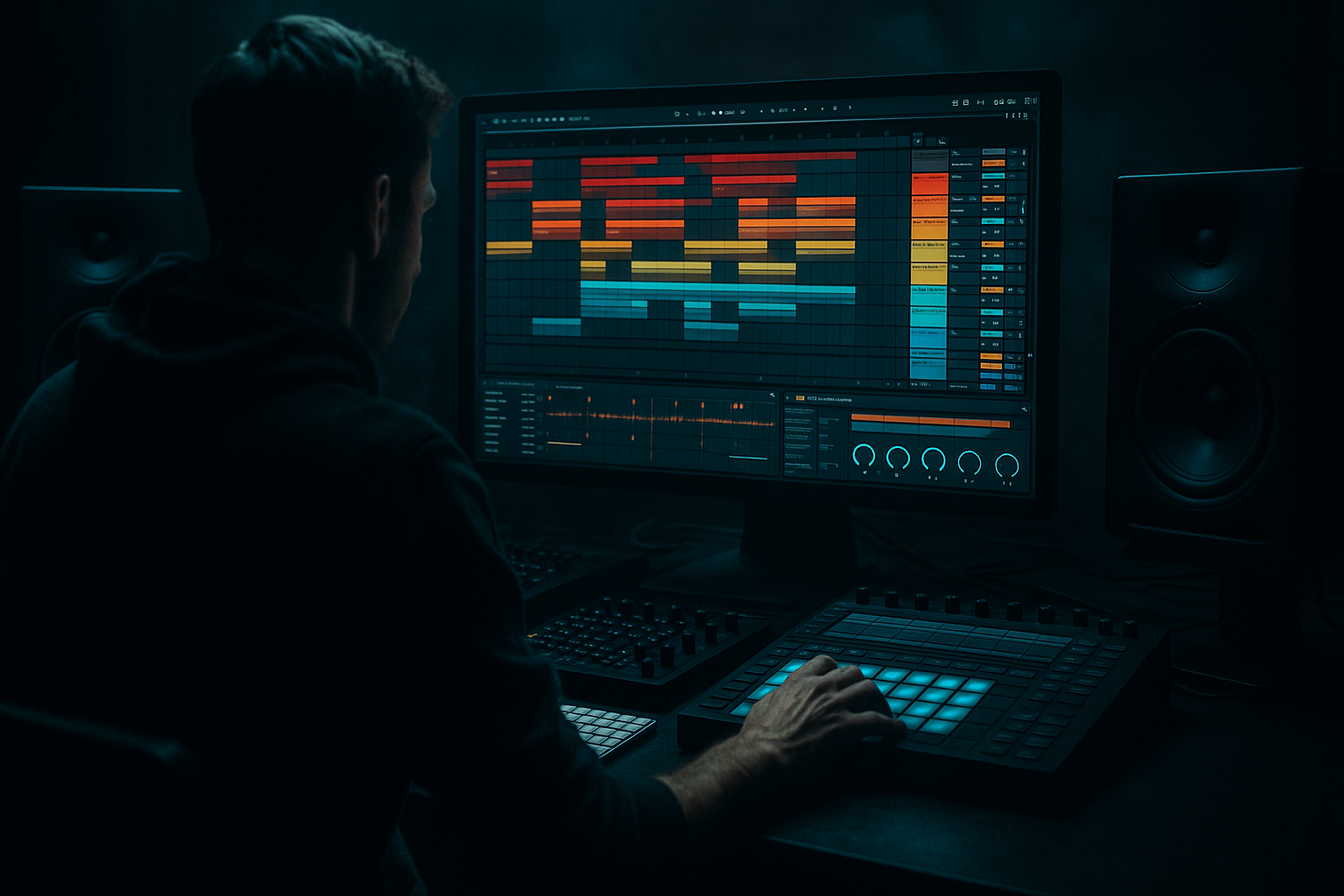
This lesson is about turning a sliced breakbeat into something that feels like it was pulled from a battered vinyl loop, then reassembled into a modern Drum & Bass drum performance with attitude. In Ableton Live 12, the goal is not just to chop a break — it’s to make the edit breathe like a real drummer while keeping that gritty, off-centre chopped-vinyl character that sits perfectly in jungle, rollers, darkstep, and neuro-adjacent DnB.
Why this matters: in DnB, the breakbeat is often the “human” layer that gives weight and movement to an otherwise precision-driven track. A good chopped break can make a drop feel alive, glue the groove to the bassline, and create tension without needing endless fills. This technique also gives you control over phrasing, transient energy, and arrangement impact. Instead of looping a break as-is, you’ll learn how to resculpt it with automation so it hits like a performance, not a sample playback preset.
We’ll use Ableton stock tools to build a break that has:
- tight slice control
- vinyl-style pitch wobble and timing drift
- automated filter movement
- resampled texture
- arrangement-ready transitions for a dark DnB tune
- starts with a classic chopped-vinyl feel
- uses subtle pitch and filter automation for instability
- includes ghost notes and micro-edits for swing and urgency
- has a heavier “drop-ready” section with more transient bite
- can be layered into a full DnB arrangement with intro, drop, and switch-up potential
- Over-slicing the break until it loses drumming logic
- Quantizing everything perfectly
- Making the break too bright and brittle
- Boosting low end in the break while the sub owns that space
- Automating too much at once
- Using compression to force groove instead of arranging the groove properly
- Forgetting mono compatibility
- Use pitch automation on snare fragments for a “vinyl sag” effect. A very short drop in pitch before a snare can feel like the sample is being dragged across the deck.
- Layer a clean transient under a dirty break slice if the snare needs more authority. Keep the dirty layer lower in level and treat it as texture.
- Put Drum Buss on the break group and automate Drive up by 1–3 dB only in fills or transition bars for extra aggression.
- Use Auto Filter with slow cutoff motion on the break bus during breakdowns, then open it fast right before the drop.
- For neuro-leaning tension, automate tiny rhythmic changes to a hat slice or shaker loop so the top end feels mechanized but still human.
- Keep the sub nearly static while the break gets more animated. That contrast is what makes heavy DnB hit harder.
- If the break gets cluttered, delete rather than layer more. Darkness often comes from space, not density.
- Use sends sparingly: a short Echo throw on one ghost hit can feel more underground than soaking the whole loop in reverb.
What You Will Build
By the end of this lesson, you’ll have a 4- to 8-bar break pattern that:
Think of it as a break that can sit under a reese bass or sub-heavy roller without sounding stiff. It should feel like a vintage loop being re-cut live, then pushed into modern territory with automation and resampling.
Step-by-Step Walkthrough
1. Choose the right break source and prep it like a crate digger 🎛️
Start with a break that has personality: think Amen-derived material, a dusty funk break, or a clean but characterful loop with strong ghost notes. For advanced DnB work, choose a break with:
- clear snare backbeat
- useful hi-hat chatter
- at least one or two “messy” transients
- enough room to reshape via transient control
In Ableton, drag the audio into a new audio track and set the Warp mode to Complex Pro only if you need to preserve a musical pitched feel; otherwise, for hard break chopping, try Beats mode with transient preservation. If the break is long and you want vinyl-like instability, don’t over-quantize. Keep the original groove alive.
Useful starting move:
- Warp OFF if the loop is already tight and you want raw timing
- Warp ON with Beats mode and Transient Loop for a more edited, punchy feel
- Preserve the original transient attack as much as possible
Why this works in DnB: jungle and DnB breaks often rely on tension between tight programming and slightly unstable human feel. If the source is too polished, you lose that “broken machine” energy.
2. Slice the break in a way that preserves drummer logic
Right-click the audio clip and choose Slice to New MIDI Track. For advanced chopping, slice by:
- Transients
- 1/16 note grid if the source is rhythmic but you want control
- or Manual markers if you want to isolate snare ghosts, hat pickup, and kick fragments
In the slicing options, create a Drum Rack. This keeps each slice playable and automatable as a MIDI performance. Don’t just scatter slices randomly — group them in a drummer-friendly order:
- kick slices
- snare slices
- hat/shaker slices
- ghosts and tail fragments
Then rename pads or color-code them. This matters a lot in complex DnB edits where you need speed.
Advanced tip: keep duplicate copies of the same snare slice on multiple pads. One can stay clean, one can be processed through distortion, and one can be pitched for fills.
3. Rebuild the groove with a drummer’s phrasing, not a grid-first mindset
Program a 2-bar MIDI clip using the slices in Drum Rack. Start with a classic DnB backbeat reference:
- snare on 2 and 4
- kick placements that push into the snare
- ghost notes leading into downbeats and offbeats
- hats that answer the snare or fill gaps around the bassline
Don’t make every hit equal. The character comes from contrast:
- strong main snare
- quieter ghost snare
- slightly late hat slices
- occasional micro-stutters before the drop
Use velocity variation aggressively. A useful range:
- main snare: 110–127
- supporting hats: 50–85
- ghost notes: 20–55
In Live 12, you can use the piano roll’s note editing and velocity shaping very quickly. Push some hits slightly off the grid by a few milliseconds, but only on selected slices. That tiny imbalance gives the break a chopped-vinyl lilt instead of sounding quantized and sterile.
4. Add chopped-vinyl movement with clip automation and pitch behavior
This is where the lesson becomes about Automation in a meaningful way. Create clip automation for:
- pitch of specific slices
- filter cutoff
- sample start for certain hits
- transpose of the Drum Rack chain or individual Simpler pads if needed
If you are using Simpler inside the Drum Rack, set the sample mode per pad and automate:
- Filter cutoff around 300 Hz to 2.5 kHz depending on whether you want muffled or open chops
- Drive lightly to moderately for grit
- Transpose small amounts: -3 to +4 semitones for vinyl-style lurch
For chopped-vinyl character, automate pitch in short phrases, not continuously. A good approach:
- first 2 bars: mostly neutral pitch
- bar 3: add downward pitch dip on one snare fragment
- bar 4: rise a few cents or semitones on a hat pickup before the next phrase
If you use the clip envelope view, automate Sample Offset or Filter to make slice repeats feel like they are being “worked” by hand. Keep changes subtle:
- pitch moves: often ±1 to ±3 semitones
- filter cutoff sweeps: 10% to 40% movement, not full open/close
- resonance: low to moderate, around 10–25% unless you want obvious squeal
Why this works in DnB: small automation moves add tension and motion without destroying the drum grid. That keeps the break energetic while still leaving space for the bassline to hit hard.
5. Shape transient weight and glue with stock drum processing
Put your Drum Rack group or break bus through a practical stock chain. A strong order for darker DnB is:
- Drum Buss
- EQ Eight
- Saturator
- Glue Compressor or Compressor
- Utility
Suggested starting settings:
- Drum Buss: Drive 5–20%, Crunch low to medium, Boom carefully tuned or left off if the sub already owns the low end
- EQ Eight: high-pass gently around 25–35 Hz, cut boxy mud around 180–350 Hz if needed, tame harsh hat peaks around 6–10 kHz
- Saturator: Soft Clip on, Drive 1–6 dB depending on density
- Glue Compressor: slow-ish attack, medium release, 1–2 dB gain reduction for cohesion
- Utility: check mono compatibility, especially if the break has stereo widening from hats or room tone
Do not flatten the break too early. You want transient punch for the snare, but enough glue that it feels like one performance. If the break is fighting the bassline, use less compression and more arrangement space instead.
6. Build call-and-response between the break and bassline
In DnB, the break often speaks to the bass. Program or arrange your bassline so it leaves holes where the break can answer. For example:
- snare hit on 2 gets a short bass rest
- a ghost snare leads into a bass stab
- hat roll opens a pocket for a reese wobble
If you’re using a reese or dark bass, keep the sub disciplined:
- sub mono, clean, and centered
- bass movement in mids and upper mids
- break occupies some transient presence, not the whole low end
Use arrangement automation to duck or reveal the break:
- automate an Auto Filter on the break bus to close during bass-heavy sections and open during fills
- automate volume envelopes for one-bar or half-bar break drops
- use returns for delay or reverb only on selected ghost hits to avoid washing out the groove
Musical context example: in a 174 BPM roller, let the chopped break run underneath a rolling sub for 8 bars, then automate a filter lift and extra hat fragmentation in the last 2 bars before the drop. That creates anticipation without needing a big riser.
7. Resample the break to print the character and commit the motion
Once the pattern feels right, resample it. Create a new audio track and record the break bus in real time. This is one of the best advanced moves in Ableton because it lets you turn automation, texture, and groove into a single audio performance.
After resampling:
- warp the printed break lightly if needed
- cut the best 1-bar or 2-bar phrases
- reverse tiny fragments for fills
- use fades to clean transitions
- duplicate the audio and process one copy for clean punch, another for dirt
Try a second pass with more aggressive processing:
- Grain Delay very subtly for texture
- Redux at low mix for a crushed edge
- Echo send on only one snare per phrase for spatial depth
Advanced workflow note: resampling makes your automation decisions more “final,” which is good. It stops endless tweaking and forces you to commit to the groove.
8. Arrange the break for a real DnB record structure
Don’t stop at the loop. Build a section that could actually live in a track:
- 16-bar intro with filtered chop and sparse ghosts
- 32-bar drop with full break + bass
- 8-bar switch-up with extra slice rearrangement
- 16-bar breakdown or half-time tension section
- return with fuller break and more open hats
Use automation to shape energy across sections:
- open filter across 8 bars into the drop
- increase saturation on the snare bus in the last 4 bars
- automate short delay throws on selected hats for transitions
- reduce low-mid energy during intro, then restore it at the drop
Keep the intro DJ-friendly. A cleaner 16-bar intro with just the break fragments, atmospheres, and hints of bass gives DJs something mixable. Then let the main break reveal itself more fully at the drop.
Common Mistakes
Fix: keep a few longer fragments and let some ghost notes breathe.
Fix: leave intentional timing offsets on selected hats and secondary snares.
Fix: tame 6–10 kHz with EQ Eight or reduce saturation on the high end.
Fix: high-pass gently, keep the break punch in the upper bass and low mids, not the sub region.
Fix: move one or two parameters per phrase. In DnB, subtle control usually sounds more expensive than obvious motion.
Fix: edit the note placements and slice choices first; compress second.
Fix: check Utility on the drum bus and keep the foundation solid in mono.
Pro Tips for Darker / Heavier DnB
Mini Practice Exercise
Set a 15-minute timer and do this:
1. Find a break with strong snare and hat detail.
2. Slice it to a Drum Rack in Ableton Live.
3. Program a 2-bar loop with:
- snare emphasis on 2 and 4
- at least 3 ghost notes
- one intentional off-grid hat hit
4. Automate one parameter only:
- either filter cutoff on the break bus
- or pitch on one repeating slice
5. Add Drum Buss and Saturator with subtle drive.
6. Resample 4 bars of the result.
7. Re-edit the resampled audio into a 1-bar fill and a 2-bar main loop.
Goal: make the loop feel less like a sample and more like a performed, chopped DnB break with attitude.
Recap
The core idea is simple: slice the break, rebuild it with drummer logic, then use automation to give it vinyl-style instability and modern energy. In Ableton Live 12, the stock tools are enough to create serious chopped-break character if you focus on timing, pitch movement, filter automation, and resampling. Keep the sub clean, let the break breathe, and automate with purpose. That’s how you get a DnB break that feels alive, heavy, and worth coming back to.

