Main tutorial
Breakdown FX Chain for VHS‑Rave Color in Ableton Live 12 (Jungle / Oldskool DnB) 📼⚡
1) Lesson overview
In oldskool jungle and early DnB, breakdowns often feel like you dropped the track into a VHS deck: wobbly pitch, smeary highs, crunchy saturation, gated reverbs, and dubby echoes—then bam, back to a clean(ish) drop.
This lesson shows you a repeatable FX chain + arrangement workflow in Ableton Live 12 to create that VHS-rave breakdown vibe using mostly stock devices—built specifically for drum & bass.
---
2) What you will build
You’ll create a Breakdown FX Rack you can slap on your Drum Bus, Music Bus, or even Master during breakdown only (I’ll show the safe way). It will give:
- VHS-style wow/flutter (pitch wobble) 📼
- Tape-ish saturation + soft compression
- Low-pass “underwater” filtering with movement
- Dub delay throws and rave reverb wash
- Optional AM/ring-mod grit for that pirate-rave edge
- A simple automation plan for classic jungle breakdown → drop impact
- Turn on LFO
- Rate: 1/4 or 1/2 (sync)
- Amount: small (5–12%)
- Wave: Sine
- Phase: 0° (keep it predictable)
- Use Utility after it
- After Hybrid Reverb, add Gate
- HP: 250–600 Hz
- LP: 3–6 kHz
- Bits: 10–14
- Downsample: 1.2–2.5
- Dry/Wet: 5–15%
- Mode: Ring Mod
- Frequency: 20–60 Hz (for subtle buzz)
- Fine: adjust to taste
- Dry/Wet: 3–10%
- Auto Filter cutoff: 12 kHz → 4–6 kHz
- Chorus Mix: 10% → 20%
- Reverb Dry/Wet: 10% → 18%
- Keep sub mostly dry/clean.
- Auto Filter cutoff: 6 kHz → 2–3 kHz
- Echo Dry/Wet: 8% → 15%
- Add a short vinyl noise / hiss layer (or Echo Noise) low in the mix.
- Add snare fill or amen ghost hits filtered.
- Cutoff dips even lower briefly (~1.5–2 kHz) then rises slightly.
- Echo Dry/Wet spikes (a throw) and Feedback increases slightly.
- Add a 1/2-bar silence or kick mute right before drop (classic tension trick).
- Instantly restore:
- Keep a tiny residual tape tone if you want continuity, but reduce to subtle.
- Keep drums more present than music in breakdowns (even filtered). A filtered amen loop with subtle saturation keeps energy.
- Add a distant fog layer: resample a pad/chord, then:
- For heavier edge, put Roar in parallel:
- Add short impact hits (reverse cymbal, noise whoosh) that land on bar lines (bar 9, 13, 15) to guide the listener.
- Use mono reverb lows:
- breakdown feels “taped”
- drop hits clean and solid
- no sub wobble/phase weirdness
- Use routing (DRUM BUS / MUSIC BUS / clean SUB) to keep control.
- Build a VHS Breakdown Rack using stock Ableton tools:
- The magic is automation: degrade in the breakdown, snap back on the drop.
---
3) Step-by-step walkthrough
Step 0 — Recommended routing (DnB-friendly)
Before effects, create a clean routing setup so your breakdown FX are easy to automate.
1. Group your drums:
- Select all drum tracks → Cmd/Ctrl+G → name DRUM BUS
2. Group your music (pads, stabs, vocals, atmos):
- Group → name MUSIC BUS
3. Keep SUB separate (very important):
- Your sub track should not go through heavy VHS wobble or wide reverb.
✅ Why: VHS effects on sub = messy phase + weak drops.
---
Step 1 — Build the “VHS Breakdown Rack” (Audio Effect Rack)
Put this rack on MUSIC BUS first (safest), then optionally a lighter version on DRUM BUS.
On MUSIC BUS, add an Audio Effect Rack and name it:
VHS BREAKDOWN (Jungle)
We’ll build it left to right:
---
Step 2 — “Underwater” filter + movement (Auto Filter)
Add Auto Filter first.
Mode: Lowpass 24 dB
Base Cutoff: ~ 6.0 kHz (start here)
Resonance: 15–25%
Drive: 2–5 dB (tiny push)
Now add movement:
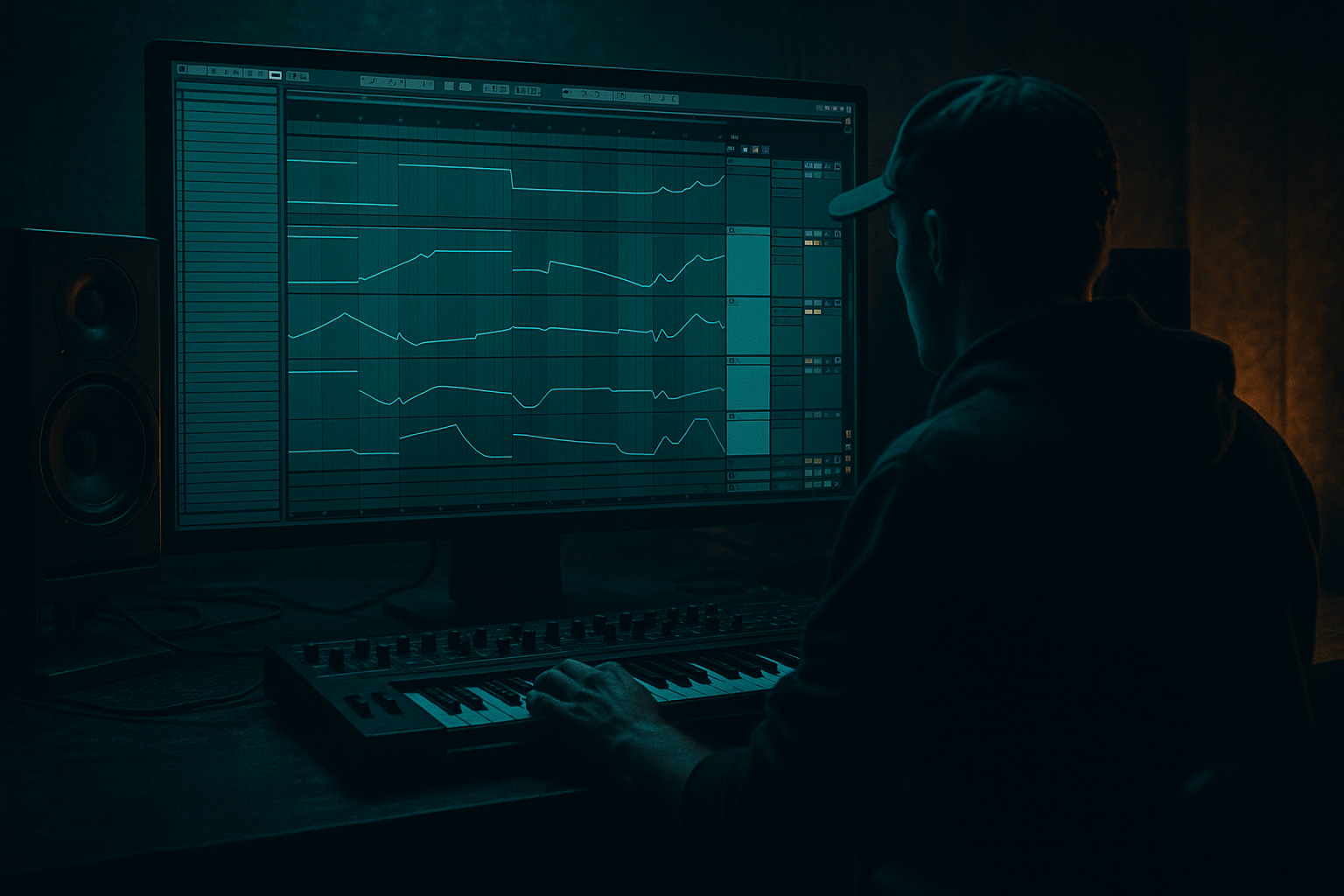
🎯 DnB breakdown move: automate Cutoff from ~12 kHz down to ~1.5–3 kHz over 8–16 bars.
---
Step 3 — VHS wow/flutter (Chorus-Ensemble + subtle detune)
Ableton doesn’t have a “VHS” knob, but micro-modulation + slight delay smear gets you there.
Add Chorus-Ensemble after Auto Filter.
Mode: Chorus
Rate: 0.12–0.35 Hz (slow)
Amount: 15–30%
Delay Time: 8–18 ms
Feedback: 0–5%
Mix: 10–25%
Optional: if it gets too wide, reduce width:
- Width: 70–100% (don’t over-widen for mono compatibility)
📌 Tip: This is your “tape wobble” layer. Keep it subtle—if it sounds like trance supersaw chorus, you’ve gone too far.
---
Step 4 — Tape-ish crunch (Roar or Saturator)
Add Roar (Live 12) if you want modern control, or Saturator for classic.
#### Option A: Roar (recommended)
Mode: Tape (or Soft)
Drive: 5–10 dB
Tone/Filter: roll a bit of top (aim to tame harsh highs)
Mix: 15–35% (parallel-ish)
#### Option B: Saturator
Curve: Soft Sine
Drive: 3–8 dB
Output: compensate so level matches bypass
Color: On
Base: ~1.0 kHz
Depth: 2–4 dB
Dry/Wet: 20–40%
🎛️ Goal: “warm smear,” not “destroyed.” Breakdown should feel nostalgic, not just clipped.
---
Step 5 — VHS “compress + pump” (Glue Compressor)
Add Glue Compressor.
Attack: 3 ms
Release: Auto (or 0.3s for slower glue)
Ratio: 2:1
Threshold: aim for 1–3 dB gain reduction
Soft Clip: On
Makeup: Off (level-match manually)
✅ This helps the wash feel like it’s coming from a single sampled source.
---
Step 6 — Rave space: gated/dirty reverb (Hybrid Reverb)
Add Hybrid Reverb.
Algorithm: Hall or Plate
Decay: 2.5–5.5s
Pre-Delay: 15–30 ms
Low Cut: 250–450 Hz
High Cut: 5–8 kHz
Dry/Wet: 10–25% (on a bus insert)
(If you want huge reverb, do it on a send—see below.)
Optional “gated-ish” trick (super oldskool):
- Threshold: set so tail gets chopped
- Release: 80–180 ms
- Floor: -inf
This gives that rave stab room without endless mud.
---
Step 7 — Dub delay throws (Echo)
Add Echo.
Time: 1/8 dotted or 1/4
Feedback: 25–45%
Filter: Bandpass-ish vibe
Modulation: 10–20% (for wobble)
Noise: 2–8% (tasteful)
Dry/Wet: 8–18%
🎯 Arrangement move: automate Echo Dry/Wet up for the last 1–2 bars before drop, then snap it back on the drop.
---
Step 8 — OPTIONAL: “Broadcast/AM radio” grime (Redux or Frequency Shifter)
For pirate-rave / VHS broadcast texture, add one of these very lightly:
#### Option A: Redux (bit/grit)
#### Option B: Frequency Shifter (AM-ish)
This makes it feel like you sampled it from a battered tape / TV recording.
---
Breakdown automation plan (the part that makes it DnB)
Here’s a classic 16-bar breakdown automation blueprint:
Bars 1–8: “Memory fog”
Bars 9–14: “Tape meltdown + space”
Bars 15–16: “Suck-out + throw”
Drop: “Snap back to clean”
- Auto Filter fully open (or bypass rack)
- Chorus mix back down
- Reverb down
- Delay down
✅ Pro workflow: map key parameters to Rack Macros (Cutoff, Wobble, Wash, Dub, Grit) and automate macros instead of 12 lanes.
---
Safe “Master Breakdown” trick (without ruining your drop)
If you want the whole breakdown to feel like VHS:
1. Create a BREAKDOWN BUS return track:
- Set Audio From: Master (or your premaster bus)
- Set monitoring to In
2. Route only breakdown sections via automation:
- Use Utility or track routing to feed the breakdown bus
3. Put your VHS rack on that bus only.
This prevents accidentally leaving VHS smear on your drop.
---
4) Common mistakes 🚫
1. Putting wow/flutter on the sub
→ phase wobble = weak low end after the drop.
2. Too much chorus width
→ your breakdown gets wide but hollow; drop feels smaller.
3. Reverb without filtering
→ mud city; you lose the classic jungle punch and clarity.
4. No level matching
→ you think it “sounds better” but it’s just louder.
5. Automation ramps too linear
→ use curves! Jungle tension often feels like it “falls apart” near the end.
---
5) Pro tips for darker/heavier DnB 🖤
- Auto Filter LP @ 2–4 kHz
- Heavy reverb
- Low volume
- Dry chain + Distorted chain (band-limited)
- Keep distorted chain mostly midrange (300 Hz–6 kHz)
- Put Utility after reverb: Width ~70–90%
- Or low-cut the reverb harder (350–600 Hz)
---
6) Mini practice exercise 🎯
Goal: Build an 8-bar VHS breakdown leading into a 32-bar rolling drop.
1. Take a classic jungle element (pad or rave stab loop) on MUSIC BUS.
2. Insert the VHS BREAKDOWN rack.
3. Automate:
- Auto Filter cutoff: 10 kHz → 2.5 kHz over 8 bars
- Echo Dry/Wet: keep low, spike in last bar
- Reverb Dry/Wet: gradually up, then snap down at drop
4. Add a 1-bar filtered amen fill in bar 8:
- Auto Filter LP @ ~3 kHz
- Small Saturator drive (2–4 dB)
5. At the drop, bypass the rack or pull macros back instantly.
Deliverable: export a 40-bar audio clip and check:
---
7) Recap ✅
- Auto Filter (movement + underwater)
- Chorus-Ensemble (wow/flutter vibe)
- Roar/Saturator (tape crunch)
- Glue Compressor (glue + soft clip)
- Hybrid Reverb (+ optional Gate for gated rave space)
- Echo (dub throws)
- Optional Redux/Frequency Shifter (broadcast grit)
If you want, tell me whether your breakdown source is rave stabs, pads, vocals, or a sampled break, and I’ll give you a tailored macro map + exact automation curve plan for a 16/32-bar jungle arrangement.

