Main tutorial
Lesson Overview
A shuffle breakdown in DnB is not just a “calm section” before the drop — it’s a momentum-shaping device. In jungle, oldskool rollers, and darker modern DnB, the breakdown can carry forward motion without the full drum pressure, using swung percussion, chopped breaks, ghost hits, bass call-and-response, and evolving texture to keep the listener leaning in. The goal here is to build a breakdown that feels like it’s breathing, skidding, and rolling at the same time.
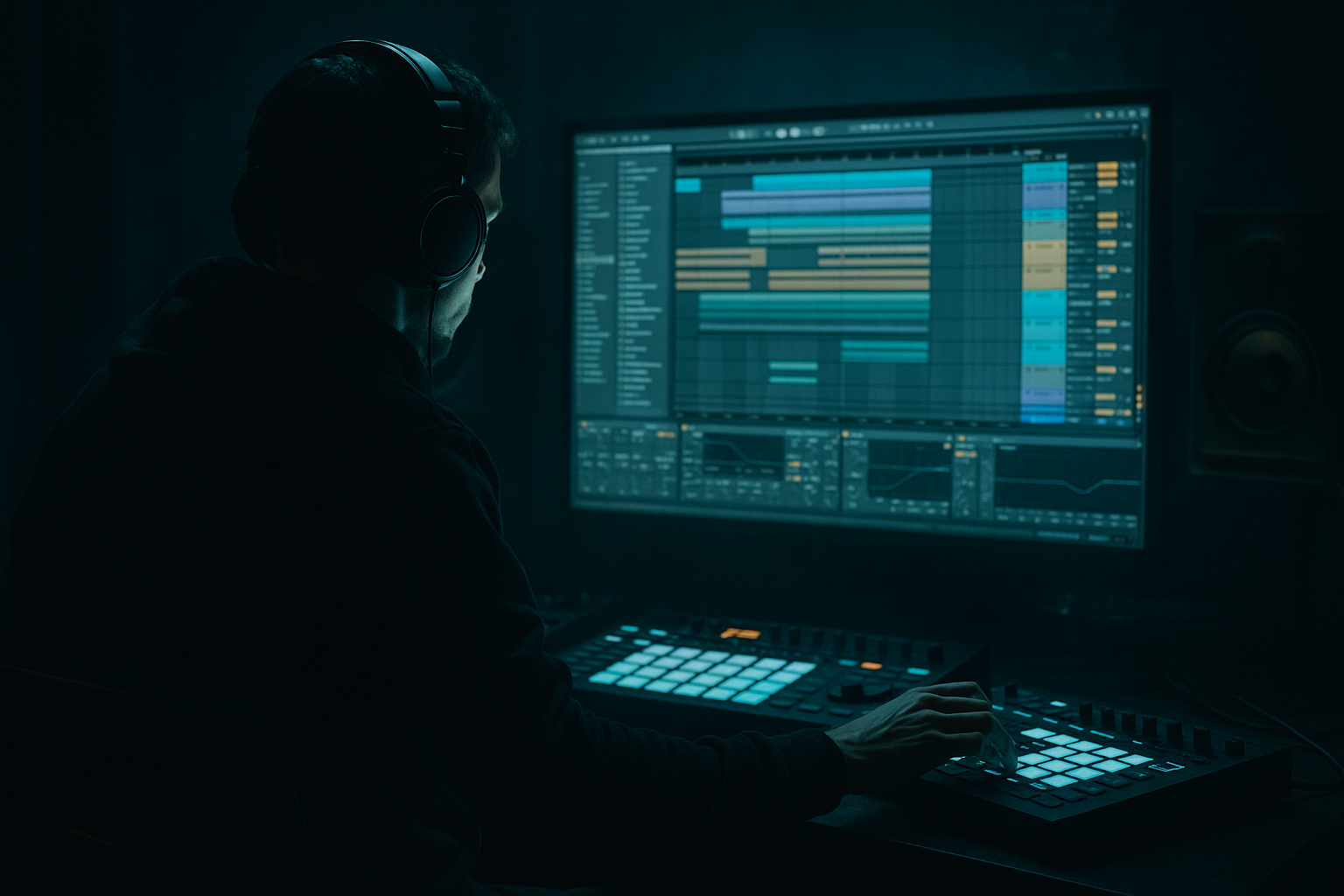
In Ableton Live 12, this is especially powerful because you can combine Groove Pool swing, tight clip editing, stock devices like Drum Buss, Saturator, Auto Filter, Echo, Beat Repeat, and Utility, plus resampling and automation to create a breakdown that still feels like part of the groove — not a separate ambient interlude.
This lesson is for advanced producers who already know their way around Live and want to make breakdowns that:
- preserve roller momentum
- nod to jungle / oldskool phrasing
- feel DJ-friendly and arrangement-aware
- create tension for a hard, satisfying re-entry
- chopped break fragments and ghost notes
- swung percussion layers that retain momentum
- a filtered reese or bass motif answering the drums
- atmospheric tails and tension FX that don’t wash out the groove
- automation that pulls energy down while keeping a clear rhythmic spine
- a transition back into the drop that feels inevitable
- Overfilling the breakdown with too many layers
- Swing applied everywhere equally
- Too much reverb on drums and bass
- Bass playing full phrases instead of answering
- No phrase arc
- Break edit too quantized or too loose
- Dropping low-end too early
- Split your bass into sub and mid layers. Keep the sub in mono and automate the mid layer’s filter or distortion for movement.
- Use subtle Drive on Drum Buss rather than heavy compression if you want the breakdown to feel grimy but still punchy.
- Automate a narrow band dip around 2–4 kHz on harsh break layers if the shuffle gets abrasive. That keeps the energy but reduces ear fatigue.
- Use reverse ambience only at phrase ends. A well-placed reverse crash or filtered noise swell into a snare fill is more effective than constant atmos.
- Add a tiny amount of Beat Repeat only on selected fills. Set short grid values and low mix so it feels like a stutter accent, not a full glitch effect.
- Keep the bass motif ambiguous. In darker DnB, a half-finished phrase can feel more threatening than a full melodic answer.
- Use saturation before filtering on bass to create a more audible midrange footprint when the sub is reduced in the breakdown.
- Resample the breakdown and commit. Once you’ve got the movement right, bounce it and edit the audio. This often creates the grime that MIDI can’t quite fake.
- swung break edits and ghost notes
- bass that answers instead of dominates
- automation that shapes tension across 4-bar phrases
- clear low-end discipline and mono control
- selective FX that enhance motion without washing out the groove
The key idea: a good shuffle breakdown should imply the drop, not replace it. It should keep the body moving while the track strips down and reloads. That’s why this technique matters in DnB: the best breakdowns in this style often work as a rhythmic illusion — less drums, more space, but still enough groove to make the return hit harder.
What You Will Build
You’ll build a 16-bar shuffle breakdown for an oldskool/jungle-leaning DnB track at around 172–174 BPM with:
Musically, this breakdown will work in a track where the first drop has already established the main drum/bass relationship, and the breakdown functions as a mid-track reset or pre-drop tension section. Think: eight bars of rolling tension, eight bars of stripped, shuffling pressure, then a tight rebuild into the next drop or switch-up.
Step-by-Step Walkthrough
1. Set the breakdown’s rhythmic identity before sound design
Start by deciding whether the breakdown sits closer to:
- oldskool jungle chop: more break-slicing, more syncopated ghost hits, more obvious swing
- roller shuffle: cleaner pulse, subtler swing, more low-end hypnosis
- darker neuro-tinged tension: less obvious drums, more engineered movement and controlled build
In Ableton Live 12, open the Groove Pool and try a classic swing source like MPC 16 Swing 57–60 or a subtle humanized groove if you want less obvious shuffle. Apply it to your break MIDI clip or audio clip, then:
- set Timing around 55–75% for a noticeable but not sloppy swing
- keep Random low, around 0–10%, if the groove must stay tight
- use Velocity around 10–25% to avoid stiff repetition
Why this works in DnB: the ear locks onto micro-timing more than harmonies in a breakdown. Even with fewer elements, a swung rhythmic grid keeps the section feeling like it belongs to the main roller energy.
2. Build the core break edit with tension, not density
Drag in a classic break or a break-heavy loop and split it into a MIDI/audio-friendly structure. Use Warp carefully if it’s audio:
- set the transient markers on the main kicks/snares
- use Beats mode for punchy breaks
- keep Preserve around 1/8 or 1/16 depending on how fractured you want the slice behavior
Now create a two-layer break system:
- Layer A: the main shuffled break, low-passed and relatively stable
- Layer B: micro-edits of ghost hits, snare pickups, and chopped hats
In the Arrangement, place the main break pattern across 16 bars, but mute or thin it in bars 5–8 and 13–16. Don’t keep the same density all the way through. Instead, make the breakdown breathe in phrases:
- bars 1–4: establish shuffle pattern
- bars 5–8: strip back kick content, emphasize hats and snare ghosts
- bars 9–12: reintroduce fragments and fills
- bars 13–16: tension ramp with filtered return cues
Use Simpler if you want to resample break hits into playable slices. Set it to Slice mode and manually trigger a few high-value slices: snare tail, ghost kick, hat tick, rim, and a reverse fragment. This gives you more control than looping the raw break.
3. Shape the groove with ghost notes and off-grid accents
The “timeless roller momentum” lives in the small notes. Program ghost notes either in a MIDI drum rack or by slicing audio and nudging clips manually.
Practical moves:
- place low-velocity ghost snares just before main backbeats
- add tiny closed-hat pickups on the “a” of the beat
- use rim clicks or break noise as off-grid glue
- delay selected hits by 5–15 ms for a laid-back feel, or push some hits earlier by a few ms for nervous energy
If you’re working in Drum Rack, use Note Velocity and Random creatively:
- snare ghosts: velocity around 25–50
- supporting hats: velocity around 30–70
- main snare accents: velocity around 90–120
- kick ghosts in jungle-style chops: velocity around 35–60
Add Groove Pool to only the ghost layers if the core break is already doing enough swing. This avoids over-swinging the main body. Advanced tip: vary groove application by layer so the breakdown feels human, but still engineered.
4. Create a bass answer that doesn’t overpower the breakdown
A shuffle breakdown needs bass presence, but not full sub dominance. Make a bassline that answers the drums instead of blanketing them.
Use a Reese or muted bass motif in Wavetable, Operator, or Analog:
- low-pass the sound to keep it controlled
- use subtle detune or filter movement for motion
- keep the sub separate on its own chain or track
Suggested starting points:
- Wavetable: two detuned saws with slight phase movement, filter cutoff around 150–400 Hz for the breakdown version
- Saturator: drive around 2–5 dB, Soft Clip on if needed
- Auto Filter: automate cutoff with a slow sweep across 8 or 16 bars
- Utility: set bass low-end to mono
For the arrangement, use call-and-response phrasing:
- bass hits on the gaps between snare ghosts
- leave half-bar spaces so the break breathes
- use short note lengths and rest-heavy patterns
In oldskool/jungle vibe terms: the bass shouldn’t “play too much.” It should be a question mark after the drum chop. Let the rhythm of the bass contribute to the shuffle, not fight it.
5. Use stock FX to create movement without losing clarity
Add texture and tension with restrained, strategic FX. In a breakdown, every effect should either support the groove or lead to the drop.
Try this chain on a drum bus or breakdown texture bus:
- Drum Buss: Drive 5–15%, Crunch low, Boom usually off or very subtle
- Saturator: soft saturation for grit
- Auto Filter: low-pass automation across the breakdown
- Echo: short feedback throws on snare tails or a reverse hit
- Beat Repeat: very occasional fills, not constant glitching
- Reverb: short or medium decay on select elements, not the whole mix
Important: keep the reverb from washing out your shuffle. Use:
- decay around 0.8–2.2 s
- pre-delay around 10–30 ms
- HP filter in the reverb return to keep low-end clean
For dark DnB, automate filter movement rather than adding more layers. A slowly opening filter on a break fragment can feel more powerful than a stack of FX.
6. Automate energy in a phrase-by-phrase arc
The breakdown should feel like it has a narrative. Use automation to shape the emotional curve over 16 bars.
High-value automations:
- Auto Filter cutoff on the drum bus or break layer
- Reese cutoff opening slightly before the return
- Reverb send increasing on the last hit of each 4-bar phrase
- Echo feedback for a single transitional hit
- Utility gain pulling down 1–3 dB in the middle, then recovering
- Pan automation on atmos or percussion for motion without widening the low-end
A strong arrangement example:
- bars 1–4: recognizable shuffle, moderate low-pass
- bars 5–8: sub thins out, hats and ghost notes take over
- bars 9–12: bass returns in short answers, a fill appears every 2 bars
- bars 13–16: filter opens, snare roll or break fill, final one-shot impact into drop
This phrasing gives the listener an unconscious countdown. It’s not just “breaking down” — it’s loading momentum into the next section.
7. Use resampling to make the breakdown feel like a performance
Advanced DnB breakdowns often sound best when they’re not obviously built from loops. Resample your own material.
In Ableton:
- route the break bus or bass answer bus to a new audio track
- record 8 bars of the performance
- slice the best moments into a fresh track or keep them as audio for additional warping and reverse tricks
After resampling, try:
- reversing a snare tail into a fill
- cutting a bass swell so it lands right before the drop
- warping a tiny break fragment into a rising tension element
- using Simpler or audio clip warp markers to create micro-variations
This is especially effective for jungle-style breakdowns because the genre tradition is rooted in rewired break performance rather than static loop repetition. The result feels more human and more dangerous.
8. Control width, low-end, and impact like a pro
A shuffle breakdown can easily become too wide, too washed, or too soft. Keep your mix discipline sharp.
Use these rules:
- keep anything below about 120 Hz essentially mono
- check the breakdown in mono with Utility
- use stereo width on atmospheres and FX, not the sub
- high-pass delay and reverb returns aggressively enough to protect kick/sub space
- don’t let the break transients get flattened by too much compression
If the drum bus needs glue, use Glue Compressor lightly:
- ratio 2:1
- attack 10–30 ms
- release Auto or around 0.1–0.3 s
- just a few dB of gain reduction
If the breakdown loses punch, back off the bus processing before adding more sounds. In DnB, clarity is often the hardest-hitting “effect.”
Common Mistakes
Fix: choose one lead rhythmic idea, one bass answer, and one atmospheric thread. If all three are busy, remove something.
Fix: apply groove selectively. Let the main break be slightly straighter if the ghost layer carries the shuffle.
Fix: keep low-end dry, and use short tails on percussion only. HP filter every return.
Fix: shorten notes, leave holes, and make the bass react to the drum rhythm.
Fix: shape the breakdown in 4-bar chunks. If every bar feels identical, the section won’t build tension.
Fix: nudge by ear. A few milliseconds of timing movement is enough. Don’t destroy the pulse trying to humanize it.
Fix: let a filtered sub hint stay in for longer. The listener needs something to anchor the body.
Pro Tips for Darker / Heavier DnB
Mini Practice Exercise
Set a timer for 15 minutes and build a 16-bar shuffle breakdown at 174 BPM:
1. Import one break and one Reese or sub-bass patch.
2. Apply a subtle groove from the Groove Pool to the break.
3. Edit the break into a 4-bar motif with ghost notes and at least one pickup fill.
4. Program a bass answer that plays only on gaps, not on every bar.
5. Add one atmosphere track with an Auto Filter sweep and one short Echo throw.
6. Automate a low-pass filter on the drum bus so the section opens gradually.
7. Make bars 13–16 feel like a buildup to the drop with one clear transitional event.
8. Check mono with Utility, then reduce anything that clouds the low-end.
When finished, bounce the breakdown and listen back once without the arrangement context. If it still grooves on its own, you’ve nailed the momentum.
Recap
The best shuffle breakdowns in DnB are built from rhythm, restraint, and phrase design. Focus on:
In Ableton Live 12, the winning workflow is usually: groove first, edit second, automate third, resample last. That order keeps the breakdown rooted in momentum — which is exactly what makes oldskool jungle pressure and timeless roller energy hit so hard.

