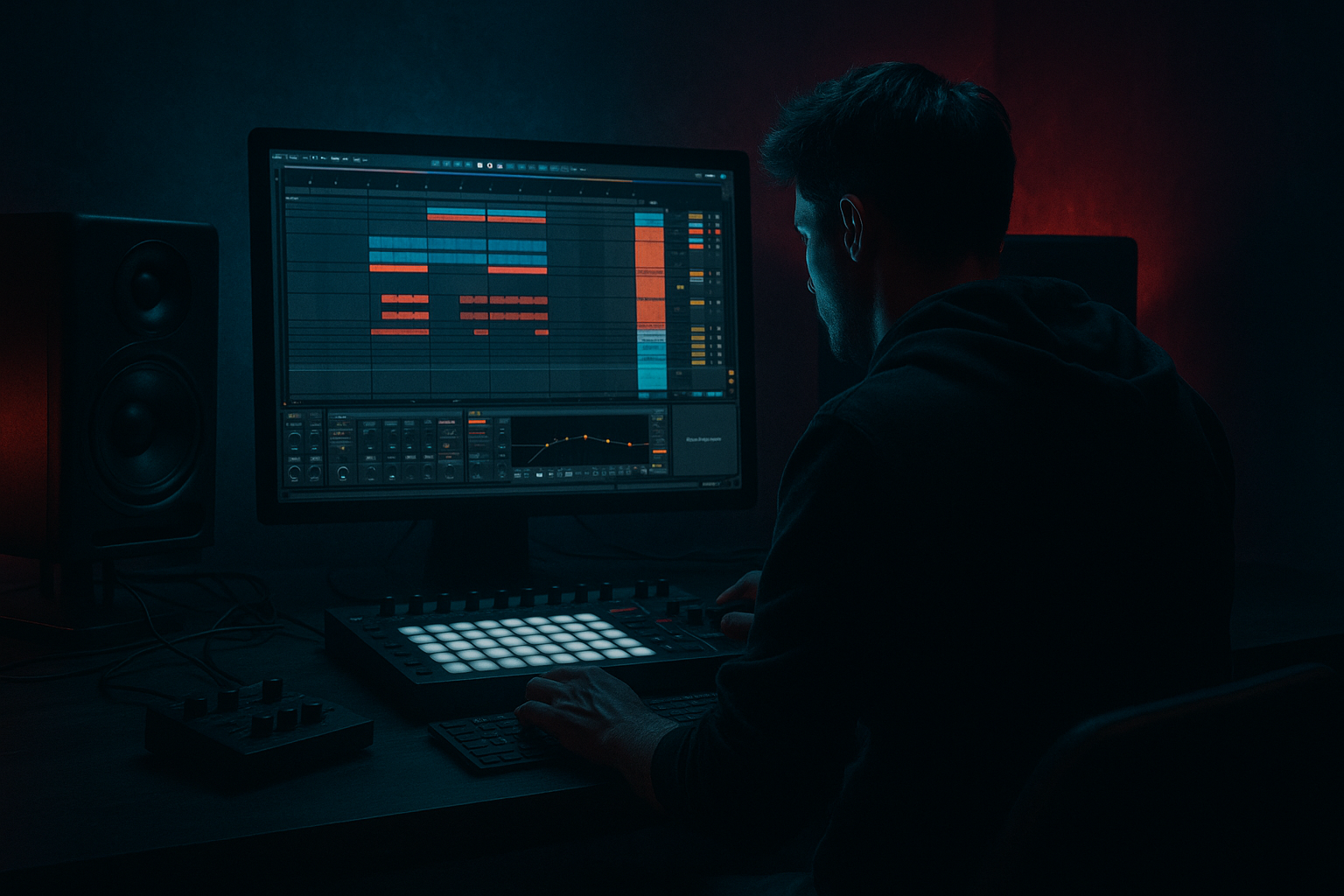
Main tutorial
```markdown
Breath and Lift in Fast Tempos (DnB in Ableton Live) 🚀
Skill level: Advanced • Category: Groove • Tempo focus: 170–176 BPM
---
1. Lesson overview
At 170+ BPM, everything can start to feel like a wall of sound—especially in rolling DnB where the drum grid is constantly busy. “Breath and lift” is the art of creating micro-gaps, dynamic contrast, and forward motion so the groove feels fast and aggressive without becoming flat and exhausting.
In this lesson you’ll build a rolling DnB drum+bass loop and then use Ableton Live techniques to inject:
- Breath: micro-silences, controlled tails, and space in the spectrum
- Lift: subtle “upward” energy via automation, ghosting, swing, and transitional detail
- Tight kick/snare backbone
- Amen-style edits / ghost notes for movement
- A sub + mid reese that “breathes” with sidechain and envelope shaping
- Micro-dropouts and uplifters that create lift every 4/8 bars
- A practical Ableton workflow using stock devices (no mystery sauce)
- Kick on 1 and optionally a light kick on “and” of 2 (classic rolling push).
- Keep it simple; lift comes from the supporting elements.
- Snare on 2 and 4 (i.e., beats 2 and 4 in a 4/4 bar).
- EQ Eight
- Saturator (both, subtle)
- Start with straight 1/16 notes.
- Velocity shape: strong on the offbeats, softer elsewhere (a “tick–tock” feel).
- Use a short noisy hat sample, place only on select offbeats or every 2 bars.
- Auto Filter
- Drum Buss
- Utility
- High-pass the break so it becomes mid/high motion, not low-end mud.
- EQ Eight
- Gate (this is a big “breath” tool)
- Transient Shaper (Drum Buss)
- Every 2 bars, remove (mute) one small break slice right before the snare (like a 1/16 or 1/32 gap).
- Consolidate the break (Cmd/Ctrl+J), then use Slice to New MIDI Track (by transients).
- Now you can mute notes for micro-gaps cleanly and automate per-hit processing.
- Instrument: Operator
- EQ Eight
- Compressor (sidechain from Kick)
- Instrument: Wavetable
- Auto Filter
- Saturator
- Chorus-Ensemble (optional)
- Compressor (sidechain from Snare OR Kick)
- Add Auto Filter
- Hybrid Reverb
- EQ Eight after it
- Auto Filter: automate cutoff upward over 1 bar
- Utility: automate gain down right before the drop (so it “sucks out”)
- Optional Redux very lightly for grit
- Bar 8 (turnaround): remove 1/4 beat of hats + break tails
- Bar 16 (end phrase): remove kick on beat 1 for a split second or mute the break layer for 1 beat (depends on style)
- Use clip envelopes (volume) for surgical mutes.
- Add tiny fades (2–10 ms) to avoid clicks.
- Don’t mute the snare on 2/4 unless you really know why—snare is your anchor.
- Bars 1–4: Full backbone + restrained hats, break filtered slightly
- Bars 5–8: Add break detail + small bass cutoff automation rising; tiny gap before snare on bar 8
- Bars 9–12: Introduce a new hat pattern or ride; increase reese movement
- Bars 13–16: Pull back (HP sweep on drums group), add noise lift, then micro-silence before bar 17 (drop/section change)
- Make breath with distortion control:
- Use sub discipline for heaviness:
- “Negative space” hits harder than more layers:
- Parallel crush for perceived lift:
- Dark atmosphere that doesn’t mask drums:
- Breath at fast tempos is created with micro-gaps, controlled tails, and frequency space.
- Lift is phrasing: automation, selective reverb/sends, and groove timing that supports 4/8/16-bar momentum.
- In DnB/jungle rollers, the win is contrast: stable kick/snare anchor + moving details + intentional silence.
---
2. What you will build
A 16-bar rolling DnB section with:
---
3. Step-by-step walkthrough
Step 0 — Session setup (so the groove tools behave) 🧱
1. Set tempo to 174 BPM.
2. Set global Groove Pool visibility (bottom left arrow).
3. In Preferences → Record/Warp/Launch:
- Turn Create Fades on Clip Edges ON (helps clicks during micro-mutes).
4. Create groups:
- DRUMS (Kick, Snare, Hats, Break)
- BASS (Sub, Mid)
- FX (Risers, Impacts, Noise)
---
Step 1 — Build a “no excuses” drum backbone 🥁
Kick pattern (1 bar loop):
Snare:
Ableton chain (Kick + Snare tracks):
- Kick: HP off, gentle dip around 250–400 Hz if boxy.
- Snare: HP around 80–120 Hz, small boost 180–220 Hz for body, 3–6 kHz for crack (taste).
- Drive 1–3 dB, Soft Clip ON (watch levels).
Breath principle: Your backbone must be stable and readable so you can afford busy micro-detail around it.
---
Step 2 — Add hats that “lift” without washing out 🌬️
Create two hat layers: Closed Hat (tight) + Air Hat (sparkle).
Closed Hat MIDI (16ths):
Add groove (advanced but controlled):
1. Drag a groove like “Swing 16-XX” into Groove Pool (or extract from a break if you have one).
2. Apply to Closed Hat clip:
- Timing: 10–20
- Random: 3–8
- Velocity: 10–20
Then commit if needed (right-click clip → Commit Groove) once it feels right.
Air Hat audio (optional):
Hat processing chain (stock):
- HP around 300–800 Hz, slight resonance if needed.
- Drive 2–6, Crunch low (0–10), Transients +5ish if dull.
- Air Hat: Width 140–170% (don’t widen closed hat too much).
Breath principle: Hats should be bright and moving, but not constant broadband noise. If your hats are full-spectrum, you’ve killed the room for the snare and the “lift” moments.
---
Step 3 — Use a break layer for motion, then carve “breath” with gates & envelopes 🔪
Add a break (Amen-ish or any crunchy break). Warp it properly:
1. Set clip Warp to Complex Pro only if needed; otherwise Beats mode is often punchier.
2. In Beats mode:
- Preserve: 1/16
- Transients: ON
- Envelope: 50–80 (tighter = more breath between hits)
Now create controlled movement:
Break track chain:
- HP around 150–250 Hz
- Dip harshness at 3–5 kHz if needed
- Threshold: set so tails tuck away between hits
- Return: short
- Use Sidechain mode from the break itself if needed to keep it natural (or key from snare to duck around snare)
- Transients +5 to +15 if it needs bite
Micro-breath edits (important):
This creates a tiny inhale → the snare feels bigger.
Ableton workflow:
---
Step 4 — Bass that breathes: sidechain + envelope discipline 🫁
Create Sub (clean) + Mid Reese (movement).
#### Sub track
- Osc A: Sine
- Envelope: short-ish release (50–120 ms) so it doesn’t smear into gaps
- Low-pass around 80–120 Hz (yes, really—keep it pure)
- Ratio: 4:1
- Attack: 5–15 ms
- Release: 60–120 ms (tune to tempo: you want it to recover musically)
- Aim for 2–5 dB GR
#### Mid bass track (reese / growl)
- Osc 1: Saw, Osc 2: Square (detune slightly)
- Unison: 2–4, Amount subtle
- Band-pass or low-pass, automate cutoff for “lift”
- Drive 3–8 dB (watch gain staging)
- Use lightly; too much kills punch
- Snare sidechain can create that “snare breath” in rollers
Breath principle: Sidechain isn’t just loudness control—it’s rhythmic punctuation. At fast tempos, clear punctuation = perceived groove.
---
Step 5 — Create lift with automation that’s felt, not heard 🎚️✨
You’ll make lift in 4- and 8-bar phrasing using small moves.
#### A) Drum “lift” every 4 bars
On the DRUMS group:
- Mode: HP
- Cutoff: automate from ~30 Hz → 90 Hz in the last 1/2 bar before a phrase turn
- Resonance: low (0.3–0.7), subtle
This creates a quick “thin-out” that makes the next downbeat hit heavier.
#### B) Micro “air push” with return reverb
Create a Return track A: ShortVerb:
- Algorithmic, Small Room/Plate style
- Decay: 0.4–0.9s
- Pre-delay: 10–25ms
- HP 200–400 Hz
- LP 7–10 kHz
Now automate send only on select hat hits or snare ghosts near transitions.
That’s lift without washing the groove.
#### C) Noise lift (classic jungle trick)
FX track: load Operator (noise) or a noise sample.
---
Step 6 — Strategic silence: the highest-level “breath” tool 🤫
Pick two moments in 16 bars where you intentionally reduce density:
Ableton execution tips:
---
Step 7 — Arrangement idea: “roller that breathes” template (16 bars) 🧭
---
4. Common mistakes ⚠️
1. Constant 100% density
If everything plays all the time, nothing feels fast—just tiring.
2. Over-swinging at 174 BPM
Too much groove timing makes hats feel late and the roller loses urgency.
3. Reverb everywhere
Reverb is not lift if it’s constant; it’s just fog.
4. Sidechain that pumps but doesn’t groove
Wrong release time = the bass never “returns” in the pocket.
5. Break layer fighting the snare transient
If your break is smacking on 2/4, you’re masking the main snare.
---
5. Pro tips for darker/heavier DnB 🕶️
Put Roar (or Saturator) on the mid bass, then automate Drive down briefly before the snare → the snare feels like it hits harder.
Keep sub mostly mono: Utility → Width 0% under ~120 Hz (or use EQ Eight mid/side carefully).
Instead of adding another percussion loop, remove a tail or mute a 1/16 before a key snare.
Return track with Drum Buss + Saturator + EQ Eight, automate send up slightly in builds, then snap it back at the downbeat.
Pads/ambience: Auto Filter HP 200–400 Hz, sidechain to snare lightly (1–2 dB GR) so it inhales with the groove.
---
6. Mini practice exercise 🎯
Goal: Create “breath + lift” without changing samples—only timing, envelopes, automation, and dynamics.
1. Take an existing 2-bar roller loop (kick/snare/hats/break/bass).
2. Add two breath moments:
- A 1/32–1/16 gap right before snare (bar 2 beat 2)
- Mute break layer for one 1/8 note in bar 2
3. Add two lift moves:
- DRUMS group HP filter sweep in the last 1/2 bar
- Increase ShortVerb send on two ghost hats leading into bar 3
4. Bounce before/after and A/B:
- Does the snare feel bigger?
- Does the groove feel like it “leans forward” without getting louder?
---
7. Recap ✅
If you want, tell me your subgenre (liquid roller, neuro, jump-up, jungle) and whether you’re using a clean two-step or a break-led groove—then I can tailor the exact swing values, sidechain timings, and a 16-bar arrangement map to match that style.
```

