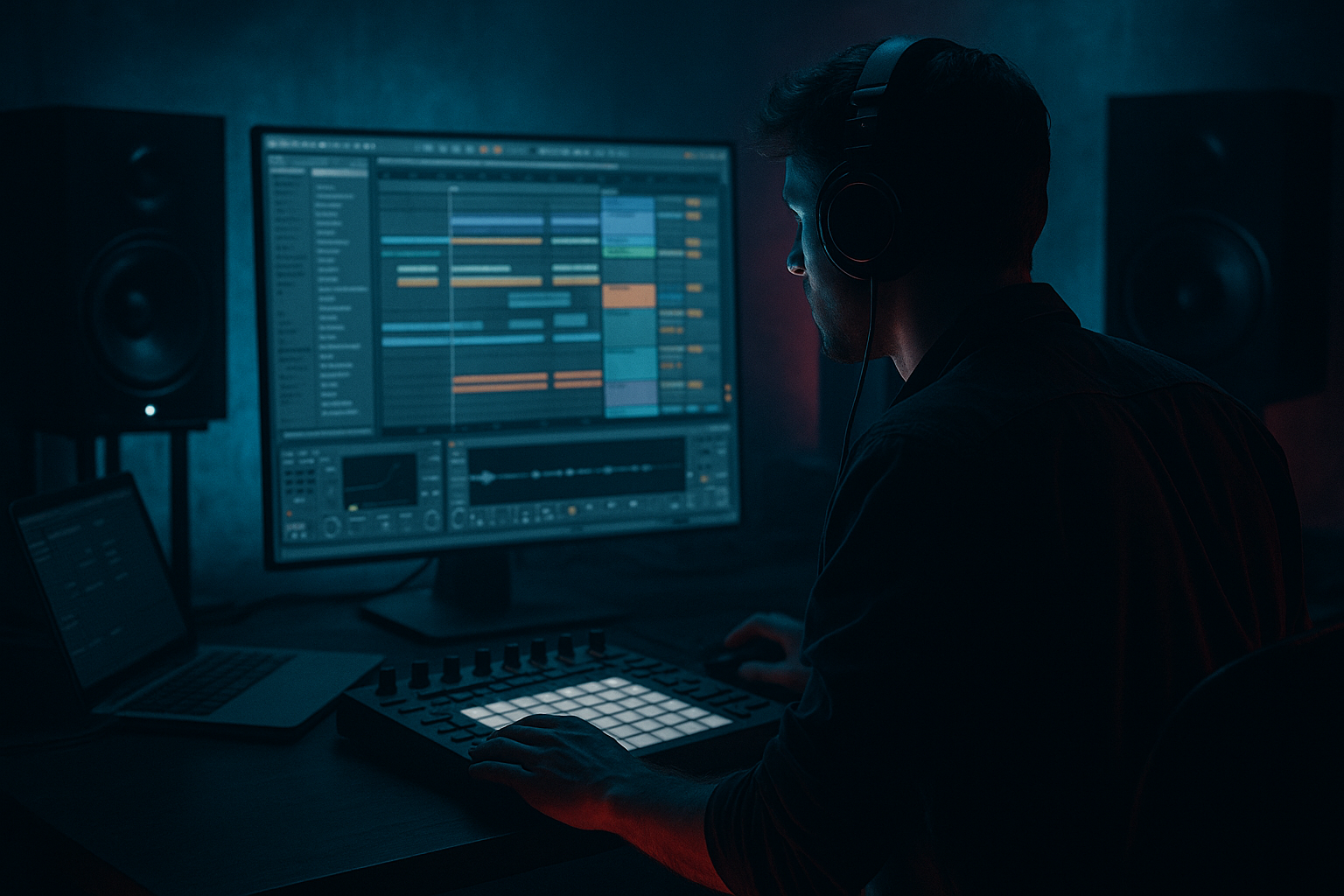
Main tutorial
Build an Amen-Style Drum Bus with an Automation‑First Workflow (Ableton Live 12)
Category: Risers (DnB/Jungle transitions using drum energy) 🥁⚡
---
1. Lesson overview
In drum & bass, riser energy doesn’t have to be a synth—a classic move is to turn your Amen-style drum bus into the riser itself: tighter, brighter, louder, more distorted, more “pulled forward” in the mix as you approach a drop.
This lesson shows a beginner-friendly way to build an Amen drum bus in Ableton Live 12 using stock devices, with an automation-first workflow so you can create rolling jungle-style builds that feel authentic and hype.
---
2. What you will build
You’ll create:
- An Amen drum bus (break sample + processing chain)
- A Riser automation system that ramps intensity over 4–16 bars
- A transition that works for jungle / liquid / rolling DnB, and can be pushed into darker/heavier territory
- A clean “base” Amen sound
- A “riser” version created with automation lanes (no need to duplicate 10 tracks)
- A repeatable workflow you can drop into any project
- HP filter (low cut): 24 dB/oct at 30–45 Hz
- Small dip (optional): 250–400 Hz if it sounds boxy (−2 to −4 dB)
- Small lift (optional): 7–10 kHz shelf +1 to +3 dB for air
- Attack: 3 ms
- Release: Auto (or 0.1–0.3s)
- Ratio: 4:1
- Threshold: aim for 2–4 dB gain reduction on peaks
- Makeup: Off (use output gain manually)
- Drive: 5–15% (start at ~8%)
- Crunch: 0–20% (start low)
- Boom: OFF for now (you’ll automate later if desired)
- Damp: adjust to avoid harshness when you push highs later
- Mode: Soft Sine (or Analog Clip for heavier)
- Drive: 2–6 dB
- Soft Clip: ON
- Keep Output so the bus doesn’t get wildly louder (gain staging matters).
- Filter Type: 12 dB or 24 dB High‑Pass
- Resonance: 0.70–1.20 (taste; don’t whistle too hard)
- Use subtle settings; this is for the build, not the drop.
- Size: Small/Medium
- Decay: 0.8–1.8s (build dependent)
- Dry/Wet: keep low (5–15%), automate later
- Bar 1: 80–120 Hz
- Bar 9: 200–300 Hz
- Bar 13: 500–800 Hz
- Bar 16 (last beat): 1.5–3 kHz (very thin = maximum tension)
- Drop (bar 17): instantly reset to 80–120 Hz (or bypass filter)
- Bar 1: 5–8%
- Bar 16: 15–25%
- Drop: snap back to 8–12% (or keep higher for heavy styles)
- Bar 1: 2 dB
- Bar 16: 6–10 dB (be careful—watch levels)
- Drop: return to 3–6 dB (depends how gritty your track is)
- Bar 1: 5%
- Bar 13: 10–15%
- Bar 16: 18–25%
- Drop: 0–5% (tight again)
- Bar 1: 0 dB
- Bar 16: +1.5 to +3 dB
- Drop: reset to 0 dB (or even -0.5 dB if the drop is huge)
- Bars 1–8: steady Amen loop, subtle filter movement
- Bars 9–12: drive + saturation rising, reverb slightly up
- Bars 13–15: intensity + rhythm density (Beat Repeat or extra slices)
- Bar 16: extreme high-pass + loudest drive + a short stutter fill
- Bar 17 (Drop): filter resets, reverb drops, transients return
- Parallel distortion (Return track)
- Make the riser “suck in” with sidechain
- Resonant high-pass “scream” near the end
- Transient control for brutality
- You built an Amen-style drum bus designed to become its own riser. 🥁
- You used an automation-first workflow: automate the bus, not 10 individual tracks.
- Core riser moves in DnB: high-pass up, drive up, reverb up, density up, then reset on the drop.
- Stock devices that do the heavy lifting: Auto Filter, Drum Buss, Saturator, Glue Compressor, EQ Eight, Hybrid Reverb, Beat Repeat, Utility.
By the end you’ll have:
---
3. Step-by-step walkthrough
Step 0 — Session setup (DnB-friendly)
1. Set tempo: 172–174 BPM (classic modern DnB).
2. Create a new MIDI/Audio arrangement section:
- 16 bars: intro/build
- 1 bar: impact/fill
- Drop: 16 bars
---
Step 1 — Load an Amen / break and warp it correctly
1. Drag an Amen break (or any classic break) into an Audio Track named: `Amen`.
2. In the clip view, set:
- Warp: ON
- Warp Mode: Beats
- Preserve: Transients
- Transient Loop Mode: Off (usually cleaner for breaks)
3. Right-click the clip → Slice to New MIDI Track (optional but powerful):
- Slicing preset: Built-in or Transient
- This gives you a Drum Rack with slices, great for fills later.
Beginner tip: If slicing feels like too much right now, keep it as one audio loop and proceed—everything still works.
---
Step 2 — Route to a Drum Bus (your “Amen Riser Bus”)
1. Create a Group Track or an Audio Return style bus:
- Easiest: Select the Amen track → Cmd/Ctrl+G to group.
- Name the group: `AMEN BUS`.
2. Keep your `Amen` track inside the group, unprocessed or lightly processed.
Why group? Because you’ll automate the bus once, and the whole break responds like a riser.
---
Step 3 — Build the Amen Bus device chain (stock devices)
On the AMEN BUS (the group track), add devices in this order:
#### 1) EQ Eight (clean-up + riser-ready tone)
#### 2) Glue Compressor (classic “break glue”)
#### 3) Drum Buss (punch + dirt)
#### 4) Saturator (controlled extra aggression)
#### 5) Auto Filter (your main “riser” tool)
#### 6) (Optional) Hybrid Reverb (space as tension)
---
Step 4 — Automation-first workflow (the “riser macro plan”) 🎛️
You’re going to automate a few parameters only, but they’ll create a big lift:
Automate on the AMEN BUS:
1. Auto Filter Frequency (main build)
2. Drum Buss Drive (intensity)
3. Saturator Drive (harmonic hype)
4. Hybrid Reverb Dry/Wet (space/tension)
5. Utility Gain (final lift into the drop)
#### Create automation lanes (Arrangement View)
1. Hit A to show automation lanes.
2. On the AMEN BUS, choose each parameter and draw ramps.
---
Step 5 — Draw a classic 16‑bar Amen riser (practical values)
Let’s assume a 16‑bar build into a drop at bar 17.
#### 1) Auto Filter (High‑Pass) Frequency
This makes the drums feel like they’re “lifting” and losing low-end before the drop hits.
#### 2) Drum Buss Drive
#### 3) Saturator Drive
#### 4) Hybrid Reverb Dry/Wet
#### 5) Utility Gain (tiny lift = huge perceived energy)
Add Utility at the end of the chain.
Important: If you automate gain up, make sure your limiter on the master isn’t destroying the transient feel.
---
Step 6 — Add Amen-style “riser rhythm” with clip edits (beginner-friendly)
A riser isn’t only tone; it’s also density.
If you sliced to Drum Rack:
1. Duplicate your build clip.
2. In bars 13–16, add:
- More ghost notes
- Faster retriggering on a snare slice
- A classic jungle “rush” in the final bar (16th notes → 32nd notes feel)
If you’re using the audio loop (not sliced):
1. Duplicate the Amen clip and in the last 4 bars:
- Use Beat Repeat on the AMEN BUS:
- Interval: 1 Bar → automate to 1/2 → 1/4 near the end
- Grid: 1/8 → 1/16
- Variation: 10–20%
- Chance: 20–40% (or automate to 100% for last bar)
2. This creates that classic “break gets frantic before the drop” vibe. 😈
---
Step 7 — Arrangement idea: DnB transition that lands hard
A reliable pattern:
Optionally: add a crash / reverse cymbal right at bar 17 for extra impact.
---
4. Common mistakes
1. Over-automating everything
Pick 3–5 key parameters. Too many moving parts gets messy fast.
2. No reset at the drop
If your filter/reverb stays “riser-y,” the drop won’t feel like it hits.
3. Clipping the bus while “making it exciting”
Drive + saturation + gain automation can explode levels. Watch the channel meter.
4. High-pass too early / too extreme
If you thin the break at bar 4, you’ve got nowhere to go by bar 16.
5. Reverb on the low end
Keep reverb mostly on mids/highs (use EQ Eight before/after reverb if needed).
---
5. Pro tips for darker/heavier DnB 🖤
- Create a Return track `DIST`.
- Add Saturator (Analog Clip) → EQ Eight (cut lows below 150 Hz) → Compressor
- Send the AMEN BUS into it and automate the send up in bars 13–16.
- Add Compressor on AMEN BUS sidechained to your kick (or a ghost kick).
- As the build progresses, automate the sidechain amount slightly up to increase pumping tension.
- On Auto Filter, automate Resonance from ~0.8 to 1.4 only in the last 1–2 bars.
- Keep it musical—too much resonance can whistle painfully.
- Use Drum Buss Transients (if you use it) or Glue attack adjustments:
- Slightly slower attack = more snap
- Faster attack = tighter, more crushed build (great for neuro-ish vibes)
---
6. Mini practice exercise (15 minutes)
1. Make a 8-bar build into a 1-bar fill.
2. Use ONLY these automations on AMEN BUS:
- Auto Filter Frequency (HP)
- Drum Buss Drive
- Hybrid Reverb Dry/Wet
3. In the last bar, add Beat Repeat and automate:
- Interval from 1/2 to 1/4
- Chance from 30% → 100%
4. Export a short loop (build + drop) and listen on low volume:
- Does the drop feel bigger than the build? If not, reset harder at the drop.
---
7. Recap
If you want, tell me whether you’re working with a full Amen loop or a sliced Drum Rack, and what substyle (jungle, liquid, neuro, jump-up). I can suggest a specific 16-bar automation curve and a matching fill pattern.

