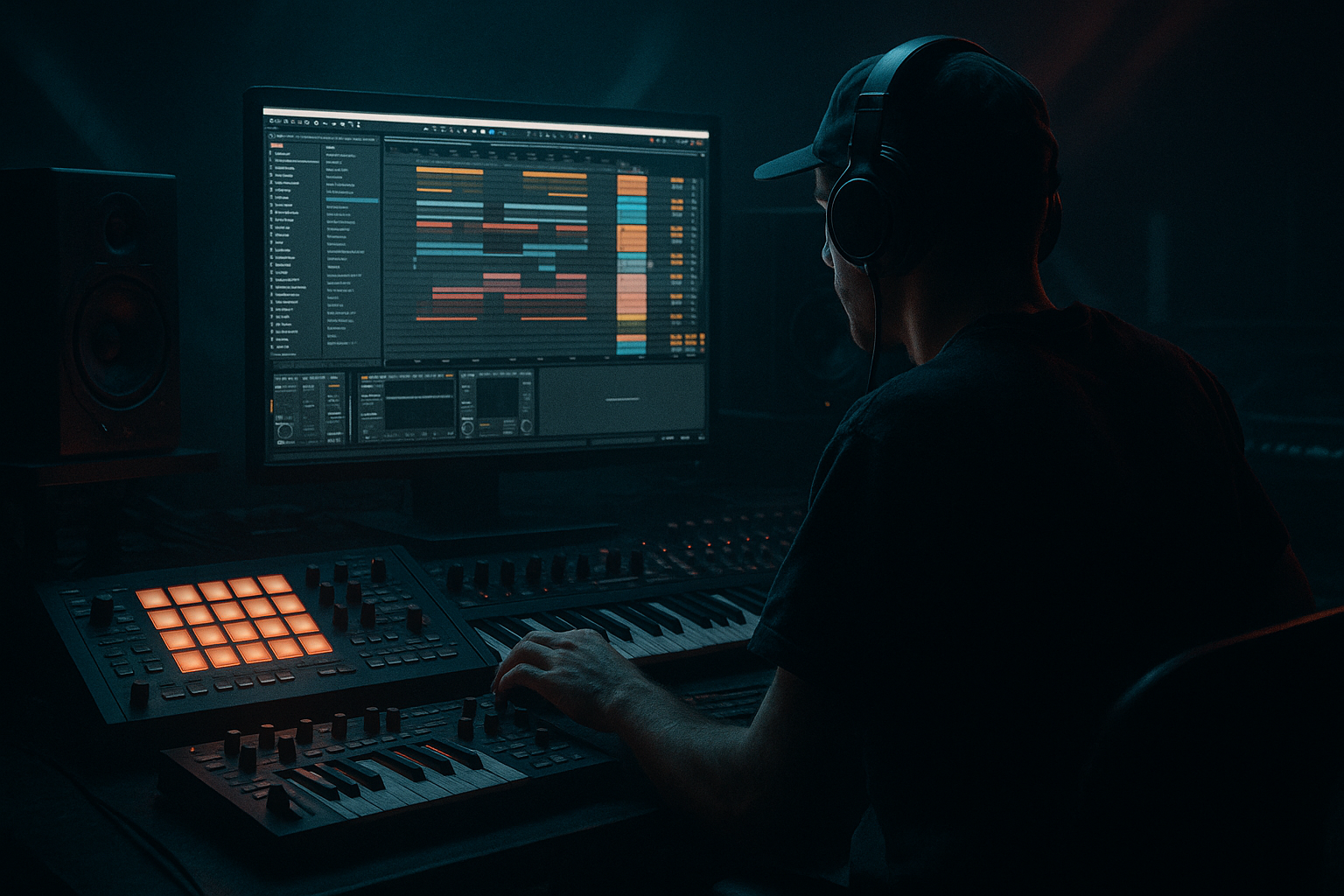
Main tutorial
Lesson Overview
An Amen-style fill is one of the fastest ways to inject 90s jungle darkness into a modern Drum & Bass arrangement. In Ableton Live 12, the goal is not just to chop a break for the sake of energy — it’s to create a controlled burst of tension that feels like it came from an old sampler, then drops back into the grid with authority.
In a dark DnB track, this kind of fill usually appears at the end of an 8-, 16-, or 32-bar phrase, right before a drop repeat, breakdown, bass switch-up, or vocal re-entry. It works especially well when the track is already built around:
- a heavy sub / reese foundation,
- sparse, threatening drum language,
- and a strong vocal hook or spoken phrase that needs a moment of interruption before coming back in.
- chopped Amen break fragments,
- pitch-smudged ghost notes,
- a short vocal hit or atmosphere slice for character,
- subtle distortion and transient control,
- and a final re-entry that slams back into a bass-heavy drop.
- bar 1: break starts to disintegrate,
- bar 2: vocal fragment / reversed texture / final snare accent,
- next bar: full drums and bass return with impact.
- Overfilling the bar
- Quantizing everything perfectly
- Using too much low end in the fill
- Making the vocal too lyrical
- Heavy distortion without transient control
- No arrangement purpose
- Use contrast between dry and haunted
- Automate width carefully
- Layer a low-tuned tom or rim with the break
- Try short reverse vocal tails
- Use frequency gaps as tension
- Resample with mild saturation
- Let the re-entry be simpler than the fill
- Build the Amen fill around a clear phrase transition, not random chopping.
- Keep the break slightly human with micro-timing and selective groove.
- Use a short vocal element to give the fill identity and tension.
- Shape the drum bus with Drum Buss, Saturator, EQ, and light resampling.
- Automate filter, reverb, delay, and width for movement and impact.
- Let the fill create space for the bassline and vocal return.
- In dark DnB, the best fills feel like a temporary breakdown of control before the track slams back harder.
Why this technique matters: in 90s-inspired jungle and darker rollers, the fill is often the moment of identity. It signals “this isn’t clean club DnB — this is broken, tense, and alive.” If you build it correctly, the fill can carry the same emotional weight as a lead synth stab or vocal chop, while still keeping the mix tight enough for modern systems.
What You Will Build
You’ll build a 2-bar Amen-style fill in Ableton Live 12 that combines:
The finished result will feel like a dark 90s jungle splice translated into a modern DnB arrangement: gritty, syncopated, slightly unstable, but still punchy and readable. The fill will have a “panic then release” feel — ideal for leading into a sub drop, a vocal callback, or a switch-up in a roller.
Musically, think of it as:
Step-by-Step Walkthrough
1. Set up the phrase and choose the transition point
Before editing audio, decide where the fill lives in the arrangement. In dark DnB, the most effective place is usually:
- the last 2 bars of a 16-bar loop,
- the final 1 bar before a drop repeats,
- or the turnaround before a vocal phrase returns.
In Ableton Live 12, drop a locator at the transition point and make sure your Session or Arrangement view is aligned to a clear phrase structure. For a classic tension move, use an 8-bar buildup into a 2-bar fill so the listener feels the break from regular groove into chaos.
If the track has vocals, plan the fill around a vocal gap. The best option is often to let the main vocal phrase end, then use the fill as a response gesture before the next vocal line or instrumental hit. This gives the fill a narrative role, not just a rhythmic one.
2. Start with a classic Amen source and warp it for control
Drag an Amen break sample into an audio track. Use a clean source with enough transient detail to survive chopping. Switch Warp on and test Beats mode first for tight transient handling.
Useful starting points:
- Beats mode: 1/16 or 1/32 segmentation for crisp chop control
- Transients amount: around 20–40 for preserving the attack
- Preserve: 0–30 ms if the break already has useful tail character
For a more authentic 90s feel, don’t quantize everything perfectly. Use Ableton’s warp markers to keep the groove slightly human. Push a couple of slices a few milliseconds late so the fill leans backward like old sampler edits. That tiny drag helps the fill feel darker and less polished.
Why this works in DnB: Amen-style fills rely on micro-swing and transient contrast. If every hit lands with digital precision, the break loses the unstable energy that made jungle break edits feel dangerous in the first place.
3. Chop the break into a playable rhythm
Convert the audio to a Drum Rack or duplicate the audio clip into smaller slices. In Live 12, you can use slicing creatively, but for this workflow keep it simple and fast:
- Slice to a new MIDI track using transient markers,
- or manually duplicate a few selected hits into an audio lane.
Build a 2-bar fill with a clear phrase shape:
- Bar 1: kick/snare punctuation with one or two fast ghost notes
- Bar 2: denser snare/break fragments, ending in a final accent or vocal chop
A strong advanced pattern idea:
- start with a snare hit on beat 2,
- add a ghost kick or broken kick-tom hit just before beat 3,
- place a fast 1/16 or 1/32 snare drag into the downbeat of bar 2,
- finish with a late snare or rim hit into the first beat of the next section.
Keep the edit musical, not random. The best fills create anticipation through fragmentation. You’re not trying to showcase every slice — you’re shaping a tension curve.
4. Add a vocal texture as the “human” interruption
Since the category emphasis here is vocals, use a short vocal element to make the fill feel intentional and memorable. This doesn’t have to be a full lyric. In dark DnB, a single word, breath, chant, or chopped syllable can be enough.
Good vocal sources:
- a spoken word phrase,
- a whispered line,
- a reversed breath,
- a chopped “no,” “go,” “stay,” or “again”-type word,
- or even a heavily processed consonant like “t,” “k,” or “s.”
Place the vocal slice at one of these moments:
- just before the fill starts,
- between snare hits in bar 2,
- or as a final pickup before the drop returns.
Process it with stock Ableton devices:
- Redux for gritty aliasing: try 8–12 bit, with downsample kept moderate
- Grain Delay very lightly for texture and smear
- Auto Filter with a band-pass or high-pass sweep
- Reverb with short decay for a distant, haunted tone
Parameter suggestions:
- Auto Filter cutoff: automate from around 300 Hz up to 2–6 kHz
- Reverb decay: 0.8–1.8 s
- Dry/Wet: 8–20% for subtle atmosphere, not wash
This gives the fill a “vocal ghost” quality, which is ideal for 90s-inspired darkness. It makes the fill feel like a memory of a rave MC, a warning, or a call-and-response stab from the shadows.
5. Shape the drum layer with transient control and grit
Route the Amen slices to a drum group and shape them with stock effects. The main objective is to keep the fill aggressive without exploding your mix.
Start with Drum Buss on the group:
- Drive: 5–15%
- Boom: very subtle, often 0–10% or off if the low end gets muddy
- Transient: +5 to +20 for more crack
- Crunch: use sparingly if you want that worn sampler edge
Add Saturator before or after Drum Buss depending on the tone you want:
- Soft Clip: On
- Drive: 2–6 dB
- Color: try a low-to-mid emphasis if the break feels thin
Then use EQ to carve space:
- high-pass nonessential pieces around 120–180 Hz if your sub is active,
- reduce boxiness around 300–500 Hz if the break clouds the bass,
- gently notch harshness around 3–6 kHz if the fill gets painful.
If you want the fill to have a more authentic sampler edge, use Redux lightly on the break group:
- sample rate reduced just enough to add grain, not destroy the transients
- keep the output balanced with gain staging so it doesn’t dominate the drop
The key is contrast: the fill should sound more raw than the main drum loop, but not so crushed that it loses shape.
6. Use automation to make the fill feel like a transition event
The difference between a chopped break and a proper DnB fill is automation. In Ableton Live 12, automate parameters so the fill evolves across the two bars.
Strong automation moves:
- Auto Filter cutoff rising on the vocal slice or break group
- Reverb send increasing only on the final 1/4 or 1/2 bar
- Delay feedback spiking briefly for a dubby tail
- Drum Buss drive increasing slightly into the final hit
- Utility width narrowing before the drop, then reopening on the return
Practical example:
- Bar 1: vocal slice is dry and close
- Bar 2: cutoff opens, delay feedback rises to 20–35%, then snaps back
- Final 1/8 bar: cut everything except the last snare and a short reverb tail
For dark DnB, abrupt transitions often hit harder than smooth ones. A quick filter move followed by a hard stop can feel more menacing than a long riser. That’s especially true if your bassline is already busy or the arrangement needs a stronger switch-up.
7. Tie the fill to the bassline so the transition feels engineered, not pasted on
A powerful Amen-style fill should interact with the bass, not ignore it. In advanced DnB production, the fill often creates space for a bass response.
Try this:
- mute or thin the bass for the first half of the fill,
- let a sub tail or bass stab answer the final snare,
- then bring the full bassline back on the drop.
If you’re using a reese or mid-bass layer, automate its filter or volume so it ducks under the fill and then surges back. In modern darker rollers, this call-and-response with bass is crucial because the fill acts like a mini breakdown inside the drop.
Useful Ableton tools:
- Utility for quick mono/width control on bass layers
- Auto Filter on the bass bus for a narrow tension sweep
- Compressor sidechained from the kick/snare only if needed, but don’t over-flatten the fill
Musical context example: if your track has a sparse vocal hook every 8 bars, use the fill to clear space for that hook’s return. The Amen fragments can “speak” underneath the vocal, then the vocal comes back with more impact because the drum break created a moment of controlled instability.
8. Print, resample, and commit the character
For an advanced workflow, don’t leave every layer endlessly editable. Route the fill to a new audio track and resample it. This is where the magic of old-school jungle workflow comes alive inside Ableton.
Once resampled:
- consolidate the final 2-bar fill,
- trim silence,
- and make tiny warp adjustments only if necessary.
Then layer the resampled fill with a second pass:
- one cleaner break layer for punch,
- one dirtier layer for texture,
- one vocal fragment for identity.
You can even offset one layer by a few milliseconds to create width and tension. Just check mono compatibility. The fill should feel wide and degraded in the moment, but still collapse cleanly into the center when the drop returns.
This is where your decisions matter: commit to a version, bounce it, and move on. Dark DnB fills get stronger when they have the confidence of an edited performance rather than endless microscopic tweaking.
Common Mistakes
- Problem: too many slices, no breathing room.
- Fix: leave at least one clear gap or held tail so the fill has shape.
- Problem: the break sounds stiff and modern, not jungle-dark.
- Fix: nudge a few slices late or early by a few ms for groove.
- Problem: the sub gets muddy right before the drop.
- Fix: high-pass break and vocal layers; let the actual bass own the low end.
- Problem: it sounds like a hook instead of a transition device.
- Fix: use a short phrase, breath, or chopped consonant that supports the fill.
- Problem: the break turns into noisy mush.
- Fix: shape with Drum Buss, transient design, and EQ before adding more crunch.
- Problem: the fill sounds cool but doesn’t change the section energy.
- Fix: use it to lead into a bass re-entry, vocal return, or drum switch-up.
Pro Tips for Darker / Heavier DnB
- Keep the first hit of the fill relatively dry, then throw the final vocal chop into reverb or delay. That contrast feels old-school and cinematic.
- Narrow the drum bus slightly before the drop, then restore width on the first downbeat. This makes the return feel bigger without needing more elements.
- A subtle tom hit around -6 to -12 dB under the Amen can make the fill feel more ritualistic and less generic.
- Reverse a spoken word or breath into the fill and filter it aggressively. This is a strong “pull into the void” move for darker styles.
- Pull some energy out around 200–400 Hz on the fill, then let the full mix return with that body restored. The listener perceives more impact than if everything stays full all the time.
- Printing the fill through a lightly driven chain gives it a more complete, cohesive feel than stacking pristine layers forever.
- If the fill is chaotic, the return should be clean. That contrast is what makes the drop feel hard.
Mini Practice Exercise
Spend 15 minutes building a 2-bar Amen-style fill in one project:
1. Load an Amen break and slice it into playable fragments.
2. Create a 2-bar fill at the end of an 8- or 16-bar phrase.
3. Add one vocal fragment: a breath, spoken word, or chopped syllable.
4. Process the drum group with Drum Buss and a light Saturator.
5. Automate an Auto Filter sweep on the vocal or break group.
6. Resample the fill to audio.
7. Make two versions:
- Version A: cleaner and punchier
- Version B: dirtier and more degraded
8. A/B them in context with the bassline and choose the one that creates the strongest return into the drop.
Limit yourself to stock Ableton devices and finish the exercise with a single committed take. The goal is not perfection — it’s making a fill that changes the emotional temperature of the arrangement.

