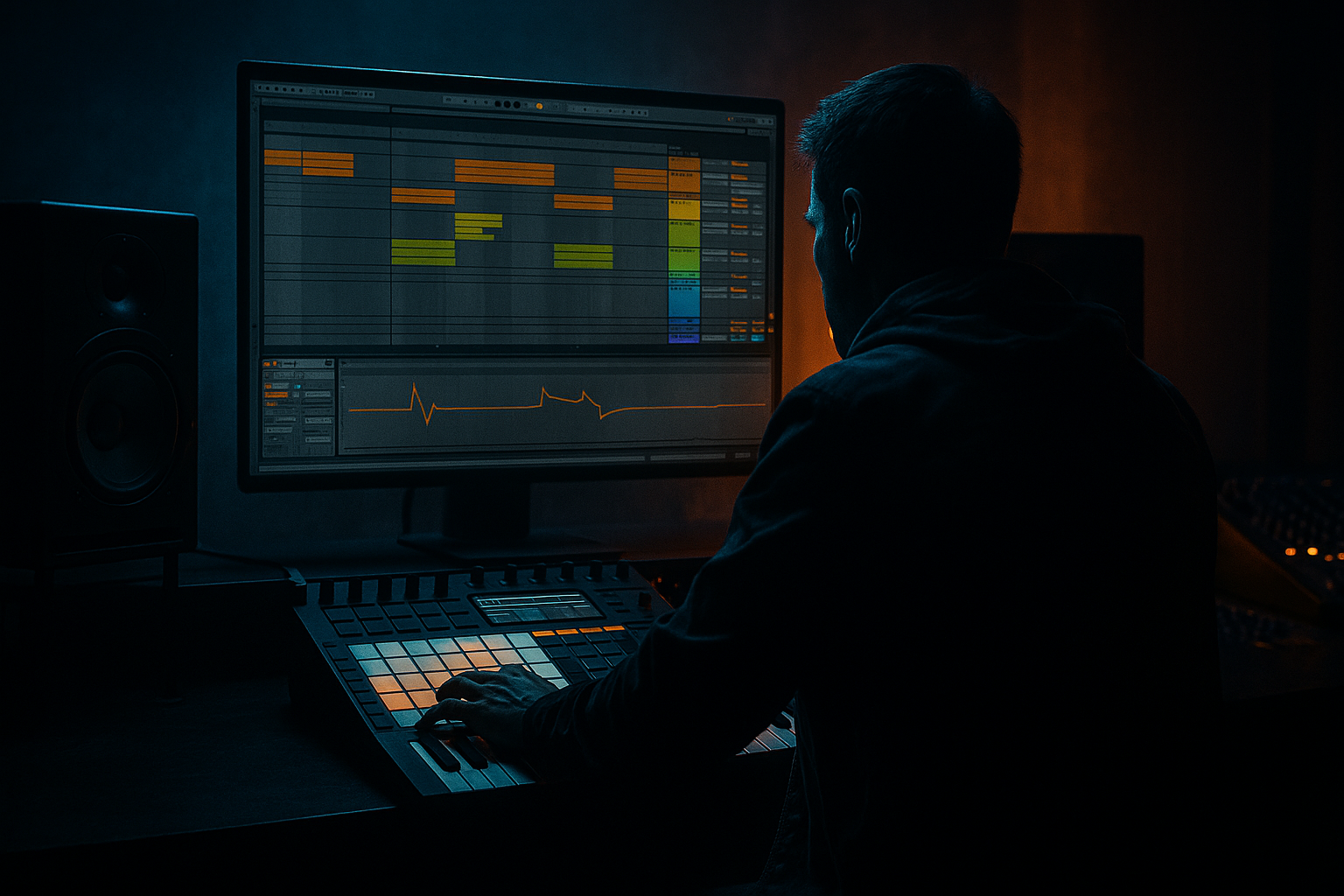
Main tutorial
Build a Jungle Breakbeat for Smoky Warehouse Vibes in Ableton Live 12
1. Lesson overview
In this lesson, you’ll build a classic jungle-style breakbeat in Ableton Live 12 that feels dusty, dark, and warehouse-ready 🥁🌫️
We’re aiming for that smoky DnB / jungle energy:
- chopped-up breakbeat movement
- punchy kick/snare drive
- ghost notes and shuffle
- gritty drum texture
- enough space for a rolling bassline to sit underneath
- use a break loop as raw material
- slice and rearrange it
- layer drums for impact
- process drums with stock Ableton devices
- create a loop that can later become a full DnB arrangement
- a main chopped break
- a solid kick and snare backbone
- ghost hits and tiny variations
- dirty processing for atmosphere
- room for a sub-bass / reese bassline
- warehouse atmosphere
- late-night jungle tension
- rolling DnB momentum
- Tempo: `170 BPM` to `174 BPM`
- `172 BPM`
- Ableton’s Core Library drum loops
- any clean break loop you already have
- a recorded drum loop from a sample pack
- clear kick and snare
- some hat movement
- a slightly human feel
- amen-style breaks
- funky drummer-style breaks
- dusty old soul breaks
- Warp = ON
- Warp Mode = Beats
- make sure the break is locked to the grid
- if the timing drifts, adjust the transients or warp markers
- Preserve: `Transients`
- Transient Loop Mode: `Off` or `Forward`
- Loop Brace: adjust so the loop is exactly 1 or 2 bars
- Slice to New MIDI Track
- Transient
- or 1/16 if the break is already very clean
- rearrange slices
- repeat tiny hits
- create variation
- make ghost notes and fills
- Kick: strong on beat 1
- Snare: strong on beat 2 and 4
- Break fragments: fill the spaces between
- Kick slice on 1
- Snare slice on 2
- Hat/ghost slice after 2
- Kick or break hit before 3
- Snare slice on 4
- small fill at the end
- same backbone
- add one extra break chop or drum roll
- vary one ghost hit to keep it alive
- quiet snare taps
- tiny kick stabs
- small hat hits
- accidental-sounding break fragments that actually groove hard
- lower velocities on smaller hits
- place them just before or after the main snare
- use them to make the loop breathe
- just before beat 2
- just after beat 2
- just before beat 4
- on the “and” of 4 leading back to bar 1
- main snare: 110–127
- ghost hits: 20–60
- select notes
- use Quantize
- then back off the strictness if needed
- 1/16 grid
- 50% to 75% quantize strength if you use adjustable quantize
- low fundamental
- little tail
- not too much click
- sharp transient
- body around the low mids
- some crack in the top end
- punch
- consistency
- translation on big systems
- break main loop: primary character
- kick/snare layer: support and weight
- Drive: 5–15%
- Crunch: low to medium
- Boom: very subtle or off at first
- Damp: adjust to tame harsh hats
- Transient: slightly up for punch
- high-pass below 25–35 Hz
- reduce muddy buildup around 200–400 Hz if needed
- small boost around 2–5 kHz for snare crack if the loop needs it
- soften harshness around 7–10 kHz if hats become brittle
- Soft Clip = ON
- Drive: 2–6 dB
- Output adjusted to avoid clipping too hard
- Attack: 10 ms
- Release: Auto or 0.3 s
- Ratio: 2:1
- Gain Reduction: 1–3 dB
- Bit depth reduction: subtle
- Downsample: tiny amounts only
- Noise mode or sine mode
- very small amounts
- automate slightly for variation
- Echo
- low feedback
- filtered delay
- very quiet send amount
- Groove Pool
- swing from a drum groove
- or manually shift certain ghost notes
- nudge hi-hats slightly late
- leave snares mostly locked
- make tiny pickup hits early for tension
- filtered break
- lighter kick/snare
- less low end
- bring in full drums
- add layer kick/snare
- increase energy
- remove one snare ghost
- add a fill at the end of bar 6
- automate filter or saturation slightly
- quick drum roll
- snare fill
- pause or half-bar drop into bass section
- drums: punch and body
- bass: sub weight and low-mid movement
- Hybrid Reverb or Reverb
- high-pass the return
- low-pass the return
- keep it quiet
- EQ
- saturation
- high-pass or band-pass filtering
- Drum Buss Drive
- filter cutoff
- send to Echo/Reverb
- snare layer volume
- easier to chop further
- easier to process as one unit
- helps you commit to a vibe
- choose a suitable break
- warp it correctly
- slice it into MIDI
- program a groove with ghost notes and variation
- layer kick and snare for power
- process with Ableton stock devices like Drum Buss, EQ Eight, Saturator, Glue Compressor, Redux, and Erosion
- add swing and arrangement movement for real DnB energy
- chop placement
- velocity changes
- subtle distortion
- break layering
- arrangement variation
This is perfect for beginner producers because you’ll learn how to:
We’ll stay inside Ableton Live 12 stock tools so you can follow along without extra plugins.
---
2. What you will build
By the end, you’ll have a 2-bar jungle breakbeat loop that includes:
This loop will feel more like:
and less like a clean pop drum loop.
---
3. Step-by-step walkthrough
Step 1: Set your project tempo
For jungle and drum and bass, start here:
For this lesson, use:
That’s a classic sweet spot for jungle / amen-style energy.
---
Step 2: Find a breakbeat source
You need a drum break to chop.
Good options:
Look for breaks with:
Examples of classic breakbeat feel:
Drag your break into Audio Track 1.
---
Step 3: Warp the break correctly
Click the loop and open Clip View.
Set:
Then:
For a drum loop, Beats mode is usually the best starting point because it keeps transients punchy.
#### Quick settings:
If the break sounds too smeared, reduce unnecessary warp markers.
If it’s too loose, add one at the downbeat.
---
Step 4: Slice the break into MIDI
Now we’ll turn the break into playable pieces.
Right-click the audio clip and choose:
Use:
Ableton creates a Drum Rack with each slice mapped to pads.
This is huge for jungle because now you can:
---
Step 5: Build the core drum pattern
Create a new MIDI clip on the sliced Drum Rack track.
Start with a simple 2-bar pattern.
#### Basic jungle pulse:
If you’re using a classic break, try this approach:
#### Bar 1
#### Bar 2
Don’t make it too perfect.
Jungle sounds exciting because the groove pushes and stumbles at the same time.
---
Step 6: Use Ghost Notes for movement
Ghost notes are a huge part of smoky jungle drums.
These are:
In the MIDI editor:
#### Good ghost note placements:
Aim for velocity values like:
This contrast gives the beat depth.
---
Step 7: Quantize lightly, not fully
Beginner mistake: making jungle drums too rigid.
Try this:
A great setting is:
If the groove feels dead, leave some hits slightly late or early.
Jungle often sounds best when it’s tight but not sterile.
---
Step 8: Layer a clean kick and snare
Even if you’re using a break, adding reinforcement makes the drums hit harder.
Create two new audio or MIDI tracks:
#### Kick layer
Use a short punchy kick:
#### Snare layer
Use a snare with:
You can use stock samples from Ableton’s library.
#### Why layer?
Because the break gives character, but the layer gives:
#### Suggested balance:
---
Step 9: Shape the drum sound with stock Ableton devices
Now we process the drums.
Put these on your break or drum bus:
#### 1. Drum Buss
This is excellent for DnB drums.
Try:
Use it gently. It can glue and energize the break fast.
#### 2. EQ Eight
Use EQ to clean the drums.
Suggested moves:
#### 3. Saturator
Great for grime and density.
Try:
This helps the beat feel thicker and more warehouse-like.
#### 4. Glue Compressor
If your drum bus feels too loose, use subtle compression.
Settings to start:
Do not crush the break flat. Keep movement.
---
Step 10: Add dirt and atmosphere
Smoky warehouse vibes are not just about the groove — they’re about texture 🌫️
Add a little grime with stock tools:
#### Option A: Redux
Use lightly to add grit.
#### Option B: Erosion
Use this on hats or upper percussion to add dust.
#### Option C: Vinyl-like ambience with Echo
Not on the drums too much, but a tiny send can create depth.
Set up a return track with:
This gives the break a humid, shadowy space.
---
Step 11: Create swing and shuffle
Jungle and DnB drum patterns live or die by the feel.
In Ableton, try:
Good workflow:
1. drag a groove onto the MIDI clip
2. keep the groove amount modest
3. listen for bounce, not sloppiness
You can also:
That contrast helps the beat roll.
---
Step 12: Use arrangement ideas for a real track feel
A drum loop is nice, but a DnB track needs arrangement energy.
Try this 8-bar idea:
#### Bars 1–2: Intro drums
#### Bars 3–4: Full break
#### Bars 5–6: Variation
#### Bars 7–8: Transition
This sets up the classic jungle “something is coming” feeling.
---
4. Common mistakes
1. Making the break too clean
Jungle should feel alive, not polished to death.
If every hit is perfectly aligned, the groove can lose character.
2. Over-compressing the drums
Too much compression flattens the break.
Keep some punch and transient movement.
3. Using too many layers
If you stack five kick samples, the loop may lose clarity.
Start with one break + one kick + one snare layer.
4. Ignoring the low end
Your drum loop must leave space for the bassline.
Cut unnecessary sub rumble from drums.
5. Too much distortion
A little grit is great.
Too much saturation can destroy transient impact and make hats painful.
6. No variation
A 2-bar loop that repeats identically can get boring fast.
Change one ghost note, one fill, or one snare hit every 2 or 4 bars.
---
5. Pro tips for darker/heavier DnB
Tip 1: Make room for the bass from the start
Use EQ to keep the drum bus clean below the low bass region.
A good rule:
If your kick is too long, shorten it.
---
Tip 2: Use filtered ambience behind the break
Put a subtle reverb or delay on a return, then filter it.
Try:
This creates that misty, industrial warehouse depth.
---
Tip 3: Layer a second, darker break
Blend a second break quietly underneath the main one.
Process it with:
This adds texture without stealing focus.
---
Tip 4: Automate drum intensity
In darker DnB, the drums often evolve.
Automate:
Tiny movement = more tension.
---
Tip 5: Use resampling
Once your beat sounds good, resample it into audio.
Why?
This is very common in jungle workflow.
---
6. Mini practice exercise
Exercise: Build a 2-bar smoky jungle loop
Do this:
1. Set tempo to 172 BPM
2. Load one break loop
3. Slice it to MIDI
4. Program a 2-bar pattern with:
- 2 strong snares
- 2 solid kicks
- 4 ghost hits
- 1 small fill at the end
5. Add:
- Drum Buss
- EQ Eight
- Saturator
6. Make one version:
- cleaner
7. Make a second version:
- darker and dirtier
8. Compare them and choose the one that feels more like a warehouse rave
Challenge
Try making the second bar slightly more active than the first.
That’s a simple but very effective DnB arrangement trick.
---
7. Recap
You now know how to build a smoky jungle breakbeat in Ableton Live 12:
The big idea is this:
> Jungle drums should feel powerful, dirty, and alive — not perfectly neat.
Keep experimenting with:
That’s how you get from a loop to a proper dark drum and bass foundation 🥁🔥
If you want, I can also write the next lesson:
“Build a Reese bassline in Ableton Live 12 for this jungle drum loop.”

