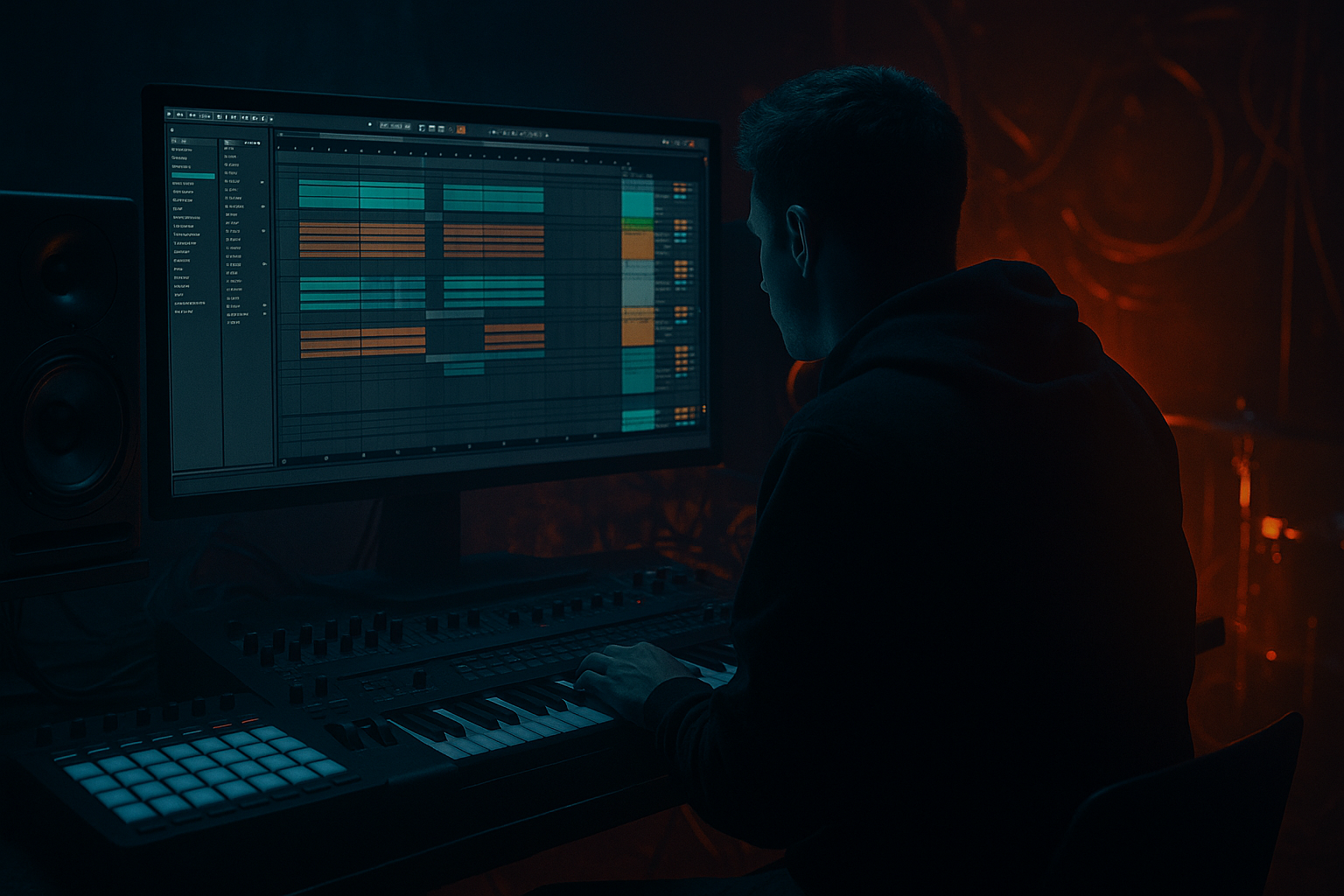
Main tutorial
```markdown
Build-up Mute Automation (DnB in Ableton Live) 🎛️🔇
1) Lesson overview
Build-ups in drum & bass are all about tension and release. One of the most effective (and beginner-friendly) ways to create tension is mute automation—strategically cutting key elements so the drop hits harder.
In this lesson you’ll learn multiple ways to do mute automation in Ableton Live (clean, reliable, and DJ-friendly), plus exactly what to mute in a rolling DnB context.
---
2) What you will build
A 16-bar DnB build-up that leads into a drop, using:
- Mute-style automation on drums, bass, and FX
- A tight “suck-out” moment right before the drop (classic jungle/DnB tension)
- A workflow that keeps your mix clean and avoids clicks/pops
- Bars 1–8: rolling groove, small mutes
- Bars 9–14: more aggressive stripping
- Bars 15–16: near-silence, then drop
- DRUMS (Kick, Snare, Hats, Percs, Break)
- BASS (Sub + Mid/Reese)
- MUSIC (Pads/Stabs)
- FX (Risers, Impacts, Noise)
- Snare on 2 & 4 feeling powerful
- Sub returning full-weight
- Top-end returning crisp
- Sub (biggest impact)
- Kick (often in DnB the snare drives the perceived drop)
- Hats/top loop (makes the drop feel wider when it returns)
- Break layer (for jungle vibes)
- On DRUMS Group → Utility Gain:
- On BASS Group → Utility Gain:
- Sub track (or BASS Group):
- Hats/Top loop:
- Snare:
- On MASTER (or a PRE-MASTER group) add Utility
- Automate Gain:
- On your snare track:
- During bar 16, mute the DRY drums (Utility Gain down)
- But let the return keep ringing (don’t mute returns)
- Highlight your 16-bar build-up
- Copy automation shapes between similar tracks:
- Use Breakpoints:
- Use Automation Shape tools:
- Mute the sub first, not the reese
- Add a low-pass “closing in” while you mute
- Distortion tail trick
- Silence + impact is the real drop multiplier
- Use jungle-style break gaps
- The most reliable “mute automation” in Ableton for DnB builds is Utility Gain automation 🔧
- Strip energy in stages: tease → reduce → near-silence → drop
- Keep momentum (often snare) while removing weight (sub) and width (tops)
- Use reverb tails and tiny fade ramps to avoid clicks and keep it pro
- A short, well-timed silence is one of the strongest build-up tools in drum & bass 🔥
You’ll end up with something like:
---
3) Step-by-step walkthrough
Step 0 — Set the context (quick session setup)
Tempo: 172–176 BPM
Typical DnB groups:
Pro workflow: Group tracks now (Cmd/Ctrl + G). This makes build automation way easier.
---
Step 1 — Choose your mute automation method (3 solid options)
You can “mute” in Ableton in a few ways. Here are the best practical choices:
#### Option A (Recommended): Utility gain automation 🔧
This is the cleanest for builds because it avoids clicking and you can shape fades.
1. On the track you want to mute (or on a Group), add Audio Effects → Utility
2. In Arrangement View, press A to show automation lanes
3. Choose automation parameter: Utility → Gain
4. Draw automation down to -inf dB (full mute) or partial cuts like -6 to -18 dB
Why it’s great: Smooth fades, no hard cuts, very controllable.
---
#### Option B: Track Volume automation
1. Press A
2. Select the track’s automation lane: Mixer → Track Volume
3. Draw dips
Note: Works fine, but I prefer Utility because it’s more modular and you can move/copy the device easily.
---
#### Option C: Gate with sidechain (for rhythmic “mute pumping”)
Not a true mute automation, but great for DnB motion.
1. Add Gate to a texture/pad or reese
2. Enable Sidechain
3. Feed it from a tight rhythmic source (e.g., hats)
4. Adjust Threshold so it “opens” only when desired
Use this with automation for extra groove.
---
Step 2 — Build-up plan: what to mute (DnB arrangement logic)
In DnB, the drop impact usually comes from:
So in your build-up, you’ll often remove:
---
Step 3 — Create the 16-bar build with automation moves (practical recipe)
Let’s assume your drop starts at bar 17. Your build-up is bars 1–16.
#### A) Bars 1–8: subtle “tease” mutes
Goal: keep groove but hint that something’s coming.
- Do two quick dips (like DJ-style cuts):
- Bar 4 beat 4: dip to -inf for 1/8 note
- Bar 8 beat 4: dip to -inf for 1/4 note
- Dip -6 to -10 dB for the last 1 beat of bar 8
Tip: Use Ableton’s grid at 1/8 or 1/16 for classic stutter cuts.
---
#### B) Bars 9–14: strip the groove harder
Goal: reduce density so the listener “leans in.”
- Gradually automate Utility Gain down from 0 dB → -12 dB over bars 9–14
- Mute in chunks:
- Bars 11–12: reduce -8 to -12 dB
- Bars 13–14: reduce -inf (full cut) for the last 2 beats of bar 14
- Keep the snare mostly present, but do one signature cut:
- Bar 14 beat 4: cut snare for 1/8 (sets up the final moment)
DnB feel note: Keeping snare gives “forward momentum,” while removing sub/top creates emptiness.
---
#### C) Bars 15–16: “suck-out” + silence trick (classic tension) 😮💨
Goal: make the drop feel like a wall hits.
Move 1 — Full-group mute moment
- Bar 16 beat 3 to beat 4: ramp down to -inf
- Drop at bar 17: snap back to 0 dB
Important: Instead of an instant cut, do a tiny ramp (5–20 ms) to avoid clicks.
Move 2 — Let the reverb tail speak
This is a big DnB trick: mute the dry signal, leave a tail.
1. Create a Return Track with Hybrid Reverb (or Reverb)
- Reverb time: 1.2–2.5s
- Pre-delay: 15–30ms
- High cut: 7–10 kHz (keeps it dark)
2. Send snare to that return
This creates that floating “air” right before the drop.
---
Step 4 — Add a stutter-mute fill (DnB/jungle signature) 🥁
Instead of just muting, do a controlled stutter.
Method: beat repeat on drums
1. On DRUMS Group, add Beat Repeat
2. Suggested settings:
- Interval: 1 Bar
- Grid: 1/16
- Variation: 0
- Gate: 50–70%
- Chance: 0% (we’ll automate it)
3. Automate Chance:
- Bars 15–16: ramp 0% → 30% → 60%
4. Combine with Utility mutes:
- Last 1/4 note before drop: hard cut (Utility Gain to -inf)
This makes the build feel intentional, not random.
---
Step 5 — Copy & scale the automation like a pro (fast workflow)
- Hats and Shaker often share the same mute pattern
- Sub and Mid-bass can share the same fade-down, but different depths
- Right-click automation line → Show Automation in New Lane for clarity
- Hold Alt/Option to bend curves (great for smooth fade-outs)
---
4) Common mistakes
1. Hard cuts that click
Fix: use Utility Gain ramps (tiny fades) instead of instant mutes.
2. Muting everything too early
If bars 9–12 are already empty, you have nowhere to go. Strip in stages.
3. Killing the snare energy completely
In rolling DnB, snare momentum matters. Remove sub/top more than snare.
4. Muting returns unintentionally
If you automate the master or a group that includes returns, you may kill the reverb tail. Consider a Pre-Master group for only “dry” elements.
5. Overdoing stutters
Beat Repeat is powerful—use it as a highlight, not the whole build.
---
5) Pro tips for darker/heavier DnB 😈
Leaving mid-bass texture without sub creates tension and “hunger.”
On DRUMS Group, add Auto Filter:
- Type: LP24
- Automate cutoff from 18 kHz → 2–6 kHz over the build
Combine with occasional mutes for a proper “pressure chamber” vibe.
Put Saturator on a drum parallel chain (Audio Effect Rack):
- Drive: 3–8 dB
- Soft Clip: On
Then mute the clean drums briefly while the dirt layer remains (or vice versa).
Even 1/8 note of silence before the drop can make it hit way bigger than more risers.
If you’ve got a break layer, cut it for a bar, then bring it back with a single ghost slice right before the drop.
---
6) Mini practice exercise (10 minutes) ⏱️
1. Create a basic rolling DnB loop (drums + bass) and duplicate it to 16 bars.
2. Add Utility to:
- DRUMS Group
- BASS Group
3. Draw these automations:
- Bar 8: Bass dip to -8 dB for 1 beat
- Bar 14: Hats cut to -inf for 2 beats
- Bar 16: Master/Pre-master cut to -inf for the last 1/4 note
4. Add a Hybrid Reverb return and let it ring through the silence.
5. Listen: does the drop feel bigger? If not, increase the contrast (mute deeper/longer).
---
7) Recap
If you tell me what style you’re aiming for (liquid / rollers / jump-up / neuro / jungle), I can suggest a specific 16-bar automation pattern that fits that sub-genre.
```

