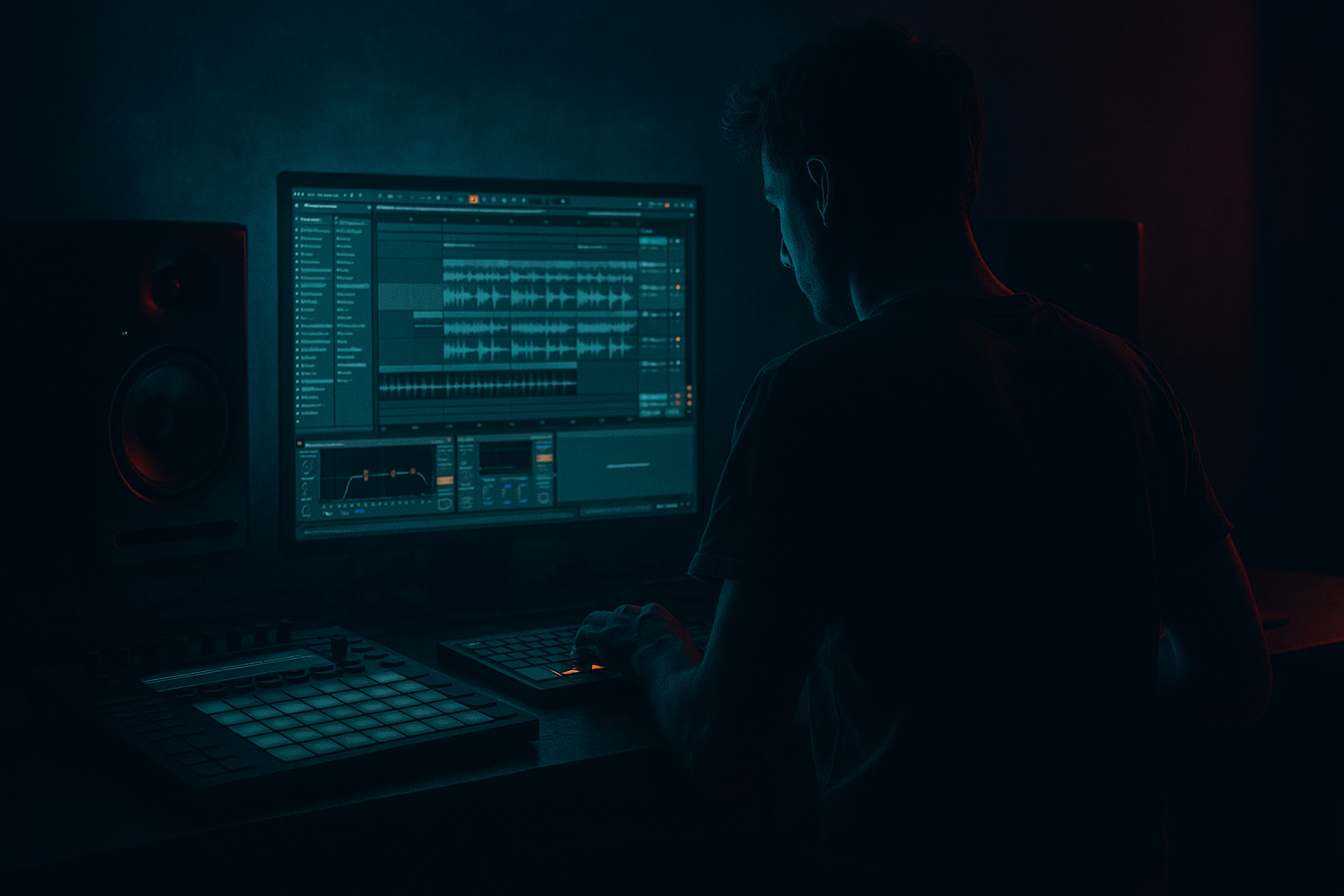
Main tutorial
```markdown
Building a Jungle Template in Ableton Live (Intermediate Workflow) 🥁🔊
1. Lesson overview
A strong jungle template lets you write faster, sound consistent, and stay inspired. In this lesson you’ll build a reusable Ableton Live template specifically for jungle / DnB: tight drum routing, fast break chopping, bass workflow, mix busses, and “go-to” effects for rolling energy and grit.
You’ll end with a project that opens ready to:
- Drop in a break and instantly slice/chop it
- Layer modern punch under old-school breaks
- Build a rolling Reese/sub quickly
- Arrange into a classic jungle structure (intro → drop → breakdown → second drop)
- Mix into a clean, loud-ish premaster chain without killing your dynamics
- DRUMS (Group)
- BASS (Group)
- MUSIC (Group)
- RETURNS
- BUSSES
- Drum Rack + Simpler (Slice mode)
- EQ Eight, Saturator, Drum Buss, Glue Compressor
- Utility (mono control + gain staging)
- Auto Filter (movement)
- Reverb, Echo, Delay (simple + fast)
- Limiter (safety only on Premaster)
- Create a Group named `DRUMS`.
- Inside it, create:
- EQ Eight
- Drum Buss
- Glue Compressor
- Utility
- Load Simpler (One-Shot mode).
- Add a punchy kick sample.
- Device chain:
- Simpler (One-Shot)
- Chain:
- Create an Audio Track named `Drum Bus` (or use the group track itself).
- Route all drum tracks into the DRUMS group (default).
- On the DRUMS group track, add:
- Reverb
- This is for subtle glue on hats/snares.
- Use Echo (great for dubby jungle)
- Great for stabs, vocal chops, snare throws.
- Chain:
- Send Break A/B lightly (start around -18 to -12 dB send).
- Instrument: Operator (simple and solid)
- Chain:
- Instrument options (stock):
- Quick Wavetable Reese starting point:
- Chain:
- Glue Compressor: 1–2 dB GR
- EQ Eight: tiny corrective moves
- `Stabs` (think rave chord hits)
- `Pads/Atmos`
- `FX` (risers, impacts, noise sweeps)
- `Vox Chops` (optional)
- Stabs: EQ Eight → Saturator → Echo send
- Pads/Atmos: Auto Filter (slow movement) → Reverb send
- FX: Utility (gain automation) → Reverb/Echo sends
- 1–17: Intro (atmos, filtered break, tease bass)
- 17–33: Drop 1 (full drums + bass)
- 33–49: Variation (switch break, add fills, vocal chops)
- 49–65: Breakdown (remove kick layer, dub delay stabs)
- 65–81: Drop 2 (heavier bass, more edits)
- 81–97: Outro (strip elements)
- 1-bar snare rush
- Amen-style tom fill
- Reverse crash / noise pull-up
- Your full track should hover around -6 dB peak before the limiter.
- Jungle needs transient punch—don’t crush it early.
- File → Save Live Set as Template
- Name: `Jungle Template – Breaks + Reese – 165`
- Also save key racks:
- Resample your break edits:
- Pitch breaks down slightly (-1 to -3 semitones)
- Saturator placement:
- Mid-bass distortion split (stock-only):
- Ghost snare for movement:
- Break slicing racks ready to chop fast
- Layer tracks for modern punch under classic breaks
- Return FX built for jungle (room, dub echo, parallel smash)
- Bass group split into mono sub + moving midbass
- Sidechain that protects low-end without killing groove
- Arrangement locators that keep you writing like a producer, not looping forever
---
2. What you will build
A template with:
Tracks / groups
- Break A (Slice/Drum Rack)
- Break B (Slice/Drum Rack)
- Tops (hats/shakers)
- Kick Layer
- Snare Layer / Clap
- Perc / Fills
- Sub (clean mono)
- Reese / Mid Bass (stereo movement)
- Stabs / Pads
- FX / Atmos
- Short Room Verb
- Dub Delay
- Parallel Drum Smash
- Drum Bus
- Bass Bus
- Music Bus
- PreMaster
Core devices
---
3. Step-by-step walkthrough
Step 0 — Session setup (tempo, warp, organization)
1. Set tempo:
- Jungle often sits 160–170 BPM.
- Start at 165 BPM (classic sweet spot).
2. Set project sample rate: if you can, use 48 kHz (common for modern production).
3. Set Global Quantization: 1 Bar (good for launching drum clips cleanly).
4. Color + naming discipline:
- Drums = orange/red, Bass = green, Music = blue/purple, FX = gray.
5. Create a “START HERE” Locator at bar 1 and name it.
> Workflow goal: when inspiration hits, you should be chopping within 30 seconds. ⚡
---
Step 1 — Build the DRUMS group (break-focused jungle workflow)
#### 1A) Create drum tracks
1. `Break A`
2. `Break B`
3. `Kick Layer`
4. `Snare Layer`
5. `Tops`
6. `Perc/Fills`
#### 1B) Break slicing rack (Break A)
1. Drag a breakbeat audio file onto `Break A`.
2. Right-click the clip → Slice to New MIDI Track.
3. Slice settings:
- Slicing preset: Built-in → Slice to Drum Rack
- Slice by: try Transients (best starting point)
- Warp: ON
4. Now you have a Drum Rack with slices mapped across pads.
On the Break A Drum Rack, add this chain on the Drum Rack “Post FX” (right side):
- HP filter around 25–35 Hz (remove useless rumble)
- Small dip if boxy: 250–400 Hz
- Drive: 5–15% (taste)
- Boom: OFF initially (often muddies breaks)
- Crunch: 3–10% for grit
- Attack: 3 ms
- Release: Auto
- Ratio: 2:1
- Aim for 1–3 dB gain reduction
- Gain: set for consistent level (template stability!)
- Width: 90–110% (don’t over-widen breaks)
> Tip: Save this sliced Drum Rack as “Jungle Break Rack – Clean” so you can swap breaks without rebuilding your chain.
#### 1C) Kick + Snare layers (modern weight under old breaks)
For Kick Layer:
- EQ Eight: HP at 25 Hz, small cut around 200–300 Hz if muddy
- Saturator: Soft Clip ON, Drive 2–6 dB
- Utility: Width 0% (keep kick mono)
For Snare Layer:
- EQ Eight: HP around 120 Hz, boost 180–220 Hz if you need body, boost 3–6 kHz for crack
- Drum Buss: light crunch 2–6%
- Utility: Width 0–50% (snare mostly central)
Simple jungle layering rule:
Let the break provide character, and your kick/snare layers provide consistency.
#### 1D) Drum routing: Drum Bus inside the group
1. EQ Eight: gentle clean-up (tiny moves)
2. Glue Compressor: 1–2 dB GR max
3. Saturator (optional): Drive 1–3 dB for cohesion
4. Limiter OFF (avoid crushing your drums early)
---
Step 2 — Returns for jungle speed (space + smash)
Create Return Tracks:
#### Return A — `RoomVerb` 🏚️
- Decay: 0.6–1.2 s
- Pre-delay: 5–15 ms
- Hi Cut: 6–10 kHz
- Low Cut: 200–400 Hz
#### Return B — `DubDelay` 🌫️
- Time: 1/8 or 1/4 (sync)
- Feedback: 20–45%
- Modulation: small (adds movement)
- Filter: cut lows below 200 Hz, tame highs above 7–9 kHz
#### Return C — `ParallelSmash` 💥
- Drum Buss (heavier): Drive 15–30%, Crunch 10–25%
- Glue Compressor: Ratio 4:1, Attack 1–3 ms, Release Auto, push 5–10 dB GR
- EQ Eight: HP 80–120 Hz so you don’t wreck your sub
> The parallel return is your “instant rave aggression” knob.
---
Step 3 — Bass group: sub discipline + Reese workflow
Create a Group named `BASS` with two tracks:
#### 3A) `Sub` (mono, clean, reliable)
- Osc A: Sine
- Envelope: short-ish release (avoid overlap mud)
- EQ Eight: Low-pass around 120–180 Hz if needed (keep it purely sub)
- Saturator: Drive 1–4 dB, Soft Clip ON (adds harmonics so sub reads on smaller speakers)
- Utility: Width 0% (always mono)
Sub notes: In jungle, sub often follows the bassline with space and intent, not constant overhang. Use note lengths deliberately.
#### 3B) `Reese/Mid`
- Wavetable (easy unison movement)
- Operator (FM growl)
- Analog (simple detune)
- Osc 1: Basic Shapes (saw-ish)
- Unison: 2–4 voices, Amount low/moderate
- Filter: LP24, drive a little
- EQ Eight: HP around 80–120 Hz (leave room for sub)
- Saturator: Drive 3–8 dB
- Auto Filter: subtle movement (slow LFO, small depth)
- Utility: Width 110–140% (careful—check mono)
On the BASS group track add:
---
Step 4 — Sidechain: classic DnB pumping without killing your break
You want the sub to get out of the kick’s way, but not turn into EDM pumping.
1. On the `Sub` track, add Compressor.
2. Enable Sidechain.
3. Input: choose `Kick Layer` (or a hidden ghost kick if you prefer).
4. Settings:
- Ratio: 4:1
- Attack: 5–15 ms (let transient through if any)
- Release: 60–140 ms (tempo dependent)
- Aim: 2–5 dB GR on kick hits
Optional: Sidechain the `Reese/Mid` more subtly (1–3 dB GR).
---
Step 5 — Music + FX: stabs, atmos, and arrangement helpers
Create a MUSIC group:
Suggested chains:
One key jungle move: automate filter + delay throws into gaps before a drop.
---
Step 6 — Arrangement locators: jungle roadmap 🧭
Set Locators in Arrangement View. A practical starting layout at 165 BPM:
Add a dedicated `Fills` clip lane (Perc/Fills track) with:
---
Step 7 — Premaster: clean headroom with a safety net (not a “make it loud” chain)
Create a track (or use Master carefully) named `PreMaster` and route all groups into it (optional but clean).
On `PreMaster`:
1. EQ Eight: very gentle tidy (no aggressive boosts)
2. Glue Compressor: optional 0–1 dB GR
3. Limiter: Ceiling -1.0 dB, just catching peaks (1–2 dB max)
Gain staging target:
---
Step 8 — Save as your default Jungle Template 💾
- Break Rack (Clean)
- Break Rack (Dirty)
- Parallel Smash Return chain (as an Audio Effect Rack)
---
4. Common mistakes
1. Over-widening breaks
Wide hats are fine; keep the core snare/kick energy centered. Check mono often.
2. Sub not truly mono
Always Utility width to 0% on sub. Stereo sub = weak club translation.
3. Too much reverb on drums
Jungle drums want immediacy. Use short rooms and low sends.
4. Warp mode mistakes on breaks
Try Beats warp mode for breaks, adjust transient settings if it smears.
5. Parallel smash adding low-end chaos
High-pass the parallel return so it adds bite, not mud.
---
5. Pro tips for darker/heavier DnB 🖤
Once you like a chop pattern, resample to audio, then slice again for “edits of edits.” That’s where the magic lives.
Then tighten with warp. Darker tone instantly, especially on Amen-style material.
Try Saturator before Glue on Drum Bus for more aggressive glue, or after for a more “mastered” edge.
On Reese/Mid: create an Audio Effect Rack with two chains:
- Chain 1 “Clean”: minimal processing
- Chain 2 “Filth”: Auto Filter HP ~200 Hz → Saturator/Overdrive heavy → EQ Eight tame highs
Blend to taste.
Add quiet ghost hits (and small velocity changes) to keep rolling momentum without adding more samples.
---
6. Mini practice exercise (20 minutes) ⏱️
1. Load one classic break into `Break A` and slice to Drum Rack.
2. Program a 2-bar loop:
- Bar 1: classic pattern (amen-ish)
- Bar 2: add one spicy edit (snare swap or kick remove + fill)
3. Add Kick Layer + Snare Layer and balance so:
- Break provides texture
- Layers provide punch
4. Write a simple bassline:
- Sub follows root notes (1–4 notes max)
- Reese answers in gaps (call-and-response)
5. Add one Echo throw on a stab or vocal chop right before bar 9.
6. Set locators for Intro and Drop and arrange 16 bars total.
Export a quick bounce and listen on headphones + small speakers. Adjust sub saturation until it translates.
---
7. Recap ✅
You now have a jungle-focused Ableton template with:
If you want, tell me your Ableton version (11/12), and whether you prefer Amen-heavy or roller/techstep vibes—I'll tailor a template variant for that style.
```

