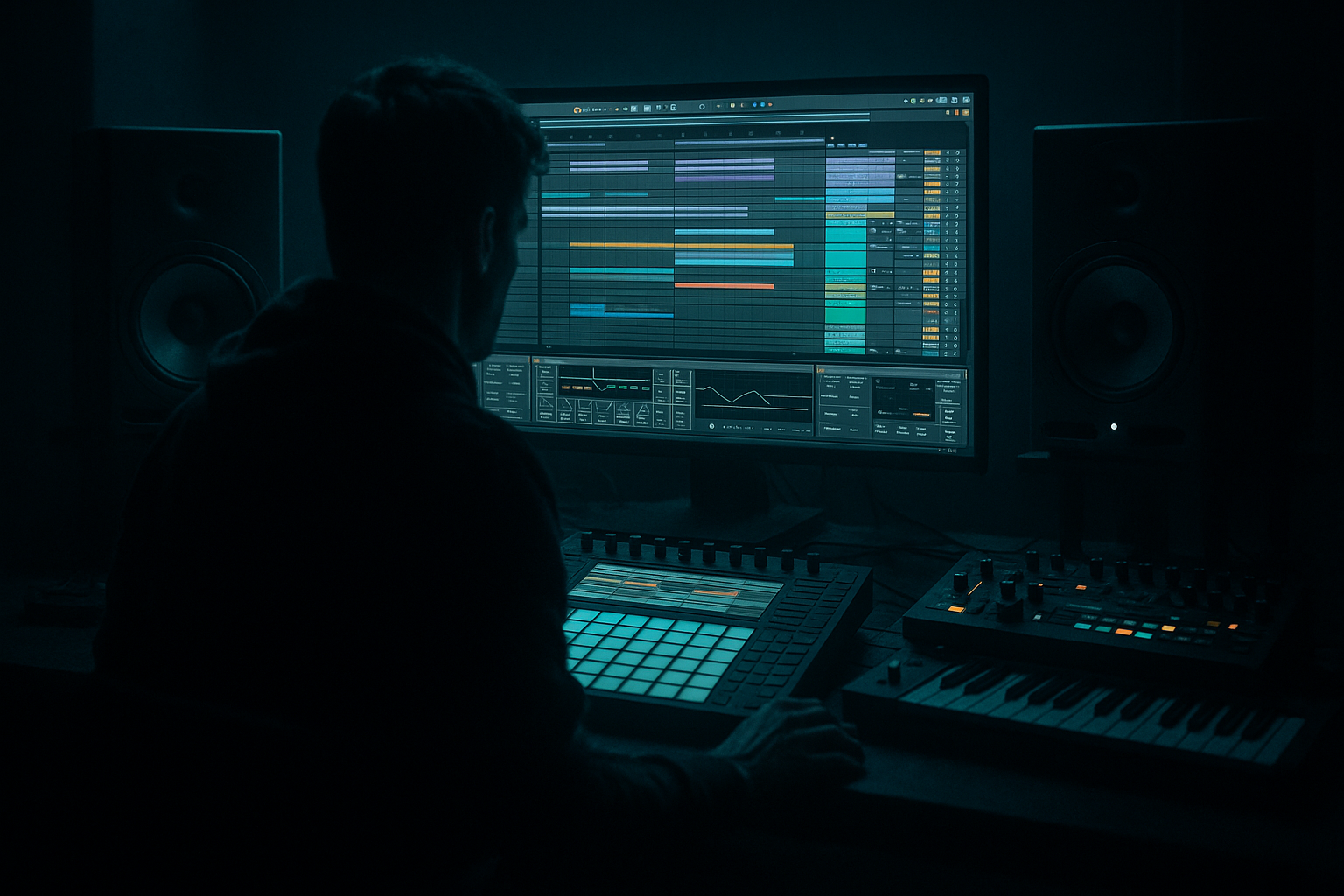
Main tutorial
```markdown
Building FX Libraries From Your Own Tracks (DnB in Ableton Live) 🎛️🔥
1. Lesson overview
A personal FX library is one of the fastest ways to make your drum & bass tracks sound like you—and to finish music quicker. In this lesson, you’ll harvest effects directly from your own projects (finished or unfinished), convert them into organized, reusable assets, and build a workflow where every track you make generates more FX for the next one.
We’ll focus on DnB/jungle-friendly FX: drum risers, bass impacts, reverse tails, glitch fills, foggy transitions, reese-downs, whooshes, “tape-stop” moments, and dense ambience beds—all created inside Ableton Live with stock devices.
---
2. What you will build
By the end, you’ll have:
- A folder-based FX library exported from your own tracks (24-bit WAV, consistent naming, BPM notes)
- Ableton Racks for quick generation:
- A repeatable resampling + consolidation workflow to turn any moment in your arrangement into:
- A Short Verb: Reverb
- B Long Verb: Hybrid Reverb (Algorithmic)
- C Delay: Echo
- 1 bar before the drop
- last 2 beats of a phrase
- the first hit of the drop
- breaks → drop transitions
- switch-ups (mid-16 or mid-32)
- Loop a section like bar 33–41 (8 bars before drop into drop).
- Record into PRINT_FX while you tweak.
- Arm PRINT_FX and record the riser movement.
- Stop. Right-click the recorded audio → Crop Sample.
- Consolidate: Cmd/Ctrl + J.
- Name: `Riser_Drums_HP_Sat_174bpm_8bar.wav`
- Warp: `Off` (for one-shots, keep it natural)
- Fade: tiny fade-in `1–3 ms` to avoid clicks
- Fade-out: tailor to taste
- EQ Eight
- Drum Buss
- Limiter (only catching peaks)
- `Impact_DropStamp_174bpm.wav`
- Clean chain
- Wide chain
- Destroy chain
- `BassThrow_ReeseWide_1bar_174.wav`
- `BassTail_Destroyed_Offbeat_170.wav`
- Place throws in beat 4 gaps, between snare hits, or at the end of 8/16 bar phrases.
- `SuckIn_SnareRevVerb_174.wav`
- `Fill_AmenGlitch_1bar_172.wav`
- `Fill_RollingTopLoop_1bar_174.wav`
- WAV, 24-bit
- Sample rate: project rate (typically 48k for modern DnB)
- Normalize: Off (keep dynamics consistent)
- Dither: Off (unless finalizing to 16-bit)
- `Riser_Drums_HP_Sat_174_8bar.wav`
- `Impact_DropStamp_DrumBuss_174.wav`
- `Whoosh_Noise_BP_170_2s.wav`
- `Atmos_DarkRoom_HybridVerb_172_16bar.wav`
- `FX/Impacts`
- `FX/Risers`
- `FX/Downers`
- `FX/Whooshes`
- `FX/Glitches_Fills`
- `FX/Atmos_Beds`
- `FX/Bass_Throws_Tails`
- Group key chains into Audio Effect Racks
- Map the macros:
- `User Library → Presets → Audio Effects Racks → DnB FX Tools`
- Printing with the sub still active: Your FX library becomes unusable in mixes. High-pass most FX at `80–150 Hz` unless it’s an intentional sub impact.
- Over-widening everything: Wide risers are great, but wide impacts can smear your drop hit. Keep impact lows mono.
- Exporting with Normalize On: Makes levels inconsistent and kills your internal “gain staging language.”
- Not consolidating cleanly: Leaving silences on the front of FX makes them annoying to place. Trim tight.
- Making FX too long: In DnB, tightness wins. Make multiple lengths: `1s, 2s, 4s, 8 bars`.
- Use distortion in stages: light Saturator → mild Overdrive → final clip/limit. One huge distortion usually turns to fizzy mush.
- Texture from Erosion + filtering: Erosion at low mix plus a moving band-pass makes menacing, foggy transitions.
- Pitch down resamples for weight: Print an impact, then transpose `-3 to -7 semitones` and layer quietly under the original for a darker “thud.”
- Sidechain FX to drums: Put a Compressor (sidechain from kick/snare) on long reverbs/atmos so the groove stays aggressive and clean.
- Create “downer” signatures: Reverse your own risers, add LP filter closing, then a short tape-stop vibe (try Frequency Shifter + automation or simply resample and pitch ramp down).
- You don’t need “more sample packs”—you need a system that turns your tracks into reusable FX.
- Resampling is your best friend for real-world DnB effects.
- Print riser energy from drums, impacts from the drop, and throws from bass movement.
- Export with clean trimming, no normalization, consistent naming, and save your best chains as Ableton racks.
- The result is a library that’s cohesive, heavy, and unmistakably yours 🎚️
- Riser Builder Rack (Noise → Filter → Saturation → Reverb → Resample)
- Impact Layer Rack (Sub hit + mid thunk + top crack)
- Bass Smash/Throw Rack (one-shot resampled bass tails)
- One-shots (impacts, stabs, glitches)
- Loops (drum fills, amen micro-edits)
- Long FX (riser-downers, atmos, noise sweeps)
---
3. Step-by-step walkthrough
Step 0 — Set up a dedicated FX harvesting session
1. Open a DnB project that already has energy and sound design (even if unfinished).
2. Save a copy:
File → Save Live Set As… → `TRACKNAME_FX_HARVEST_v1`
3. Create 3 return tracks (if you don’t already):
- A: Short Verb (tight room)
- B: Long Verb (wash)
- C: Delay/Space (movement)
Suggested stock returns
- Decay: `0.6–1.2s`
- Pre-Delay: `5–15ms`
- Low Cut: `250–400 Hz`
- High Cut: `7–10 kHz`
- Decay: `4–10s`
- Size: `80–120%`
- Mod: `10–25%` (subtle movement)
- EQ: Cut below `250 Hz`
- Time: `1/8D` or `1/4`
- Feedback: `25–45%`
- Wobble: `5–15%`
- Filter: HP `200 Hz`, LP `8–12 kHz`
This gives you consistent spatial “glue” while you print FX.
---
Step 1 — Create a resampling lane (your FX printer) 🖨️
1. Add a new audio track: name it PRINT_FX.
2. Set Audio From: `Resampling`
3. Monitor: `Off` (avoid feedback surprises)
4. Arm it for recording.
Why: You’ll print exactly what you hear—including automation, returns, sidechain, and bus processing—perfect for real-world FX.
Workflow suggestion:
Color-code FX print tracks and keep them at the bottom of your session. Your future self will thank you.
---
Step 2 — Harvest “transition moments” from your arrangement
In rolling DnB, FX live in the cracks:
Action:
Now you’re not designing from scratch—you’re capturing the track’s real vibe.
---
Step 3 — Build a DnB riser from drums (not just noise) 🥁⬆️
Classic trick: risers that feel “embedded” because they’re made of your drum bus.
1. Duplicate your Drum Bus track → name it DRUM_RISER_SRC
2. On DRUM_RISER_SRC, add this chain:
Device chain (stock)
1. EQ Eight
- HP filter: start `80 Hz`, automate to `600–1kHz` over 4–8 bars
- Add a gentle bell boost around `2–4 kHz` if it needs bite
2. Auto Filter
- Mode: `LP24`
- Drive: `3–8 dB`
- Envelope: off
- Automate cutoff up (classic sweep)
3. Saturator
- Type: `Analog Clip`
- Drive: `3–10 dB` (push until it speaks)
- Soft Clip: `On`
4. Redux (optional for jungle grit)
- Downsample: `2–6`
- Bit Reduction: tiny, `0–2` (don’t kill transients)
5. Reverb (or Hybrid Reverb)
- Decay: `3–8s`
- Pre-delay: `10–25ms`
- Low Cut: `300 Hz`
6. Utility
- Width: `120–160%` (keep low end filtered anyway)
- Gain: automate up slightly into the drop
3. Send it hard to B Long Verb and C Echo (tastefully).
Print it:
✅ Result: a riser that belongs to your drums.
---
Step 4 — Make impact layers from your own drop (the “drop stamp”) 💥
Instead of grabbing generic impacts, steal the first hit of your own drop.
Method:
1. Find the exact first transient of the drop (kick+snare+crash moment).
2. Record 1–2 seconds into PRINT_FX.
Then shape it into a one-shot:
On the printed audio clip:
Optional impact sweetener chain (on the printed clip track):
- HP at `25–35 Hz` (tighten sub rumble)
- Dip `200–350 Hz` if boxy
- Add `6–10 kHz` shelf if you want air
- Drive: `5–15`
- Crunch: `5–20`
- Boom: `0–10` at `50–60 Hz` (careful—DnB subs are sacred)
- Gain until it kisses `1–2 dB` reduction max
Export as:
Now every track has its own “branding” impact.
---
Step 5 — Create bass throws and reese tails (DnB ear candy) 🐍
A “bass throw” is a short resampled moment of your bass with FX that you can toss into gaps.
How:
1. Duplicate your bass track → name it BASS_THROW_SRC
2. Add an Audio Effect Rack with 3 chains:
- Clean
- Wide
- Destroy
Chain settings
- EQ Eight: HP `80–120 Hz` (so it layers without fighting sub)
- Chorus-Ensemble:
- Amount `20–40%`, Rate `0.2–0.6 Hz`, Width `120–200%`
- Utility: Bass Mono `On` (if available) or Width automation
- Overdrive: Drive `20–60%`, Tone `40–60%`
- Erosion: Amount `0.2–1.5`, Freq `4–9 kHz` (adds hissy edge)
- Auto Filter: band-pass sweep for movement
3. Record 1/2 bar to 2 bars of bass movement into PRINT_FX
4. Chop the best chunk → consolidate → export
Name examples:
Arrangement idea (rolling DnB):
---
Step 6 — Reverse reverb “suck-ins” from your own drums (instant tension) 🌀
1. Take a snare or vocal stab from your track.
2. Duplicate it on a new audio track: REV_SUCKIN
3. Add:
- Reverb (100% wet)
- Decay: `2–6s`
- Pre-delay: `0ms`
- Low Cut: `400 Hz`
- Freeze (if using Reverb) → Flatten (prints the tail)
4. Reverse the printed audio clip.
5. Trim so the reverse swell ends exactly on the drop snare.
Export:
This is very jungle-friendly when layered quietly under breaks.
---
Step 7 — Turn glitch fills into a reusable loop pack ✂️
Take a 1-bar break edit you already have (Amen, think, or your own drums), and generate 10 variations quickly.
Fast variation workflow
1. Duplicate the bar 10 times.
2. On each duplicate, apply one transformation:
- Beat Repeat
- Interval: `1 Bar`
- Grid: `1/16` or `1/32`
- Chance: `10–30%`
- Variation: `10–20`
- Grain Delay (subtle!)
- Dry/Wet: `5–15%`
- Frequency: `1–3 kHz`
- Pitch: `-12 / +12` for a single moment (automate)
- Gate
- Sidechain from ghost kick/snare for pumping chop
- Frequency Shifter
- Fine: `50–200 Hz` for metallic movement (automate in small doses)
3. Print each bar to PRINT_FX, consolidate, export as loops.
Name like:
---
Step 8 — Export, normalize your system, and tag properly 📁
This is where “library” becomes usable.
Export settings (recommended)
Naming convention
`TYPE_Source_Process_BPM_Length_Key(optional).wav`
Examples:
Library structure
Bonus: Add a `/_FromTracks/TrackName/` subfolder so you can trace where a sound came from.
---
Step 9 — Save the generators as Ableton presets (not just audio)
Audio is great, but repeatable chains are elite.
- Macro 1: Filter sweep (Auto Filter cutoff)
- Macro 2: Dirt (Saturator drive / Overdrive)
- Macro 3: Space (Reverb decay / send amount)
- Macro 4: Motion (Echo feedback / chorus amount)
Save racks to:
Now every track can generate fresh “you-coded” FX fast.
---
4. Common mistakes
---
5. Pro tips for darker/heavier DnB 🖤⚙️
---
6. Mini practice exercise (20 minutes) ⏱️
Goal: Build 10 FX from one 16-bar section of a rolling DnB track.
1. Choose a 16-bar build → drop section.
2. Print:
- 2 risers (one drum-based, one noise-based)
- 2 impacts (drop stamp + a processed version)
- 2 bass throws (wide + destroyed)
- 2 reverse suck-ins (snare + vocal/chop)
- 2 glitch fills (1/2 bar + 1 bar)
3. Export all with consistent naming + BPM.
4. Drag them into Ableton’s Browser (User Library) and audition them in a new blank DnB project at 174 BPM.
If they drop in and work immediately, your library system is working.
---
7. Recap
If you want, tell me your typical sub-bass approach (pure sine, reese-sub split, FM, etc.) and I’ll suggest a tailored FX harvesting template specifically for your bass architecture.
```

