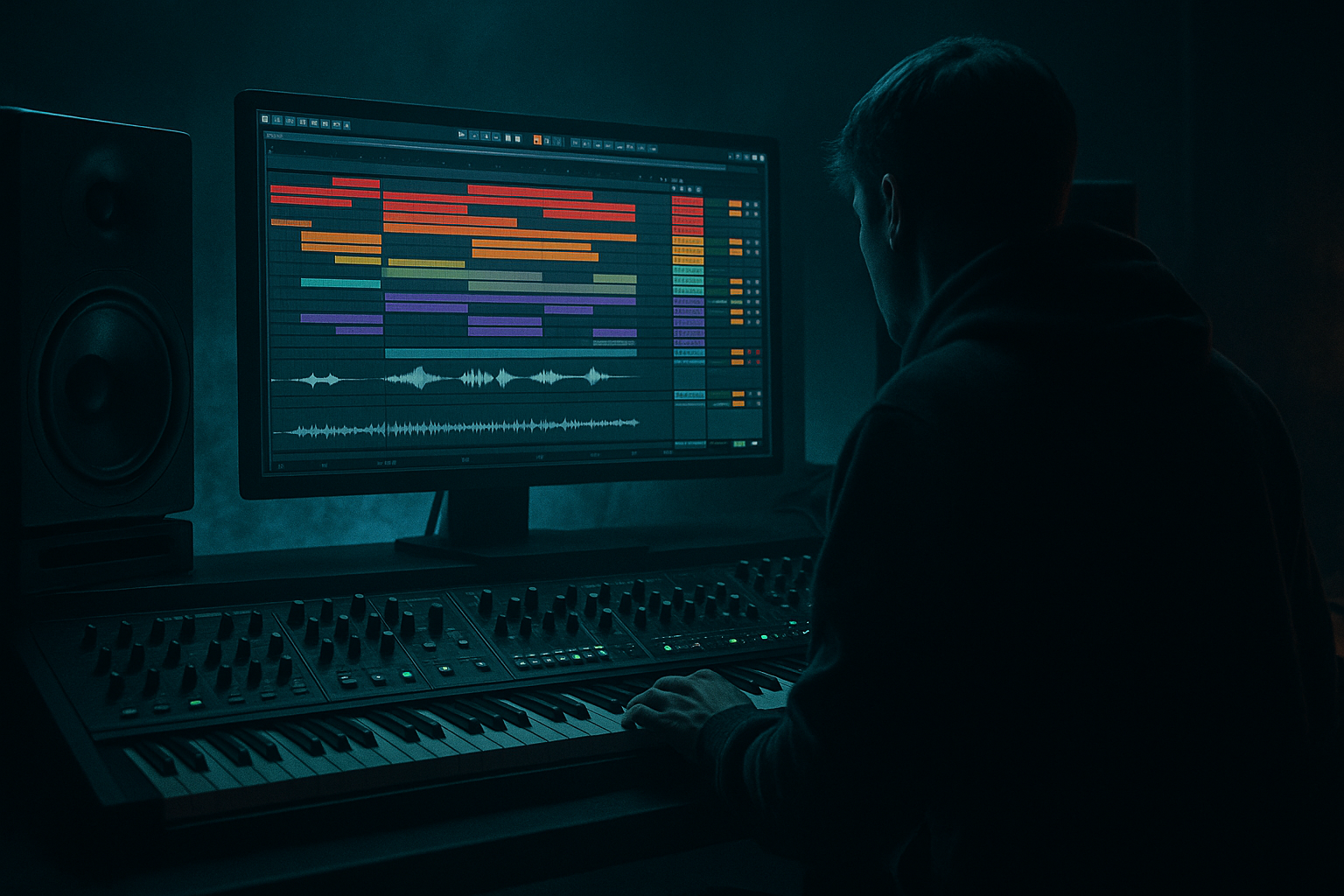
Main tutorial
```markdown
Call-and-Response Filter Motion (90s Rave Flavor) in Ableton Live (DnB/Jungle)
1. Lesson overview
In classic 90s rave/jungle, movement often comes from filters and envelopes—not just fancy synth patches. In this lesson you’ll build a call-and-response filter automation system that makes your riff/bass/amen chops “talk” back and forth across the bar. Think: squelchy opens, tight muffled answers, and rhythmic sweeps that feel alive 🌀.
We’ll do this from scratch in Ableton Live using mostly stock devices, with a workflow you can reuse across tunes.
---
2. What you will build
You’ll end up with a two-voice call-and-response section in your DnB arrangement:
- CALL track: brighter, more open filter moves (the “shout”).
- RESPONSE track: darker, tighter filter moves (the “answer”).
- Both locked to 174 BPM, with automation that breathes with the drums.
- Optional: resampling to audio for authentic 90s grit and easier arrangement.
- CALL: “wahhh / squelch open” on beats 1–2
- RESPONSE: “muffled / band-passy snap back” on beats 3–4
- In the drop, keep CALL/RESPONSE alternating every 1 bar for clarity.
- In the mid-section, switch to half-bar alternation for hype.
- Filter type:
- Resonance: 25–45% (enough to speak, not whistle constantly)
- Drive (if available in your version): small amount (subtle)
- Envelope: leave at 0 for now (we’ll automate instead)
- Drive 3–7 dB
- Soft Clip On
- Color: Analog Clip (if available)
- High-pass: 24 dB/oct @ 25–35 Hz (clean rumble)
- If it’s harsh: small dip 2–5 kHz by 1–3 dB
- Fast open: ramp up in the first 1/8–1/4 note then hold
- Talking squelch: ramp up + small dip + ramp again (like “wa-eh”)
- Automate Resonance to rise slightly during the open:
- Keep it mostly closed (dark)
- Do short openings on offbeats (like “uh-huh”):
- Put the response “answer” on the syncopations where your ghost snares live.
- Keep automation in Arrangement.
- Great when you’re writing a full tune and evolving the drop.
- Redux:
- Erosion (sparingly):
- Vinyl Distortion (if you have it) or Saturator again gently
- Intro (16 bars): only RESPONSE (dark, filtered), tease the motif
- Build (8 bars): CALL begins opening more each 2 bars
- Drop (32 bars): strict CALL/RESPONSE alternating every bar
- Switch (8 bars): resampled edits + more aggressive filter sweeps
- 2nd Drop: halve the call length (half-bar) for extra energy
- Both parts sound the same: If CALL and RESPONSE share the same filter range, it won’t read as a “conversation.” Push contrast (bright vs dark / long sweep vs short bumps).
- Too much resonance: Classic rave is resonant, but if you’re constantly above ~50–60% it can whistle and fatigue fast.
- Automation ignoring the drums: If sweeps peak between snare hits, it can feel random. Align key moments to 2 and 4.
- Over-filtering the low end: If this is your main bass, don’t high-pass too aggressively. Consider splitting: sub separate, mid bass filtered.
- No gain staging: Auto Filter resonance + Saturator can spike volume. Use Utility to trim.
- Split sub and mid:
- Use Autofilter into distortion:
- Automate filter type for menace:
- Add reverb throws only on CALL:
- Parallel “edge” bus:
- You built a call-and-response system by duplicating a source and giving each track contrasting filter automation.
- You used Auto Filter as the main “talking” tool, with resonance and frequency motion tied to the snare/backbeat.
- You glued it to the drums using sidechain compression and optionally got true 90s energy by resampling + chopping.
- This technique scales: apply it to rave stabs, reeses, breaks, pads, even FX sweeps.
Example target vibe:
…or split the conversation across 2 bars for more rolling tension.
---
3. Step-by-step walkthrough
Step 0 — Set the foundation (tempo + drums)
1. Set tempo to 174 BPM (or 170–176).
2. Drop in a break (Amen-style) or your own drum rack. Make sure you have:
- Kick + snare hitting with a DnB backbone.
- Some ghost notes/shuffles (16ths) so filter motion feels glued to groove.
Workflow tip: Group your drums (Cmd/Ctrl+G) as DRUM BUS so you can sidechain later.
---
Step 1 — Create a simple “rave” sound source (fast + authentic)
You can use a synth riff, a resampled stab, or a reese. Here are two stock-friendly options:
#### Option A: Rave stab (fast)
1. Create a MIDI track → Instrument: Wavetable (or Operator).
2. Pick a bright waveform:
- Wavetable: Basic Shapes → start with Saw.
3. Add Unison (Wavetable):
- Unison: Classic / 3 voices, Amount 20–35%
4. Amp envelope:
- Attack 0 ms
- Decay ~200 ms
- Sustain -inf (or very low)
- Release 80–150 ms
Write a short 2-bar riff (staccato stabs work best).
#### Option B: Reese (rolling DnB)
1. MIDI track → Operator
2. Osc A: Saw, Osc B: Saw (slightly detuned)
3. Detune: use Fine on Osc B +5 to +15 cents
4. Add a touch of Saturator after it:
- Drive 2–6 dB, Soft Clip On
Keep notes simple: root + occasional fifth/octave, 1/8 or 1/16 rhythm.
---
Step 2 — Duplicate into CALL and RESPONSE tracks
1. Duplicate your sound track (Cmd/Ctrl+D).
2. Name them:
- RAVE CALL
- RAVE RESPONSE
3. In Arrangement View, alternate clips:
- Bar 1: CALL plays first half, RESPONSE plays second half
- Or: CALL plays bar 1, RESPONSE plays bar 2 (cleaner, more old-school)
DnB arrangement idea:
---
Step 3 — Build the filter chain (stock devices)
On both CALL and RESPONSE tracks, add this device chain:
1. Auto Filter
2. Saturator (optional but very 90s)
3. EQ Eight (cleanup)
4. Utility (gain staging / width)
#### Auto Filter settings (starting point)
- For rave flavor: MS2 (or OSR) Lowpass (more character)
#### Saturator (optional)
#### EQ Eight
---
Step 4 — Program the “call” filter motion (automation)
On RAVE CALL, we’ll make the filter open and “announce” itself.
1. Hit A to show Automation lanes.
2. Choose automation target:
- Auto Filter → Frequency
3. Draw a 1-bar shape:
- Start around 200–400 Hz
- Sweep up to 3–8 kHz by beat 2
- Then pull back slightly by the end of bar
Practical 90s-style shapes
Add resonance movement (optional, but effective):
- e.g., 30% → 42% during the sweep
🎛️ Groove tip: Put your peaks on snare hits (beat 2 and 4) so the filter “yells” with the backbeat.
---
Step 5 — Program the “response” filter motion (contrast + pocket)
On RAVE RESPONSE, do the opposite: tighter, more muffled, maybe bandpassy.
1. Set Auto Filter to:
- Bandpass (for nasal reply) OR keep Lowpass but lower frequency range
2. Automate Frequency:
- Lowpass response: 120–900 Hz range
- Bandpass response: center around 500 Hz–2 kHz
Response automation idea (1 bar):
- quick bumps on 1.2, 1.4, 1.6 (16th grid), or offbeat 8ths
Make it feel like jungle:
---
Step 6 — Lock the motion to rhythm (clip envelopes vs arrangement automation)
You have two strong workflows:
#### Workflow A: Arrangement Automation (best for composing)
#### Workflow B: Clip Envelopes (best for repeatable patterns)
1. Switch to Session View (or open the clip in Arrangement).
2. In the clip box, go to Envelopes:
- Device: Auto Filter
- Control: Frequency
3. Draw a repeating envelope pattern per clip.
✅ Clip envelopes are killer for rolling DnB, because you can duplicate clips and the motion stays consistent.
---
Step 7 — Add “pump” and glue (sidechain + subtle movement)
To make the filter motion feel integrated with drums:
1. Add Compressor after Auto Filter on both CALL/RESPONSE.
2. Enable Sidechain:
- Input: DRUM BUS
- Start settings:
- Ratio 3:1
- Attack 5–15 ms
- Release 80–140 ms
- Adjust Threshold for 2–5 dB gain reduction
Now your filter moves won’t feel like they’re floating—they’ll bounce with the groove 🔥.
---
Step 8 — 90s rave seasoning (resample + texture)
This is where it gets authentic.
#### Option: Resample to audio (highly recommended)
1. Create a new audio track called RAVE PRINT.
2. Set its input to Resampling.
3. Record 8–16 bars of your CALL/RESPONSE section.
4. Slice, reverse, and re-trigger bits:
- Use Warp modes (Complex/Pro can smear; try Beats for gritty chops)
- Cut tiny 1/8–1/16 chunks and repeat for classic rave edits
#### Add subtle lo-fi grit (stock)
- Downsample slightly (don’t crush): 2–8
- Amount 0.2–1.5, Frequency 3–8 kHz
---
Step 9 — Arrangement: where this works in DnB
Try this structure:
---
4. Common mistakes
---
5. Pro tips for darker/heavier DnB
- Sub track: clean sine (Operator), minimal movement
- Mid track: your CALL/RESPONSE filter madness
This keeps the drop heavy while the mids talk 😈
Filtered harmonics into Saturator / Roar (if available) hits harder than distorting first.
Switch RESPONSE to Bandpass for a bar, then back to lowpass—instant “switch” energy.
Put Reverb on a return, automate send on the last stab of the call. Very rave.
Send both tracks to a return with Overdrive + EQ Eight (high-pass at 200–400 Hz). Blend low.
---
6. Mini practice exercise
Goal: Create a 4-bar loop that clearly “speaks.”
1. Make a 2-bar riff (stabs or reese).
2. Duplicate into CALL/RESPONSE.
3. CALL automation:
- Frequency sweeps 400 Hz → 6 kHz over first half of the bar
4. RESPONSE automation:
- Keep under 1 kHz, add three short bumps (16th grid)
5. Add sidechain comp (2–5 dB GR).
6. Resample 4 bars and create one edit:
- Reverse the last 1/8 note of the CALL and repeat it twice.
Deliverable: A loop that still grooves with drums muted low, not just soloed.
---
7. Recap
If you want, tell me what sound you’re using (stab vs reese vs break chops) and your target vibe (dark rollers vs jump-up vs jungle), and I’ll suggest exact automation shapes and filter modes for that style.
```

