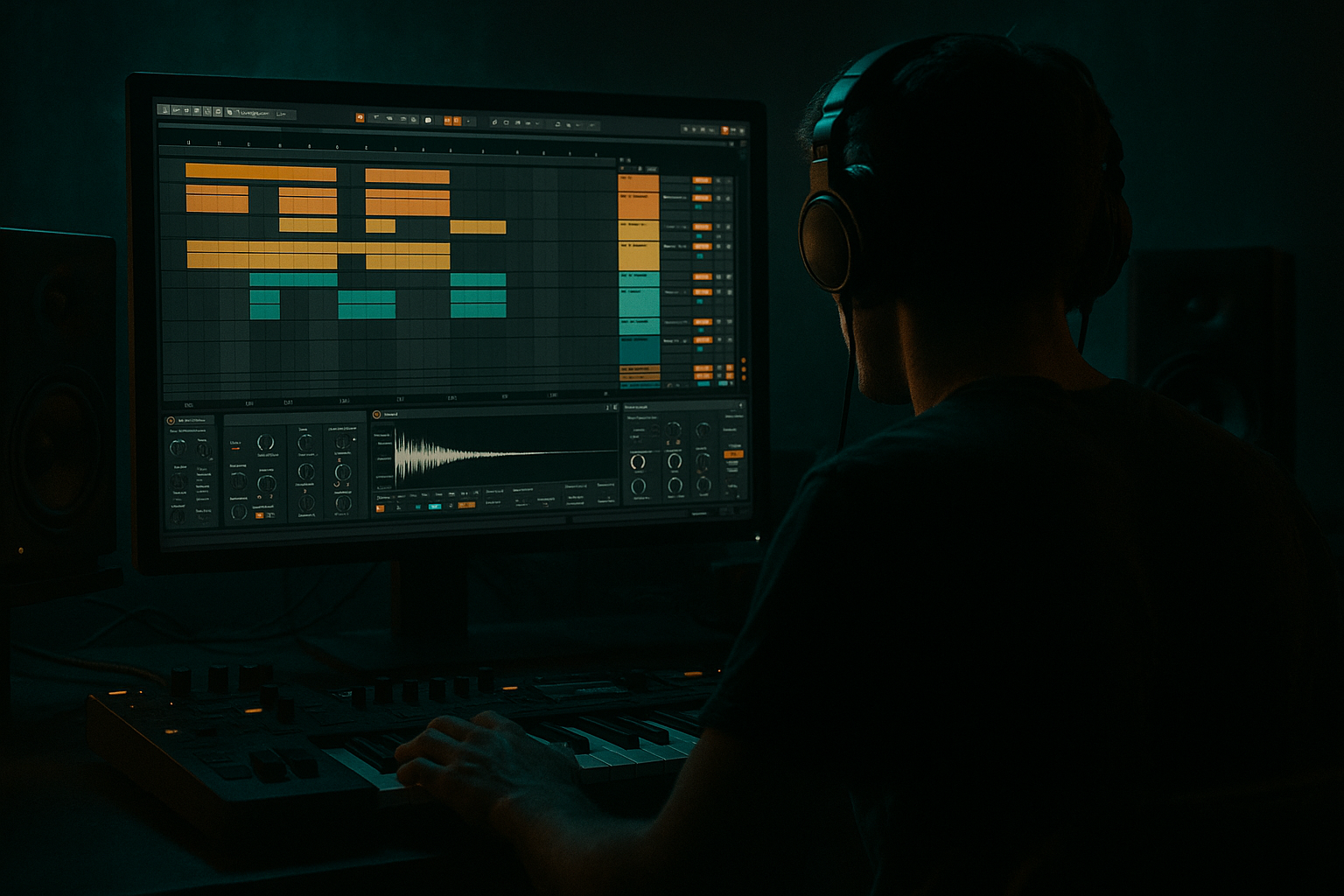
Main tutorial
Call-and-Response Filter Motion (Stock Ableton Only) — Advanced DnB Automation 🎛️⚡
1. Lesson overview
In rolling drum & bass, call-and-response isn’t just melodic—it’s movement. This lesson shows you how to create two (or more) alternating filter “voices” using only Ableton Live stock devices, with automation that feels intentional, rhythmic, and heavy.
We’ll focus on:
- Filter motion that “talks” in sync with your groove
- Alternation between bars/half-bars (classic DnB phrasing)
- Automation workflows that stay editable (and mix-friendly)
- CALL: focused, tight, band-limited / resonant movement (more “speech”)
- RESPONSE: more open, wider, or differently shaped filter motion (more “answer”)
- A device rack with two filter “lanes” you can switch between
- A macro-based workflow for fast experimentation
- An arrangement template for 8/16-bar DnB phrases (drop-ready)
- Add Operator
- Osc A: Saw (or Square)
- Add a little movement:
- Turn on Filter inside Operator:
- Add Saturator after Operator:
- Osc 1: Basic Shapes / saw-ish
- Osc 2: detuned slight (optional)
- Unison: low (2–4) if you want width (watch mono!)
- Auto Filter = classic, easy, has envelope + LFO
- EQ Eight = surgical, great for bandpass “talking” shapes
- Filter Delay = can be used creatively, but careful (can smear)
- Put Auto Filter in each chain.
- Auto Filter:
- Auto Filter:
- In Arrangement, draw automation:
- Switch every half-bar in a fill:
- Keep both chains audible but control levels:
- Automate Auto Filter Frequency in short shapes:
- Example (1 bar pattern):
- Automate Frequency with longer arcs:
- Example:
- Attack: 5–20 ms
- Release: 80–180 ms
- Amount: start low, 5–15% mapping range
- Smoothing: moderate
- Bar 1: CALL (tight BP talk)
- Bar 2: RESPONSE (open LP)
- Bar 3: CALL (variation automation)
- Bar 4: RESPONSE (slightly more open + tiny rise into bar 5)
- Bars 5–6: Switch every half-bar
- Bar 7: Mostly CALL (more mid focus = tension)
- Bar 8: RESPONSE opens, then hard low-pass choke in last 1/4 bar to set up the loop restart
- Automating too wide a frequency range: if your BP swings 200 Hz → 5 kHz, it’ll feel like random tone loss. Keep it musical.
- Resonance too high without gain staging: Auto Filter resonance can spike—watch meters and consider a Limiter (gentle) after the rack.
- Switching chains with reverb/delay inside each chain: switching can cut tails. Put time-based FX after the rack (or use the Utility method).
- Moving the sub with the mids: split sub/mid or keep sub stable.
- Ignoring phrasing: call-and-response only works if it repeats in a recognizable pattern (at least initially).
- Use band-pass + saturation for “vocal” snarls:
- Add subtle FM or warp movement pre-filter (Operator/Wavetable): the filter then “reads” like a talking mouth.
- Post-filter bite: add Pedal (stock) after the rack:
- Use Auto Pan as rhythmic mod (not stereo gimmick):
- Resample your best 4 bars: commit to audio, then do micro-edits (reverse a response, fade a call, etc.). Jungle heads love that chopped intent.
- You built two filter “voices” (CALL vs RESPONSE) using stock Auto Filter inside an Audio Effect Rack.
- You used Chain Selector or Utility gating to alternate them in classic DnB phrasing.
- You shaped motion with precise automation, optionally enhanced by Envelope Follower tied to drum groove.
- You kept it professional by splitting sub/mids and managing resonance/gain staging.
No third-party plugins. Just clean Live technique. ✅
---
2. What you will build
You’ll build a DnB bass or synth layer that alternates between:
You’ll end up with:
---
3. Step-by-step walkthrough
Step 0 — Set the musical context (DnB phrasing)
1. Set tempo: 172–175 BPM (e.g., 174).
2. Create a simple 2-step drum loop:
- Kick on 1
- Snare on 2 and 4
- Hats with 1/16 or shuffled 1/16 swing (Groove Pool optional)
Why: Filter call-and-response lands best when it’s anchored against the predictable kick/snare grid.
---
Step 1 — Pick your source (bass recommended)
You can do this on a synth stab, Reese, neuro mid, or even a break layer—but bass is the most obvious.
Option A (fast, stock):
- Pitch Env Amount: 0 (keep stable)
- Voices: 1 (for clean mono)
- Type: LP24
- Freq: ~ 700–1.5kHz (starting point)
- Res: 0.6–1.2
- Mode: Analog Clip
- Drive: 3–8 dB
- Soft Clip: On
Option B (for heavier mids):
Use Wavetable (still stock):
---
Step 2 — Build the “Call vs Response” filter rack (clean + switchable)
1. Select your bass track devices (Operator/Wavetable + Saturator).
2. Add an Audio Effect Rack after them.
3. Create 2 chains:
- Chain 1: `CALL`
- Chain 2: `RESPONSE`
Now put a filter on each chain (stock options below).
#### Recommended filter devices (stock)
For now:
#### CALL chain settings (tight / speaking)
- Mode: Band-Pass (BP)
- Slope: 24 dB
- Freq: 350–900 Hz (start around 550 Hz)
- Resonance: 50–75%
- Drive: 2–6 dB (taste)
- LFO: Off (we’ll automate manually for precision)
#### RESPONSE chain settings (wider / answering)
- Mode: Low-Pass (LP)
- Slope: 12 dB (more open)
- Freq: 1.2–4 kHz (start around 2 kHz)
- Resonance: 15–35%
- Drive: 0–3 dB
Why this works: The CALL is mid-focused and resonant (sounds “spoken”), while the RESPONSE opens out and feels like a release.
---
Step 3 — Switch between the chains rhythmically (the “conversation”)
You’ve got two strong options (both stock):
#### Option 1: Chain Selector automation (best for arrangement control)
1. In the rack, open Chain List → Chain Selector.
2. Set chain zones so:
- CALL active at 0
- RESPONSE active at 127
3. Map Chain Selector to Macro 1 (“Call/Response”)
Now automate Macro 1 (or chain selector directly):
- Bar 1: CALL (0)
- Bar 2: RESPONSE (127)
- Bar 3: CALL (0)
- Bar 4: RESPONSE (127)
To make it more DnB:
- Beat 1–3: CALL
- Beat 3–4: RESPONSE (little answer before the snare) 🔥
Workflow tip: Use square/instant jumps for selector (not ramps), unless you want morphing.
#### Option 2: Volume/Gate “duel” (best for overlapping textures)
- Add Utility at end of each chain
- Automate Utility Gain:
- CALL: 0 dB when active, -inf when inactive
- RESPONSE: opposite
This is great if you want tails/reverb sends to keep ringing even when the “voice” changes.
---
Step 4 — Create filter motion inside each “voice”
Now the real sauce: each voice gets its own movement.
#### CALL movement (snappy, rhythmic, “talking”)
- 1/8 or 1/16 ramps
- Quick dips right before snare hits
- Beat 1: 600 → 900 Hz (fast rise)
- Beat 2: 900 → 450 Hz (drop)
- Beat 3: small wiggle 500 ↔ 700 Hz
- Beat 4: hard dip to 350 Hz before the snare, then reset
Ableton trick: Hold Alt/Option while dragging automation for finer resolution.
#### RESPONSE movement (smoother, opening/closing)
- 1/2 bar sweeps or 1-bar curves
- Beat 1–3: 1.8k → 3.5k (open)
- Beat 3–4: 3.5k → 1.5k (close into snare)
Result: The response feels like it “breathes” behind the drums.
---
Step 5 — Add controlled movement with Envelope Follower (advanced, stock)
To make the filter react to the groove (super DnB), use Envelope Follower triggered by drums.
Goal: Kick or ghost hats subtly “push” the filter.
1. On your drum group, create a Send (or duplicate a “sidechain trigger” track).
2. On the bass track, add Envelope Follower (Audio Effect).
3. Set Audio From (sidechain input) to:
- Drum group, or specifically hats/ghosts (often best)
4. Map Envelope Follower to:
- CALL Auto Filter Frequency (small range)
- RESPONSE Auto Filter Frequency (even smaller)
Suggested Envelope Follower settings:
Pro move: Let hats drive CALL (speechy chatter), while kick drives RESPONSE (bigger push). Keeps it rolling without random chaos.
---
Step 6 — Glue it into a DnB arrangement (8/16-bar logic)
A practical drop phrasing using your selector automation:
Bars 1–4 (statement):
Bars 5–8 (variation + tension):
DnB feel tip: Put the “smartest” response moves right before snares—listeners perceive it as conversational timing.
---
Step 7 — Make it mix-ready (keep sub clean)
If this is a bass:
1. Split sub and mids:
- Create an Audio Effect Rack
- Two chains: `SUB` and `MID`
2. SUB chain:
- EQ Eight low-pass at 80–120 Hz
- Keep it mostly steady, minimal filter automation
3. MID chain:
- Your CALL/RESPONSE rack lives here
- Aggressive motion is fine above 120 Hz
Reason: Filter automation on sub can cause level dips and translation issues on club systems.
---
4. Common mistakes ❌
---
5. Pro tips for darker/heavier DnB 🖤
CALL chain: BP + Saturator (Drive 6–12 dB) + EQ Eight to notch harshness around 2.5–4.5 kHz.
- Mode: OD or Distortion
- Tone: slightly down
- Drive: modest (don’t flatten dynamics)
- Put Auto Pan before the filter
- Set Phase to 0° (so it becomes tremolo)
- Rate: 1/8 or 1/16
- Amount: 10–30%
This creates consistent rhythmic pulses the filter then shapes.
---
6. Mini practice exercise 🧪
Goal: Build a 16-bar drop loop where the bass “speaks” for 8 bars and “argues back” for 8 bars.
1. Make an 8-bar bass MIDI clip (simple 1–2 notes is fine).
2. Create CALL/RESPONSE rack with Auto Filter on each chain.
3. Automate:
- Bars 1–4: switch every bar
- Bars 5–8: switch every half-bar
4. Duplicate to bars 9–16, but invert the logic:
- Where it was CALL, make it RESPONSE and vice versa
5. Bounce/resample and do two edits:
- Reverse a single RESPONSE hit
- Add a 1/8-bar low-pass choke at the end of bar 16
If it still grooves with drums after the inversion, your call-and-response is solid.
---
7. Recap ✅
If you tell me what kind of bass you’re using (Reese, neuro mid, foghorn-ish, jungle stab), I can suggest exact frequency ranges and automation curves that match that sound.

