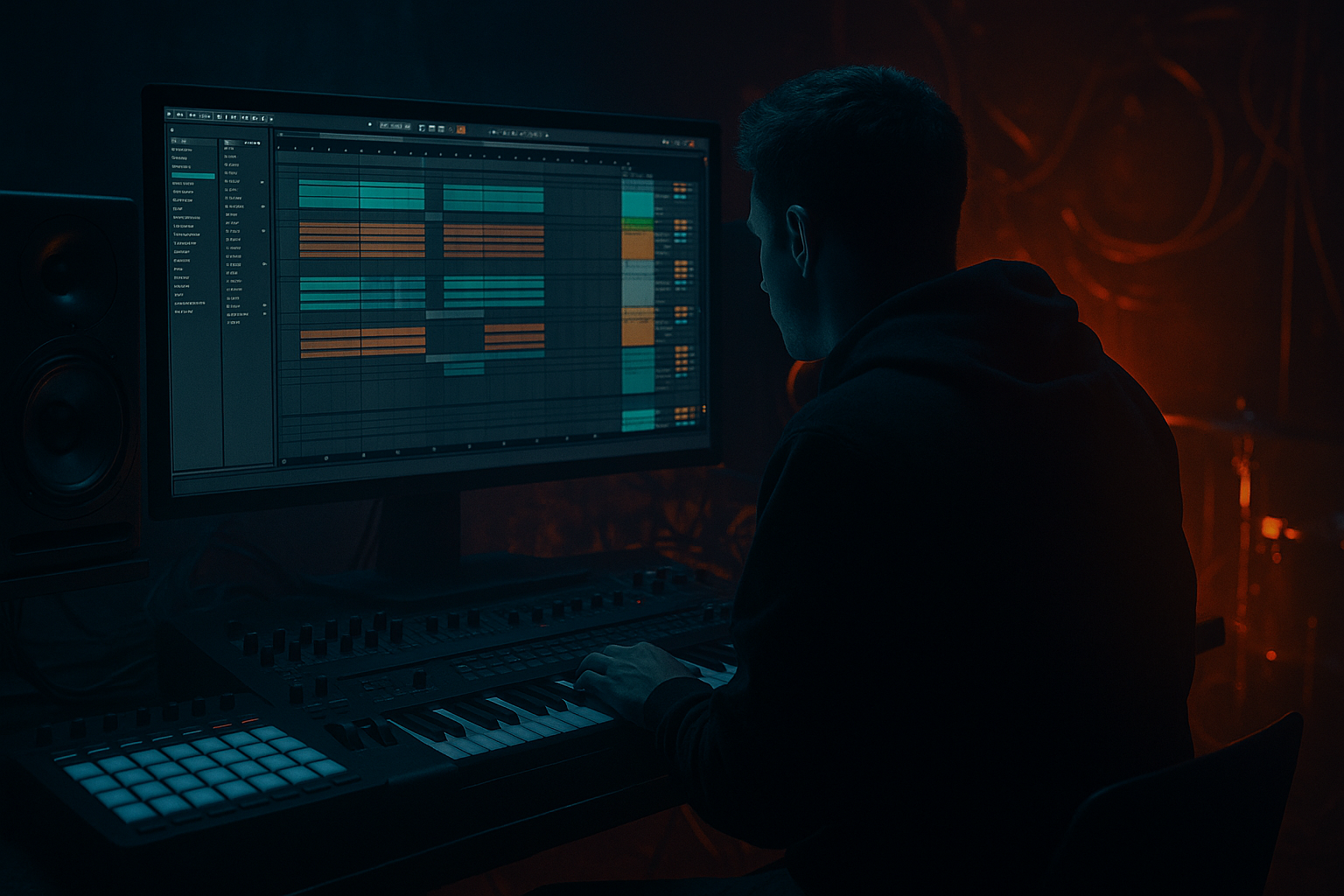
Main tutorial
Capture MIDI for Rave Hooks Masterclass (DnB in Ableton Live)
Modern control, vintage tone — fast workflow, maximum impact 🔥
---
1. Lesson overview
This lesson is about capturing those lightning-strike rave hook moments (stabs, hoovers, pianos, rave leads) as MIDI in Ableton Live, then tightening them into arrangement-ready hooks that cut through rolling drum & bass.
You’ll learn an advanced workflow built around:
- Capture MIDI (and why it’s your best friend for hooks)
- Turning messy improvisation into tight 8/16-bar phrases
- Vintage tone via resampling, saturation, filtering, chorus, and “old sampler” tricks
- Hook design that respects DnB: space for drums + bass while still sounding massive
- A 2–4 note stab motif with rhythmic variations
- Call/response between two hook layers (e.g., stab + hoover)
- Automation that makes it evolve (filter, reverb throws, pitch dips)
- A resampled “vintage” layer for grit and authenticity 🎛️
- A MIDI clip you can edit endlessly (modern control)
- A resampled audio version (vintage tone + weight)
- Wavetable (best for modern control + classic shapes)
- Or Analog (instant old-school vibe)
- First pass = rhythm (one note)
- Second pass = pitch contour (notes)
- Third pass = performance (velocity, timing, mod wheel)
- Change sound character (not the whole part)
- Bars 1–4: Hook A (simple motif)
- Bars 5–8: Hook A + short Hook B answer (last 1–2 beats)
- Bars 9–12: Hook A changes rhythm (syncopation)
- Bars 13–16: Hook A drops out for 1 bar, Hook B leads → creates “reload” energy
- Redux
- EQ Eight
- Saturator
- Auto Filter
- Right-click Hook track → Freeze → Flatten
- Then process audio as above.
- Auto Filter cutoff: gradually open from bars 1–8
- Reverb throw: automate Hybrid Reverb Dry/Wet up on the last stab of bar 8/16
- Pitch dip: automate instrument Pitch Bend or transpose clip briefly (-2 or -12 for a moment)
- Beat Repeat (tastefully!):
- Overplaying the hook: too many notes = no space for drums and bass.
- Too much reverb: rave needs size, but DnB needs impact. Low-cut your reverbs.
- No resampling step: staying purely MIDI can sound “too clean” and separate from the mix.
- Stereo low end: wide hooks below ~150 Hz can wreck your drop power.
- Hard quantize at 100%: makes stabs feel robotic in the wrong way (DnB needs tight + human).
- Phrygian / Harmonic Minor scales = instant menace. Use Scale device to lock it in.
- For darker hoovers: in Wavetable, modulate Filter Drive or use Saturator into Auto Filter.
- Layer a noise/transient click on the stab:
- Use Corpus subtly on the resampled stab:
- Print two versions:
- Capture MIDI lets you improvise freely and still keep the magic 🎹⚡
- Tighten captured hooks with selective quantize + groove, not robotic snap.
- Build call/response hooks for real DnB arrangement momentum.
- Print/resample for vintage tone, then mix with sidechain + EQ discipline.
- Automate filter/reverb/fills to make hooks DJ-friendly and alive.
---
2. What you will build
A 16-bar rave hook section suitable for modern DnB (rollers, jungle-leaning, or dark dancefloor):
You’ll end up with:
---
3. Step-by-step walkthrough
Step 0 — Project setup for DnB speed + capture readiness
1. Set tempo: 172–176 BPM (try 174).
2. In Preferences → Record/Warp/Launch:
- Enable Start Recording on Scene Launch (optional, great for jamming).
3. Create these tracks:
- Drums (Audio or Drum Rack): your current groove loop
- Bass (MIDI): your rolling sub/reese placeholder
- Hook A (MIDI): main stab/lead
- Hook B (MIDI): secondary answer/variation
- Resample Print (Audio): for vintage bounce
Keep drums and bass playing while you jam hooks — you’ll write parts that actually fit.
---
Step 1 — Prepare a “Rave Hook Capture Rack” (fast to jam, easy to mix)
On Hook A (MIDI), load an Instrument Rack and build this chain:
Instrument (choose one):
- Osc 1: Saw
- Osc 2: Square or Saw, detune slightly
- Unison: 2–4 voices, Amount low/moderate
- 2 oscillators, slight detune, lowpass filter
MIDI devices (before instrument):
1. Scale (optional): lock to a mode (e.g., Harmonic Minor / Phrygian for darker rave)
2. Chord:
- Start with +7 (power-ish) or +3/+7 for minor flavor
3. Arpeggiator (optional):
- Style: Up
- Rate: 1/16 or 1/8
- Gate: 35–60%
- Retrigger: On (for consistent rave rhythm)
Audio FX (after instrument):
1. Auto Filter
- Type: LP24
- Drive: 3–6 dB
- Envelope: light (optional)
2. Saturator
- Type: Soft Sine or Analog Clip
- Drive: 2–8 dB (depends on source)
- Soft Clip: On
3. Chorus-Ensemble (or Chorus)
- Keep it subtle — width without washing out transients
4. Hybrid Reverb
- Short plate/room for body (0.8–1.6s)
- Low Cut: 250–500 Hz
5. Utility
- Width: 120–160% (if needed)
- Bass Mono: 120 Hz
Save this as “Rave Hook Capture Rack” so you can drop it into any project.
---
Step 2 — Jam first, edit later: using Capture MIDI like a weapon ⚡
1. Loop an 8-bar section with your drums + bass running.
2. Arm Hook A.
3. Do not press record. Start playing ideas on your MIDI keyboard:
- Stabs on the offbeats (classic rave energy)
- Short motifs: 2–4 notes max
- Leave gaps — your drums need air
4. When you play something that hits: click Capture MIDI (top transport, looks like a little box).
Live will pull your performance into a clip even if you weren’t recording.
Advanced capture habit:
Jam in “layers”:
Capture each, then choose best or combine.
---
Step 3 — Make it DnB-tight: quantize with swing and intention
Open the captured MIDI clip.
1. Groove Pool:
- Try MPC 16 Swing 55–60 (classic shuffle without wobble)
- Or use a groove extracted from your break.
2. Apply groove at 30–60%.
3. Quantize selectively:
- Don’t hard-quantize everything to 100%.
- Try Quantize Settings → 1/16 → Amount 60–80%.
4. Fix note lengths:
- Rave stabs often feel best with short, consistent lengths
- Start with 1/16 to 1/8 note lengths depending on density
DnB hook rule:
If your hook is busy, your drums must be simpler — or vice versa.
---
Step 4 — Build call/response: Hook A + Hook B arrangement
Duplicate Hook A to Hook B.
On Hook B:
- Swap filter slope (LP12 instead of LP24)
- Add Frequency Shifter very subtly (1–5 Hz) for movement
- Different chord flavor (Chord device: try +10 instead of +7 for a darker lift)
Arrangement idea (16 bars):
This is how you get “rave hook” vibe without looping a dead phrase.
---
Step 5 — Vintage tone: resample your hook like it came from an old sampler 📼
Now we turn modern MIDI into gritty, nostalgic audio.
Option A: Resampling inside Live (fast + controllable)
1. Create Resample Print (Audio) track.
2. Set input to Resampling.
3. Solo Hook A (and Hook B if you want a combined print).
4. Record 8–16 bars of the hook.
Now process the audio print for vintage tone:
- Downsample: 10–18 kHz
- Bit reduction: 10–14 bits
- Keep it subtle; you want edge, not destruction
- High cut: 10–14 kHz (gentle slope)
- Small bump around 1–3 kHz if it lost presence
- Soft Clip On
- Drive: 2–6 dB
- Map cutoff to a macro for movement
Option B: Freeze/Flatten (keeps timing and is super clean)
Why this works:
Your MIDI stays editable, but your printed audio gives you that glued, finished vibe that sits in a DnB mix.
---
Step 6 — Make it hit in a rolling mix: sidechain + frequency discipline
Your hook must not fight the bass and snare.
1. Add Compressor to Hook A and/or audio print:
- Sidechain: from Kick (or Kick group)
- Ratio: 2:1 to 4:1
- Attack: 1–10 ms
- Release: 60–140 ms (time it to the groove)
- Aim for 2–5 dB gain reduction
2. Add EQ Eight:
- High-pass: 120–250 Hz (depends on sound)
- If it clashes with snare crack, dip 180–240 Hz a bit
3. Utility:
- Bass Mono: 150 Hz (hooks don’t need stereo low end)
---
Step 7 — Performance automation: make the hook evolve like a real rave record 🎚️
Automate for energy and DJ-friendly phrasing.
Try these automations across 16 bars:
- Place on a return track or only in a fill
- Interval: 1 bar
- Grid: 1/8 or 1/16
- Chance: 10–25%
- Use in bars 15–16 for hype
---
4. Common mistakes
---
5. Pro tips for darker/heavier DnB 🖤
- Add a second chain in the Instrument Rack with a short noise burst (Operator noise or Wavetable noise)
- Very short decay, low level — gives the stab “bite”
- Tune resonance to the key note
- Mix low (5–15%) for metallic warehouse edge
- “Clean MIDI” hook (for clarity)
- “Destroyed audio” hook (for attitude)
Blend them like parallel processing.
---
6. Mini practice exercise (15–20 minutes)
1. Load a rolling DnB drum loop (kick/snare/hats) and a simple sub.
2. Build the Rave Hook Capture Rack (or reuse it).
3. Jam for 2 minutes without recording.
4. Use Capture MIDI every time you like a phrase (aim for 3 captured clips).
5. Choose the best clip and:
- Apply MPC 16 Swing 57 at 40%
- Tighten note lengths
6. Resample to audio and add:
- Redux (12 bits, 14 kHz)
- Saturator (Drive 4 dB)
7. Arrange a 16-bar hook section with one “dropout” moment.
Deliverable: a 16-bar hook that feels rave, sits in a roller, and evolves.
---
7. Recap
If you want, tell me your sub style (clean sub + tops, or full reese) and your hook vibe (piano, stab, hoover, trance lead), and I’ll suggest a specific rack preset and 16-bar arrangement template tailored to it.

