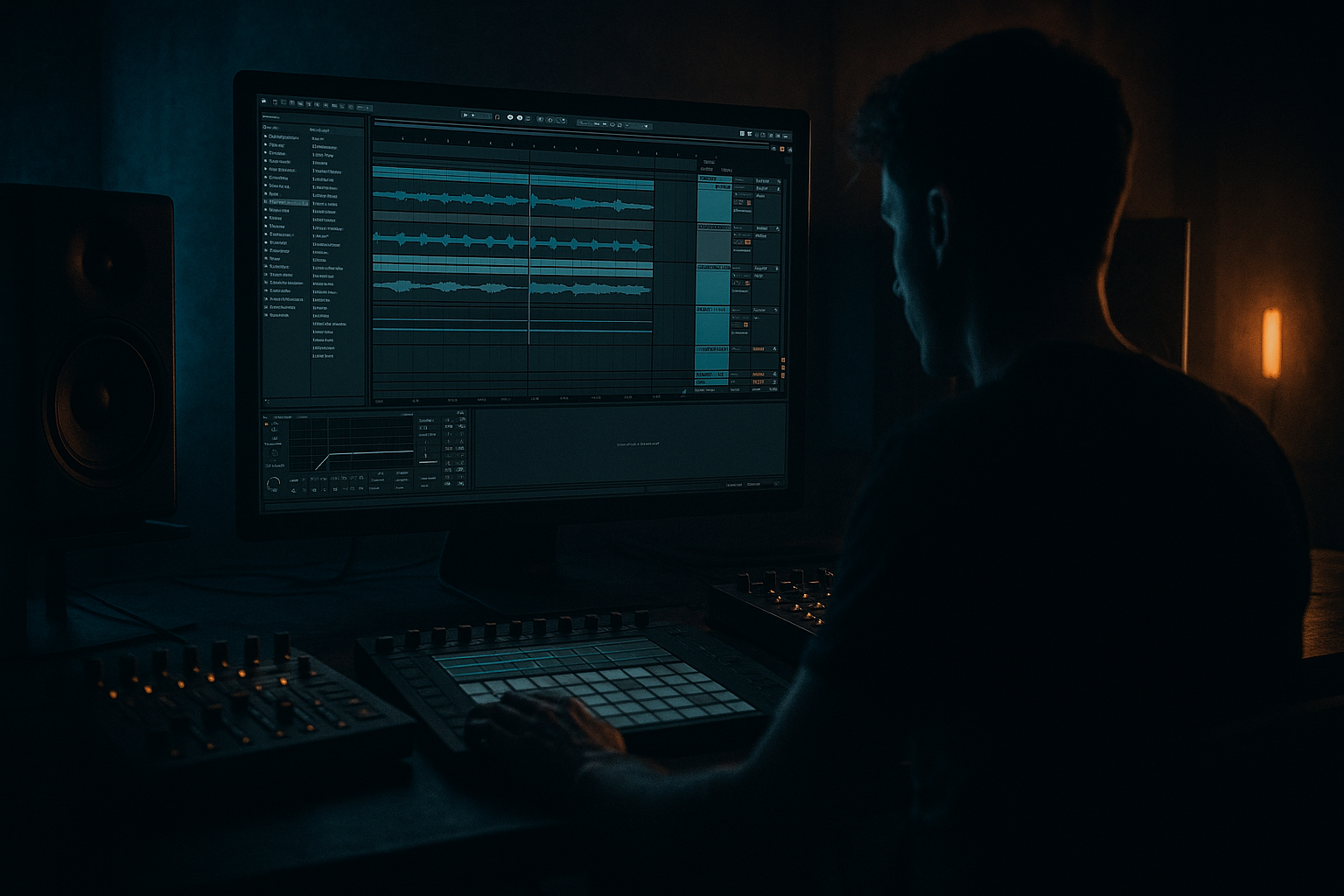
Main tutorial
Lesson Overview
The chop bounce system is one of the fastest ways to give your jungle or oldskool DnB atmospheres real movement, character, and “played” energy without losing the rawness that makes the style hit. In this lesson, you’ll learn how to resample atmospheric material, chop it into rhythmic phrases, and bounce those chops into new audio layers so they behave like a living part of the arrangement instead of just sitting in the background.
In a DnB track, this technique usually sits in the intro, breakdown, pre-drop, switch-up, or half-time breathing space before a drop. It’s especially useful when you want to bridge the gap between:
- hazy pads and cinematic texture,
- chopped break energy,
- and the darker bass/music tension that makes jungle and roller sections feel urgent.
- a long atmospheric source sound, such as a vinyl-style pad, field recording, eerie synth wash, or reverb-heavy stab
- a chopped version that has syncopated, off-grid energy while still sitting in the groove
- one or two resampled audio layers with extra saturation, filtering, and ghost movement
- a version that works as:
- washed-out atmospheres hitting in between break snare gaps,
- little reverse tails that lead into drum hits,
- chopped pads that duck around the kick and sub,
- and a bounced, gritty layer that feels like it was “played” from a sampler, not drawn in with a mouse.
- Making the atmosphere too full-range
- Chopping randomly without groove logic
- Over-widening the texture
- Too much reverb washing out the break
- Not resampling enough
- Ignoring arrangement
- Add subtle grit with Saturator before the resample and again after the bounce, but keep each stage small rather than crushing it all at once.
- Use Auto Filter with band-pass mode for eerie midrange motion in breakdowns, then open it slowly into a full-range wash before the drop.
- Try frequency-separated atmospheres: one high-passed noisy layer for air, one filtered mid layer for mood. Keep them independent so you can automate each differently.
- If you want a darker roller feel, let the chop rhythm stay sparse and syncopated, then automate the filter to move in long arcs over 8 or 16 bars.
- For heavier neuro-adjacent darkness, bounce the atmosphere through a slightly driven chain and cut tiny rhythmic holes with mute automation so it “pumps” around the drums.
- Use very short Echo throws on selected chops only — one or two hits per phrase — to create menace without clutter.
- For extra jungle character, layer a faint vinyl noise or room tone under the chopped atmosphere and resample both together. That glue can make the sound feel historically rooted and less sterile.
- If the track needs more urgency, duplicate the chop pattern and offset the duplicate by a 16th or triplet feel in selected spots. Small timing changes can make the whole phrase breathe.
- Keep checking mono. Dark DnB sounds powerful when the low-mids are controlled and the stereo image is deliberate, not random.
- Chop bounce works because it turns static atmospheres into rhythmic, playable DnB texture.
- Resampling is the key move: record, chop, bounce again, refine.
- Always shape the chops around the drum groove and phrase structure.
- Keep the sub and kick clean, and let the atmosphere live in the mids and highs.
- Use Ableton stock tools like EQ Eight, Saturator, Auto Filter, Echo, Reverb, Compressor, Utility, and Simpler to build tension and grit.
- For jungle and oldskool DnB, the best atmospheres don’t just fill space — they move like part of the break.
Why it matters: oldskool jungle and DnB often feel exciting because the atmosphere is not static. It flickers, stutters, ducks, repeats, and gets re-ordered in response to the drums. This lesson teaches you how to build that motion inside Ableton Live 12 using resampling workflows, stock devices, and practical arrangement thinking. The result is not just a texture layer — it becomes a rhythmic atmospheric instrument that can support breaks, hint at the drop, and make your track feel more intentional. ✨
What You Will Build
By the end of this lesson, you’ll create a chop-bounced atmospheric loop for a jungle/DnB section that includes:
- a 16-bar intro texture
- a 4-bar pre-drop tension layer
- or a call-and-response fill between break edits and bass phrases
Musically, you’ll end up with something like:
This is especially strong for jungle oldskool DnB vibes, where the atmosphere often carries memory, darkness, and movement rather than just polish.
Step-by-Step Walkthrough
1. Choose an atmospheric source with texture, not just sustain
Start with a sound that has character in the mids and highs, not only low-end body. Good sources for this style in Ableton Live include:
- a sustained note from a synth on Wavetable or Analog
- a washed field recording or vinyl noise loop
- a pad rendered from Operator with slight detune
- a reversed reverb tail from a stab or chord
For oldskool/jungle atmosphere, the best source usually has one or more of these:
- a slightly grainy top end
- some movement or pitch instability
- a long tail that can be chopped into smaller phrases
- enough harmonic content to survive filtering
If you’re making the source from scratch, keep it simple:
- Wavetable: two saws, a little detune, low-pass filter around 3–6 kHz, slow attack, moderate release
- Operator: sine or saw-based pad with a little FM texture, then add reverb after
- Analog: stacked saws with a slow LFO on filter cutoff for subtle drift
Why this works in DnB: jungle atmospheres are often stronger when they have a slightly imperfect tone. They sit behind breaks and bass while still adding identity. Clean pad = fine. Pad with dust, movement, and harmonic smear = much more authentic.
2. Build a resampling track in Ableton Live 12
Create a new audio track called something like ATM RESAMPLE. Set its input to:
- Resampling if you want to capture the whole mix path, or
- the specific atmospheric track if you want cleaner control
Put a simple chain on the source or on the resample track if needed:
- EQ Eight: high-pass around 120–200 Hz to remove low-end clutter
- Utility: mono low-end discipline if the source feels wide and messy
- Saturator: soft drive around 1.5–4 dB for density
Keep the source track playing a long phrase, ideally 4–8 bars. Don’t worry about the final rhythm yet. The goal is to create material you can later slice into interesting segments.
Record the source into audio. Then immediately consolidate or rename the best take so you’re not lost later. Organization matters here because resampling workflows get messy fast.
3. Slice the atmospheric audio into rhythmic chop points
Drag the recorded audio into a new audio track or an Audio Effect Rack workflow if you prefer grouped control. Now slice it manually or use Ableton’s built-in slicing approach:
- use transient markers if the sound has natural peaks
- or cut by ear at musically useful points
- focus on phrases that feel like breaths, swells, consonants, or hits
Good chop locations for jungle atmospheres:
- just before a snare
- after a break fill
- at the tail of a reversed sound
- on off-beats between kick/sub impacts
Aim for 6–12 chops across a 4-bar phrase, then duplicate and rearrange. A strong early move is to create one version with:
- longer notes on bar 1 and 3
- shorter stabs on bar 2 and 4
- one reversed chop leading into a drum accent
If you’re using Simpler for this, try:
- Classic mode for manual retriggering
- Warp off if the material is already in tempo
- a short fade to avoid clicks if the chops are abrupt
4. Give the chops bounce with envelope shaping and groove
The main goal is to make the atmosphere feel rhythmically alive, not just chopped randomly. In Ableton, you can do this with a mix of clip envelopes, fades, and groove.
Try these moves:
- shorten some chops so they “answer” the snare
- leave a few chops long enough to smear into the next beat
- add tiny fade-ins/outs for musical transitions
- apply a groove from the Groove Pool if the chops feel too rigid
Useful groove choices for this style:
- light swing around 54–58%
- subtle MPC-style swing, but don’t overdo it
- keep the break itself more central while the atmospheres can sit slightly behind the grid
Automation ideas:
- automate Auto Filter cutoff so each 4-bar phrase opens slightly more
- automate Reverb dry/wet from about 8–18% in transitions
- automate Utility width from narrower in the build to wider at the phrase end
Why this works in DnB: drums in jungle and DnB are often dense and highly syncopated. A chopped atmosphere that has its own bounce fills the gaps without stepping on the break. It creates motion in the “air” around the drums, which is a huge part of the genre’s energy.
5. Resample the chopped version into a second layer
Now record your chopped atmosphere again into a fresh audio track. This is where the magic really starts.
The purpose of the second bounce is to commit to a vibe and create a layer that feels more like a unique sound than a clean edit. During this resampling pass, process it more aggressively:
- Saturator: drive 2–6 dB for grime
- Redux: subtle bit reduction for grain, try 10–12 bits
- Auto Filter: low-pass or band-pass movement
- Echo: short, dark repeats if you want flicker
- Reverb: small to medium space for depth, not washout
Capture 1–2 minutes of variations, then choose the best 4–8 bar sections. This “print and choose” method is how you make the track feel more produced and less loop-based.
If the resampled layer gets too cloudy:
- high-pass it again around 150–300 Hz
- reduce stereo width below 200 Hz with Utility
- trim reverb tails so they don’t blur the kick/snare relationship
6. Shape the bounce against the drum groove
Put the chopped atmosphere against a drum loop or your full break pattern. This is where the arrangement becomes genre-specific.
Start by checking how the chops interact with:
- the snare on 2 and 4
- ghost notes in the break
- kick/sub phrasing
- any pickup fills before bar 1 or bar 9
Practical approach:
- mute the atmosphere and listen to the break alone
- bring the atmosphere back in and check whether it supports the rhythm or distracts from it
- cut or move chops that fight the snare
You can also sidechain the atmosphere lightly to the drums using Compressor:
- ratio around 2:1 to 4:1
- fast attack, medium release
- just 1–3 dB gain reduction
If the atmosphere is dark and dense, use EQ Eight to carve space:
- dip around 200–500 Hz if it clogs the drum body
- tame harshness around 2.5–5 kHz if the chop edges get too spitty
- keep the very low end mostly out of the atmospheric chain
This is one of the most important parts of the process: the atmosphere should make the drums feel bigger, not smaller.
7. Add transition movement and phrase logic
Now turn the chops into arrangement material, not just loop decoration. Jungle and oldskool DnB live and die by phrasing.
Build a 16-bar section like this:
- bars 1–4: sparse atmosphere, mostly tail and negative space
- bars 5–8: more frequent chops, slight filter opening
- bars 9–12: add a reverse chop or echo throw before key snare moments
- bars 13–16: increase intensity, then strip back before the drop
Good transition tools inside Ableton:
- Reverb with automation for pre-drop bloom
- Echo for rhythmic tail throws
- Reverse clips for pull-in energy
- Frequency Shifter for eerie movement, used subtly
- Auto Pan set slow and gentle for drift
Arrangement example:
- intro: chopped atmosphere under vinyl crackle and break intro
- 8-bar build: atmosphere becomes more rhythmic and filtered
- 4-bar pre-drop: chopped hits align with snare fills and risers
- drop: atmosphere retreats, leaving only tiny ghost echoes
This keeps the listener locked in by giving them motion before the main impact arrives.
8. Print a final “performance” version and clean the mix
After you’ve built the bounce, print a final performance pass so the part is ready for arrangement. Resample the best section one more time if needed, then edit it into the timeline.
Final mix checks:
- keep the atmosphere out of the sub range
- make sure the kick and sub still own the center
- check mono compatibility with Utility
- avoid wide chorus-like movement that blurs the center if the track is already busy
A helpful final chain on the atmosphere bus:
- EQ Eight high-pass
- Saturator very lightly
- Glue Compressor if the chops need glue, but only gently
- Utility for width control
If you want the atmosphere to feel like part of the drum system, group it with a drum-fx return or send it to a common reverb space at very low levels. That creates the “same room” illusion that makes oldskool DnB feel cohesive.
Common Mistakes
- Fix: high-pass aggressively and keep the low end out of the way. The sub and kick need clean space.
- Fix: place chops around drum accents and snare gaps. The rhythm should feel intentional, not accidental.
- Fix: keep low frequencies mono and use width mainly in the upper mids/highs.
- Fix: shorten decay, reduce wet amount, or print a separate dry chop layer.
- Fix: commit to audio. The second bounce is often what gives the atmosphere its gritty, “finished” character.
- Fix: use the chopped atmosphere in phrases, not just loops. DnB needs tension and release across bars, not only sound design.
Pro Tips for Darker / Heavier DnB
Mini Practice Exercise
Spend 10–20 minutes making a 4-bar chopped atmosphere phrase.
1. Pick one atmospheric source in Ableton Live: pad, field recording, reverse tail, or synth wash.
2. Record 4 bars of it into audio using resampling.
3. Chop it into at least 8 pieces.
4. Rearrange the chops so they answer a break pattern or simple kick/snare grid.
5. Bounce the chopped version again with light saturation and filtering.
6. Make one automation pass:
- filter opens over the 4 bars, or
- reverb increases at the end of bar 4
7. Check it against drums and sub, then adjust until the atmosphere supports the groove instead of masking it.
Goal: create a loop that could sit in the intro or pre-drop of a jungle DnB track and already feel like a real arrangement element.

