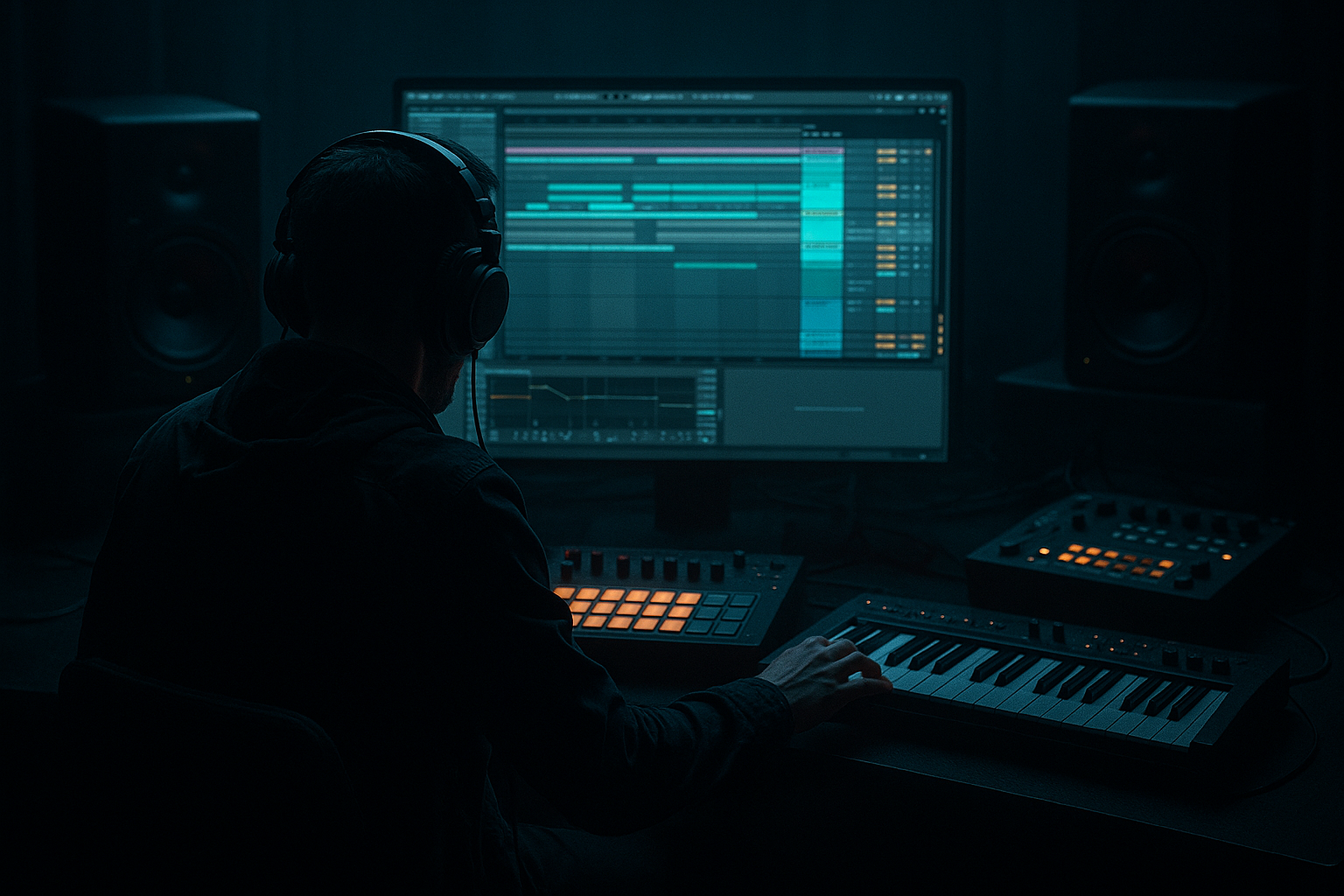
Main tutorial
Chop Ghost Method: Warm Tape-Style Grit in Ableton Live 12 (Oldskool Jungle/DnB) 🎛️🔥
1. Lesson overview
The Chop Ghost Method is a practical way to get tape-ish grit, movement, and “hardware-style” instability into your jungle/DnB drums without wrecking the transient punch.
You’ll create a “ghost” duplicate of your break, then chop/automate it aggressively (warble, saturation, filtering, noise, dropouts) and blend it under the clean main break.
This works especially well for:
- Amen / Think / Funky Drummer style breaks
- Oldskool 94–97 jungle grit
- Rolling DnB with textured top-end and controlled crunch
- Tight transient, consistent level, solid mono compatibility
- Minimal distortion (or none)
- Tape-style flutter/pitch drift, saturation, noise, filtered “ghost air”
- Automated mutes, filter sweeps, wobble depth, and saturation drive
- Blended in with utility gain and parallel-style control
- EQ Eight
- Drum Buss
- A Drum Rack with slices
- A MIDI clip that triggers the slices
- Create little dips to -inf for tiny moments (1/16 or 1/8 note)
- Or do “DJ-style” dropouts at phrase ends (last 1/2 bar)
- Bars 1–8: ghost at -18 dB (barely there)
- Bars 9–16: rise to -12 dB
- Bars 17–24 (drop): -9 dB + more movement automation
- In buildup bars, sweep from 6 kHz → 14 kHz
- In drops, do rhythmic “pump” moves:
- If your ghost is still audio (not sliced), use clip envelopes:
- Use Pitch on selected pads (simpler):
- Or place Shifter after the rack and automate Fine very slightly.
- On fills, last 1/4 bar before drop: Drive +2 to +5 dB
- On snare-heavy moments: small drive bumps on 2 and 4 (or 2 and 4 + ghost 16ths)
- Nudge the Break GHOST MIDI clip late by 5–15 ms (Track Delay in mixer view is perfect).
- Or selectively shift a couple snare slices slightly late for a “drag” feel.
- Ghost too loud: If you clearly “hear another break,” it’s probably too high. The ghost should feel like texture + motion.
- Too much low end in ghost: HP the ghost (often 150–250 Hz) so your kick/sub stay clean.
- Over-wobble pitch: If it sounds seasick, reduce to cents, not semitones.
- Phasey top end: If your ghost has wide stereo processing, check mono. Use Utility → Width to rein it in.
- Over-saturating transients: If snares lose snap, back off drive or use Saturator Soft Clip with less drive + lower mix.
- Ghost-only distortion: Put heavier distortion on the ghost while keeping MAIN clean. That’s how you get weight without losing punch.
- Mid/Side filtering: On ghost EQ Eight, try M/S mode:
- Add “room grime” (subtle): On ghost, add Reverb:
- Roar for controlled brutality: Use Roar with a band-focused setup (distort mids/highs more than lows). Automate Mix on drops.
- Resample once: After you like the ghost, Resample it to a new audio track and chop again. That “second-generation” degradation is pure jungle.
- Duplicate your break and turn it into a ghost layer.
- Slice + automate the ghost for choppy, unstable, resampled character.
- Use stock devices (Utility, Saturator, Auto Filter, EQ Eight, Drum Buss/Glue, Vinyl Distortion) to build tape-style grit.
- Keep MAIN punchy; let GHOST be the messy “tape personality.”
- Automate dropouts, filter, subtle pitch drift, and drive to make it feel alive—proper oldskool jungle energy.
Category focus: Automation (because the movement is the whole vibe).
---
2. What you will build
A two-layer drum system:
A) Main Break (Clean/Controlled)
B) Ghost Break (Chopped + Warbly + Saturated)
End result: warm grit + unstable “tape” personality under a punchy break—classic jungle energy 😈
---
3. Step-by-step walkthrough
Step 1 — Prep your break (Main Track)
1. Create an audio track: `Break MAIN`
2. Drop in your break (Amen/Think etc).
3. Warp settings (Audio Clip View):
- Warp: On
- Start with Beats mode
- Preserve: Transients
- Set Transient Loop Mode: Off (often cleaner)
- If it’s getting clicky/phasey, try Complex only if needed (but Beats is usually punchier for breaks).
4. Gain staging: aim for peaks around -6 dBFS on the track meter. Leave headroom.
Optional MAIN chain (keep it subtle):
- HP around 25–35 Hz (12 or 24 dB/oct)
- Tiny dip 250–400 Hz if boxy
- Drive 2–6
- Crunch 0–10%
- Boom Off (or very low) if you already have sub/bass elsewhere
Keep MAIN relatively stable. The ghost does the “dirt performance.”
---
Step 2 — Create the Ghost track (duplicate + slice)
1. Duplicate the track: `Break GHOST`
2. On Break GHOST, right-click the clip and choose:
- Slice to New MIDI Track…
- Slicing preset:
- Try Transient (good for Amen/Think)
- Or 1/16 if you want more rigid oldskool choppage
- Choose Built-in slicing preset (fine), or “None” if you’ll build your own chain.
This creates:
Why slice? Because automation + variation becomes insanely easy: you can mute hits, change timing, re-trigger tiny bits, and drive “tape moments” only on selected chops.
---
Step 3 — Build a “Tape Grit” Ghost chain (inside the Drum Rack)
Open the Drum Rack on Break GHOST. You’ll process the whole rack output (or specific pads if you want surgical control).
Recommended rack-output device chain (stock):
1. Utility
- Gain: start -12 dB (ghost should be quiet at first)
- Width: 80–120% (optional; watch mono)
2. Saturator
- Mode: Soft Clip
- Drive: 4–10 dB
- Output: adjust so it’s not blasting
- Color: On (if it helps your break)
3. Roar (Live 12) OR Pedal (if you want simpler)
- Roar option (great for modern “tape-like” grime):
- Start with a gentle model / curve (avoid full obliteration)
- Mix: 20–50% (parallel within the device)
- Add a little Noise if available (subtle!)
- Pedal option:
- Mode: Overdrive or Saturation
- Drive: 10–30%
- Tone: dark-ish (don’t fizz)
4. EQ Eight
- High-pass: 120–250 Hz (ghost shouldn’t fight kick/sub)
- Optional low-pass: 10–14 kHz for “tape rolloff”
- Small presence bump 3–6 kHz if the ghost needs bite
5. Auto Filter
- Filter type: LP24 or MS2 (character)
- Start with cutoff around 8–12 kHz, res 0.7–1.2
6. Vinyl Distortion (yes, it’s “vinyl,” but it does dirt well)
- Tracing Model: 2–6
- Pinch: 0–3
- Drive: 0.5–2
- Crackle: Off or very low (unless you want obvious noise)
Goal: The ghost layer sounds like a mangled resample—warm, unstable, slightly dark—while MAIN stays punchy.
---
Step 4 — The “Chop Ghost” automation moves (the secret sauce) ✂️🎚️
Now you’ll perform the ghost track with automation so it feels like old hardware resampling + tape wear.
#### 4A) Volume “dropout chops” (classic jungle texture)
On the Break GHOST track (or the Drum Rack chain), automate Utility Gain or track volume:
Arrangement idea:
This creates forward momentum without adding new samples.
#### 4B) Filter sweeps that feel like resampling
Automate Auto Filter cutoff:
- On every 2nd bar: quick dip 14 kHz → 8 kHz → 14 kHz
Keep resonance moderate—too much makes it squeal.
#### 4C) “Tape wobble” with clip envelope pitch (subtle, musical)
For tape-style instability, automate pitch very lightly:
Option 1: Clip Envelopes (Audio Clip)
- Clip → Envelopes → choose Transposition
- Draw slow curves: ±5 to ±15 cents
- Add tiny quick bends at fills: -20 cents for a split second
Option 2: For sliced Rack
- Pick a few slices (snare ghosts, little tails) and detune them -5 to -15 cents
Key rule: This is micro-motion, not dubstep pitch dives. Jungle tape wobble is subtle but constant.
#### 4D) Saturation “push” on impact points
Automate Saturator Drive (or Roar/Pedal Drive):
This mimics “printing hot to tape” at key moments.
---
Step 5 — Make the ghost swing against the main (micro timing)
Oldskool breaks feel alive because layers don’t hit perfectly aligned.
DnB tip: keep kick transients aligned (MAIN), let ghost snares/hats smear a bit.
---
Step 6 — Blend and bus it like a pro (glue without mush)
Route both breaks to a group: `BREAK BUS`
On BREAK BUS (subtle glue chain):
1. EQ Eight
- HP 25–30 Hz
- Tiny dip if harsh 7–10 kHz (depends on hats)
2. Glue Compressor
- Attack: 3 ms
- Release: Auto
- Ratio: 2:1
- GR: aim 1–2 dB
3. Limiter (optional)
- Only to catch peaks, not to crush
Now bring up the Ghost level until you feel the grit in the groove, but MAIN still punches.
---
4. Common mistakes 🚫
---
5. Pro tips for darker/heavier DnB 🖤
- Sides: low-cut higher (e.g., 300 Hz) to keep low end centered
- Size small, Decay 0.3–0.7s, Low Cut 300+ Hz, Wet 5–12%
- Automate wet up slightly on fills for that warehouse tail.
---
6. Mini practice exercise (15 minutes) ⏱️
1. Load an Amen break at 165–172 BPM.
2. Build MAIN clean and stable.
3. Make GHOST via Slice to MIDI.
4. Add this ghost chain (quick version):
- Utility (-12 dB)
- Saturator (Soft Clip, Drive 7 dB)
- Auto Filter (LP24, start 10 kHz)
- EQ Eight (HP 180 Hz, LP 12 kHz)
5. Automate over 16 bars:
- Utility Gain: 6–10 tiny dropouts
- Auto Filter cutoff: one slow sweep up across bars 9–16
- Saturator Drive: +3 dB on the last 1/4 bar before bar 9 and bar 17
6. A/B mute the ghost. If the groove feels flatter without it—you nailed it.
---
7. Recap ✅
If you want, tell me what break you’re using (Amen/Think/other) and your target vibe (94 ragga vs 97 techstep vs modern deep roller), and I’ll suggest a specific ghost automation pattern + device values for that style.

