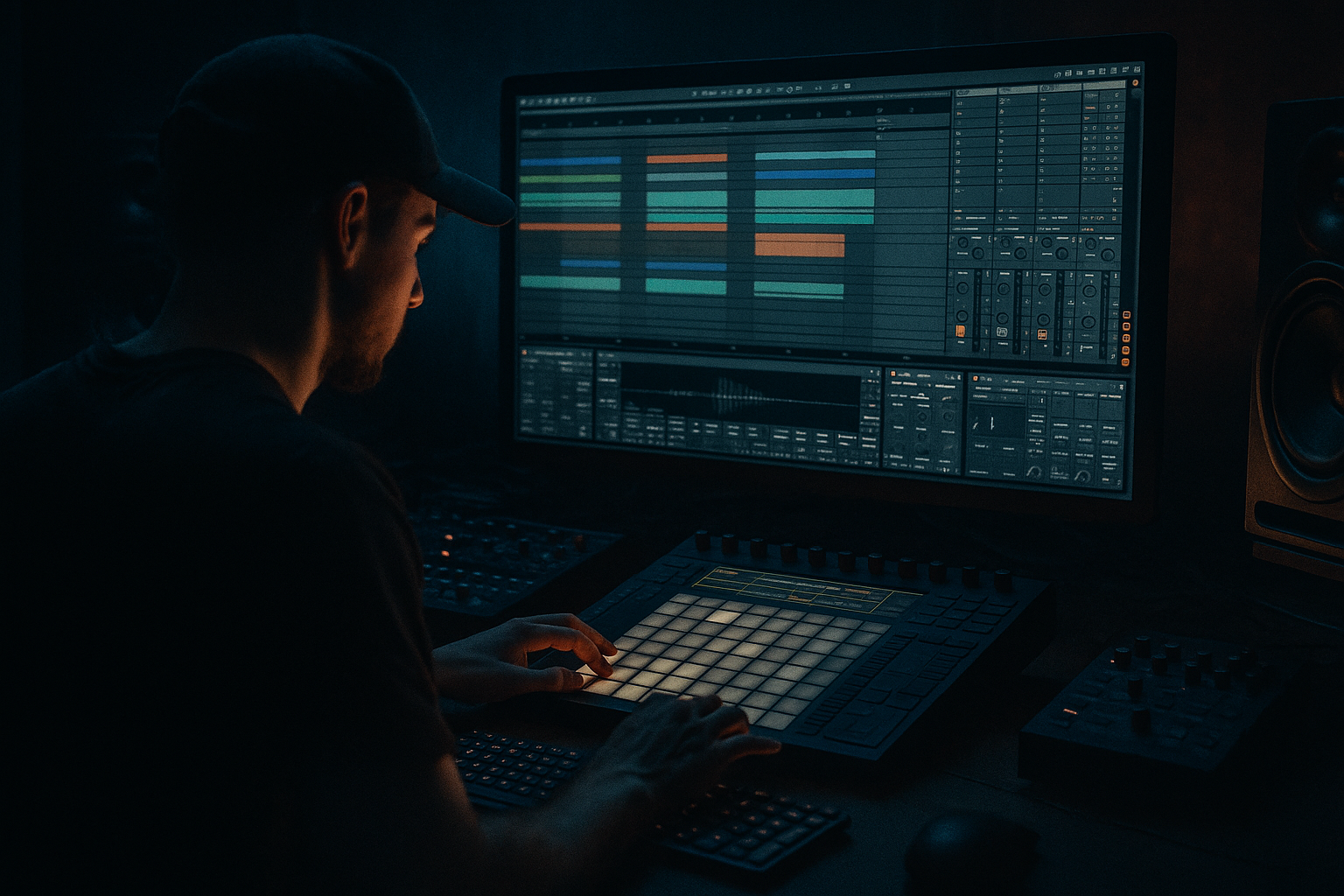
Main tutorial
Chop in Ableton Live 12: Stretch It Using Groove Pool Tricks for Jungle / Oldskool DnB Vibes
1. Lesson overview
In this lesson, you’ll learn how to take a chopped sample in Ableton Live 12 and make it feel like classic jungle / oldskool drum & bass by using the Groove Pool to add swing, timing push/pull, and musical looseness. 🥁⚡
This is not about random warping for the sake of it. The goal is to make your chop feel:
- tight enough to drive a DnB track
- loose enough to sound human and classic
- stretchy and characterful like sampled break culture
- musically locked to your bassline and drums
- audio chopping
- warp modes
- Groove Pool
- groove extraction
- MIDI and audio clip nudging
- arrangement thinking for jungle / rolling DnB
- chopped vocal hits
- synth stabs
- break fragments
- one-shot atmospheres
- re-sampled chopped phrases
- old soul / funk / reggae-style sample fragments
- sits over a 174 BPM drum & bass groove
- has a slightly swung, broken-up rhythmic feel
- uses Groove Pool to create micro-timing movement
- can be arranged into a loop, call-and-response phrase, or breakdown section
- a chop that feels like it was lifted from a classic sampler
- a groove that breathes instead of sounding rigid
- a practical template you can reuse for intros, drops, and switch-ups
- a soul vocal stab
- a reggae phrase
- a horn hit
- a dusty Rhodes chord
- a percussive break fragment
- a short synth phrase
- transients
- sustained tone
- natural swing potential
- not too much low-end clutter
- use Beats if you want aggressive slice-like behavior
- use Complex if you want smoother stretching and more sampled vibe
- experiment with Transient Loop Mode in Live 12 if the sample has repeatable bite
- fast chop programming
- finger-drummed vibes
- rearranging phrases into new patterns
- Slice to New MIDI Track
- Transient for drum-like phrases
- Warp Marker for tighter control
- 1/8 or 1/16 slices if the sample is rhythmically dense
- more vintage “tape edit” feeling
- visible waveform editing
- manual groove shaping
- answer the snare
- leave gaps for the kick and bass
- use syncopation around the offbeat
- repeat a motif with small variations
- Chop 1 on beat 1
- Chop 2 slightly after 1.2
- Chop 3 just before beat 2
- Chop 4 on the “and” of 2
- Chop 5 on beat 3
- Chop 6 slightly late on 3.3
- Chop 7 on beat 4
- Chop 8 with a pickup into the next bar
- MPC-style grooves
- Swing 16
- MPC 56 / 57 / 58 style grooves if available
- any subtle swing groove that doesn’t overdo it
- Timing: 10–30%
- Random: 0–5%
- Velocity: 10–25%
- Base: usually 1/16
- Quantize: match your chop rhythm, often 1/16 or 1/8
- Timing: 20%
- Random: 2%
- Velocity: 15%
- Base: 1/16
- Quantize: 1/16
- Commit: only after you like the feel
- Use warp markers to slightly pull certain hits earlier or later
- Let the groove apply microtiming
- Stretch longer notes so they bloom into the next beat
- Use transients to keep the front edge sharp
- Groove only the chop triggers
- Leave a few notes manually late or early for tension
- Avoid making every slice hit exactly on the grid
- Put the main chop on the grid
- Put the answer chop slightly late
- Put the pickup chop slightly early
- Simpler in Slice mode
- EQ Eight
- Saturator
- Redux for crunchy oldskool texture
- Utility to manage width
- Auto Pan lightly for movement
- Does the chop land against the snare or respond to it?
- Is the groove pushing forward into the next bar?
- Does it leave space for bass fills?
- Is it colliding with the kick transient?
- Let the chop hit after the snare for a laid-back feel
- Let it anticipate the snare for urgency
- Use shorter chops in busy sections
- Use longer stretched chops in breakdowns
- dry chop on bar 1
- grooved stretched chop on bar 2
- filtered chop on bar 3
- reversed or delayed chop on bar 4
- filtered chop with reverb tail
- fewer hits
- groove present but understated
- more chop density
- automate filter opening
- add delay throws on the last hit of every 4 bars
- full chop phrase
- tighter drum interaction
- maybe layer with a second chop an octave higher or lower
- stretch the chop more
- increase reverb
- reduce drum density
- automate groove-feel by changing clip emphasis or note placement
- change groove amount
- move one chop early
- reverse the final slice
- mute one slice for a bar to create lift
- EQ the lows
- control width
- use short ambience
- let the drum break stay punchy
- slightly late vocal chops
- staggered stabs before the snare
- a tiny push on the last hit before the drop
- Saturator
- Redux
- Drum Buss
- Pedal
- Amp and Cabinet for aggressive tone shaping
- EQ Eight
- Saturator
- Redux
- Auto Filter
- Utility
- spaces after the snare
- room between kick and ghost notes
- short pockets where the chop can jab in and out
- less groove in the intro
- more groove in the drop
- slightly more random in the breakdown
- tighter feel in the final section
- Version A: tight and dry
- Version B: more groove and delay
- Version C: darker, filtered, and more swung
- oldskool jungle
- rolling DnB
- darker halftime-inspired tension
- Warp the sample correctly first
- Chop it into playable rhythmic fragments
- Use Groove Pool for subtle swing and human feel
- Keep timing movement small and intentional
- Let the chops interact with the snare and bassline
- Add stock Ableton processing for grit, width, and impact
- Arrange variations so the part evolves like a real DnB record
You’ll work with:
This technique is especially useful for:
---
2. What you will build
You’ll build a 4-bar jungle-style chop phrase that:
By the end, you’ll have:
---
3. Step-by-step walkthrough
Step 1: Set the project up for DnB
Start with a solid jungle-friendly foundation.
1. Set tempo to 170–176 BPM
A classic starting point is 174 BPM.
2. Create a drum rack or audio drum loop with:
- kick on 1 and occasional syncopations
- snare on 2 and 4
- hats with some shuffle or off-grid motion
3. Add a sub bass or simple rolling bassline, but keep it minimal for now.
Why?
Your chop should interact with the drums, not fight them. DnB groove is all about motion in the pocket.
---
Step 2: Choose a sample that can “stretch”
Pick a sample with clear rhythmic or melodic identity:
If possible, choose something with:
Tip: Oldskool jungle often sounds great when the sample has a little grit already. Don’t be afraid of noise, tape wobble, or imperfect timing.
---
Step 3: Warp it correctly first
Drag the sample into an audio track.
1. Double-click the clip to open Clip View
2. Turn Warp on
3. Choose a warp mode:
- Complex or Complex Pro for full musical phrases
- Beats for percussive chops
- Tones for monophonic melodic fragments
4. Set the original tempo if needed
5. Make sure the sample is aligned to your project tempo
For jungle-style chops:
Important:
Don’t over-stretch before applying groove. Get the sample basically in time first.
---
Step 4: Chop the sample into playable pieces
You have two good options in Ableton Live 12:
#### Option A: Slice to MIDI Track
Best for:
Right-click the clip and choose:
Suggested slicing settings:
Then use the resulting Drum Rack or Simpler chain to trigger the chops.
#### Option B: Keep it as audio and duplicate slices
Best for:
Duplicate the clip across several tracks or separate regions and nudge them around manually.
For this lesson, we’ll focus on audio/MIDI chop performance plus groove pooling, because that gives you the best mix of control and vibe.
---
Step 5: Build a basic chop phrase
Create a 1-bar or 2-bar pattern using the slices.
Good jungle / DnB chop rhythms often:
Try this as a starting point:
The idea is to make it feel like a sampled phrase being performed, not a perfectly quantized loop.
---
Step 6: Extract or choose a groove
Now the fun part: use Groove Pool to make the chop breathe.
#### Using a built-in groove
Open the Groove Pool from the Browser. Try:
For jungle / oldskool DnB, start subtle:
#### Extract groove from a break or reference clip
If you have a classic break loop with the right feel:
1. Right-click the clip
2. Choose Extract Groove
3. Save it into Groove Pool
4. Apply that groove to your chop
This is a powerful way to inherit the DNA of a breakbeat.
DnB tip:
If your groove comes from a break, it often works best when your chop and drums share some of that same microtiming. That’s what makes the whole track lock together like old sampler records.
---
Step 7: Apply groove to the chop clip
Now apply the groove to your chop clip.
1. Select the audio or MIDI clip
2. In the Clip View, find the Groove chooser
3. Select your groove from the Groove Pool
4. Adjust the groove amount using:
- Timing
- Random
- Velocity
- Base
- Quantize
#### Suggested starting settings for jungle vibes:
This keeps the rhythm alive without becoming sloppy.
---
Step 8: Stretch the chop feel with groove, not just warp
This lesson is about making the chop feel stretched rhythmically, not necessarily pitched down or time-stretched in a dramatic way.
Here’s how to do that:
#### For audio chops:
#### For MIDI chops:
A useful trick:
That contrast creates the “stretch” feeling you hear in classic jungle edits.
---
Step 9: Add movement with stock Ableton devices
To make the chop sit like a real DnB element, add a chain of stock devices.
#### Example audio chain
1. EQ Eight
- HPF around 120–200 Hz if the chop is midrange only
- cut muddy low mids around 250–500 Hz if needed
2. Saturator
- Drive: 1–4 dB
- Soft Clip: on
3. Drum Buss
- Drive: subtle
- Crunch: low to medium
- Boom: usually off for midrange chops
4. Auto Filter
- subtle rhythmic sweeps
- automate cutoff for breaks and transitions
5. Delay
- use short ping-pong or tape-style repeats
- keep it tucked behind the dry chop
6. Reverb
- short to medium plate/room
- high-passed return to avoid mud
#### Example MIDI chop chain
If the chops are in Simpler or Sampler:
Important:
DnB chops often sound best when they are midrange-forward and not too clean.
---
Step 10: Make the groove interact with the drums
Now align the chop rhythm with your break and bassline.
Ask:
Try these arrangement tactics:
A classic jungle tension move:
---
Step 11: Commit, then refine
Once you like the groove:
1. Commit the groove to the clip if needed
2. Consolidate or bounce the phrase
3. Edit the timing manually if one or two hits need extra push/pull
4. Duplicate the phrase and vary it every 4 or 8 bars
This is crucial in DnB. Repetition is good, but variation keeps the energy alive.
---
Step 12: Arrange it like a DnB record
Use the chop in arrangement sections like this:
#### Intro
#### Build
#### Drop
#### Breakdown
#### Switch-up
---
4. Common mistakes
1. Over-quantizing everything
If every chop is exactly on the grid, you’ll lose the classic jungle bounce.
Fix:
Use groove lightly and manually nudge a few hits.
---
2. Using too much random timing
Random can destroy the pocket if pushed too far.
Fix:
Keep Random low, usually 0–5%.
---
3. Stretching before cleaning up the sample
If warp markers are messy, Groove Pool won’t save it.
Fix:
Make sure the sample is warped properly first, then apply groove.
---
4. Choosing a groove that’s too dramatic
A heavy swing groove can sound more house than DnB.
Fix:
Use subtle swing and focus on micro-shifts.
---
5. Letting chops fight the snare
The snare is king in most DnB arrangements.
Fix:
Leave room around beats 2 and 4, or deliberately answer them with a call-and-response idea.
---
6. Overprocessing the chop
Too much reverb, too much stereo, or too much low end can blur the groove.
Fix:
Keep the chop focused:
---
5. Pro tips for darker/heavier DnB
Tip 1: Use groove to create menace, not softness
For darker DnB, keep groove subtle and use it to create a dragging, tense pocket.
Try:
This creates pressure without sounding cheesy.
---
Tip 2: Layer the chop with grit
A clean chop can feel too polite. Add dirt.
Useful stock devices:
A great dark chain:
Keep the chop mid-focused and let the bass own the sub.
---
Tip 3: Chop into the negative space of the break
Classic heavy DnB often feels strongest when the sample fills the gaps between break hits.
Listen for:
That negative space is where the energy lives. ⚡
---
Tip 4: Automate groove feel in sections
You don’t have to keep the same groove amount the whole track.
Try:
This helps the arrangement evolve without rewriting the part.
---
Tip 5: Print the result and re-chop
For darker DnB, re-sampling is huge.
Workflow:
1. Render or freeze the grooved chop
2. Drag it back into a new audio track
3. Slice it again
4. Reorder or reverse some hits
5. Add a second layer of distortion or filtering
That’s how you get the “sampled from a sampler” vibe.
---
6. Mini practice exercise
Exercise: Build a 4-bar jungle chop phrase
Do this in Ableton Live 12:
1. Choose a 2–4 second sample
2. Warp it correctly at 174 BPM
3. Slice it to MIDI using Transient slicing
4. Program a 4-bar phrase with 6–10 hits
5. Add a Groove Pool groove:
- Timing: 15–25%
- Random: 0–3%
- Velocity: 10–20%
6. Add a simple stock chain:
- EQ Eight
- Saturator
- Delay
7. Arrange it so the final bar has:
- one reversed chop
- one delayed chop
- one empty gap for tension
Challenge version
Make three variations:
Then compare which one feels most like:
---
7. Recap
You’ve now learned how to make a chopped sample feel stretched, musical, and alive using Groove Pool in Ableton Live 12.
Key takeaways:
If you want that jungle oldskool vibe, think like a sampler operator:
small edits, strong groove, controlled chaos. 🔥
If you’d like, I can also turn this into:
1. a workflow template for Ableton Live 12, or
2. a specific example using a reggae vocal chop and a 174 BPM break.

