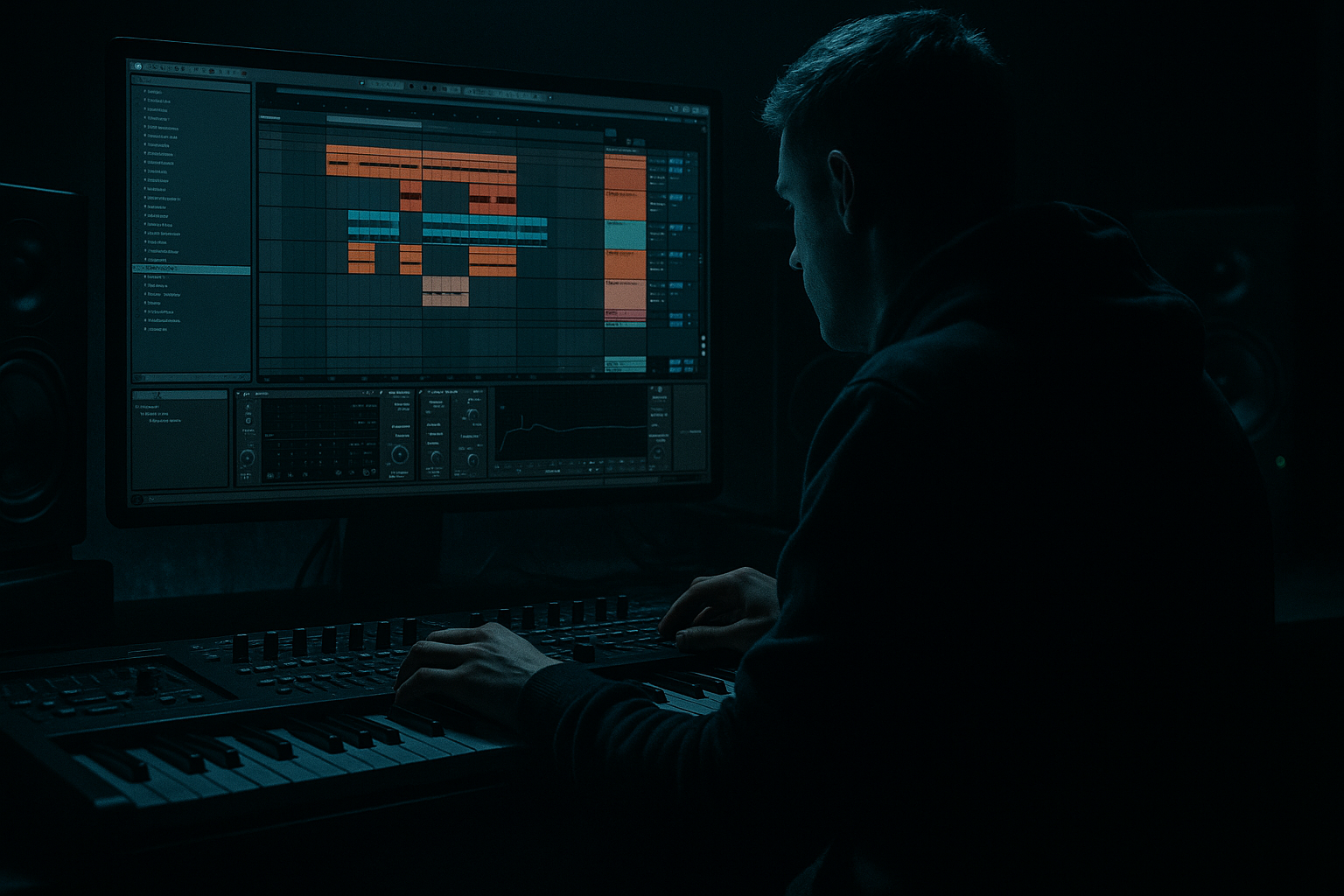
Main tutorial
Chop Resample System: Session View to Arrangement View in Ableton Live 12 for Jungle / Oldskool DnB Vibes 🥁⚡
1. Lesson overview
This lesson is about building a repeatable chop-resample workflow in Ableton Live 12 that starts in Session View and ends in a structured Arrangement View track — with that oldskool jungle / ragga DnB energy.
The core idea:
- Use Session View to jam loops, one-shots, and vocal bits quickly.
- Resample the best moments into new audio.
- Chop those recordings into playable fragments.
- Rearrange them in Arrangement View to create a full tune with edits, drops, fills, and tension.
- Keep the sound gritty, rhythmic, and human — not overly polished.
- Loop manipulation
- Sample chopping
- Live resampling
- Accidental happy mistakes
- Arrangement built from edits rather than long linear composition
- A drum rack for breakbeats
- A bass/ragga call-and-response layer
- A vocal or MC chop track
- A resample return chain
- A Session View performance setup
- An Arrangement View edit pass with:
- Amen or break edit
- dubwise bass stab
- ragga vocal chop
- filtered build
- hard drop with resampled transitions
- Tempo: `160–175 BPM`
- A sweet spot for this method: `168 BPM`
- Time signature: `4/4`
- Turn Fixed Grid on if you like exact chopping.
- Use 1/16 and 1/8 grids frequently.
- For break slicing, having access to 1/32 is useful too.
- `Drum Rack` or plain audio clips
- `EQ Eight`
- `Drum Buss`
- `Saturator`
- `Wavetable`, `Operator`, or `Analog`
- `EQ Eight`
- `Saturator`
- `Auto Filter`
- `Glue Compressor` if needed
- `Simpler` for chop playback, or audio clips
- `Reverb`
- `Delay`
- `Echo`
- `Auto Filter`
- `Redux` for lo-fi attitude
- `Hybrid Reverb`
- `Echo`
- `Corpus` if you want weird resonant hits
- `Grain Delay` for dubby throws
- Audio track input set to Resampling
- Arm this track whenever you want to record the full performance or a submix
- Amen
- Think break
- Hot Pants
- Funky Drummer
- any dusty loop with transient detail
- vocal ad-libs
- MC phrases
- toasting lines
- shouted one-shots
- call-and-response phrases
- Set mode to Slice
- Slicing preset: `Transient`
- Make sure the sample is well-trimmed
- Play chops with MIDI notes in Session View
- Osc 1: sine or triangle
- Osc 2: subtle saw or square at low level
- Add a touch of unison only if needed
- Filter: low-pass with envelope movement
- Use portamento/glide for classic movement
- Keep sub mostly mono
- Avoid too much stereo widening below ~120 Hz
- Use an envelope to make the bass punchy and short
- Sidechain lightly to the kick/snare pattern if needed
- breakbeat
- tops/percussion
- bass stabs
- ragga vocal chops
- dub FX
- Start with break only
- Bring in bass after 8 or 16 bars
- Drop vocal chops on the offbeat or fill moments
- Add FX throws into transitions
- Trigger clips manually
- Mute and unmute tracks
- Launch fills and stop clips
- Play with scene launching
- the full mix
- a subset of tracks via routing
- a performance moment
- a vocal delay throw
- a break edit pass
- a bass + drum interaction
- 4 bars of your main groove
- 8 bars with a transition
- 1 bar of an intense fill
- a dub delay tail
- a breakdown moment with only vocals and FX
- snare flams
- vocal stabs
- breakbeat fills
- delay tails
- bass hits with movement
- accidental glitches that sound musical
- cut the clip manually in Arrangement or Session
- duplicate the best phrase
- reverse a selected piece
- consolidate and re-chop
- `Warp Markers` for timing
- `Simpler` in Slice mode for re-playing audio chops
- `Fade handles` for clean edits
- `Auto Filter` automation on chopped phrases
- slice it to MIDI track
- map it to a Drum Rack
- create a new performance bank of jungle edits
- kick/snare/break fragments
- vocal shouts
- FX sweeps
- bass run snippets
- trigger fills on demand
- create call-and-response patterns
- do breakdowns and rebuilds in real time
- “bwooy” style vocal hits
- snare rolls
- rewind-style stutters
- dub drops
- short phrase answers to the bass
- Intro: 16 bars
- Build: 8 bars
- Drop 1: 16 or 32 bars
- Breakdown: 8 bars
- Drop 2: 16–32 bars
- Outro: 8–16 bars
- Duplicate clips and alter the last bar of each phrase
- Use automation on filters and sends
- Cut drums for tension before drops
- Add “rewind” moments using reversed audio or delay throws
- Create a fake drop by stripping everything but vocal + FX for 1 bar
- `Auto Filter` cutoff on breaks and vocals
- `Echo` feedback on vocal throws
- `Reverb` size for breakdowns
- `Saturator` drive for lift sections
- `Utility` gain for drop impact
- low-pass the whole drum bus before the drop
- push delay feedback on the last vocal phrase of each 8-bar phrase
- mute bass for 1 beat before the drop
- automate a fast filter sweep on a resampled chop
- increase drum saturation in the second drop for more aggression
- `EQ Eight` for cleanup
- `Glue Compressor` for a bit of cohesion
- `Saturator` for gentle density
- `Limiter` only for rough monitoring, not final loudness
- mute/unmute
- automate filters
- throw delays
- vary percussion
- intro
- buildup
- drop
- breakdown
- second drop
- bass through saturation
- vocal through delay feedback
- break through bit reduction
- drum loop through filter sweeps
- a clean sine/sub layer
- a distorted upper-mid layer
- movement from filter or pitch modulation
- `Operator` for clean sub
- `Wavetable` for mid grit
- `Saturator` and `Redux` for edge
- snare doubles
- kick flams
- breakbeat micro-cuts
- reverse snare pickups
- tiny vocal repeats before the drop
- vocal says something
- drums answer
- bass answers again
- FX punctuate the space
- `Auto Filter`
- `Frequency Shifter` very subtly
- `Redux` for texture
- `Vinyl Distortion` if you want roughness
- break chop chain
- vocal chop chain
- dub FX chain
- darker
- less clean
- more aggressive
- with a heavier bass response and more broken-up vocal rhythm
- perform it first
- record the chaos
- sculpt it into structure afterward
- energetic
- authentic
- DJ-friendly
- full of movement and grime 🔥
This is a very DnB-friendly method because jungle and ragga music often come from:
If you’re producing oldskool drum and bass, this workflow helps you create that chopped-up, energetic feel without losing control of the arrangement.
---
2. What you will build
You’ll build a mini system with:
- intro
- drop
- breakdown
- second drop
- variation and turnaround
By the end, you should have a track skeleton that feels like:
---
3. Step-by-step walkthrough
Step 1: Set your tempo and grid for jungle energy
For oldskool DnB / jungle, start with:
In Ableton Live:
Tip: If you want more classic jungle movement, don’t make everything perfectly quantized. Let some chops land a hair early or late.
---
Step 2: Build a Session View performance template
Create these tracks in Session View:
1. DRUMS - BREAK
2. DRUMS - TOPS
3. BASS
4. RAGGA VOX
5. FX / DUB
6. RESAMPLE
This is your working playground.
#### Suggested stock devices:
On DRUMS - BREAK
On BASS
On RAGGA VOX
On FX / DUB
On RESAMPLE
---
Step 3: Prepare your breakbeat source
For jungle, use a break or break layer with character:
#### Method A: Audio clip chopping
1. Drag a break into an audio track.
2. Turn on Warp if needed.
3. Set warp mode:
- Beats for drums
- Use `Preserve` settings to avoid smearing transients
4. Duplicate the break clip in a few Session slots:
- full loop
- half-length version
- chopped fill version
- reverse or stutter variation
#### Method B: Slice to Drum Rack
1. Right-click the break clip.
2. Choose Slice to New MIDI Track.
3. Slice by:
- `1/16` for fast editing
- `transients` for more musical break slicing
This gives you a Drum Rack with each hit on pads.
Why this matters:
In jungle, chopping the break into playable hits lets you perform fills, re-order the groove, and create those classic hyper-edited patterns.
---
Step 4: Make a ragga vocal chop source
Import:
Use Simpler in Slice mode if you want phrase chopping, or keep them as audio clips if you want quick manual edits.
#### In Simpler:
#### For gritty ragga feel:
Add this chain:
1. `EQ Eight` — cut low rumble below ~120 Hz
2. `Saturator` — soft clip or push drive slightly
3. `Echo` — short dub delay
4. `Auto Filter` — automate LP/HP sweeps
5. `Redux` — if you want a rawer, more vintage digital edge
Keep vocal chops short and percussive.
Ragga in DnB often works best like a rhythmic instrument, not a full sustained vocal line.
---
Step 5: Create the bass foundation
For an oldskool / jungle bass feel, you want something simple, heavy, and controlled.
#### Bass patch idea in Wavetable:
#### Bass chain:
1. `Wavetable` or `Operator`
2. `Saturator`
3. `EQ Eight`
4. `Compressor` or `Glue Compressor`
5. `Auto Filter` for movement
6. Optional `Drum Buss` for weight
#### Bass settings suggestion:
DnB note:
A lot of oldskool energy comes from a bass that answers the drums instead of fighting them.
---
Step 6: Record a live Session View jam
Now build a loop in Session View that combines:
#### Jam structure:
Use Session View as a performance tool:
Important:
Don’t try to perfect the whole song here. Capture energy first. Arrangement comes later.
---
Step 7: Set up resampling correctly
This is the heart of the method.
#### Create the RESAMPLE track:
1. Add an audio track.
2. Set Audio From to `Resampling`.
3. Arm the track.
4. Make sure monitoring is set appropriately.
Now you can record:
#### Practical resample targets:
Why resample?
Because it turns live DnB energy into audio material you can chop, reverse, stretch, and rearrange into a more polished tune.
---
Step 8: Chop the resampled audio
After recording into the RESAMPLE track, find the best bits.
#### Good things to listen for:
Now you can:
#### Best workflow:
1. Record a 4–8 bar resample.
2. Drag it to a new audio track.
3. Split at interesting transient points.
4. Create micro-edits:
- 1/8 note vocal repeats
- 1/16 drum stutters
- one-bar fill reverses
- pre-drop risers made from chopped FX
#### Use stock tools:
---
Step 9: Convert the best chops into a playable Session View instrument
Take your chopped resample and:
#### Great slice targets:
Now your Session View becomes a live jungle edit instrument:
This is especially useful for ragga DnB because you can trigger:
---
Step 10: Move from Session View into Arrangement View
Once your jam feels good, hit Record in Arrangement View and perform your clip launches live.
You’re now building the track’s backbone in real time.
#### Suggested arrangement roadmap:
- filtered break
- atmosphere
- small vocal tease
- bass hints
- delay throws
- increasing drum density
- full break
- bass locked in
- vocal chops
- half-time feel or stripped section
- FX and vocal fragments
- variation of drums
- new chop pattern
- more aggressive bass
- filter down
- remove bass
- leave a final vocal echo
#### Arrangement editing ideas:
---
Step 11: Add movement with automation
This style needs movement to stay alive.
Automate:
#### Good automation moves:
---
Step 12: Glue the track together
At this stage, your track should feel like a live jungle edit that became a song.
On the master or groups, try subtle processing:
Keep the energy raw.
Oldskool DnB is often more about character and momentum than super-smooth polish.
---
4. Common mistakes
1. Over-editing the chops
Too many tiny edits can kill groove.
If every bar is hyper-detailed, nothing feels special.
Fix: leave room for the break to breathe.
2. Making the bass too wide
Sub-bass spread will weaken the low end.
Fix: keep bass mono or near-mono below ~120 Hz.
3. Resampling boring sections
If you resample static loops, you’ll get static chops.
Fix: perform the Session View jam with intent:
4. Using too much reverb on drums
Jungle needs impact and edge.
Fix: keep drum reverb short or use sends sparingly.
5. Forgetting phrase structure
Even wild oldskool DnB needs a roadmap.
Fix: think in 8s, 16s, and 32s:
6. Ignoring transient control
Messy transients can make resampled chops feel weak.
Fix: use `Warp Markers`, `Simpler`, `Drum Rack`, and clean fades.
---
5. Pro tips for darker/heavier DnB
Use resampling as sound design
Print your own chaos:
Then chop the result into new material.
Layer a dark sub with distorted mid-bass
A powerful DnB bass often has:
You can use:
Make fills from chopped ghost notes
Oldskool drums feel alive because of little ghosts and rolls.
Try:
Use call-and-response phrasing
For ragga elements:
That dialogue is a huge part of the vibe.
Darken with filtering, not just EQ
Use:
Save your best resample chains as presets
If you find a killer chain, save it:
That makes future jungle sessions much faster.
---
6. Mini practice exercise
Exercise: 8-bar jungle chop-to-arrangement sketch
#### Goal
Create an 8-bar loop in Session View, resample it, then turn it into a short arrangement section.
#### Steps
1. Set tempo to 168 BPM.
2. Build:
- 1 break loop
- 1 bass patch
- 1 ragga vocal chop
- 1 dub FX hit
3. Jam for 8 bars in Session View.
4. Record the performance into Resample.
5. Drag the resample into a new audio track.
6. Slice the best section into:
- intro chop
- fill chop
- drop chop
- vocal hit
7. In Arrangement View, create:
- 2-bar intro
- 2-bar buildup
- 2-bar drop
- 2-bar variation
8. Automate:
- filter opening
- delay throws
- drum mute before the drop
#### Challenge version
Repeat the exercise but make the second version:
---
7. Recap
This workflow is all about turning live Session View performance into editable Arrangement View structure.
The core chain:
1. Build a Session View jam
2. Perform break, bass, and ragga elements
3. Resample the best moments
4. Chop the recordings into new material
5. Re-sequence the chops
6. Arrange the song with tension and drops
The big idea:
For jungle and oldskool DnB, your sound often gets better when you:
If you lean into this chop-resample system, you’ll get tracks that feel:
If you want, I can also give you:
1. a track template for this workflow in Ableton Live 12, or
2. a specific 16-bar ragga jungle arrangement map with bar-by-bar clip actions.

