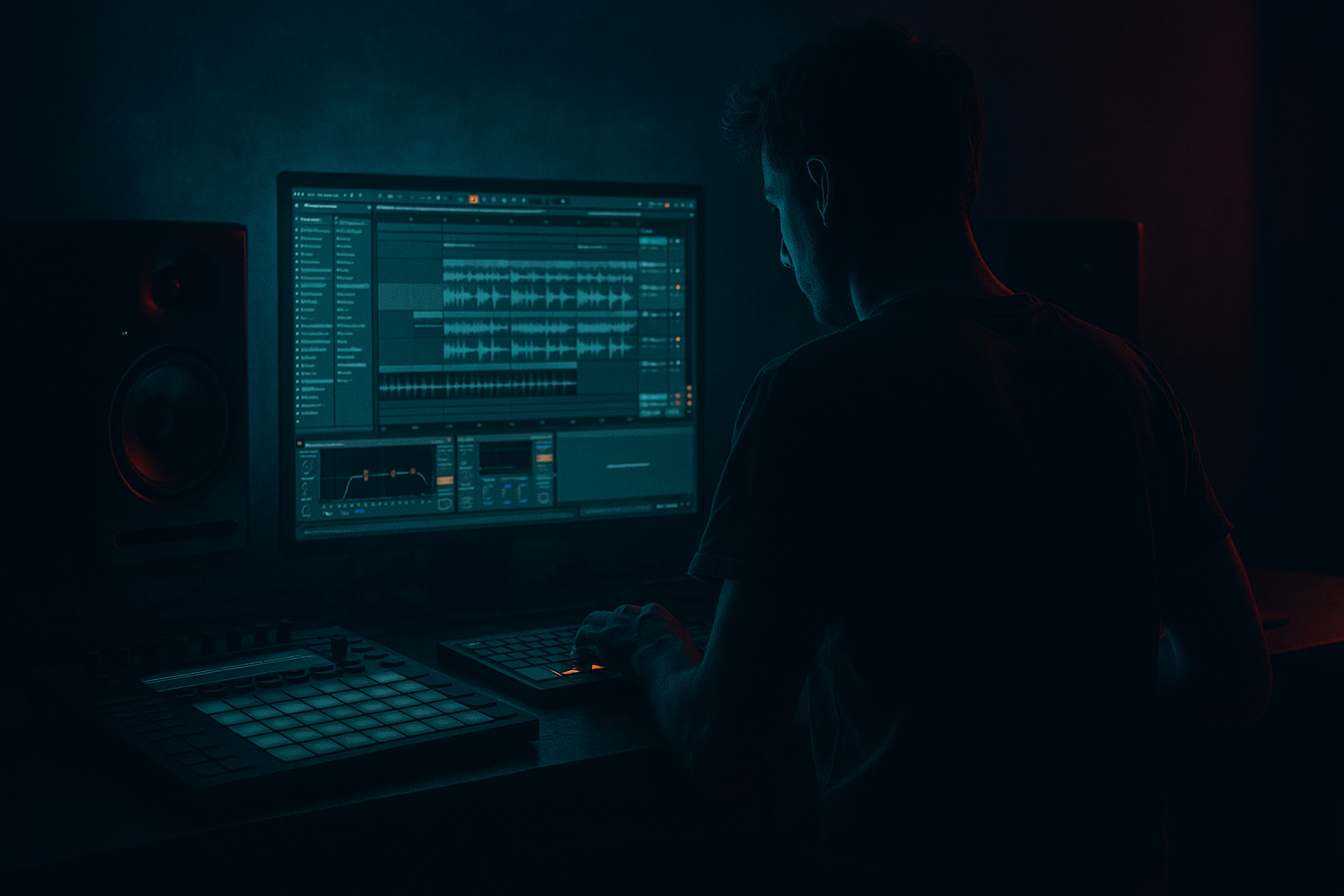
Main tutorial
Chopping jungle breaks with the groove preserved — Ableton Live (Intermediate)
Energetic, hands-on lesson for drum & bass producers who want to chop classic jungle breaks (Amen, Funky Drummer, Think Breaks, etc.) into tight, rolling patterns while keeping the original micro-timing and feel. We'll use Ableton Live’s stock tools (Slice to New MIDI Track, Drum Rack, Simpler/Sampler, Groove Pool, Warp/Beats mode, EQ Eight, Saturator, Glue Compressor, Multiband Dynamics, Beat Repeat) and practical workflow tips so your chopped breaks still swing like a real drummer. 💥🥁
---
1) Lesson overview
Goal: chop a break, turn it into a MIDI-playable Drum Rack while preserving the original groove (micro timing & human swing), then process it for a tight drum & bass roll that sits well with rolling basslines.
What you'll learn:
- When and how to slice (transients vs. fixed grid)
- Extracting the break’s groove and applying it to MIDI slices
- Building a Drum Rack + processing chain for a DnB-ready drum bus
- Workflow to resample and rearrange chops while keeping feel
- Arrangement tips and darker/heavier DnB finishing touches
- A sliced Drum Rack of a jungle break (mapped to MIDI) that plays in-time with the original human swing.
- A 2-bar rolling drum pattern that grooves like the original break but allows for more modern DnB editing (fills, rolls, pitch tricks).
- A drum bus processing chain to glue and darken the drums for heavy roller production.
- A reusable workflow: extract → slice → map → groove → process → resample.
- Intro (0:00–0:16): original un-sliced break with long reverb/filtered low-pass.
- Build (0:16–0:32): sliced pattern enters, low-pass on drum bus opens up.
- Drop (0:32): heavy processed drum resample + rolling sub bass.
- Breakdowns: strip to raw groove then re-introduce processed chops.
- Warping the original break in Complex/Complex Pro and then slicing it: Complex modes can smear transients and destroy the punch. If you must warp, use Beats mode and Preserve setting carefully (see Step G).
- Slicing to a fixed grid instead of transients: You lose micro-timing and end up robotic.
- Over-quantizing MIDI after applying groove: defeats the purpose—don’t Quantize after you apply the groove unless it’s subtle.
- Applying heavy global reverb to the entire drum bus: this kills punch. Use sends or small-shelf EQ’d reverb on snare only.
- Using Beat Repeat directly on the master to create rolls without preserving timing: it can throw off groove. Use it lightly on a return or on duplicated drum tracks.
- Sub-attach the kick: take the first kick slice, duplicate, pitch down an octave and low-pass (24 dB) to create sub reinforcement. Sidechain the sub to the bass.
- Reverse small ghost slices: reverse very short slices (25–60 ms) and layer under snares for creepy pre-attack texture.
- Layer with synthetic hits: layer a thin, processed 909/snare transient on your break snare to get more "punch follow-through" and control the snap.
- Use Saturator + Multiband Dynamics chain on the resampled drum loop: OTT-style aggressive multiband boosting on top bands (subtle amounts) adds weight. Try Multiband Dynamics “Heavy” presets and pull down the mid band to avoid honk.
- Low-pass automation on the drum bus at 8–10 kHz during breakdowns to darken, then open up at the drop to reveal top-end bite.
- Parallel distortion: send to a distortion return (Saturator or Overdrive) and blend back in, focusing distortion on mid-range 200–4kHz to create aggressive grit.
- Use frequency-specific gating: lowcut everything above 2–4 kHz on reverb sends to avoid muddying the top-end.
- Pitch shifting slices: pitching down certain snare or tom slices by 3–7 semitones and layering underneath gives weight without losing transient.
- Preserve groove by slicing to transients and extracting the original break’s groove into the Groove Pool. Apply that groove to your MIDI slices.
- Use Drum Rack with Simpler/Sampler slices for flexible editing; route to a drum bus and use stock Ableton devices (EQ Eight, Saturator, Glue, Multiband Dynamics) for DnB-ready processing.
- For heavier, darker tones: sub-attach, parallel distortion, pitch down layers, and resample/chop your processed drum bus.
- Avoid warping the original break in a way that smears transients and don’t over-quantize after applying groove.
Expect to use: Slice to New MIDI Track, Drum Rack, Simpler/Sampler, Groove Pool, Warp (Beats mode), Glue Compressor, Saturator, EQ Eight, Multiband Dynamics, and Return channels.
---
2) What you will build
---
3) Step-by-step walkthrough
Tools assumed: Ableton Live (9/10/11/12+), basic familiarity with Clip View and MIDI editing. I’ll use the Amen break as an example, tempo target 174 BPM.
Step A — Prep the break
1. Drag your clean break audio into an audio track. Set your Live Set tempo to your DnB target (170–176 BPM; we’ll use 174 BPM).
2. IMPORTANT: Disable Warp for a moment (uncheck Warp in the clip) to hear the original timing. If Live auto-warps, click the clip and toggle Warp off. We want to keep the original groove as reference.
Step B — Duplicate and safe copy
1. Duplicate the clip (Cmd/Ctrl+D). Keep one raw copy untouched (refer back), work on the other.
Step C — Slice to New MIDI Track (fast, accurate chops)
1. Right-click the working audio clip → “Slice to New MIDI Track…”
2. In the dialog: choose Slice By → Transients. (This detects drum hits and creates slices at transients.)
- Slicing Preset: leave default or “Slice to Drum Rack” option (Ableton will map each slice to a Drum Rack pad using Simpler/Sampler).
3. Confirm. Ableton will create a new MIDI track with a Drum Rack filled with slice-simplers and a 1-bar MIDI pattern that triggers the original slice positions.
Why this works: slicing by transients preserves the original attack locations. We’ll transfer the timing feel separately to the MIDI pattern.
Step D — Extract the groove from the original break
1. Go back to the untouched raw break clip (the disabled-warp one). Click and drag that clip directly into the Groove Pool (found in the lower-left corner, or open via View → Groove Pool).
2. A new groove is created in the pool representing the break’s timing and velocity feel.
3. Select the new groove and tweak the parameters:
- Timing: start around 60–85% (more keeps more micro-timing; less softens).
- Random: 0–5% for slight human variance.
- Velocity: 60–90% if you want the MIDI velocities to follow the break’s accents.
- Rate: leave at 1/1 typically.
Step E — Apply groove to your MIDI slice clip
1. Open the MIDI clip that was created with the Drum Rack (from the slice step).
2. In the Clip View, set the Clip’s Groove to the groove you extracted.
3. Enable “Commit” if you want the timing applied (or leave it as a groove — committed timing is printed into MIDI). For workflow, apply then Commit Groove if you plan to resample and edit slices freely: right-click the MIDI clip → Groove → Apply Groove (or use the GUIDED flow: hit the Commit button in the Groove Pool if available).
4. Listen: the MIDI pattern should now move off-grid subtly and match the feel of the original break’s micro-timing.
Step F — Tighten slices and design your pattern
1. Edit the MIDI notes to craft a 2-bar rolling pattern (copy the original slice arrangement, then tweak).
2. Use velocity to bring out ghost hits and human dynamics — the groove will have given you timing; velocity controls should emphasize snare hits and tail off ghost notes.
3. For additional swing on subdivisions, you can slightly nudge hi-hats forward/back with small ms adjustments (Grid → set to 1/16 or 1/32 and nudge by 1–6ms).
Step G — Drum Rack chain & bus processing (stock device chain)
Drum Rack Pads → Drum Bus (route Drum Rack output to a dedicated Drum Bus track). On the Drum Bus chain:
1. Gain/Utility: place Utility first for gain staging. Set Gain to -2 to -6 dB if clipping.
2. EQ Eight: HP filter at ~40–50 Hz (shelve rarely, but remove problematic rumble). Slight cut 300–500 Hz (–1.5 to –3 dB) to tighten mud.
3. Saturator: Soft Clip mode, Drive 2–4, Dry/Wet ~30–50% — adds grit and harmonics.
4. Glue Compressor: Threshold -10 to -6 dB, Ratio 2–4:1, Attack 10–30 ms, Release ~0.2–0.8s. Slight gain makeup +2–4 dB. This glues slices together.
5. Multiband Dynamics (optional): compress low band lightly to control sub-kicks and prevent mud.
6. EQ Eight final: gentle boost 4–8 kHz +1.5–3 dB for presence on top-end.
7. Send Reverb/Delay: set up short plate reverb on a return for snares only (send knob on drum rack pad or send on the bus). Keep reverb low and EQ’d to avoid wash.
Step H — Rolls, fills & automation
1. For drum fills, duplicate the MIDI clip region, shorten quantization and draw 1/32 or triplet patterns. Because groove is applied, manually nudge notes if needed.
2. For fast rolls, rather than using Beat Repeat live (which destroys groove), program MIDI rolls using repeated slice notes with velocity variation. If you want algorithmic, place Beat Repeat on a Return at low grid (1/16–1/32) and automate amount briefly.
3. Automate Drum Bus Saturator Drive or filter to give impact at transitions.
Step I — Resampling & consolidation (freeze a final chopped take)
1. When you're happy, solo the drum bus and create a new audio track set to “Resampling”.
2. Record a take of the chopped pattern for 2–4 bars. This bounces the human-timed chops to a single audio file.
3. Warp the recorded resample back using Warp Mode = Beats and Preserve = 1/16 (if you need to time-stretch later without losing micro feel), or keep Warp off if you want it rigid.
Arrangement idea:
---
4) Common mistakes
---
5) Pro tips for darker/heavier DnB
Emoji tip: dark = low-pass + saturation + sub reinforcement. 🖤🔥
---
6) Mini practice exercise (20–40 minutes)
1. Load an Amen break at 174 BPM. Duplicate it.
2. Slice the duplicate to a Drum Rack (Slice by Transients).
3. Drag the original duplicate (raw) into the Groove Pool to extract its groove.
4. Apply that groove to the Drum Rack’s MIDI clip and commit it.
5. Create a 2-bar rolling pattern that uses at least 6 different slices (kick, snare, two ghost snares, hi-hat, cymbal).
6. Add simple bus processing: Utility → EQ Eight HP40 → Saturator Drive 3 → Glue Compressor (mild).
7. Resample 2 bars of the result to audio. Add a parallel Saturator send with 30% wet and blend.
8. Make a 16-bar loop: play it, listen for groove coherence with a rolling sine sub on a separate track with sidechain compression (Compressor set to sidechain from the drum bus).
Goal: hear your MIDI chops groove like the raw break. If it sounds stiff, increase the groove Timing % or nudge velocities.
---
7) Recap
Now go chop that break — keep the roll, keep the swing, and push the grit. Post a render if you want feedback and I’ll make specific mix/process suggestions. 🎧🔥

