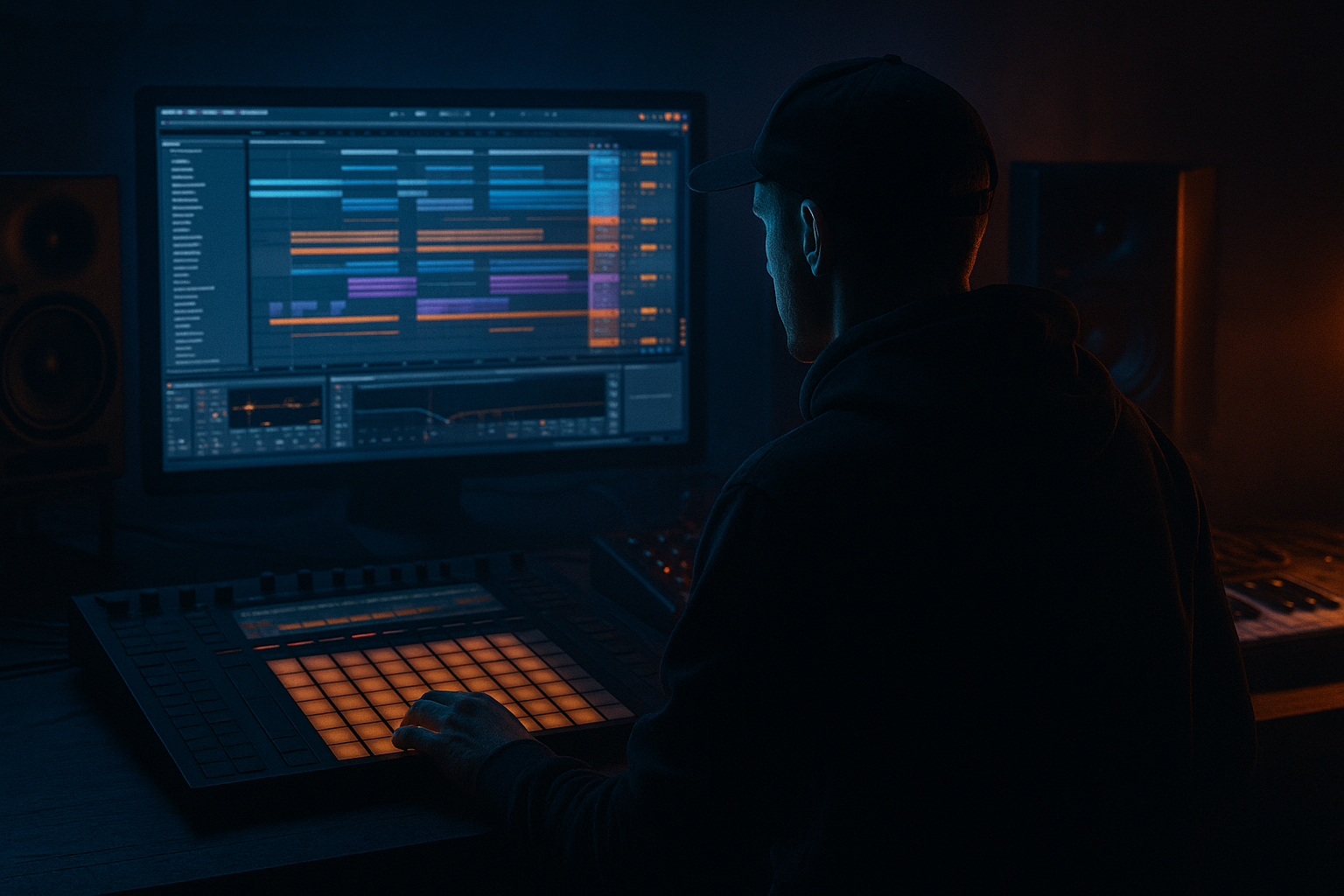
Main tutorial
```markdown
Chord Pacing at 170 BPM (DnB) — Using Session View in Ableton Live 🎛️⚡
1) Lesson overview
At 170 BPM, chord changes can feel either too slow and empty or too busy and confusing—especially in drum & bass where drums and bass dominate the groove. In this lesson you’ll use Session View as a rapid composition lab to audition chord pacing (how often the harmony changes) against a proper DnB drum grid and bass context.
We’ll focus on:
- Building multiple chord pacing lanes (half-time, 1-bar, 2-bar, syncopated) in Session View
- Using Follow Actions, clip lengths, and Launch Quantization to test movement fast
- Making pacing choices that support rolling drums, sub pressure, and dark atmospheres 🖤
- Drum loop (reference groove)
- Sub + reese bass anchor
- Chord stack made of 4–8 chord clips with different pacing strategies:
- A playable “scene” structure: Intro → Drop → Mid → Variation → Outro
- Drum Rack
- Glue Compressor (gentle bus glue)
- Saturator (soft clip)
- Instrument: Operator
- Add Utility (mono + gain staging)
- Optional: Saturator (Drive 1–3 dB)
- Instrument: Wavetable
- Add:
- PAD track: sustained, filtered, background glue
- STAB track: rhythmic punctuation, syncopation
- Instrument: Analog (or Wavetable)
- Auto Filter
- Reverb
- EQ Eight
- Utility
- Instrument: Simpler (stab sample) or Wavetable pluck
- Amp Envelope: short Decay, low Sustain
- Transient shaping (stock-ish): use Drum Buss
- Echo
- Reverb (shorter than pad)
- Minor key, suspended tones, 7ths/9ths sparingly
- Avoid huge root movement if bass is already active
- i → VI → VII (common dark DnB motion)
- i(add9) held while bass does movement underneath (common roller approach)
- Stab 1: hits on beat 1 only (anchor)
- Stab 2: hits on 1 and the “&” of 2 (classic DnB syncopation)
- Stab 3: call/response around snare: (1.3) and (3.3) type placements
- Stab 4: sparse jungle feel: single stab just before the snare (late pickup)
- DRUMS: full groove
- SUB: on
- REESE: on
- PAD: Clip A (2-bar hold)
- STAB: none or Stab 1
- PAD: Clip B
- STAB: Stab 2
- PAD: Clip C
- STAB: Stab 3 (sparingly)
- PAD: Clip D
- STAB: Stab 4
- Does the groove feel bigger or smaller?
- Are chords stepping on snare impact?
- Does harmonic motion complement bass movement or fight it?
- For PAD clips: enable Legato so launching doesn’t restart modulation/phrase—great for seamless pad movement.
- For STAB clips: keep Legato off so stabs trigger cleanly.
- Arm a new audio resampling track or record to Arrangement.
- Hit Record in the top transport and perform scene launches for ~3 minutes.
- Then go to Arrangement View and edit:
- 16 bars intro (atmos + sparse pad)
- 16 bars pre-drop tension (faster chord pacing starts here)
- 32–64 bars drop (reduce harmonic changes to keep weight)
- Mid-section: switch to anticipation/syncopated changes for freshness
- Outro: strip back to 2-bar holds
- Use harmonic rhythm for tension, not prettiness:
- Pedal note trick (dark hypnosis):
- Automate movement instead of changing chords:
- Sidechain chords to the drum groove, not just the kick:
- Stab call/response with the snare:
- Parallel distortion return for chords:
- At 170 BPM, chord pacing is a groove decision, not just a harmony decision.
- Session View is perfect for auditioning pacing because you can A/B instantly with scenes.
- Build multiple pacing variants (2-bar hold, 1-bar changes, half-bar flips, anticipation) and test against real drums + bass.
- Use Launch Quantization, Legato, and Follow Actions to explore and then record a performance into Arrangement.
- For darker/heavier DnB: fewer chord changes, more automation, cleaner low-mids, and stabs that interact with the snare.
Advanced means we’ll assume you’re already fluent with routing, warping basics, clip editing, and core Live workflow.
---
2) What you will build
A Session View “harmonic performance set” for a 170 BPM roller, including:
- 2-bar held chords (minimal / atmospheric)
- 1-bar changes (classic liquid / rolling support)
- 1/2-bar changes (more urgent / techy)
- Syncopated stabs (jungle-ish, call/response)
You’ll be able to launch scenes and clips live to feel what pacing works before committing to Arrangement.
---
3) Step-by-step walkthrough
Step 0 — Session View setup (project + global timing)
1. Set tempo to 170 BPM.
2. In the top bar:
- Global Launch Quantization: start at 1 Bar (we’ll change later).
3. Create these tracks (top to bottom):
- DRUMS (Audio or MIDI)
- BASS (SUB) (MIDI)
- BASS (REESE/MID) (MIDI)
- CHORDS (PAD) (MIDI)
- CHORDS (STAB) (MIDI)
- ATMOS/FX (Audio/MIDI)
Workflow tip: Color-code: drums red, bass dark blue, chords purple, atmos grey. It speeds up Session navigation.
---
Step 1 — Establish a reliable DnB groove reference 🥁
You can use your own drum rack, but the goal is a consistent “truth” to judge harmony pacing against.
Option A (quick): Drop in a 2-bar drum loop you trust.
Option B (preferred advanced): Make a tight 2-bar drum groove (MIDI) so harmony interacts predictably.
Stock-device chain suggestion (DRUMS MIDI track):
- Attack: 3 ms
- Release: Auto
- Ratio: 2:1
- Gain reduction: ~1–2 dB
- Drive: 2–5 dB
- Soft Clip: On
Groove note: Use a rolling pattern: kick on 1, snare on 2 & 4, hats with 16th motion + light swing.
---
Step 2 — Lock bass fundamentals so chords don’t lie 🎚️
Chord pacing decisions will be wrong if bass is floating. Get a stable sub “center of gravity.”
#### SUB (MIDI)
- Osc A: Sine
- Amp Env: Attack 0 ms, Decay ~300 ms, Sustain -inf (if you want short notes) or full sustain (for legato sub)
- Bass Mono: On
Write a simple 2-bar sub phrase (e.g., F → Eb → F → C as an example vibe; choose your own key).
#### REESE/MID (MIDI)
- Unison: 2–4
- Detune light
- Auto Filter (LP24)
- Saturator (or Overdrive)
- Chorus-Ensemble (subtle width on mids only)
- EQ Eight (high-pass around 120–200 Hz so it doesn’t fight sub)
Key rule: Bass phrase should loop cleanly over 2 or 4 bars. Now chords can be judged accurately.
---
Step 3 — Build a chord sound that works at 170 (pad + stab separation) 🎹
At 170, long pads can smear. Separate roles:
#### CHORDS (PAD) device chain (stock-friendly)
- 2 oscillators slightly detuned
- Filter: LP12 with mild drive
- Key tracking: optional
- Envelope amount small
- Decay: 3–6 s
- Pre-delay: 15–30 ms
- Low cut: 250–500 Hz
- High-pass: 200–350 Hz
- Small dip around 300–600 Hz if boxy
- Width: 120–160% (only if you’ve high-passed enough)
#### CHORDS (STAB) device chain
- Drive: 2–6
- Transients: +10 to +30
- Time: dotted 1/8 or 1/4
- Feedback: 15–35%
- Filter: keep low end out
- Decay: 1–2.5 s
---
Step 4 — Create multiple chord pacing “test clips” in Session View 🧪
This is the core. You’ll create variants where the same harmonic idea is paced differently.
#### 4A) Choose a harmonic cell (simple but strong)
Pick a 2-bar or 4-bar chord loop that fits your bass notes. Keep it DnB-friendly:
Example harmonic flavor (don’t treat as strict theory, treat as vibe):
#### 4B) Create 4 clip types on CHORDS (PAD)
On CHORDS (PAD) create these clips (all 2 bars long to start):
1. Clip A: 2-bar hold (minimal)
- One chord held for 2 bars
- Automation: subtle filter movement in clip (Auto Filter cutoff gently rising)
2. Clip B: 1-bar change
- Chord 1 (bar 1), chord 2 (bar 2)
3. Clip C: 1/2-bar change
- Chords change every 2 beats (half-bar at 170 is energetic)
- Keep voicings tight; don’t jump octaves
4. Clip D: “anticipation” change
- Change chord one 8th note early before the snare on beat 2 or 4
- This creates forward pull without speeding the whole progression
Advanced clip detail: In each clip, open the Notes box and write what it is (“2-bar hold”, “1-bar”, etc.). Session View can get messy fast.
#### 4C) Create 4 clip types on CHORDS (STAB)
Make 1-bar clips (stabs are more rhythmic). Try:
Keep stabs high-passed so they don’t steal weight from bass.
---
Step 5 — Use Scenes to audition pacing like a DJ 🔥
Create scenes (rows) that combine your drum + bass + chord clips:
Scene 1: “DROP – Minimal”
Scene 2: “DROP – 1-bar harmonic roll”
Scene 3: “DROP – Busy / techy”
Scene 4: “DROP – Anticipation / tension”
Now launch scenes and ask:
---
Step 6 — Tighten timing behavior with Launch Quantization + legato
This is where Session View becomes a composition weapon.
1. Set Global Launch Quantization to 1 Bar for clean testing.
2. Then experiment:
- 1/2 Bar quantization to feel faster harmonic “flips”
- 1/4 Bar for stab performance (careful—can get messy)
Legato launch (per clip):
---
Step 7 — Follow Actions: generate pacing permutations automatically 🤖
Follow Actions are amazing for finding unexpected pacing at 170.
On your PAD clips:
1. Select the 4 PAD clips → Clip View → Launch box.
2. Turn on Follow Action:
- Follow Action Time: 2 Bars
- Follow Action A: Next
- Follow Action B: Other
- Ratio: 3 : 1 (mostly Next, sometimes surprise)
Now let it run while drums + bass loop. Record yourself launching / reacting:
Pro workflow: When something feels great, duplicate that clip and rename it “KEEP – …”.
---
Step 8 — Commit to Arrangement (without losing Session magic)
Once you’ve found the pacing that works:
- Consolidate the best 16/32/64-bar section
- Copy/paste variations intelligently
DnB arrangement pacing idea:
---
4) Common mistakes
1. Changing chords too often while bass is busy
At 170, bass movement + chord movement = clutter. If your bass has lots of notes, use slower chord pacing (2 bars / 1 bar).
2. Full-spectrum chords masking the snare
Snare lives in the 150–250 Hz body + 2–5 kHz crack. High-pass pads and tame harshness with EQ Eight.
3. Reverb washing the groove
Long reverb tails blur rhythmic clarity. Use:
- Reverb low cut
- Shorter decay on stabs
- Or gate the reverb return
4. Voicings too wide in the low-mids
Dense notes around 200–600 Hz stack up fast. Keep chord voicings tighter, move extensions up an octave.
5. No “control” version
Always keep a “2-bar hold minimal” clip as your baseline. Without it you can’t tell if complexity is actually better.
---
5) Pro tips for darker/heavier DnB 🖤🔩
In heavy rollers, harmony often behaves like texture. Try one chord + moving top note (a single-note melody) instead of full changes.
Keep one common tone across chord changes (often the 5th or root in an upper octave). This makes faster pacing feel cohesive.
Keep chord the same for 2 bars but automate:
- Auto Filter cutoff
- Redux (tiny amount for grit)
- Saturator drive
You get evolution without harmonic clutter.
Use Compressor sidechained from a ghost trigger (e.g., a muted hat pattern) for subtle rhythmic pumping that matches the roll.
In darker jungle/DnB, stabs often “answer” the snare. Place stabs after the snare for weight, before for urgency.
Create a Return track:
- Saturator (Drive 6–12 dB, Soft Clip on)
- EQ Eight (high-pass 300 Hz)
Send pads/stabs lightly. This adds aggression without muddying subs.
---
6) Mini practice exercise (15–20 minutes) ⏱️
1. Build a 2-bar drum + bass loop at 170.
2. Make one chord that fits.
3. Create these PAD clips:
- 2-bar hold
- 1-bar change (two chords)
- anticipation (8th early change)
4. Create these STAB clips:
- hit on 1
- hit on 1 + & of 2
5. Make 3 scenes combining them.
6. Perform launching for 2 minutes, record to Arrangement.
7. Listen back and choose:
- Which pacing made the drop feel heaviest?
- Which pacing made it feel most “driving”?
- Where did the snare lose impact?
Write your answer in clip names (e.g., “DROP = 2-bar hold + sync stabs”).
---
7) Recap
If you want, tell me your sub pattern (MIDI rhythm + key) and I’ll propose 3 chord pacing sets that will sit cleanly over it at 170.
```

