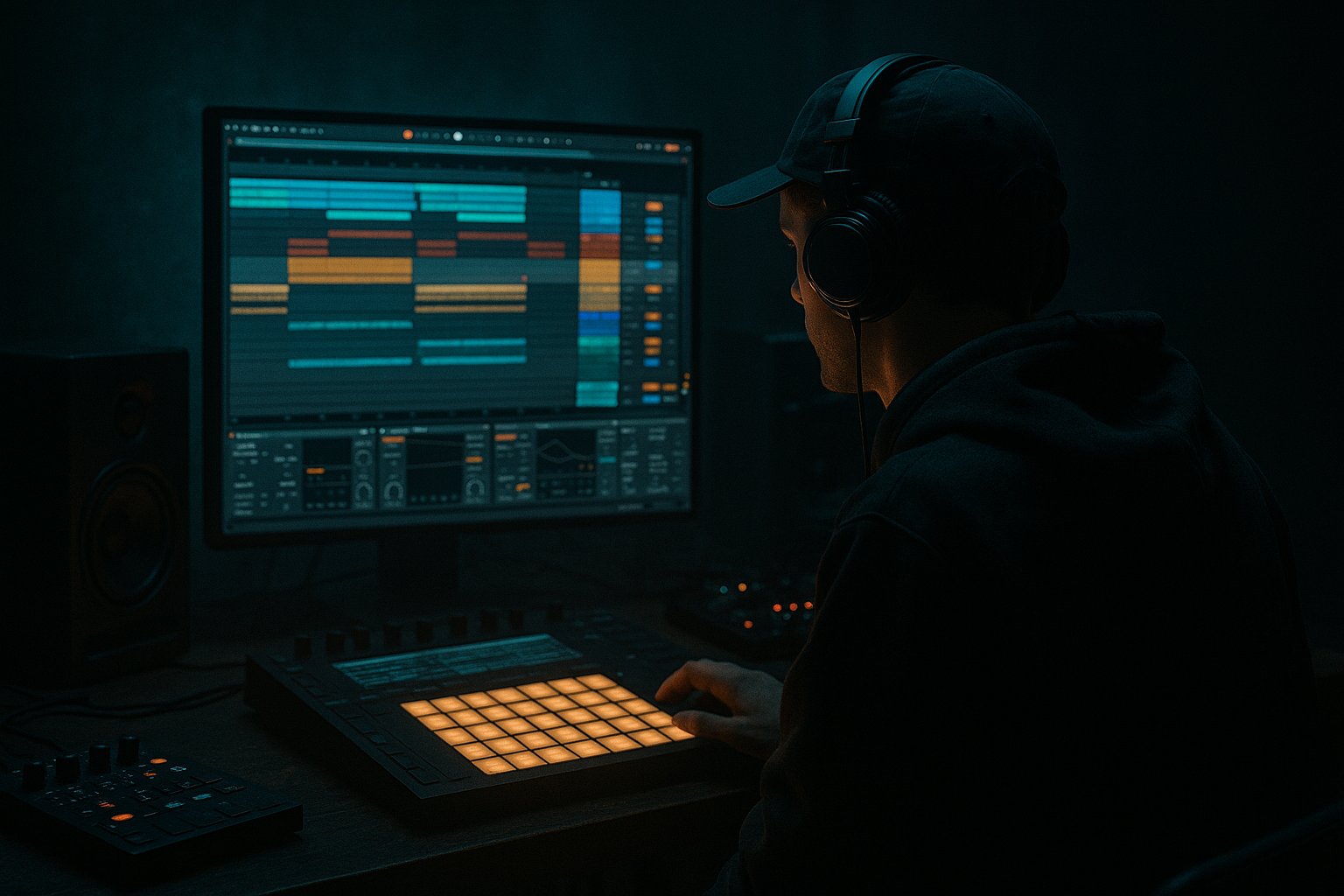
Main tutorial
Cinematic opener to club drop flow in Ableton
Advanced Arrangement Tutorial for Drum & Bass Producers
---
1. Lesson overview
In this lesson, we’re going deep on one of the most important arrangement skills in modern drum & bass: how to move from a cinematic intro into a high-impact club drop without losing energy, tension, or clarity. 🎬➡️💥
This is where a lot of otherwise strong DnB tracks fall apart. Producers often make one of two mistakes:
- The intro sounds amazing, but the drop feels disconnected.
- The drop hits hard, but the intro feels like filler and doesn’t set it up properly.
- the atmosphere foreshadows the bassline,
- the tonal palette carries through,
- the tension ramps in useful stages,
- and the transition feels inevitable.
- Bars 1–8: cinematic opener
- Bars 9–16: rhythmic implication and tension build
- Bars 17–24: energy lift, risers, bass foreshadowing, drum detail
- Bars 25–32: pre-drop strip-down and impact setup
- Bar 33: full drop lands
- dark pads
- field recordings
- tonal atmospheres
- ominous reese hints
- filtered break textures
- sub implication before full sub reveal
- club-focused drop impact
- EQ Eight
- Auto Filter
- Saturator
- Reverb
- Echo
- Utility
- Drum Buss
- Glue Compressor
- Compressor
- Hybrid Reverb
- Corpus
- Redux
- Roar if available
- Sampler / Simpler
- Operator / Wavetable
- Shifter
- Gate
- Limiter
- Set project tempo to 172–176 BPM. For this example, use 174 BPM.
- In Arrangement View, create locators:
- Pad
- Texture
- Foley
- Riser FX
- Reverse FX
- Intro Chords
- Reese Tease
- Lead Motif
- Impact Tonal Layer
- Filtered Break
- Top Loop
- Snare Build
- Drop Drums
- Sub Tease
- Mid Bass Tease
- Main Drop Bass
- Downlifters
- Impacts
- Noise Sweeps
- dark
- spacious
- ominous
- unresolved
- connected to the drop
- Osc 1: Saw
- Osc 2: Sine or another gentle saw, detuned slightly
- Low-pass filter at around 250–600 Hz
- Long attack: 80–200 ms
- Release: 2–5 seconds
- Auto Filter
- Hybrid Reverb
- Utility
- vinyl noise
- rain / city ambience / industrial hum
- reversed cymbal or metal scrape
- EQ Eight: remove lows below 150–250 Hz
- Auto Filter for movement
- Echo at low feedback for ghost tails
- Utility to automate width over time
- i chord drone for 4 bars
- move to a bVI or bVII flavor for bars 5–8
- return unresolved
- Bars 1–4: Fm drone
- Bars 5–6: Db tonality hint
- Bars 7–8: tension tone back toward F
- a reese phrase,
- a vocal phrase,
- a note rhythm,
- a bass texture,
- Osc A: Saw
- Osc B: Saw, detune by a few cents
- Osc C optional: sine for body
- Filter: low-pass around 250 Hz
- Add Saturator
- Add Chorus-Ensemble lightly
- Add EQ Eight
- use a long note swell,
- reverse the tail,
- or play a half-bar motif once every 4 bars.
- duplicate the bass channel
- high-pass it at 250–500 Hz
- add heavy Reverb
- reverse sections
- automate Auto Filter opening slowly
- a distant snare on bar 12
- a pre-echo snare at bar 16
- ghosted jungle chatter tucked low
- Reverb with long decay
- Gate after reverb if you want that dramatic controlled tail
- metal hit
- tom pulse
- low-passed rim
- heavily processed foley transient
- low density
- dark and wide
- minimal rhythm
- slightly more density
- filtered break enters
- brighter top texture emerges
- pulse implied
- more rhythmic certainty
- bass teaser closer to final tone
- snare build / impacts increase
- automation opens top end
- strategic subtraction
- remove key layers before drop
- focus listener on impact cue
- EQ Eight
- Saturator
- Roar or Dynamic Tube if you want aggression
- Compressor
- Auto Filter
- if your drop bass phrase starts on beat 1 and answers on the “and” of 2, hint that rhythm here with muted versions.
- Glue Compressor
- Saturator
- Reverb
- Utility
- sustained pad lows
- excess stereo wash
- busy top percussion
- harmonic clutter
- long reverb tails
- one defining riser or tonal scream
- one bass teaser motif
- snare build or kick pulse
- one vocal or impact phrase if relevant
- automation that creates expectation
- break is more audible
- bass teaser appears every 2 bars
- filtered riser grows
- tonal stab repeats
- strip out break mids
- keep tops and build snare
- automate master-adjacent tension bus slightly upward
- near-vacuum
- one reverse impact
- one vocal shot or reese tail
- silence or micro-gap before bar 33
- cut nearly everything for 1/8 note or 1/16 note
- leave only a reverse tail or tiny noise swell
- Osc A: sine or triangle
- automate pitch up 7–12 semitones
- long reverb send
- high-pass the reverb return
- add Shifter or Frequency Shifter subtly for eerie motion
- Bounce a drop bass hit to audio
- Reverse it
- Fade it in into bar 33
- Layer a subless impact under it
- Add Corpus for metallic resonance if needed
- create a downlifter that starts on bar 33
- this makes the drop feel like it exploded open rather than just started
- Auto Filter cutoff on pads, breaks, risers
- Reverb send amount on teaser sounds
- Utility width
- Track volume
- Saturator drive
- Noise riser filter frequency
- Drum buss drive/transients
- Bass teaser low-pass frequency
- Group mutes and clip fades
- Atmos group volume
- Drum intro group filter
- FX group width
- Bass teaser tone opening
- increase reverb through the build,
- then sharply reduce reverb in the final bar,
- then hit the dry drop.
- Is the drop groove already implied?
- Is the drop tone foreshadowed?
- Is there a tension release mechanism?
- Does the downbeat feel stronger than bar 1 of the intro?
- Have I cleared enough frequency space before impact?
- full drums enter with confidence
- sub arrives for the first time or with much greater weight
- stereo image changes intentionally
- transient information is stronger than the intro
- first bass phrase is simple and readable
- EQ Eight: high-pass at 180 Hz
- Auto Filter: LP around 700 Hz, automate slowly
- Hybrid Reverb: Hall, decay 6.5 s, mix 20–35%
- Utility: Width 130%
- EQ Eight: cut below 180 Hz
- Auto Filter: LP from 2 kHz to 8 kHz over section
- Drum Buss: Drive 5–10%, Transients 10–20%
- Saturator: gentle analog clip
- Utility: automate gain and width
- Chorus-Ensemble: subtle spread
- Saturator: Drive 4 dB
- EQ Eight: cut below 80 Hz, slight dip around 300 Hz if muddy
- Reverb: medium dark plate, low mix
- Auto Filter: HP rising over 8 bars
- Echo: low feedback, synced 1/8 or 1/4
- Utility: narrow to 70–90% width before drop
- Section 1: atmospheric only
- Section 2: same idea + break pulse
- Section 3: same idea + bass teaser + build
- Section 4: reduced version with tension focus
- duplicate 8 bars in Arrangement View
- edit each block
- automate transitions between them
- unrelated sound palette
- no teaser motifs
- different harmonic language
- bring drop bass texture, vocal, or motif into intro in subtle form
- cinematic drones competing with future sub
- huge reverbs full of low mud
- high-pass nearly everything in the intro except intentional impact layers
- keep true sub reserved for the drop
- relying on generic FX instead of density and rhythmic control
- build tension with rhythm, filtering, space reduction, and motif repetition
- fear of losing energy
- remove layers
- narrow stereo image
- shorten reverbs
- leave room for the downbeat
- build section already maxed out
- no dynamic contrast left
- don’t over-limit the premaster while arranging
- let the build breathe so the drop can feel bigger
- intro is purely cinematic with zero pulse
- introduce filtered breaks, ghost snares, or percussive motifs by bar 9 or earlier
- Utility on groups
- reduce width to 0–60% on selected atmos and FX
- distorted low-mids
- resonant atmospheres
- filtered reese harmonics
- resample your reese
- reverse it
- stretch it
- pitch it
- drown it in Hybrid Reverb
- add a semitone rub or tritone layer quietly in the atmos
- automate it out before the drop if needed
- reverse tails
- tighten fades
- align transients exactly
- create custom impacts
- Bars 1–8: cinematic intro
- Bars 9–16: rhythmic tension lift
- Bars 17–24: pre-drop
- Bar 25: drop hit
- 1 pad
- 1 texture loop
- 1 break loop
- 1 bass teaser patch
- 1 riser
- 1 impact
- 1 snare build
- 1 vocal or tonal phrase
- High-pass everything except impact layers before the drop
- Tease the drop bass rhythm at least twice before it lands
- Automate stereo width narrower in the final 2 bars
- Use a micro-gap before the drop
- Remove at least 3 elements in the last 2 bars
- Can I hear the drop coming without hearing the full drop?
- Does bar 25 feel bigger because of arrangement, not just loudness?
- Is the intro rooted in the same sonic world as the drop?
- Have I preserved enough sub and brightness for impact?
- make a second version with a more jungle-led intro using filtered break edits and dubby echo shots.
- Start with a strong cinematic identity
- Foreshadow the drop’s tone and rhythm early
- Introduce pulse gradually with filtered breaks and ghost percussion
- Escalate in stages: density, brightness, rhythmic certainty
- Strip back before the drop
- Use automation intentionally
- Reserve true sub and full drum force for impact
- Auto Filter for progressive reveals
- EQ Eight for intro cleanup
- Utility for width control
- Hybrid Reverb / Reverb / Echo for space design
- Saturator / Drum Buss for tension and grit
- group automation for fast section shaping
- a bar-by-bar 32-bar Ableton arrangement template
- a specific Neuro / Jump Up / Deep Roller version
- or a stock-only Ableton rack blueprint for the intro-to-drop transition.
Our goal is to make the opener feel like part of the drop’s DNA. In other words:
We’ll build this specifically in Ableton Live, using stock tools where possible, with a workflow tailored for dark DnB, jungle-influenced intros, and rolling bass music.
---
2. What you will build
You’ll build a full cinematic intro → tension section → pre-drop pullback → club drop flow, designed for advanced DnB arrangement.
Final structure target
A practical 32-bar pre-drop structure at 174 BPM:
Sonic direction
Think:
What you’ll use in Ableton
Useful stock devices:
---
3. Step-by-step walkthrough
---
Step 1: Set your arrangement foundation
Start with tempo and markers before you do any detailed sound design.
Session setup
- `Intro A`
- `Intro Lift`
- `Pre-Drop`
- `Drop 1`
Recommended track layout
Create these groups:
Atmos Group
Music Group
Drums Group
Bass Group
FX Group
Color code them. At advanced level, speed matters. Clean routing = better creative decisions.
---
Step 2: Build the cinematic opener first, not the full intro
A cinematic opener works best when it’s emotionally clear in the first few bars.
Bars 1–8 goal
Create a scene that says:
Build a tonal bed
Start with a pad or drone.
#### Option A: Wavetable pad
Use Wavetable:
Then add:
- low-pass mode
- gentle modulation
- long hall or shimmer-like setting
- decay: 5–9 seconds
- high-pass the reverb return around 200 Hz
- Width: 120–140%
Keep the low end out of the pad. Let it feel large but not muddy.
#### Option B: Audio texture stack
Layer 3 audio textures:
Process each with:
Add a simple harmonic center
Don’t over-compose the intro. In heavy DnB, one strong tonal center often works better than a complex progression.
Try:
Example in F minor:
This keeps it cinematic while preserving drop focus.
---
Step 3: Plant drop information early
This is the big arrangement secret: the intro should quietly teach the listener what the drop will be about.
If your drop is based on:
then preview it subtly.
Reese foreshadowing technique
Create a “tease” bass patch with Operator or Wavetable.
#### Simple Operator reese
- Soft Clip on
- Drive: 2–5 dB
- remove sub below 60 Hz for intro version
Now don’t play the full drop phrase. Instead:
Better than full bass: spectral implication
Take the drop bass audio and create an intro teaser:
This creates continuity without spoiling the impact.
---
Step 4: Introduce rhythm without giving away the drop
By bars 9–16, the listener should feel pulse and momentum.
Add filtered break movement
Take a jungle break or your own top loop and make it intro-safe.
#### Break teaser chain
On a break loop:
1. EQ Eight
- cut below 180 Hz
- slight dip around muddy mids if needed
2. Auto Filter
- low-pass around 2–5 kHz
- automate opening over 8 bars
3. Drum Buss
- Drive: low to moderate
- Boom: off or very low
- Transients: small boost
4. Utility
- automate gain up gradually over bars 9–16
The point is not full drums yet. You’re adding kinetic suggestion.
Add sparse snare indicators
Try:
Use:
Rhythmic tension idea
Introduce a percussive motif every 2 bars:
Pan these subtly with Auto Pan at slow rate or automate manually.
---
Step 5: Build in layers, not in one linear slope
Advanced arrangement is about staged escalation. Don’t just keep making everything louder.
Think in 3 energy lanes:
1. Density
2. Brightness
3. Rhythmic certainty
You want each lane to increase at different times.
Example energy map
#### Bars 1–8
#### Bars 9–16
#### Bars 17–24
#### Bars 25–32
That last point matters most: the final pre-drop bars often need less, not more.
---
Step 6: Make bars 17–24 feel like “the walls are closing in”
This section should transition from cinematic to club-functional.
Introduce bass pressure without full sub
Use your bass teaser and add controlled low-mid weight.
#### Mid-bass teaser processing
- roll off below 80–100 Hz
- Drive: 3–6 dB
- tame peaks
- automate low-pass from 500 Hz to 2 kHz over several bars
Use short motifs that reference the drop rhythm.
Example:
Add snare build intelligently
Avoid generic white-noise-only risers. In DnB, the snare build should feel integrated with groove.
#### Build layer recipe
Layer 3 parts:
1. Main build snare
- every beat, then every half beat, then every quarter beat
2. Noise layer
- white noise through Auto Filter HP
3. Textural layer
- break chop ghosts or foley ticks
#### Processing chain
On the snare build group:
- light glue, 1–2 dB GR
- automate decay shorter near the drop
- automate width narrower right before impact
That narrowing trick is powerful. If bars 29–32 become more mono, the drop feels wider when it opens.
---
Step 7: Create a proper pre-drop vacuum
The biggest impact trick in club DnB is contrast.
By bars 25–32, stop trying to impress with “more stuff.” Start setting the trap.
What to remove
In the final 4–8 bars before the drop, try removing:
What to keep
Keep only:
Practical 8-bar pre-drop example
#### Bars 25–28
#### Bars 29–30
#### Bars 31–32
The micro-gap trick
At the very end of bar 32:
That empty space massively increases perceived drop impact.
Be careful not to overdo it if your track is very rolling and continuous. But for cinematic-to-club transitions, it works beautifully.
---
Step 8: Build transition FX that support the drop key and groove
A lot of producers use FX that sound cool but don’t support the track musically.
Tonal riser idea
Take the root note of your track and build a rising tonal effect.
#### In Operator
Reverse reese impact
Downlifter after impact
Don’t forget the post-drop support:
---
Step 9: Use automation lanes like an arranger, not just a mixer
Advanced arrangement in Ableton is often won through automation.
Here are the most useful lanes to automate:
Essential automation targets
Key workflow suggestion
Use group automation heavily:
This lets you shape sections quickly without getting lost in 20 tracks.
One advanced move: reverb automation in reverse
Many producers increase reverb into the drop. Often better:
That dry contrast feels more club-ready and aggressive.
---
Step 10: Make sure the drop arrival is earned
Your intro should specifically prepare the listener for the exact nature of drop 1.
Ask:
Drop arrival checklist
On bar 33:
If your first drop bar is too dense, the intro-to-drop payoff gets blurred.
Best practice
Make the first 2 bars of the drop slightly simpler than bars 3–8 of the drop.
That gives the transition room to hit.
---
Step 11: Example Ableton device chains
---
#### Cinematic pad chain
`Wavetable → EQ Eight → Auto Filter → Hybrid Reverb → Utility`
Suggested settings:
---
#### Intro break chain
`Simpler/Audio Clip → EQ Eight → Auto Filter → Drum Buss → Saturator → Utility`
Suggested settings:
---
#### Reese teaser chain
`Operator → Chorus-Ensemble → Saturator → EQ Eight → Reverb`
Suggested settings:
---
#### Pre-drop riser chain
`Operator noise/sine layer → Auto Filter → Saturator → Echo → Reverb → Utility`
Suggested settings:
---
Step 12: Arrange by contrast snapshots
A very practical advanced workflow: treat each section as a snapshot.
Duplicate your 8-bar intro idea and modify each duplicate into the next section.
For example:
This keeps continuity while accelerating arrangement.
In Ableton, this is fast:
This is especially effective in DnB where motifs need consistency but energy needs to ramp decisively.
---
4. Common mistakes
1. Intro and drop feel like different songs
Cause:
Fix:
---
2. Too much low end in the opener
Cause:
Fix:
---
3. Endless risers, no actual tension design
Cause:
Fix:
---
4. Final pre-drop bars are too busy
Cause:
Fix:
---
5. Drop arrives over-compressed and flat
Cause:
Fix:
---
6. No rhythmic foreshadowing
Cause:
Fix:
---
5. Pro tips for darker/heavier DnB
Use mono-to-wide contrast
For dark/heavy DnB, make the last 1–2 bars before the drop more centered:
Then open up the drop again. This feels huge in clubs. 🔊
---
Build menace with midrange, not sub
Heavy intros often feel stronger when the “weight” comes from:
Keep actual sub restrained until impact.
---
Use detuned tonal FX from your bass patch
Instead of unrelated risers:
Now your whole arrangement feels like one world.
---
Breaks should evolve before the drop
In rolling bass music, the intro break can move through stages:
1. filtered and distant
2. brighter and more defined
3. chopped or ghosted
4. stripped away before impact
This gives momentum without using the full drop drums too early.
---
Use tonal dissonance carefully
For darker cinematic intros:
This creates dread without cluttering the main drop key.
---
Resample transition moments
Print your risers, reverses, and teaser basses to audio.
Then:
Audio editing usually beats endless live-device complexity for final transitions.
---
6. Mini practice exercise
Here’s a focused Ableton drill to improve this skill quickly.
Exercise: 16-bar cinematic setup into 8-bar pre-drop
Create a new project at 174 BPM.
Task
Build:
Constraints
Use only:
Required moves
Self-check questions
After you finish, ask:
Bonus challenge:
---
7. Recap
A powerful cinematic opener to club drop flow in drum & bass is all about continuity + escalation + contrast.
The core ideas
In Ableton, focus on
Final mindset
For dark DnB, jungle, and rolling bass music, the intro isn’t decoration—it’s narrative engineering. If the opener, tension, and pre-drop all point toward the same destination, your drop won’t just hit harder—it’ll feel inevitable. ⚡
If you want, I can also turn this into:

