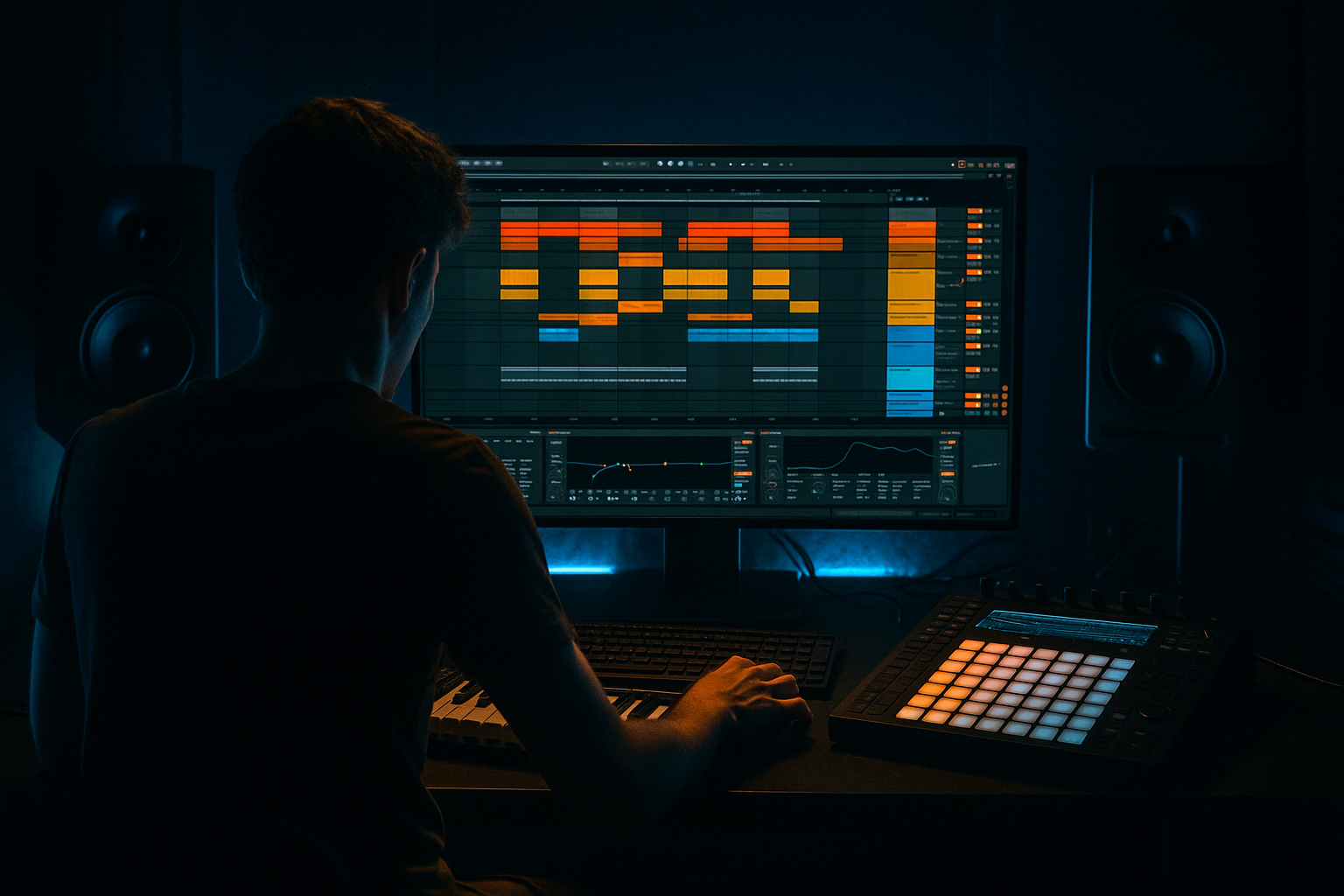
Main tutorial
```markdown
Classic Amen Slicing with Warp Markers (Ableton Live) 🥁⚡
Beginner • Drum & Bass / Jungle • Drums
---
1. Lesson overview
In this lesson you’ll learn the classic jungle/DnB method of chopping the Amen break using Warp Markers in Ableton Live—not relying on auto-slice alone. This approach is how you get that tight, snappy, “played by a machine but still human” rolling feel.
We’ll cover:
- Importing + warping the Amen properly
- Placing warp markers on key hits (kick/snare/ghost notes)
- Turning those markers into manual slices
- Building a DnB drum rack and rearranging into new patterns
- Processing for punch and grit using stock Ableton devices
- A sliced Amen Drum Rack mapped across pads/keys
- A new 2-bar rolling DnB/jungle pattern (170–175 BPM)
- A solid processing chain (tight, punchy, dark-ready)
- Turn on the metronome.
- Set loop brace to 2 bars.
- For breaks: start with Beats mode
- Start with 1 bar only.
- Place markers on:
- After each marker, drag it slightly so the transient lines up with the grid.
- Keep kicks and main snares very close to grid.
- Leave some ghost notes slightly late/early for vibe.
- If it sounds stiff, remove a few warp markers from small hits.
- A new MIDI track with a Drum Rack
- Each slice mapped across pads (usually starting at C1)
- Snare on beat 2 and 4 (in 4/4)
- Kick patterns around it
- Main snare: 110–127
- Ghost hits: 30–70
- Kicks: 90–120
- Add EQ Eight on the snare pad chain
- Add Redux very lightly for old-school bite (tiny amounts!)
- Intro (8–16 bars): filtered Amen, sparse hits
- Drop (16–32 bars): full Amen pattern + layered kick/snare
- Variation every 4 or 8 bars:
- Warp the Amen using Beats mode for clean drum transients.
- Set 1.1.1 on the first kick and lock key hits using Warp Markers.
- Slice to new MIDI track → Warp Marker for authentic manual-chop control.
- Program a 2-bar rolling DnB pattern with velocity dynamics.
- Use stock devices (EQ Eight, Drum Buss, Glue Compressor, Saturator) to push it into modern DnB weight.
---
2. What you will build
By the end, you’ll have:
---
3. Step-by-step walkthrough
Step 0 — Prep your session (DnB defaults)
1. Set tempo to 174 BPM (classic modern DnB zone).
2. Create two tracks:
- Audio Track: “Amen Source”
- MIDI Track: “Amen Rack”
Optional but recommended:
---
Step 1 — Import the Amen and warp it correctly 🎯
1. Drag your Amen break audio onto Amen Source.
2. Double-click the clip to open Clip View.
3. Make sure Warp is ON.
4. Set Seg. BPM close to the original break if Live guessed badly. (Don’t stress—next steps fix it.)
#### Choose a Warp Mode (important)
- Preserve: Transients
- Transient Loop Mode: Off
- Envelope: try 40–70% (lower = tighter, less ringing)
This keeps drums punchy and avoids weird smearing.
---
Step 2 — Align the first downbeat (the “1”) ✅
1. Zoom in on the start of the waveform.
2. Find the first strong kick of the break.
3. Right-click that transient → “Set 1.1.1 Here”
4. Right-click again → “Warp From Here (Straight)”
Now the break should sit on the grid.
Check: Play it with metronome. If it drifts, don’t panic—we’ll pin it with warp markers.
---
Step 3 — Place Warp Markers on the key hits (your “slice points”) ✂️
This is the core skill: you decide what matters.
1. Turn on Warp Markers (double-click in the clip to create one if needed).
2. Work through the break and place markers on:
- Main kick transients
- Main snare transients (Amen’s snare is iconic)
- Useful ghost notes (tiny hits that give swing)
Practical workflow
- The first kick (already done)
- The main snare
- Any “pickup” hits before the snare
Tip: Don’t warp every tiny micro-transient at first. Too many markers can make it sound robotic.
---
Step 4 — Tighten timing for DnB bounce (without killing groove) 🕺
DnB is tight, but jungle swing is real.
Fast test:
Loop 1 bar → listen for flamming against the click → adjust only the hits that feel off.
---
Step 5 — Create manual slices from Warp Markers
Now we turn warp points into playable chunks.
1. In Clip View, right-click inside the waveform:
2. Choose “Slice to New MIDI Track…”
3. Settings:
- Slice By: Warp Marker ✅
- Create One Slice Per: Warp Marker
- Slicing Preset: Built-in → Drum Rack
Ableton creates:
Rename it: Amen Rack (Warp Slices).
---
Step 6 — Program a classic rolling pattern (2 bars)
Create a 2-bar MIDI clip on the Drum Rack.
Basic DnB backbone:
#### Simple “Amen-rework” starter idea
1. Place the main snare slice on:
- Bar 1: 1.2
- Bar 1: 1.4
- Bar 2: 2.2
- Bar 2: 2.4
2. Add kick slices:
- Strong kick on 1.1
- Add extra kicks around 1.1.3 or 1.3 (taste)
3. Sprinkle 1–3 ghost slices per bar (quiet notes) just before snares.
Velocity tip:
This alone creates motion.
---
Step 7 — Make it sound like DnB (stock processing chain) 🔥
Here’s a clean, classic Ableton chain for Amen slices:
#### On the Drum Rack (group level)
1. EQ Eight
- High-pass around 25–35 Hz (remove rumble)
- Small cut around 250–400 Hz if boxy
- Small boost around 3–6 kHz if you need crack
2. Drum Buss
- Drive: 5–15 (to taste)
- Crunch: 0–20 (careful)
- Boom: Off or very low for breaks (subs belong to the bass)
- Transient: +5 to +20 for snap
3. Glue Compressor
- Attack: 3–10 ms (let transients through)
- Release: Auto or 0.1–0.3 s
- Aim for 1–3 dB gain reduction
4. Saturator (optional)
- Soft Clip ON
- Drive 2–6 dB for grit
#### Optional: process the snare slice separately
Inside the Drum Rack:
- Boost ~200 Hz slightly for body (if needed)
- Boost ~5 kHz for crack
---
Step 8 — Arrangement ideas (make it feel like a track) 🧱
A classic DnB/jungle arrangement move:
- Use Auto Filter (LP filter, automate cutoff down/up)
- Remove a kick
- Add a snare fill (repeat a slice at 1/16)
- Reverse one slice for a stutter (audio trick)
DnB trick: Add a crash/ride on the first bar of every 8.
---
4. Common mistakes 🚫
1. Warp markers on every transient
- Result: robotic, phasey, weird groove
- Fix: marker main hits only; let small stuff breathe.
2. Wrong warp mode
- Complex/Complex Pro can smear drums.
- Fix: use Beats mode for breaks.
3. Slicing without tightening timing first
- Your slices will be “wrong” if the warp grid is off.
- Fix: align the “1”, then key hits, then slice.
4. Overprocessing
- Too much saturation/compression kills punch.
- Fix: aim for subtle glue; do heavy distortion selectively.
---
5. Pro tips for darker/heavier DnB 🖤
1. Layer a clean modern kick under the Amen
- Add a separate kick sample on another Drum Rack/Simpler.
- Sidechain the break slightly using Compressor (Sidechain ON).
2. Make the Amen shorter + punchier
- On the Drum Rack, add Gate after saturation:
- Short release for tighter tails.
- Or use Drum Buss Transient to sharpen hits.
3. Parallel distortion for aggression
- Create a Return Track (Send):
- Saturator → Amp → EQ Eight
- Send only snare/ghost slices into it.
4. Dark “room” without washing out
- Use Hybrid Reverb on a return:
- Short decay (0.3–0.8s)
- High-pass the reverb with EQ Eight (cut below 300 Hz)
- Send mostly snare, tiny amount of break.
5. Classic jungle pitch tricks
- Transpose some slices down -1 to -3 semitones (inside Simpler or clip)
- Or automate clip transposition for fills.
---
6. Mini practice exercise 📝
Goal: Make a 2-bar loop with 2 variations.
1. Warp your Amen and slice by Warp Marker.
2. Program a 2-bar pattern:
- Snare on 2 and 4
- At least 5 kick hits total
- At least 4 ghost hits total
3. Create variation B:
- Copy the clip
- In bar 2, replace the last snare with a double-hit stutter (two 1/16 notes)
4. Add light processing:
- EQ Eight (HP at 30 Hz)
- Drum Buss (Drive 8, Transient +10)
5. Export a 10-second audio bounce and listen on headphones:
- Is the snare consistent?
- Do the ghost notes add movement without clutter?
---
7. Recap ✅
If you want, tell me your Ableton version (Live 11 or 12) and whether you’re aiming for classic jungle, neuro/techy, or dark rollers, and I’ll suggest a specific Amen pattern + processing recipe for that vibe.
```

