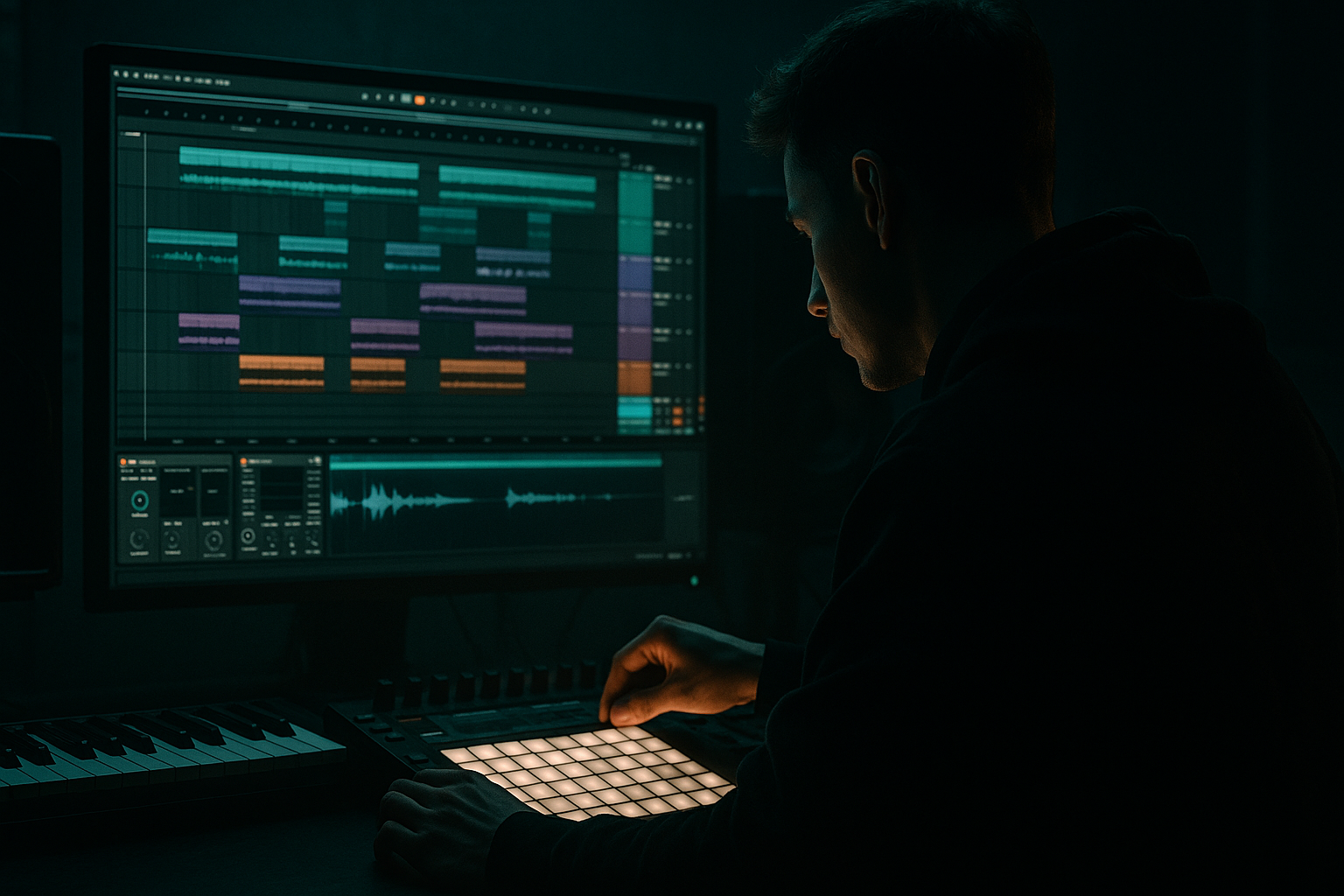
Main tutorial
Classic Rave Bass Under Jungle Breaks (Ableton Live) 🎛️🔥
1. Lesson overview
In this lesson you’ll make a classic 90s rave-style bass that sits cleanly under jungle breaks—tight, punchy, and rolling without fighting the kick/snare. We’ll do it using Ableton Live stock devices (Wavetable/Operator, Saturator, EQ Eight, Compressor, Sidechain, Glue, Utility), plus a workflow that keeps your low-end solid.
You’ll learn:
- How to build a 2-layer rave bass (sub + mid “rave” tone)
- How to write a jungle-friendly bassline that locks to the break
- How to EQ, saturate, and sidechain so it hits hard but stays controlled
- Sub layer: clean sine/triangle (mono, stable, big)
- Rave mid layer: detuned/saw-ish tone with movement (the “character”)
- Processing: saturation → EQ → compression → sidechain
- Arrangement: a 16-bar loop that works under classic breaks (Amen/Think-style patterns)
- Algorithm: A only (just one oscillator)
- Oscillator A:
- Amp Envelope:
- Bass Mono: On (or just set Width to 0%)
- Gain: leave at 0 for now
- Drive: 1–3 dB
- Soft Clip: On
- Output: reduce to match (aim not to get louder, just thicker)
- Osc 1: Saw (Basic Shapes → Saw)
- Osc 2: Saw (same wavetable)
- Detune:
- Filter:
- Attack: 0–10 ms
- Decay: 200–500 ms
- Sustain: 0 to -6 dB
- Release: 80–150 ms
- Add LFO to Filter Cutoff:
- Use short 1/8 notes with a couple of gaps for the snare.
- Try this rhythmic concept:
- Mostly root note (F) + occasional G# (minor 3rd) or C (5th).
- Don’t jump too wildly yet—rolling bass is more about rhythm than melody.
- Note length: 1/16–1/8 (shorter = tighter)
- Velocity: keep consistent at first (you can humanize later)
- Break filtered (Auto Filter low-pass opening slowly)
- Bass: mid layer only, high-passed more (e.g., HP at 250 Hz)
- Full break
- Full bass (sub + mid)
- Add a one-shot stab or reese hit sparingly
- Remove sub for 1 bar to create tension
- Add a small bass fill: a quick 1/16 run up to the root
- Bring sub back
- Open mid filter slightly
- Add a short riser or crash into bar 13
- Make it nastier without ruining sub:
- Add controlled grit with Multiband Dynamics (carefully):
- Mono the lows, widen the mids (subtle):
- Darker vibe via filter + note choice:
- Tighter roll with Groove Pool:
- You built a 2-layer rave bass: clean mono sub + characterful mid.
- You wrote a jungle-friendly rolling pattern that leaves space for the break.
- You used stock Ableton tools to make it mix-ready: EQ, saturation, glue, and sidechain.
- You arranged it into a simple 16-bar DnB structure with variation and energy.
---
2. What you will build
A bass group with:
Target vibe: classic rave + jungle roll—think early DnB energy with a modern clean low-end.
---
3. Step-by-step walkthrough
Step 0 — Session setup (2 minutes)
1. Set tempo: 165–170 BPM (start at 168 BPM).
2. Create two MIDI tracks:
- `BASS - SUB`
- `BASS - RAVE MID`
3. Group them: select both → Cmd/Ctrl + G → name group `BASS BUS`.
---
Step 1 — Get jungle breaks in first (so the bass fits)
1. Add an audio track `BREAK`.
2. Drop in a breakbeat loop (Amen/Think/any jungle break).
3. Warp mode:
- For breaks, try Beats mode
- Transients: Preserve Transients
- If it sounds too clicky, switch to Complex Pro (but Beats is often punchier for breaks)
4. Add EQ Eight on `BREAK`:
- High-pass around 30 Hz (gentle) to remove useless rumble.
- Optional: small dip around 200–350 Hz if the break is boxy.
✅ Now you’re mixing bass into the break, not guessing.
---
Step 2 — Build the sub layer (simple and bulletproof) 🧱
On `BASS - SUB`, load Operator (stock).
Operator settings:
- Wave: Sine
- Level: ~ -6 dB (leave headroom)
- Attack: 0–5 ms
- Decay: 200–400 ms
- Sustain: -inf (or very low)
- Release: 60–120 ms
Why these envelopes?
Short-ish notes keep the sub tight under fast breaks, and release prevents clicks without smearing.
Add Utility after Operator:
Optional (very light control): Saturator
---
Step 3 — Build the rave mid layer (the classic character) ⚡
On `BASS - RAVE MID`, load Wavetable (or Operator if you prefer).
Wavetable settings (simple rave tone):
- Unison: 2–4 voices
- Amount: 10–20%
- Type: LP24
- Cutoff: start around 200–500 Hz
- Resonance: 10–20%
- Drive: a little (5–15% if available)
Amp Envelope:
Add movement (classic rave “talk”):
- Rate: 1/8 or 1/16 (sync)
- Amount: subtle—just enough to animate
- Try triangle shape for smooth roll
Now add this device chain after Wavetable:
1. Saturator
- Drive: 3–8 dB
- Soft Clip: On
2. EQ Eight
- High-pass: 120–180 Hz (24 dB/oct if needed)
- Small boost around 700 Hz – 2 kHz if you need presence
- Dip harshness around 3–5 kHz if it bites
3. Auto Filter (optional “rave sweep” moments)
- Map cutoff to a Macro later for transitions
✅ The key: mid layer has no real sub. It’s all attitude.
---
Step 4 — Write a bassline that works with jungle breaks 🎼🥁
Create a 2-bar MIDI clip on both bass tracks (copy notes to both layers).
Scale / key suggestion:
Start in F minor (classic rave mood, sits well in DnB).
Classic jungle-friendly pattern idea (2 bars):
- Bar 1: hit on 1, 1&, 2&, 3, 3a, 4&
- Bar 2: similar but change the last two hits for variation
Note choices (keep it simple):
Length & velocity:
🎯 Jungle tip: Leave space around the main snare hits (often on beat 2 and 4 in many break patterns). If your bass hits exactly with snare every time, it can feel cluttered.
---
Step 5 — Glue the bass layers together (Bass Bus processing) 🧩
On `BASS BUS`, add:
1. EQ Eight
- Very gentle high-pass at 25–30 Hz (just to clean sub-rumble)
- Optional: tiny dip 250–400 Hz if it’s muddy
2. Glue Compressor
- Attack: 3 ms
- Release: Auto
- Ratio: 2:1
- Threshold: aim for 1–3 dB gain reduction on peaks
- Make-up: off (adjust output manually)
3. Limiter (safety, not loudness)
- Ceiling: -0.3 dB
- Only catching stray peaks (1–2 dB max)
✅ This makes the bass feel like one instrument.
---
Step 6 — Sidechain the bass to the kick/snare (clean jungle bounce) 🔧
Even in jungle, sidechain is your friend—just don’t overdo it.
1. Add Compressor to `BASS BUS`.
2. Enable Sidechain.
3. Sidechain input: select your BREAK track (or kick track if you have one).
4. Settings:
- Ratio: 2:1 to 4:1
- Attack: 1–5 ms
- Release: 60–120 ms
- Threshold: adjust until you get 2–5 dB gain reduction when the kick/snare hits
🎯 Goal: the break punches through, bass stays present. If the bass “pumps” like house, back off release/threshold.
---
Step 7 — Arrangement idea (16 bars that feels like DnB) 🧱➡️🚀
Build a simple structure:
Bars 1–4: Intro tease
Bars 5–8: Drop
Bars 9–12: Variation
Bars 13–16: Second drop / bigger
---
4. Common mistakes (and quick fixes)
1. Mid bass fighting the sub
- Fix: High-pass the mid layer at 120–180 Hz and keep the sub clean.
2. Bassline too long and boomy
- Fix: Shorten MIDI note length + reduce release time on the sub.
3. Bass clashes with break transients
- Fix: Sidechain lightly from the break, or duck only the sub with a separate sidechain compressor.
4. Too much saturation on the sub
- Fix: Saturate the mid more than the sub. Sub should stay stable.
5. Mixing too loud too early
- Fix: Keep `BASS BUS` peaking around -10 to -6 dB while building.
---
5. Pro tips for darker/heavier DnB 🖤
Distort only the mid layer (Saturator / Overdrive), keep sub mostly clean.
- Use it on the mid layer or bass bus lightly.
- Don’t crush the low band—DnB needs dynamics to breathe.
- Sub: Utility width 0%
- Mid: a little width (Unison, Chorus-Ensemble lightly), but check mono compatibility.
- Keep bass mostly around root + minor intervals.
- Low-pass the mid slightly more and boost presence with gentle saturation instead of bright EQ.
- Add a subtle swing groove (like MPC-style 16 swing) to the bass MIDI slightly so it matches the break feel.
---
6. Mini practice exercise (10–15 minutes) ⏱️
1. Pick any jungle break and loop 8 bars.
2. Write two different 2-bar bass patterns:
- Pattern A: mostly root notes, rhythmic variation
- Pattern B: add one extra note (minor 3rd or 5th) as a call-and-response
3. Create a drop at bar 5:
- Bars 1–4: mid only, filtered
- Bars 5–8: full bass (sub + mid)
4. Bounce a quick export and listen on:
- Headphones
- Small speakers (or phone)
5. Adjust:
- Mid HP frequency
- Sidechain amount
- Sub note length
---
7. Recap ✅
If you want, tell me what break you’re using and the key/tempo—I'll suggest a specific 2-bar MIDI pattern and exact cutoff/LFO settings to match that groove.

