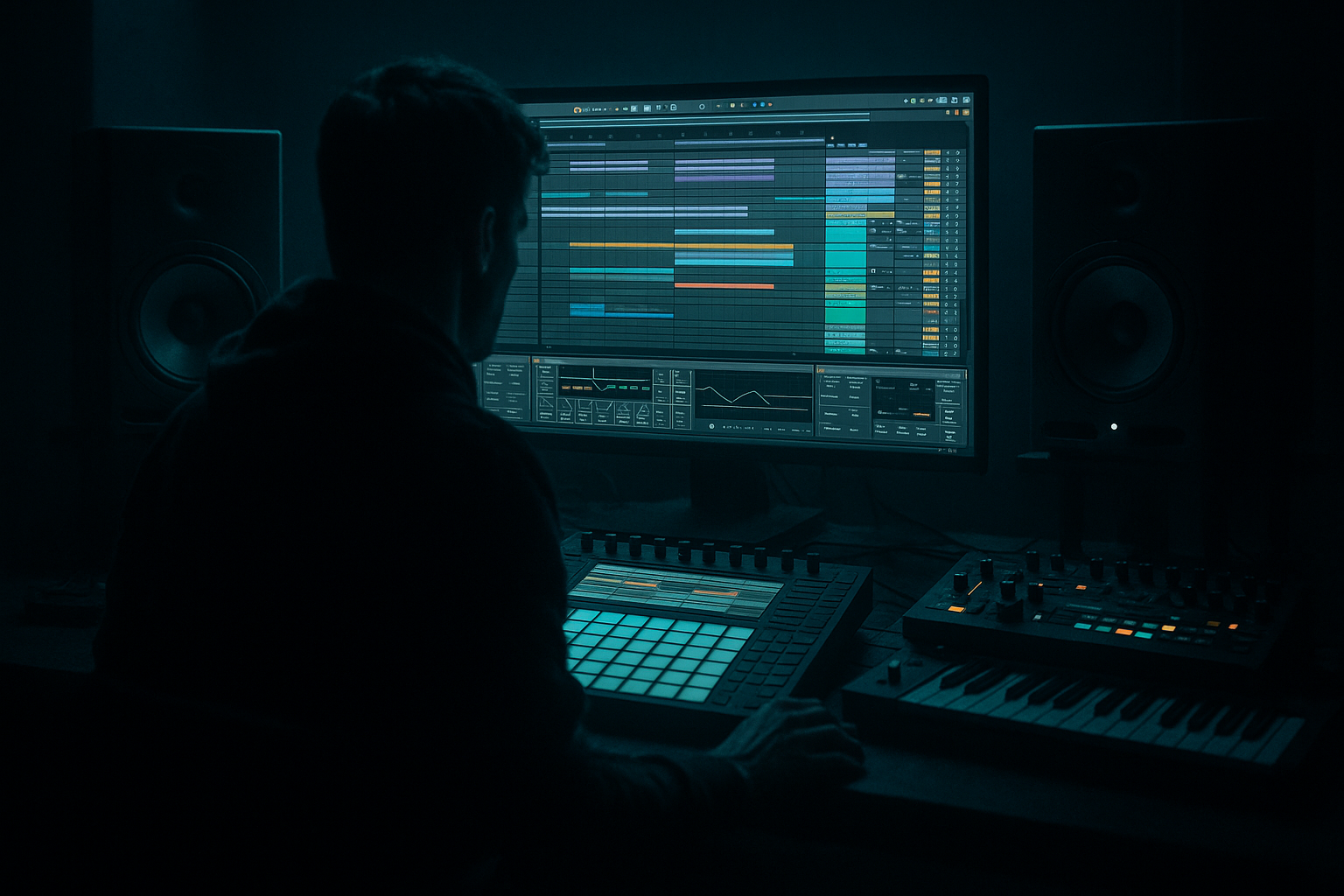
Main tutorial
Lesson Overview
This lesson is about building a clean oldskool jungle arp in Ableton Live 12 that sits naturally in a Drum & Bass track without sounding like a random trance stab or a cheesy 90s preset. The goal is to create that bright, rhythmic, slightly tense arpeggio you hear in classic jungle and oldskool DnB intros, breaks, and mid-track switch-ups — but with enough control to make it work in a modern mix.
In DnB, an arp like this usually plays one of three roles:
1. Intro driver — carrying movement before the full drums and bass arrive
2. Drop support — adding harmonic rhythm above the reese/sub/breaks
3. Transition tool — filling space during 2-bar or 4-bar switch-ups
Why it matters: jungle and oldskool DnB often rely on energy from repetition and variation, not huge chord stacks. A clean arp gives you forward motion, tension, and vibe without fighting your drums or bass. If you build it with the right MIDI, synth shape, and routing, it can sound authentic, musical, and mix-friendly at the same time.
We’ll use stock Ableton devices and a workflow that keeps the sound editable all the way into arrangement. This is not just “make a melody” — it’s a practical DnB workflow for creating a reusable arp element that can survive in a busy drum-and-bass tune. 🔥
What You Will Build
By the end of this lesson, you’ll have:
- A clean jungle-style arp patch built with Ableton stock devices
- A tight MIDI pattern that works at DnB tempo
- A dark, rhythmic movement chain with controlled stereo width
- A versioned workflow you can reuse for intros, drops, and breakdowns
- A loopable 2-bar or 4-bar arp phrase that supports breakbeats and bass without clutter
- Minor-key or modal
- Bright but not thin
- Rhythmic and hypnotic
- Slightly detuned or animated, but still clean
- Able to sit above a breakbeat + sub + reese arrangement
- Making the arp too wide in the low mids
- Using too many notes
- Leaving the filter fully open all the time
- Too much reverb
- Ignoring velocity and note length
- Not checking against the break and bass
- Overprocessing before the MIDI is right
- Use minor seconds or flattened notes sparingly for tension, especially at the end of a 2-bar phrase. One wrong note in the right place can feel very dark.
- Automate filter resonance during transitions to create that tight oldskool squelch without needing huge effects.
- Layer a quiet noise or airy texture underneath the arp using Operator noise or a filtered Analog/Wavetable layer for extra attack and atmosphere.
- Send the arp into short, dark delay and then automate the return down in the drop. That gives you a professional “tail disappearing into impact” feel.
- Resample and distort a copy of the arp for a heavier alternate layer, then blend it subtly underneath the clean version.
- Use call-and-response with your bassline: let the arp speak in the gaps, then pull it back when the reese or sub phrase is active.
- Try half-bar mute automation on the arp during snare fills or drum edits. That creates space and makes the next hit feel larger.
- Keep the core clean, dirty the edge: if you want underground character, add grit with Saturator, Redux, or gentle clipping rather than destroying the whole patch.
- Check mono regularly. Dark DnB gets muddy fast, and a mono-safe arp will translate much better on club systems.
- an intro
- a drop layer
- a transition
- Keep the arp simple, rhythmic, and tightly phrased
- Build it with stock Ableton devices like Operator/Wavetable, Arpeggiator, Auto Filter, EQ Eight, Saturator, Echo, and Reverb
- Use automation and sends to make it feel like part of a DnB arrangement
- Protect the mix with high-pass filtering, mono discipline, and restrained stereo width
- Think in 16-bar and 8-bar phrases so the arp supports jungle / oldskool DnB energy, not just endless looping
- Resample when the sound is good so you can move faster and arrange with confidence
Musically, the result should feel like:
Think of it as the kind of arp that can carry a 16-bar intro, then disappear into a drop while your drums and bass take over, or reappear in a filtered form during a switch-up.
Step-by-Step Walkthrough
1. Set up the project around DnB phrasing first
Start by setting your project tempo to a typical jungle / DnB range: 170–174 BPM. For oldskool jungle vibes, 172 BPM is a great default because it gives you enough speed for rolling breaks while keeping the arp readable.
Create a new MIDI track and name it something practical like:
- `ARP_Main`
- `ARP_FX`
- `ARP_Alt`
Put a 4-bar loop on the timeline so you can hear phrasing immediately. In DnB, thinking in 4s and 8s helps your arps land musically against the drums. If you already have breaks and bass in the session, mute them for a minute and design the arp on its own first. That keeps you from overfitting the sound to a messy mix.
Workflow tip: color-code this track in a different family than drums and bass. You’ll thank yourself later when arranging a full tune.
2. Build the core sound with Operator or Wavetable
For a clean oldskool jungle arp, keep the source simple and harmonically stable.
Use Operator first if you want a classic, focused tone:
- Oscillator A: sine or triangle-like shape
- Oscillator B: very low level saw or square for extra harmonic bite
- Turn off unnecessary oscillators if they muddy the tone
- Use a short amp envelope:
- Attack: 0–5 ms
- Decay: 200–600 ms
- Sustain: 40–70%
- Release: 80–180 ms
Or use Wavetable if you want more movement:
- Start with a basic saw or square-based wavetable
- Keep the wavetable position simple, not heavily modulated at first
- Use a unison amount of 2–4 voices max if needed
- Detune lightly: 5–15% if you want width without blur
The point here is to avoid overdesigned synth sound. Oldskool jungle arps often feel strong because the note pattern, filter motion, and delay are doing the work. The synth itself should be clean enough to let rhythm lead.
3. Write a simple arp phrase in MIDI
Make a short MIDI clip — ideally 1 or 2 bars to start. Use notes from a minor scale or mode that fits your track. Classic jungle-friendly choices:
- A minor
- D minor
- E minor
- Phrygian flavor for darker tension
Start with a small note set:
- Root
- Minor third
- Fifth
- Optional octave
- Occasional passing tone for movement
Example musical context: if your tune is in D minor, a strong oldskool arp might cycle around D–F–A–C with one or two octave jumps. Keep it repetitive enough to feel hypnotic, but add one note change at the end of every 2 bars so the loop breathes.
Then program the rhythm:
- Use 1/16 notes as the base
- Add a few rests to create groove
- Use velocity differences so not every note hits the same
- Nudge some notes later or earlier by a tiny amount if needed
In Ableton, you can use the MIDI editor’s Fold feature to keep the clip tidy and focused. If your phrase is getting too busy, reduce it. In jungle, a cleaner loop often sounds more expensive than a crowded one.
4. Add an Arpeggiator for controlled movement
Drop Ableton’s stock Arpeggiator before the synth if you want a more classic arp-driven workflow, or after the synth if you want to transform your manually written notes.
Solid starting settings:
- Style: Up or Converge/ Diverge for more character
- Rate: 1/16 or 1/16 Triplet if you want a more rolling jungle feel
- Gate: 45–70%
- Retrigger: On
- Hold: Off unless you want sustained MIDI
- Distance: 12 for octave movement if you need more lift
For oldskool DnB, I’d usually keep the arp pattern short and decisive. The Gate setting is important: too long and the line blurs into a pad; too short and it loses energy. Around 55–60% is a very usable starting point.
Why this works in DnB: the arp creates fast rhythmic information without needing long notes or big chords. That gives you motion above drums and bass while preserving low-end space. Since DnB arrangements move fast, a short, repeatable arp can act like a hook without cluttering the groove.
5. Shape the tone with filter, saturation, and movement
Add Auto Filter after the synth. This is where the sound becomes “jungle” instead of just “MIDI notes.”
Suggested Auto Filter settings:
- Filter type: Low-pass
- Frequency: start around 500 Hz to 2.5 kHz
- Resonance: 10–30%
- Drive: a little if needed, but don’t crush it
Automate the filter to open across 4 or 8 bars. A classic move:
- Bar 1: filtered and restrained
- Bar 2: brighter
- Bar 3: more open
- Bar 4: openest or slightly pulled back for loop reset
Then add Saturator:
- Drive: 2–6 dB
- Soft Clip: On
- Keep output gain matched so you judge tone, not loudness
If you want a more vintage edge, try Redux very subtly:
- Downsample just a little
- Bit reduction very lightly
- Use it sparingly; too much and it becomes lo-fi in the wrong way
For extra movement, you can use LFO in Live 12 if available in your workflow, or simply automate filter cutoff and resonance manually. A slow cutoff sweep over 8 bars is usually enough. Don’t over-animate the arp. The drums in DnB are already busy — your arp should have motion, but still feel intentional.
6. Control space with delay and reverb, then keep the mix disciplined
Jungle arps often sound great with delay, but the trick is to keep the echoes musical and not wash the whole top end.
Use Echo or Delay:
- Sync time: 1/8 dotted or 1/16
- Feedback: 15–35%
- Filter the delay return so the low end stays out
- Add a little modulation if you want a more liquid shimmer
For reverb, keep it restrained:
- Use Reverb or Hybrid Reverb
- Decay: 0.8–2.0 s
- Pre-delay: 10–30 ms
- High-pass the reverb return so it doesn’t cloud the mix
A very useful workflow in Ableton is to route delay and reverb to sends instead of loading them directly on the arp. That way you can automate send levels per section:
- More reverb in intro
- Less in the drop
- More delay during transition bars
This is especially important in DnB because the arp is competing with crisp breaks, sub, and mid-bass. Send-based FX let you preserve dry clarity while still giving the arp atmosphere.
7. Make it fit the drums and bass with EQ and stereo discipline
Add EQ Eight after the main sound chain.
Useful starting moves:
- High-pass anywhere from 120–250 Hz depending on the patch
- Reduce harshness around 2.5–5 kHz if the arp fights hats or snare presence
- If it sounds boxy, try a gentle dip around 300–600 Hz
Then check stereo width carefully:
- Keep the low mids centered
- If you use Utility, narrow the width slightly for a more focused center image
- Use mono checks on your master or group to make sure the arp doesn’t vanish when summed
A clean oldskool DnB arp often sounds best when the actual note body is fairly centered and any width comes from delay or subtle unison, not from huge stereo detune.
Put the arp into a group with its FX if you want fast control:
- `ARP Core`
- `ARP FX`
- `ARP Group`
That makes it easier to mute, bounce, or automate as one unit.
8. Arrange it like a real DnB element, not a loop stuck in time
Now place the arp into the arrangement with intent.
Common DnB placement ideas:
- 16-bar intro: filtered arp enters alone, then breaks come in
- 8-bar build: arp opens up as drum layers increase
- Drop support: arp returns in the top end during bar 9–16 or at the end of a phrase
- Switch-up: arp drops out for 2 bars, then comes back with delay tails
Use automation to make the arrangement feel alive:
- Filter cutoff opens into a transition
- Reverb send rises before a drum fill
- Delay feedback spikes for the last hit of a phrase
- Volume dips slightly during heavy snare/bass moments
In oldskool jungle, phrase movement is everything. A 2-bar arp can feel huge if it’s introduced, filtered, and removed with confidence. Don’t leave it running full-volume for the entire tune unless it’s serving as a background texture.
9. Resample if you want more character and faster workflow
Once the arp is working, resampling is a great intermediate-level move.
In Ableton:
- Create a new audio track
- Route the arp group or track into it
- Record 4–8 bars of audio
- Chop the best bits into clips
This gives you options:
- Reverse a tail for a transition
- Slice a 1-bar section and re-trigger it
- Apply warp creatively for a short fill
- Freeze a certain vibe so you can commit and move on
Resampling is especially useful in DnB workflow because it speeds up decision-making. Instead of endlessly tweaking the synth, you can commit to a great-sounding arp and turn it into an arrangement asset. That keeps momentum high when building full tracks.
Common Mistakes
Fix: high-pass it and keep width mostly in the delay or upper harmonics.
Fix: reduce the phrase to 3–5 useful tones. Jungle often sounds stronger when the arp is simpler.
Fix: automate cutoff so the arp has movement and phrase shape.
Fix: shorten decay, high-pass the return, and use sends so the dry arp stays clear.
Fix: vary velocity and gate/length to create groove and prevent the line from sounding robotic.
Fix: test the arp with your drum loop and sub/reese, not just in solo. A good solo sound can still ruin the mix.
Fix: lock the pattern first. In DnB, rhythm and placement matter more than fancy sound design.
Pro Tips for Darker / Heavier DnB
Mini Practice Exercise
Spend 10–20 minutes making three versions of the same arp so you can learn fast:
1. Build a basic 2-bar arp in A minor, D minor, or E minor.
2. Make Version A: clean and dry with only EQ Eight.
3. Make Version B: add Auto Filter automation and a short delay send.
4. Make Version C: resample the arp to audio and chop one 1-bar variation.
5. Test all three against:
- a breakbeat loop
- a sub note or simple reese
- a snare-led DnB groove
Your goal is to decide which version works best in:
Do not keep all three. Pick the one that serves the arrangement best, then save the others as alternates in a rack or separate track. That decision-making is the real workflow skill here.
Recap
If you keep the core clean and let rhythm, filter motion, and arrangement do the heavy lifting, you’ll get that authentic oldskool jungle arp energy without sacrificing mix clarity.

