Main tutorial
Lesson Overview
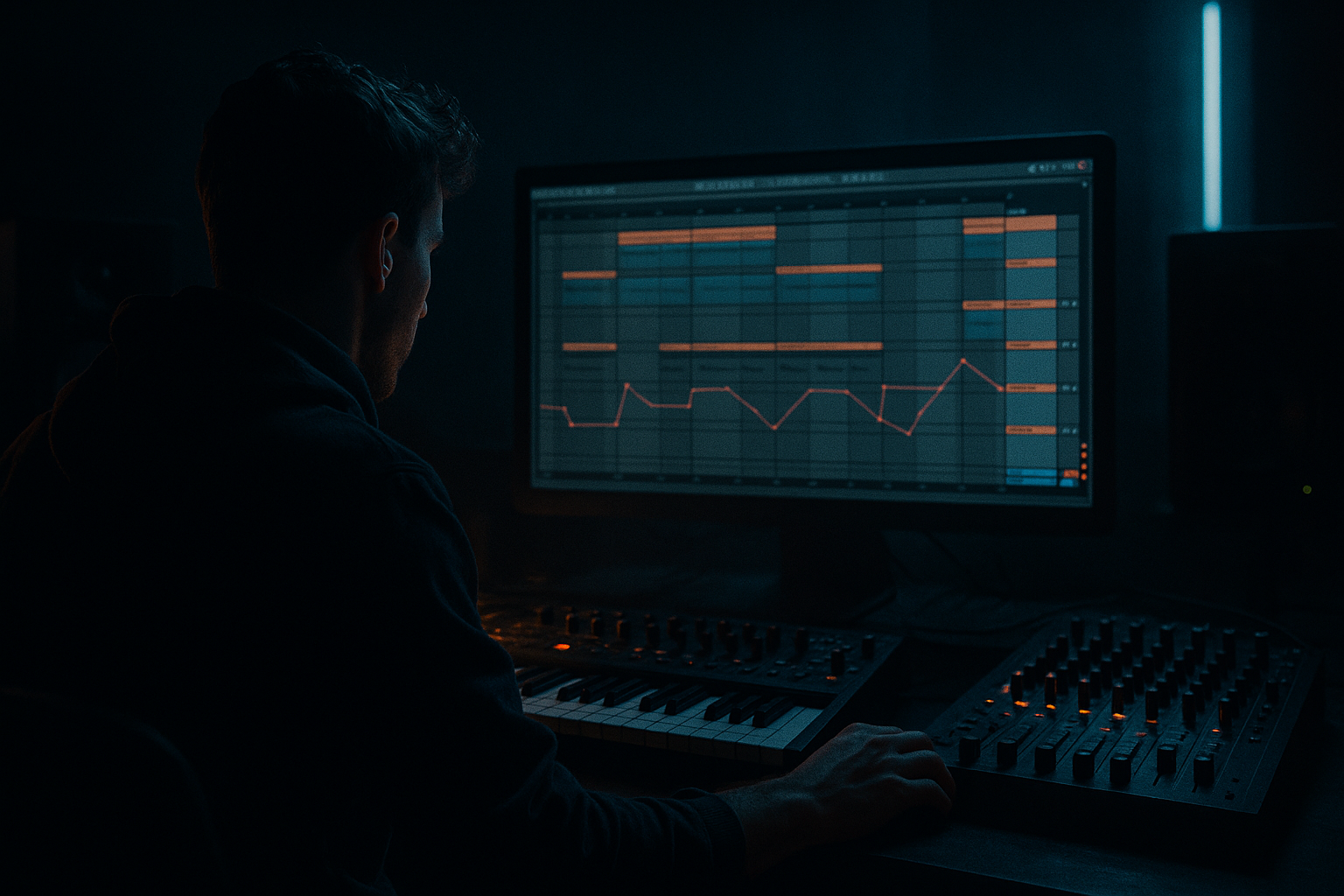
An Amen-style riser is one of the most effective ways to lift tension into a drop in Drum & Bass, especially when you want the transition to feel gritty, organic, and still very controlled. In this lesson, you’ll build a riser from an Amen break source, then shape it with an automation-first workflow in Ableton Live 12 so the movement feels intentional before you even commit to resampling.
This matters because DnB transitions live or die on momentum. A good riser doesn’t just get louder — it evolves in tone, density, stereo image, and rhythm. In jungle, rollers, neuro, and darker bass music, that evolution often comes from a break fragment that gets pushed, filtered, warped, distorted, and reprinted until it becomes a new texture. That’s the core idea here: use the Amen as the raw DNA, then automate the transformation first, resample second.
You’ll learn how to:
- build a riser from chopped Amen hits and noise
- automate shape, tone, and space in a deliberate order
- resample the result into a cleaner, more playable audio clip
- finish it so it lands hard into a drop without muddying the low end
- starts with a narrow, mid-focused break fragment
- gradually opens into a brighter, more unstable top end
- gains perceived intensity through automation of filter frequency, envelope shape, reverb, and saturation
- uses resampling to consolidate several automation passes into one playable audio phrase
- can be placed as a 2-bar or 4-bar lead-in to a DnB drop, or stretched into a longer phrase for breakdown-to-drop energy
- Leaving too much sub in the riser
- Automating only volume
- Using too much reverb too early
- Making the riser too smooth
- Ignoring harshness in the upper mids
- Forgetting drop compatibility
- Use the Amen’s snare transient as the anchor
- Try parallel crunch
- Automate width in reverse of intuition
- Use short feedback bursts
- Make the final frame ugly on purpose
- Check in mono before printing
- Think like a DJ
- Which one creates more tension?
- Which one leaves more space for the drop?
- Which one feels more “jungle” and which feels more modern/neuro?
- slower first half, faster last quarter
- narrower start, wider finish
- more reverb in the last 8 beats only
This is especially useful in a DnB arrangement where you need 2-, 4-, or 8-bar tension builders that feel musical, not generic. Think of it as a pre-drop phrase that can sit before a halftime switch, a full-speed drop, or a drum reset. If your riser sounds like a random white-noise sweep, it’ll get ignored. If it sounds like a mutated Amen pulling itself into the drop, it feels like part of the record. 🔥
What You Will Build
By the end, you’ll have an Amen-derived riser that:
Musically, the result should feel like a broken drum loop being pulled upward into a vortex — not a clean synth riser. It should have the character of jungle source material, but the polish and dynamic control of a modern Ableton workflow.
Step-by-Step Walkthrough
1. Prepare the source and set the phrase length
Start with a clean Amen break sample on an audio track in Ableton Live 12. Warp it if needed, but keep the transient character intact. For this lesson, loop a 1-bar or 2-bar section that contains a strong kick/snare relationship and some hat or ghost-note detail.
Good starting choices:
- 2-bar loop at 170–174 BPM
- focus on one or two especially characterful slices, like a snare flam or a hat run
- keep the clip gain conservative so you preserve headroom for processing
If you’re working from a classic Amen chop, consolidate a version with only the upper-mid and transient-rich material. The point is not to use the full break as-is; it’s to extract a rising rhythmic texture that still “reads” as Amen.
In an advanced DnB workflow, the phrase length matters. A 2-bar riser feels tight and DJ-friendly; a 4-bar riser gives you more space for tonal automation and a more cinematic build. Choose based on arrangement. For example, if the drop is coming after a breakdown with bass absent for 8 bars, a 4-bar riser can reintroduce urgency without feeling rushed.
2. Turn the Amen into a resample-ready texture
Route the break track to a new audio track set to resample or create a new audio track with “Audio From” set to the Amen track. On the source track, insert only the minimum needed processing first:
- EQ Eight to remove unusable low end below roughly 120–180 Hz
- Auto Filter in low-pass or band-pass mode
- Saturator with Drive around 2–5 dB
- Utility to control width if the source is too wide
Why this works in DnB: the riser needs to rise in perceived energy without stealing the sub lane. Removing low-end junk early prevents the build from fighting the drop, and it lets the eventual bassline or sub hit with more authority.
Keep the source fairly dry at this stage. You want the automation to define the motion before you commit to resampling. Think “shape first, ambience later.”
3. Build the core automation arc
This is the automation-first part. Before resampling, write a clear multi-parameter curve over the length of the riser. In Ableton Live 12, automate directly in Arrangement View or on the clip envelope if you’re staying in Session-based workflow.
Automate these in this order:
- Auto Filter cutoff: start around 300–800 Hz and open toward 6–12 kHz
- Filter resonance: modest lift, around 10–25%, to add vocal-like emphasis
- Saturator drive: slowly increase from 2 dB to 6–8 dB
- Reverb dry/wet: keep subtle early, then increase in the last third
- Utility width: start narrower and widen slightly toward the end
A practical 4-bar automation shape:
- Bars 1–2: mostly band-pass, restrained and woody
- Bar 3: open the filter, add saturation, increase room size
- Bar 4: push brightness and movement, then clip or cut abruptly into the drop
If you want a more neuro-leaning result, modulate the filter cutoff in a stepped or semi-stuttered way rather than one smooth rise. That creates the sensation of an unstable machine ramping up.
4. Add movement with envelope shaping and transient emphasis
Insert Drum Buss or Envelope Shaper-style control if your workflow prefers transient manipulation. For stock Ableton devices, Drum Buss is very useful here. Use it lightly:
- Drive: 5–15%
- Boom: usually off or very restrained for this use
- Crunch: subtle, if the source feels too polite
- Transients: positive if you want the hits to poke through more clearly
For a harsher result, add Redux after the filter but before the reverb, then automate Dry/Wet or Downsample carefully. Keep it subtle until the last third of the phrase. A tiny amount of bit reduction can make the Amen fragments feel more “wired” and urgent.
You can also use Auto Pan with:
- Amount around 10–30%
- Rate synced to 1/4, 1/8, or dotted 1/8
- Phase at 0° if you want more amplitude movement than full stereo sweep
This gives the build a nervous shimmer without turning it into a wide wash. Advanced tip: automate Auto Pan Amount only near the end so the riser “wakes up” right before the drop.
5. Shape the ambience last, not first
Add Reverb after the motion devices and treat it like a reveal, not a blanket. In DnB, too much early reverb kills punch and low-mid clarity fast.
Suggested Reverb starting points:
- Decay Time: 1.2–2.8 s
- Pre-Delay: 10–30 ms
- Low Cut: 250–500 Hz
- High Cut: 6–10 kHz
- Dry/Wet: automate from 5–15% up to 25–35% in the final third
If you want a more dangerous, underground feel, use Echo instead of or alongside Reverb:
- Time: 1/8 or 1/16 dotted
- Feedback: 15–35%
- Filter the repeats so they sit above the body
- Automate feedback up briefly before cutting it hard
This is where the riser starts sounding expensive. The echoed fragments and reverb tail should imply space without smearing the next downbeat. The goal is to create tension that expands in the top end while the actual low-frequency mix remains disciplined.
6. Print the automation into audio using resampling
Now record the entire automated source to a new audio track. This is the resampling stage, and it’s the key to making the result feel finished.
Why resample here:
- you freeze a complex automation performance into one clip
- you can edit the audio surgically afterward
- you can reverse, re-chop, or time-stretch the result without rebuilding the chain
- you reduce CPU and turn a moving effect chain into a playable arrangement element
After resampling, consolidate the phrase so it starts and ends cleanly. Then audition the audio clip on its own. You’re listening for:
- a clear upward energy path
- no low-end clutter
- no sudden harsh spike in the 2–5 kHz range
- a drop-ready tail that can be cut or echoed into the downbeat
If the resampled result feels too smooth, that’s often a sign the automation arc was too linear. Go back and make the movement more contrasty: slower early, faster late, with a sharper final push.
7. Post-process the printed riser as a self-contained audio asset
Now treat the resampled clip like a sound design element, not a live instrument.
Useful stock-device cleanup:
- EQ Eight: high-pass around 150–250 Hz, remove any boxy build-up around 300–600 Hz, and tame harshness if needed around 3–6 kHz
- Compressor: light glue, 1–2 dB gain reduction if the dynamics are too wild
- Utility: reduce width in the lower mids if the resampled clip feels too diffuse
For a more aggressive DnB edge, duplicate the resampled track and process the duplicate with heavy saturation or clipping, then blend quietly underneath the clean version. This can add density without making the main riser too obvious.
Then arrange the clip into the song. A classic placement:
- 4 bars before the drop: riser starts restrained
- last 1 bar: brightest and widest point
- final 1/4 beat: cut, reverse tail, or hard stop into the drop
In a darker rollers context, you might even let the riser resolve into silence for a split beat before the drums return. That little vacuum can make the drop hit harder than a constant whoosh.
8. Create variation for arrangement and call-and-response
Don’t stop at one version. Make two or three printed variants:
- one brighter and more aggressive
- one darker and more filtered
- one with extra rhythm and less ambience
Use these in different parts of the arrangement:
- build into first drop
- shorter 2-bar version before a switch-up
- filtered variant before the second drop to avoid repetition
In DnB, repetition is fine, but repetition with identical transition energy gets stale fast. A call-and-response approach works well: let the first build be more organic and the second more synthetic, or vice versa. That contrast helps the track breathe while staying consistent in identity.
Common Mistakes
- Fix: high-pass early and again after resampling if needed. Keep the build out of the sub lane.
- Fix: move filter cutoff, saturation, width, and reverb together. DnB tension comes from tonal evolution, not just loudness.
- Fix: keep the first half tight and dry. Save the bloom for the final third.
- Fix: add stepped automation, short filter jumps, or small rhythmic edits. Amen-based rises should feel animated, not sterilized.
- Fix: check 2–5 kHz after resampling and use EQ Eight or gentler saturation to smooth the spike.
- Fix: audition the riser in context with kick, snare, and bass. If the drop feels smaller, the riser is probably too wide, too bright, or too long.
Pro Tips for Darker / Heavier DnB
- Build the riser around the snare hit and its tail. That gives the transition a rhythmic identity, not just a texture.
- Keep one clean path and one heavily saturated path, then blend the dirty layer low. This adds menace without destroying clarity.
- Sometimes start slightly wide and narrow into the peak, then hit the drop in mono. That can make the drop feel bigger by contrast.
- On Echo or Delay, automate feedback for just the last beat. A quick burst of repeats feels more alive than a constant wash.
- A tiny overload, clip, or destabilizing grain can make a riser feel like it’s breaking apart right before the drop. That’s very effective in neuro and darker rollers.
- If the riser disappears or becomes phasey in mono, reduce width earlier in the chain or simplify the stereo effects.
- Leave enough space for the kick/snare impact of the drop. A riser that’s too full-bodied can blur the first downbeat when played on a club system.
Mini Practice Exercise
Spend 10–20 minutes making two 2-bar Amen-style risers:
1. Make Version A using:
- Auto Filter
- Saturator
- Reverb
- resample the result
2. Make Version B using:
- Auto Filter
- Drum Buss
- Echo
- resample the result
Then compare them in context with a simple 174 BPM DnB drop. Ask:
Finally, choose one and make a second variation by changing only the automation shape, not the devices. For example:
This exercise trains the exact skill that matters: making transition energy through automation decisions before you commit to audio.
Recap
The key move is simple: shape the Amen riser with automation first, then resample it into a focused audio phrase. Use filter movement, controlled saturation, selective ambience, and subtle stereo evolution to build tension without stealing space from the drop. In DnB, the best risers feel like part of the rhythm section’s DNA — not generic effects pasted on top.

