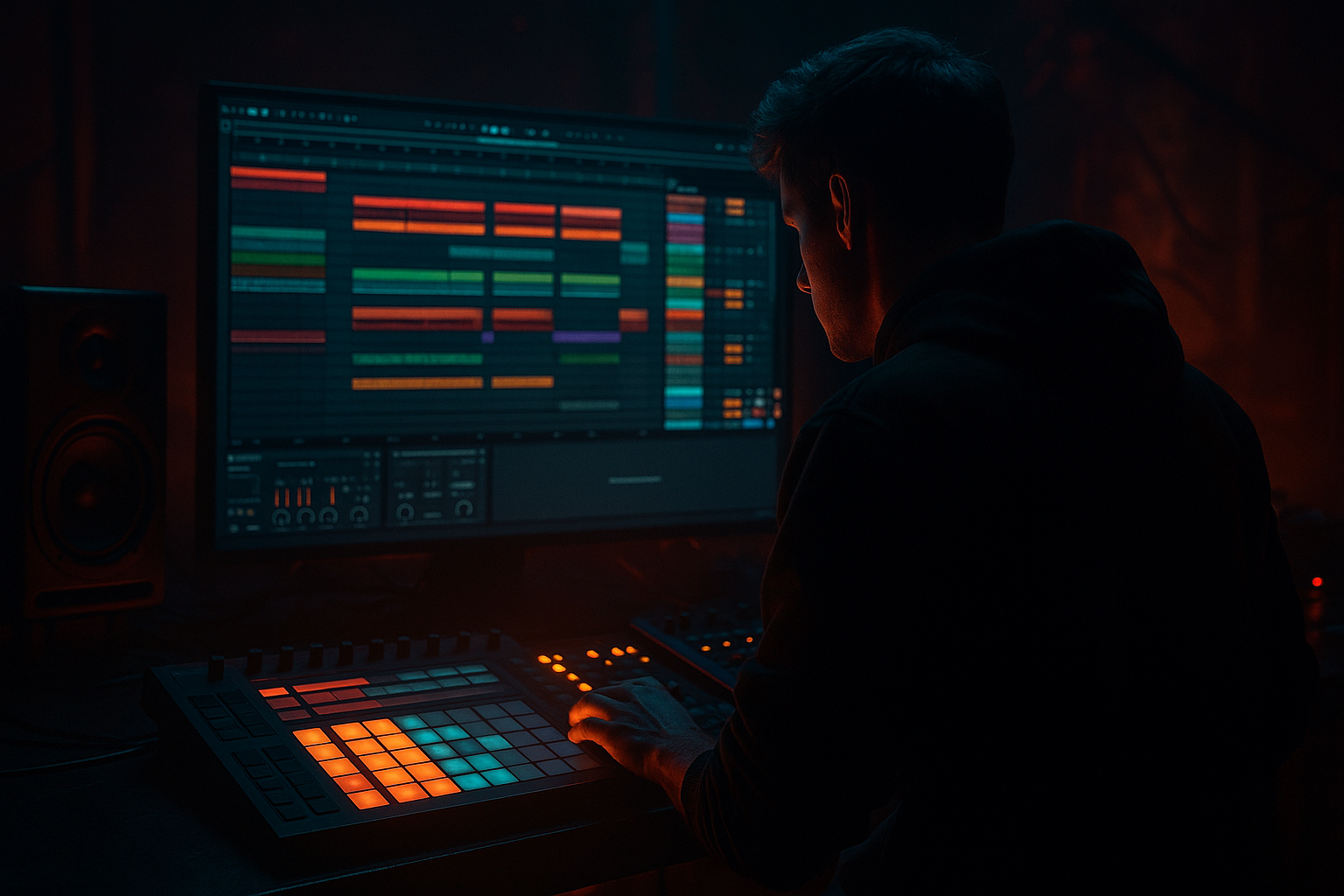
Main tutorial
Color Jungle DJ Intro for Rewind‑Worthy Drops in Ableton Live 12 (Advanced Sound Design) 🔥🥁
1. Lesson overview
A proper jungle/DnB DJ intro is more than “8 bars of drums.” It’s a controlled tease: recognizable era vibes (ragga stabs, timestretched vox, Reese hints, amen ghosts), tight DJ-friendly phrasing, and mixable frequency management—all engineered to make the drop feel like a rewind moment.
In this lesson you’ll design a colorful jungle intro that:
- DJs can mix easily (clean low end + clear phrasing)
- Builds tension with classic jungle signifiers
- Hits a drop that feels inevitable (and loud) without messy gain staging
- Bars 1–8: “DJ safe” – hats, percussion, subtle FX, filtered tops only
- Bars 9–16: introduce jungle color – stabs, vox chops, amen ghosts, rising noise
- Bars 17–24: bass hint + tension – mid bass filtered, call/response stabs
- Bars 25–32: pre-drop – snare rolls, tape stop, uplifter, silence micro-cuts
- Drop: full drums + bass + signature hook, with a tight transition impact
- Create a Drum Rack called `TOPS`.
- Program a 2-bar loop:
- On the `TOPS` track add:
- Add a MIDI track with Wavetable:
- Add Auto Pan:
- Keep it quiet: you should miss it when muted, not notice it loudly.
- Glue Compressor:
- Roar (subtle):
- EQ Eight (post): tiny shelf at 8–10k (+1 dB) if dull
- Grab a short vocal phrase (one-shot or a tiny slice).
- Put it in Simpler (Slice mode):
- Processing chain:
- Osc A: Saw, Osc B: Square (slightly detuned)
- Filter: 12 dB LP, Freq ~2–4 kHz, Res 10–20%
- Amp Env: Attack 0 ms, Decay 250–500 ms, Sustain -inf, Release 80–150 ms
- Chorus-Ensemble: subtle width (Amount 15–25%)
- Echo: 1/8 dotted or 1/4, Feedback 20–35%, HP/LP filters engaged
- Reverb: small plate feel, keep low cut high (300+ Hz)
- EQ Eight: notch anything harsh around 2–4 kHz if needed
- Bar 9: single stab on beat 1
- Bar 11: call/response (beats 1 and “and” of 3)
- Bar 16: stab + delay throw leading into the next section
- Put an Amen loop in Simpler or audio clip
- Warp mode: Beats (Preserve: Transients)
- Highpass it aggressively:
- Gate it rhythmically:
- Keep it -12 to -18 dB relative to your main drums (it’s a hint, not the drums).
- Osc 1: Saw, Osc 2: Saw, detune 10–20 cents
- Unison: 2–4 voices, Amount low/moderate
- Filter: LP24, Drive 5–15%
- Saturator (or Roar): add harmonics
- EQ Eight:
- Auto Filter (movement): automate cutoff over 8 bars (e.g., 400 Hz → 2 kHz)
- Introduce a snare build layer:
- Add Drum Buss on the build snare:
- Cut everything for 1/8 to 1/4 beat (a tight silence)
- Add a tape stop style on a resampled bus:
- Impact layer:
- Uplifter:
- Ensure any bass teaser track has a Utility with Bass Mono (Live 12 Utility has bass mono options) or simply:
- Bring in your full kick + snare (2-step, jungle roller, or hybrid).
- Add a break layer (Amen/Think) but keep it controlled:
- Sub (Operator):
- Mid bass (the teased Reese) now loses the HP filter:
- Same sample, different rhythm
- Less reverb, more punch
- Automated delay throws at phrase ends only (bar 36, 40 etc.)
- Sub in the intro: makes DJs hate mixing your tune. HP your teaser bass until the drop.
- No phrasing: random 7-bar ideas. Stick to 8/16/32 bar logic.
- Over-layering “jungle things”: amen + 5 stabs + 6 vox chops = clutter. Pick 1–2 heroes.
- FX too wet: big reverb tails blur the pre-drop punch. High-pass your reverbs and keep tails intentional.
- Drop not different enough: if the intro already has full drums/bass, the drop has nothing to reveal.
- Swap “colorful” stabs for ominous minimal stabs: shorter decay, more midrange bite (1–2 kHz), less chorus.
- Use Roar for controlled filth: parallel distortion (Mix 10–30%) + filter the distorted band so it lives above 150 Hz.
- Make the pre-drop smaller, not bigger: reduce width, low-pass the mix, then slam open at the drop.
- Kick clarity trick: if your intro has lots of tops, notch 8–10 kHz on hats right before the drop, then restore on drop for perceived lift.
- Reese movement with restraint: automate filter cutoff + subtle FM amount rather than stacking 4 distortions.
- Amen ghosts + ragga chop + dubby stab
- One tape-stop moment at bar 32
- No amen ghosts
- Reese hint with slow filter automation
- Replace tape-stop with 1/4 beat silence + single impact
- Intro has no sub content (verify with EQ Eight / Spectrum)
- Every 8 bars adds one new idea
- Drop feels at least 2× bigger without being 2× louder (clean low end + opened filters + reduced reverb)
- Build intros in DJ-friendly tiers: tops → color → tension → pre-drop → drop.
- Tease jungle identity with vox, stabs, break ghosts, but keep it sparse and intentional.
- Engineer the “rewind” with pull-back moments: micro-silence, tape-stop resample, focused impact.
- Make the drop feel massive through contrast and clarity, not just volume.
Everything uses stock Ableton Live 12 devices.
---
2. What you will build
A 32‑bar DJ intro + 8‑bar pre-drop leading into a rewind-worthy drop:
You’ll also build a reusable Intro Bus chain for glue + vibe.
---
3. Step-by-step walkthrough
A) Session setup (do this first)
1. Tempo: 170–174 BPM (try 172 BPM).
2. Time signature: 4/4.
3. Arrangement markers:
- 1 (Intro A), 9 (Intro B), 17 (Intro C), 25 (Pre), 33 (Drop)
4. Return tracks (recommended):
- A – ShortVerb: Reverb (Decay 0.6–1.0s, Low Cut 300 Hz, High Cut 8–10 kHz, Dry/Wet 12–18%)
- B – DubDelay: Delay (Sync 1/8 or 1/4, Feedback 25–40%, Filter on, keep lows out)
- C – CrushRoom: Reverb (Decay 1.2–1.8s) + Redux (Downsample subtle) for lo-fi splatter
5. Group routing:
- Group your intro elements (except kick/sub) into INTRO BUS
- Drums group, Bass group, Music/FX group (standard DnB hygiene)
---
B) Build the “DJ-safe” opening (Bars 1–8) 🎛️
Goal: a DJ can bring you in without your intro fighting their bassline.
#### 1) Top loop foundation (hats + rides)
- Closed hat: 1/8 pattern with slight velocity variation (e.g., 70–100)
- Ride or shaker layer: offbeats or 1/16 sprinkle
- EQ Eight: HP at 180–250 Hz (24 dB slope)
- Auto Filter: HP mode, Envelope off, set Freq ~350 Hz, Resonance 10–20%
- Saturator: Soft Clip ON, Drive 1–3 dB (tiny grit)
- Utility: Width 120–140% (keep it wide, but don’t go cheesy)
#### 2) Subtle “air noise” bed (for movement)
- Osc 1: Noise (any bright noise)
- Filter: HP, set around 600–1kHz
- Rate: 1/2 or 1 bar, Amount 20–35%, Phase 180° (stereo drift)
#### 3) Intro Bus glue
Group those intro elements into INTRO BUS and insert:
- Attack 3 ms, Release Auto, Ratio 2:1
- Aim for 1–2 dB GR max
- Use a gentle saturation style, Mix 10–20%, HP the distortion if needed
---
C) Add jungle “color language” (Bars 9–16) 🌈
Now we start teasing signature elements—without dumping the whole track early.
#### 1) Ragga / jungle vocal chops (callouts)
- Slice by Transients
- Trigger slices via MIDI for rhythmic placement (classic: last 1/4 of bar 8, bar 12 pickups, bar 16 fill)
- EQ Eight: HP 200–350 Hz
- Saturator: Drive 2–5 dB, Soft Clip ON
- Beat Repeat: (for a single bar “stutter” moment)
- Interval: 1 bar
- Grid: 1/16
- Chance: 20–35% (or automate to 100% on a specific hit)
- Filter: ON, keep lows out
- Send to DubDelay return (tiny)
Placement tip: keep vox sparse. One strong shout can do more than 12 random chops.
#### 2) Jungle stabs that feel “dubplate”
Create a stab with Operator:
Chain it:
Arrangement idea:
#### 3) “Amen ghosts” (without full break yet)
Use a break slice, but make it feel like a teaser:
- EQ Eight: HP 450–800 Hz
- Gate: sidechain from your hats or a ghost 1/8 trigger
---
D) Tension with bass “hinting” (Bars 17–24) 🐍
You want the crowd to feel the bass coming, but still leave space for the DJ mix.
#### 1) Mid-bass teaser (no sub yet)
Make a Reese-ish mid with Wavetable:
Processing:
- HP at 90–120 Hz (important: no sub in the intro)
- small cut if it masks snares (often 200–300 Hz)
Rhythm: keep it minimal—half notes, or a 2-step pattern that hints at the drop groove.
#### 2) Drum energy ramp (without revealing drop drums)
- Use a snare sample or noise burst
- Put it on 1/2 notes → 1/4 → 1/8 progression across bars 21–24
- Drive 5–10%, Boom 0 (don’t add low), Transients +10 to +20
---
E) Pre-drop “rewind bait” (Bars 25–32) 💣
This is where you earn the reaction.
#### 1) The “pull-back” moment (micro-silence + tape stop vibe)
At bar 31 (or last 1 bar before drop):
1. Resample the intro music for the last 2 bars to a new audio track
2. Warp OFF (or keep Warp but be consistent)
3. Apply Pitch automation down 6–12 semitones quickly over 1/2 bar
4. Add Reverb tail to catch the stop (send to ShortVerb)
This is classic “reload energy” when done tastefully.
#### 2) Impact + uplifter design (stock)
- White noise burst (Wavetable noise) + short kick transient (highpassed)
- Transient Shaper isn’t stock, so use Drum Buss Transients + Saturator Soft Clip
- Noise in Wavetable, automate LP → HP sweep into the drop
- Add Auto Pan fast (1/8) near the end for urgency
- Finish with Limiter on the uplifter channel only (catch peaks)
#### 3) “DJ-friendly” bass management
On the MASTER (or better: on groups), avoid hyping sub in the intro.
- Utility Width 0% below ~120 Hz via EQ (or keep teaser HP’d)
---
F) The drop: make it actually rewind-worthy (Bar 33) 🚀
A rewind drop doesn’t just get louder—it gets cleaner, heavier, and simpler.
#### 1) Drums: reveal the real groove
- EQ Eight: HP 120–180 Hz (breaks don’t own the sub)
- Glue Compressor on the DRUMS group: 2:1, Attack 10 ms, Release Auto, 1–3 dB GR
- Drum Buss: Drive 3–8%, Crunch subtle, Boom tuned to taste (often 50–60 Hz) only if it helps (don’t fight the sub)
#### 2) Bass: full spectrum now (sub + mid)
- Sine, mono, clean
- Sidechain with Compressor from kick (fast attack, release timed to groove)
- Let it reach down to ~60–80 Hz if it’s part of the body, but keep true sub mostly in the dedicated sub track.
#### 3) “Signature hook” continuity
Use one element from the intro (a vox chop or stab) as a drop motif, but tighter:
---
4. Common mistakes 🚫
---
5. Pro tips for darker/heavier DnB 🖤
---
6. Mini practice exercise 🎯
Create two versions of the intro using the same drop:
1) Version A (classic jungle):
2) Version B (dark roller):
Checklist:
---
7. Recap ✅
If you want, tell me your target vibe (e.g., 94 jungle, metalheadz darkness, modern jump-up jungle hybrid) and I’ll suggest exact bar-by-bar elements + a starter Ableton template routing.

