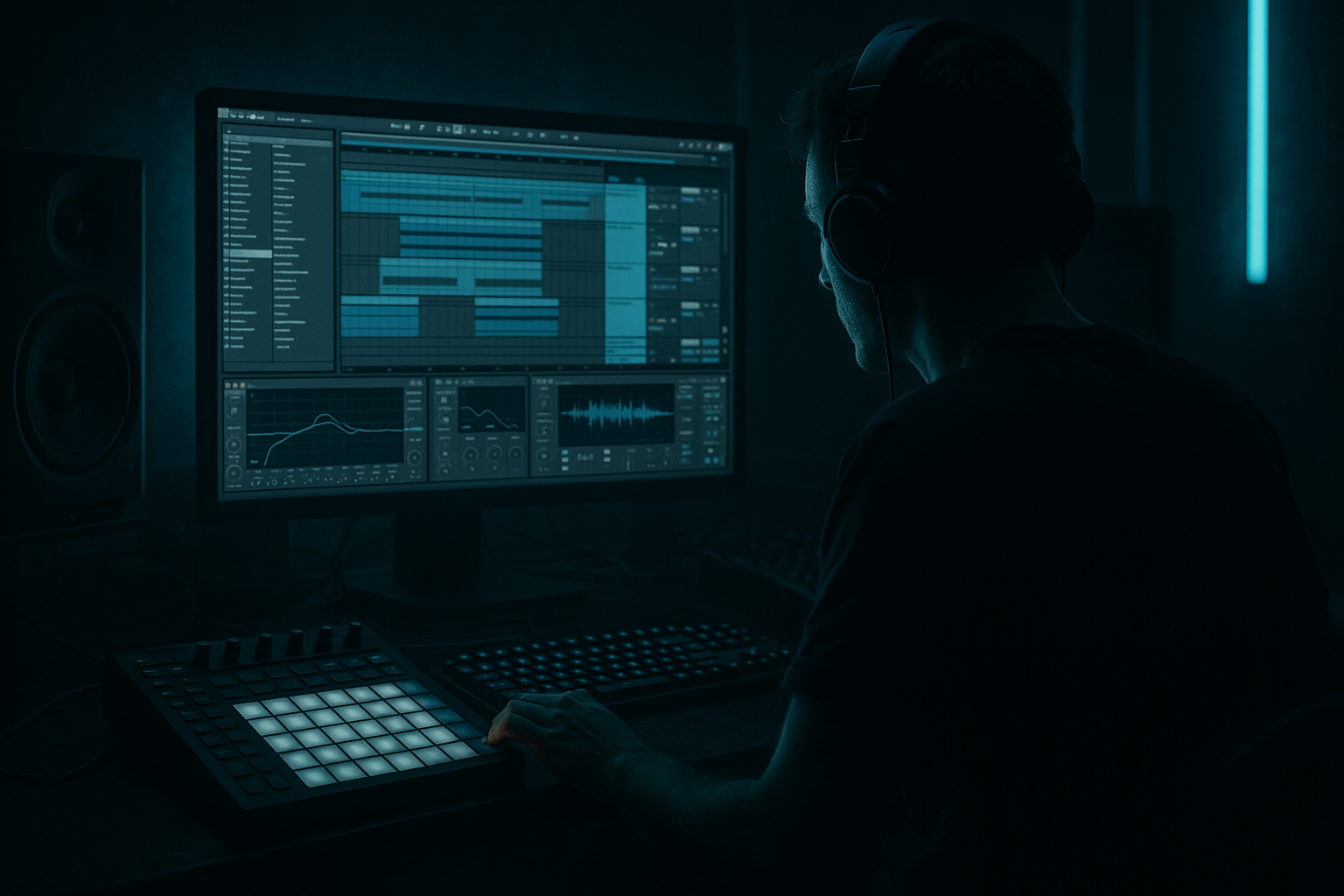
Main tutorial
```markdown
Color an Oldskool DnB Transition with Modern Punch + Vintage Soul (Ableton Live 12) 🎛️🔥
Skill level: Intermediate
Category: Basslines (but we’ll glue bass + drums + FX the right way for a proper jungle/DnB transition)
---
1) Lesson overview
Oldskool jungle/DnB transitions have movement, tape-ish grime, and musical “story”—but modern DnB demands punch, clarity, and headroom.
In this lesson you’ll build a 32-bar transition that takes a classic rolling bass vibe and colors it with:
- Vintage soul (saturation, wow/flutter, resampling, organic modulation)
- Modern punch (tight envelope control, transient shaping, clean sub management)
- DJ-friendly energy (risers, fills, filter sweeps, tension/release)
- A reese/rolling mid-bass that gets progressively dirtier + wider
- A tight sub layer that stays clean and mono
- A transition FX chain that evolves: tape-ish → crunchy → punchy
- A drop impact that feels modern (clean transient + controlled low end)
- Narrower stereo
- More “tape” movement (wow/flutter style)
- Slightly rolled-off top
- Tighter transient feel
- Cleaner low end
- Controlled brightness
- Wider but mono-safe lows
- MID Auto Filter cutoff (more open toward drop)
- Roar Drive (more aggression toward drop)
- Chorus mix (less at the final moment so drop hits solid)
- Utility Width (widen mids gradually; keep sub mono always)
- Bars 1–8: tease bass + minimal drums, “dusty” vibe
- Bars 9–16: add drum layers, more mid-bass movement
- Bars 17–24: tension building (risers, edits, fills)
- Bars 25–32: pre-drop energy + pullback, then impact
- Add an LFO to Osc Pitch or Fine
- Rate: 0.05–0.20 Hz
- Amount: tiny (think 2–6 cents)
- Keep it subtle: it should feel like “hardware mood,” not out-of-tune chaos
- Assign LFO to cutoff
- Rate: 1/8 or 1/4 (sync)
- Amount: small (enough to create motion)
- Duplicate MID, then:
- EQ Eight: Highpass 400–800 Hz
- Saturator: Drive 5–10 dB
- Redux (light!): Downsample slightly (start at 12–18 kHz)
- Utility: Width 120–160%
- Add Gate
- Use it like a tone shaper, not a destroyer.
- Slightly compress low-mids if they bloom.
- Keep sub out of this; sub is on its own track.
- Add Operator
- Auto Filter (Bandpass)
- Reverb
- Utility: keep it wide (140%) and low in level
- Put Delay (stock) on a Return track
- Cut the Chorus mix on MID to near 0–10% at the exact downbeat
- Pull Roar Drive down slightly at the downbeat (yes, sometimes less distortion hits harder)
- Add a short transient layer (kick/snare impact) while bass stays controlled
- Widening the sub: instant weak drop in clubs. Keep sub mono with Utility.
- Over-distorting early: if the build is already maxed, the drop has nowhere to go.
- No separation between sub and mids: you’ll fight phase, headroom, and clarity.
- Too much chorus at the drop: it smears punch; automate it down right at impact.
- Ignoring mono compatibility: always check with Utility (Width 0%) on the master briefly.
- Tune your distortion: in Roar, use filtering so distortion focuses on 200 Hz–2 kHz, not sub.
- Automate “brightness” more than “volume”: open filters + harmonics reads as energy without clipping.
- Use short, nasty edits: 1/16 or 1/8 stutters before the drop (audio slice your resample).
- Sidechain the MID to the kick (subtle): Compressor on MID, sidechain from Kick, 1–3 dB GR. Keeps the drop clean.
- Dark jungle vibe: roll a bit of top end in the build (Auto Filter lowpass around 10–14 kHz) then release it at the drop.
- You built a proper DnB transition by layering: clean mono sub + character mid bass.
- You created “vintage soul” using subtle drift, chorus, saturation, resampling, and controlled grit.
- You kept “modern punch” by tight envelopes, clean low-end management, automation contrast, and mono-safe widening.
- You used stock Ableton tools: Operator, Wavetable, Auto Filter, Roar, Saturator, Glue Compressor, Utility, Multiband Dynamics, Redux.
We’ll do it using stock Ableton Live 12 devices (plus smart routing and resampling).
---
2) What you will build
A classic DnB/jungle transition from “oldskool” to “modern” over 32 bars:
By the end you’ll have an arrangement-ready transition you can copy into any tune.
---
3) Step-by-step walkthrough
Step 0 — Session setup (fast + DnB-correct)
1. Tempo: 172–176 BPM (try 174 BPM).
2. Key idea: Pick a root note like F, F# or G (common for heavy DnB).
3. Create groups:
- DRUMS
- BASS
- FX/ATMOS
- MIX BUS (optional)
✅ Goal: clean routing so your “color” processing is controlled, not messy.
---
Step 1 — Build the bass layers (sub stays modern, mids get soul)
We’ll split bass into SUB + MID. This is non-negotiable for punch.
#### A) SUB track (clean + solid)
1. Create MIDI track: BASS – SUB
2. Add Operator
- Osc A: Sine
- Voices: 1
3. Add Auto Filter
- Type: Lowpass 24
- Frequency: ~120 Hz
- Resonance: 0.0–0.5
4. Add Glue Compressor
- Attack: 10 ms
- Release: Auto
- Ratio: 4:1
- Threshold: adjust for 1–2 dB GR on loud notes
5. Add Utility
- Bass Mono: ON (or Width = 0%)
- Gain: set so sub peaks are stable
MIDI tip: Keep sub notes simple (root + occasional fifth). Oldskool vibe comes from mids; modern punch comes from consistent sub.
---
#### B) MID bass track (the “oldskool soul” canvas)
1. Create MIDI track: BASS – MID
2. Add Wavetable (or Operator/Simpler if you prefer)
- Wavetable: pick something harmonically rich (e.g. saw-ish)
- Unison: 2–4 voices, Amount low (don’t go supersaw)
3. Add Auto Filter
- Highpass/Low cut: 24 dB
- Cut at ~120 Hz (so mids don’t fight sub)
4. Add Saturator
- Mode: Analog Clip
- Drive: 3–8 dB
- Soft Clip: ON
5. Add Chorus-Ensemble (for vintage width)
- Mode: Chorus
- Rate: 0.2–0.6 Hz
- Amount: 10–25%
- Mix: 15–30%
6. Add Roar (Ableton Live 12) for evolving dirt
- Start with a preset like a gentle tube/tape drive
- Drive: low at first (we’ll automate up)
- Filter inside Roar: keep lows under control
✅ Now you have: Modern sub foundation + soulful mid character.
---
Step 2 — Create the “oldskool → modern” transition concept (automation plan)
We’re going to automate 4 things over 32 bars:
Oldskool (intro of transition):
Modern (approach drop):
What to automate (best targets):
---
Step 3 — Make the transition feel like jungle/DnB (arrangement moves)
Assume you’re transitioning from a rolling section into a drop.
#### A) 32-bar skeleton (classic)
---
Step 4 — Add “vintage soul” movement (without wrecking the mix) 🎚️
Oldskool soul often comes from instability: subtle pitch drift, filter wobble, resampled grit.
#### A) Add controlled pitch drift to MID
On Wavetable (or your synth):
#### B) Filter “talk” in the mids
On Auto Filter (MID):
#### C) Add a dusty top layer (optional but very jungle)
Create an Audio track: BASS – DUST
Blend low (like -18 to -24 dB)—it’s air-grit, not a main element.
---
Step 5 — Modern punch: tighten the bass envelope + transient behavior
Oldskool bass can be smeary; modern bass needs start/stop discipline.
#### A) Control note tails (super important at 174 BPM)
On BASS – MID:
- Threshold: set so it closes between notes
- Return: short
- Attack: 0.5–2 ms
This keeps rolls clean and prevents “mud wash.”
#### B) Multiband shaping (stock + effective)
Add Multiband Dynamics (MID) gently:
---
Step 6 — The transition “color” bus (where the magic happens)
Group BASS – SUB + BASS – MID into BASS GROUP.
On BASS GROUP, add this chain:
1. EQ Eight
- Low cut: off (don’t kill sub)
- Dip mud: 200–350 Hz by -1 to -3 dB (if needed)
2. Roar (as bus color, not main distortion)
- Drive: 1–4 dB early, automate to 4–8 dB by bar 28
- Mix: 60–100% depending on intensity
3. Glue Compressor
- Attack: 3–10 ms
- Release: Auto
- Ratio: 2:1
- Aim for 1–2 dB GR when it gets hype
4. Utility
- Width automation on mids only is better, but on bus: keep conservative
- If needed: automate Width from 90% → 110% across the build
- Never widen if it wrecks mono
✅ This gives you a single “transition color fader” via Roar Drive + Glue threshold automation.
---
Step 7 — Add transition FX that scream DnB (and are mix-friendly) 🌀
#### A) Noise riser that doesn’t fight bass
Create Audio track: FX – Riser
- Noise oscillator on
- Automate cutoff rising over 8–16 bars
- Decay: 3–6 s
- High Cut: ~6–8 kHz (keep it vintage/dark)
#### B) Classic “tape stop / time smear” moment (tasteful)
On the last 1 bar before drop, try:
- Time: 1/8 or 1/4
- Feedback: 20–35%
- Filter: remove lows under 200 Hz
Send a snare fill or vocal stab into it for that oldskool echo-trail.
---
Step 8 — The drop impact: modern punch with oldskool attitude 💥
At the drop, do a quick “contrast move”:
Pro move: Put a Utility on MID and automate Gain -1.5 dB for the last 1/8 note before drop, then snap back at drop. That micro-silence creates perceived punch.
---
Step 9 — Resample for authentic oldskool texture (fast workflow)
This is where you get “vintage soul” in a modern session.
1. Create Audio track: RESAMPLE BASS
2. Set its input to Resampling
3. Solo BASS GROUP and record a few bars of your build
4. Now process the audio:
- EQ Eight: clean harshness at 2–5 kHz if needed
- Saturator: light glue
- Redux: tiny (for texture)
5. Blend resample under the main bass or use it just in the build.
This gives you that “printed” feeling—like older hardware workflows—without losing your clean sub.
---
4) Common mistakes
---
5) Pro tips for darker/heavier DnB 🖤
---
6) Mini practice exercise (15–25 minutes) ⏱️
1. Make a 16-bar build into an 8-bar drop.
2. Use SUB (Operator sine) + MID (Wavetable).
3. Automate these 3 parameters across the build:
- MID Auto Filter cutoff: lower → higher
- Roar Drive on BASS GROUP: 2 dB → 7 dB
- Chorus mix on MID: 25% → 5% at the drop
4. Resample the last 8 bars of the build and layer it quietly under the drop (-20 dB-ish).
Checkpoint: Your drop should feel cleaner and heavier than the build, even if the build is dirtier.
---
7) Recap
If you want, tell me what sub note range you like (e.g., F to G#) and whether your drums are more jungle breaks or 2-step, and I’ll suggest a bassline pattern + automation lane map tailored to your vibe.
```

