DNB COLLEGE

AI Drum & Bass Ableton Tutorials

LESSON DETAIL

Comping ideas into final arrangements at 170 BPM (Advanced)

An AI-generated advanced Ableton lesson focused on Comping ideas into final arrangements at 170 BPM in the Workflow area of drum and bass production.

Free plan: 0 of 1 lesson views left today. Premium unlocks unlimited access.

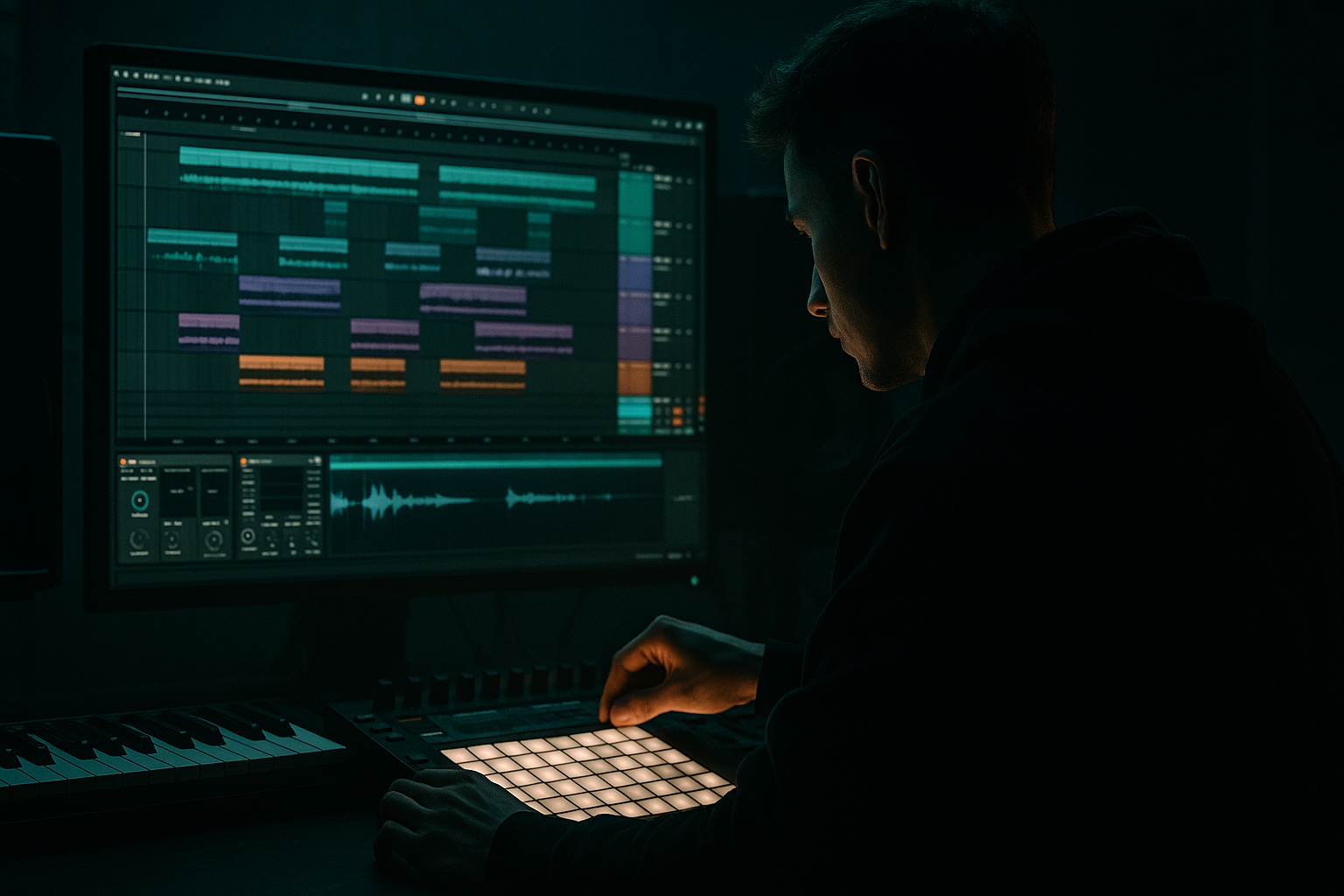
Comping ideas into final arrangements at 170 BPM (Advanced) cover image

Narrated lesson audio

The voice track includes the tutorial plus extra teacher commentary.

Open audio file

Main tutorial

```markdown

Comping Ideas into Final Arrangements at 170 BPM (Ableton Live / DnB Workflow) 🥁⚡

1. Lesson overview

This lesson is about turning a folder full of 8–32 bar loops, jams, and resamples into a cohesive 170 BPM drum & bass arrangement—fast.

We’ll use Ableton Live’s strengths: Session View for idea generation, Arrangement View for structure, and smart comping-style selection (even if you didn’t record “takes” in the traditional sense).

You’ll build a system for:

  • Auditioning multiple versions of drums/bass/atmos quickly
  • Committing to the best bars (“keepers”) without losing alternatives
  • Arranging with DnB logic: tension, release, reloads, and DJ-friendly phrasing
  • ---

    2. What you will build

    A DJ-ready rolling DnB arrangement at 170 BPM, roughly 3:00–4:00 long, containing:

  • 16-bar intro (mix-in friendly, sparse drums/atmo)
  • 16-bar pre-drop build (riser + drum density)
  • 64-bar drop A (rolling groove + bass hook)
  • 16-bar breakdown / “breather”
  • 64-bar drop B (variation, heavier sound design)
  • 16–32 bar outro (mix-out friendly)
  • And you’ll do it by comping the best 4–8 bar sections from multiple idea clips into a final arrangement.

    ---

    3. Step-by-step walkthrough

    Step 0 — Set up your “comping” framework (10 minutes)

    Goal: Make it impossible to get lost when you have multiple good versions.

    1. Set tempo to 170 BPM.

    2. In Arrangement View, set Global Quantization to 1 Bar (top left).

    3. Create groups (Cmd/Ctrl+G) like this:

    - DRUMS (Kick, Snare, Hats, Perc, Break)

    - BASS (Sub, Reece/Neuro, Bass FX)

    - MUSIC (Pads/Atmos, Stabs, Keys)

    - FX (Risers, Impacts, Noise, Vox)

    4. Color-code consistently (e.g., drums = red, bass = purple, atmos = blue).

    5. Make a “PRINTS” audio group (empty for now). You’ll print resamples here later.

    Workflow rule: Every time you “commit,” you print something. Every time you “explore,” you do it in Session.

    ---

    Step 1 — Build an “idea matrix” in Session View 🎛️

    Goal: Put all variations in a grid so you can audition like a DJ.

    1. Go to Session View.

    2. Create scenes named:

    - `A1 - Drop (clean)`

    - `A2 - Drop (busier)`

    - `A3 - Drop (break emphasis)`

    - `B1 - Drop (heavier)`

    - `Build 1`

    - `Breakdown`

    3. For each scene, place 8 or 16-bar clips per group:

    - Drums: variations of hats, ghost snares, extra tops, break layers

    - Bass: different phrases / fills / call-response

    - Atmos: different textures, space, vocal chops

    4. Put one scene that is intentionally minimal: `Intro / Mix-in`.

    Advanced audition tip:

  • Assign Launch Mode of crucial clips (like breaks) to Gate temporarily if you want “performance-style” testing.
  • For most clips, keep Launch Mode as Trigger and quantized to 1 Bar.
  • ---

    Step 2 — Create “keeper lanes” using duplicate tracks (pseudo-comping) ✅

    Ableton’s comping is designed for recorded takes, but for DnB arrangement comping, this method is faster.

    1. For any key track (e.g., Break, Top Loop, Bass Hook), make 3 duplicates:

    - `Break - KEEPER`

    - `Break - ALT 1`

    - `Break - ALT 2`

    2. Put your best clip on KEEPER, alternatives on the ALTs.

    3. Mute ALTs by default. You can swap sections later by copying bars.

    Why this works: You get “comp lanes” you can swap from without hunting through project history.

    ---

    Step 3 — Record a “performance arrangement” from Session to Arrangement 🎚️

    Goal: Capture your best scene changes quickly and musically.

    1. Arm Arrangement Record (top transport).

    2. Trigger scenes live:

    - 16 bars intro

    - 16 bars build

    - 64 bars drop A (cycle between A1/A2/A3 every 8–16 bars)

    - breakdown

    - 64 bars drop B

    - outro

    3. Don’t overthink: this is your first draft arrangement.

    Critical DnB detail: Keep phrasing in multiples of 16 bars most of the time. DJs love it, listeners feel it.

    ---

    Step 4 — Hard-comp the best 4–8 bar sections (the real magic) ✂️

    Now you sculpt the arrangement like an editor.

    1. In Arrangement View, enable Loop and audition sections in 4–8 bar chunks.

    2. Use Split (Cmd/Ctrl+E) at bar lines.

    3. For each chunk ask:

    - Is the groove pushing forward?

    - Is the bass phrase “answering” the drums?

    - Do I need variation (fills, stop-start, break switch)?

    #### Practical comp method:

  • For a weak 8-bar section in Drop A:
  • 1. Locate an alternative clip/scene version from earlier in the arrangement (or from ALT tracks).

    2. Copy just bars 9–16 of the better version.

    3. Paste it over the weak section.

    4. Crossfade (see below).

    #### Crossfades (important for breaks & bass resamples)

  • Turn on Create Fades on Clip Edges (Preferences → Record/Warp/Launch).
  • Add short fades:
  • - Break edits: 5–20 ms

    - Bass edits: 2–10 ms (or zero + ensure zero-crossing)

  • If phase issues occur with layered breaks, consolidate (Cmd/Ctrl+J) after edits to commit.
  • ---

    Step 5 — Build DnB arrangement landmarks (drop logic) 🧱

    Here’s a practical blueprint to “DnB-ify” your structure:

    #### Intro (0:00–0:30 / 16 bars)

  • Elements:
  • - Atmos/pad (Auto Filter slowly opening)

    - Sparse tops (no full hats yet)

    - Optional break teaser filtered

  • Devices:
  • - Auto Filter (LP 12 dB, envelope or slow automation)

    - Echo (1/8 dotted, low feedback, high-passed)

    #### Build (0:30–0:52 / 16 bars)

  • Add:
  • - Snare build (increasing density)

    - Noise riser

    - Short vocal stab

  • Devices:
  • - Drum Buss on drum group (Drive 5–20%, Crunch 0–10)

    - Utility for mono-ing lows (below ~120 Hz via Bass Mono if you use EQ Eight M/S)

    #### Drop A (0:52–1:52 / 64 bars)

  • Bars 1–16: establish groove (rolling hats + main bass hook)
  • Bars 17–32: add break layer or extra ghost snares
  • Bars 33–48: variation (bass call-response, reese movement)
  • Bars 49–64: pre-switch energy (fills, tension, small “fake drop”)
  • Devices/chain example (Bass Group):

  • EQ Eight: HP @ 25–30 Hz, tame harsh bands (2–5 kHz)
  • Saturator: Soft Clip on, Drive 2–8 dB
  • Amp (optional): subtle character (try “Blues” low)
  • Glue Compressor: 1–2 dB GR for cohesion
  • Limiter: safety (don’t squash)
  • #### Breakdown (1:52–2:08 / 16 bars)

  • Pull out kick + sub for 8 bars, keep break ghosted
  • Use a tape-stop style moment via:
  • - Pitch automation (clip transpose down)

    - Or Frequency Shifter (fine-tune, subtle)

    #### Drop B (2:08–3:08 / 64 bars)

  • Same skeleton, heavier sound design:
  • - New bass patch layer or different reese movement

    - Switch break or change hat pattern

    - One signature “moment” every 16 bars (big fill, bass sustain, stop-cut)

    #### Outro (3:08–end / 16–32 bars)

  • Reduce bass complexity
  • Keep drums steady for mixing out
  • Remove risers/ear candy
  • ---

    Step 6 — Print your comps to audio (commit like a pro) 🎚️

    This step makes your arrangement feel “real” and avoids endless tweaking.

    1. Freeze & Flatten selected tracks or resample:

    - Create an audio track in PRINTS

    - Set input to Resampling

    - Record 16–32 bar sections (Drop A drums, Drop B bass, etc.)

    2. Replace complex layers with printed audio where appropriate:

    - Break stack

    - Bass resample phrases

    - FX impacts

    Benefit: Editing becomes surgical, CPU drops, decisions lock in.

    ---

    Step 7 — Micro-automation pass (the “glue” pass) 🧪

    Make your comped sections feel intentionally connected.

  • Filter transitions (Auto Filter) on atmos and tops entering new sections
  • Reverb throws (Hybrid Reverb) on snares at the end of 16-bar phrases
  • Delay throws (Echo) on vocal chops or stabs
  • Drum fill moments: 1-bar tom/snare rush every 16 bars
  • Ableton stock power move:

    Use Utility gain automation for +0.5 to +1.5 dB lift in Drop B (or perceived lift by thinning midrange before it hits).

    ---

    4. Common mistakes

  • Arranging in 8-bar loops with no landmarks: You need identifiable 16/32/64 bar events.
  • Too many break layers at once: transient smear + phase mess. Commit to one main break and one supportive layer.
  • Bass phrases not respecting the drums: if the bass is “talking” constantly, the groove loses punch. Leave gaps.
  • No “mix-friendly” intro/outro: DJs want clean sections with stable drums and controlled bass.
  • Endless alt hoarding: set a rule: two ALTs max per key part.
  • ---

    5. Pro tips for darker/heavier DnB 🕶️

  • Make the drop feel heavier by removing, not adding: drop the hats for 4 bars, keep only kick/snare + sub, then slam back in.
  • Controlled distortion chain for reese/neuro layers (stock):
  • - EQ Eight (pre) → Saturator (Soft Clip) → Overdrive (low Dry/Wet) → EQ Eight (post)

  • Break brutality without losing snap:
  • - Drum Buss on break buss (Drive + Transients)

    - Parallel crunch: duplicate break → heavy Saturator/Overdrive → low-pass around 6–8 kHz → blend at -12 to -18 dB

  • Tension using note repetition: 1-bar bass note “machine gun” at end of 16 bars, then silence on bar 1 of next phrase.
  • Sub discipline: keep sub mostly mono (Utility), and comp/edit sub phrases separately from mid-bass.
  • ---

    6. Mini practice exercise (20–30 minutes) 🎯

    1. Create three Drop scenes in Session:

    - A1: clean roll

    - A2: extra ghost snares + busier hats

    - A3: break emphasis (extra amen chop layer)

    2. Record a 2-minute performance into Arrangement.

    3. Now “comp” it:

    - For the drums, choose your best 8 bars from A1/A2/A3 and build a 32-bar Drop A.

    - For bass, choose best 4-bar phrases and assemble call-response across 16 bars.

    4. Print (resample) the 32-bar drums into audio and do three edits:

    - a 1-bar fill

    - a 1/2-bar stop

    - a fade/crossfade to fix a click

    Deliverable: a 32-bar drop that evolves every 8–16 bars and feels DJ-ready.

    ---

    7. Recap ✅

  • Build an idea matrix in Session View, then record a performance into Arrangement.
  • Use keeper + ALT tracks as pseudo-comp lanes to swap the best bars quickly.
  • Comp in 4–8 bar chunks, respecting 16/32/64 bar DnB phrasing.
  • Print to audio to commit and speed up editing.
  • Finish with a micro-automation glue pass so transitions feel intentional and heavy.

If you want, tell me your current project structure (how many drum layers, breaks, bass tracks), and I’ll suggest a comp lane layout and a 3–4 minute arrangement map tailored to your sound (rollers, jungle, neuro, minimal, etc.).

```

Ask GPT about this lesson

Chat with the lesson tutor, get follow-up help, or use quick actions.

Bigup 👽 Ask me anything about this lesson and I’ll answer in context.

Narration script

Show spoken script
Title: Comping ideas into final arrangements at 170 BPM (Advanced)

Alright, let’s do the thing that separates a hard drive full of sick eight-bar loops from an actual drum and bass track people can mix and rewind.

Today is advanced workflow in Ableton Live: comping ideas into a finished arrangement at 170 BPM. Not “comping” like vocal takes, but comping like an editor. You’re going to audition multiple versions fast, commit to the best bars without losing your options, and build a DJ-friendly structure that feels intentional: tension, release, reloads, and those clean 16 and 32 bar phrases that just make sense in a set.

By the end, you’re aiming for a 3 to 4 minute rolling DnB arrangement:
16 bar intro, 16 bar build, 64 bar Drop A, 16 bar breakdown, 64 bar Drop B, then a 16 to 32 bar outro. Classic. Reliable. And it still leaves room for personality.

Let’s start with the mindset: explore in Session View, commit in Arrangement View. Every time you commit, you print. Every time you explore, you stay flexible.

Step zero: set up a comping framework so you don’t get lost.

Set your tempo to 170. Then go Arrangement View and set Global Quantization to one bar. That way, everything launches and records in clean chunks, and you don’t end up with awkward off-grid scene changes.

Now make four main groups:
DRUMS, BASS, MUSIC, and FX. Color code them consistently. It sounds like a small thing, but when you’re comping at speed, color is navigation. Drums red, bass purple, atmos blue, FX yellow—whatever, just be consistent.

Then create an empty audio group called PRINTS. This is where you’ll record resamples and flattened sections. This is your “commitment zone.” If you’re the kind of producer who keeps tweaking forever, this PRINTS group is your new best friend.

Extra coach note before we start auditioning: lock your grid before you comp.
At 170 BPM, tiny timing differences can feel exciting in Session View, but messy in Arrangement View. Pick one reference groove—usually your main break—and align everything else to it.

If you’re warping breaks, use Beats mode and preserve transients. Keep Complex Pro off for drums. For bass audio, try Tones mode if it’s sustained reese movement. Or don’t warp it if it’s already tight.

And here’s a power move: use Track Delay in milliseconds to nudge entire layers while you’re still experimenting. It’s cleaner than sliding a hundred tiny clips and then regretting it.

Step one: build your idea matrix in Session View.

Go to Session View and create scenes that represent sections and variations, not just random jams. Name them like:
A1 Drop clean
A2 Drop busier
A3 Drop break emphasis
B1 Drop heavier
Build 1
Breakdown
And a minimal one: Intro mix-in

Now fill each scene with 8 or 16 bar clips for each group.
For drums, you want variations in hats, ghost snares, extra tops, break layers.
For bass, different phrases, fills, and call-and-response.
For atmos and music, different textures and space: pads, noise beds, stabs, vocal chops.
For FX, risers, impacts, little ear candy.

Think of this like a DJ crate. You’re not arranging yet. You’re building options that are easy to audition.

Advanced audition tip: if you want to test breaks performance-style, temporarily set crucial clips to Gate launch mode, so they only play while held. For most things, keep it on Trigger with one-bar quantization. The goal is clean phrasing.

Step two: create keeper lanes using duplicate tracks. This is pseudo-comping.

Ableton’s take lanes are great, but for DnB arrangement comping, this is often faster.

Pick key parts: maybe your main break track, your top loop, and your main bass hook. Duplicate each one three times.

Name them like:
Break KEEPER
Break ALT 1
Break ALT 2

Put your best clip on KEEPER. Put your alternatives on ALT tracks. Mute the ALT tracks by default.

Why this works: when you’re deep in arrangement mode, you can swap sections in seconds by copying bars from the ALT track into the keeper timeline. No hunting through old scenes. No “where did that version go?” panic.

And a rule to keep you sane: two ALTs max per key part. If you have twelve alternates, you don’t have alternates—you have procrastination.

Step three: record a performance arrangement from Session into Arrangement.

This is where you capture the vibe before you start cutting it up.

Arm Arrangement Record. Then trigger your scenes live, like a mini set:
16 bars intro
16 bars build
64 bars Drop A, switching between A1, A2, A3 every 8 or 16 bars
16 bars breakdown
64 bars Drop B, using the heavier scene and variations
Then an outro

Do not overthink it. This is a first draft. You’re basically generating raw footage that you’ll edit later.

Critical DnB detail: keep phrasing in multiples of 16 bars most of the time. You can break it on purpose later, but first earn the right to break the rule.

Now step four: hard-comp the best 4 to 8 bar sections. This is the real magic.

Go to Arrangement View. Turn on loop. And start auditioning in 4 or 8 bar chunks.

Use split at bar lines. And ask three questions every chunk:
Is the groove pushing forward?
Is the bass answering the drums, or is it just talking nonstop?
Do I have enough variation—fills, stop-starts, break switches—to keep attention?

Here’s a practical comp method:
Let’s say bars 9 through 16 of your Drop A feel weak. Maybe the hats feel flat or the bass phrase doesn’t land.
Find a better version—either earlier in the arrangement where you recorded a different scene, or from your ALT tracks.
Copy just that better 8 bars and paste it over the weak section.
Then fix the edit.

Now, crossfades. This is non-negotiable if you want clean break edits.

Go to Preferences and enable “Create Fades on Clip Edges.”
For break edits, use short fades like 5 to 20 milliseconds.
For bass edits, even shorter, like 2 to 10 milliseconds. Sometimes zero is fine if you’re cutting at zero crossings, but don’t gamble if you hear clicks.

If you get phase issues with layered breaks, don’t sit there suffering. Once you like the edit, consolidate to commit. You can even consolidate the break stack after you’ve chosen the comp, because it locks the phase relationship and makes the whole thing feel like one record.

Now step five: build DnB arrangement landmarks. This is how you turn “cool bars” into “story.”

Let’s blueprint it.

Intro, 16 bars.
Keep it mix-in friendly. Atmos or pad with a filter slowly opening. Sparse tops. Maybe a filtered break teaser. Not the full chaos yet.
Use Auto Filter with a low-pass, and a little Echo—like an eighth dotted—high-passed so it doesn’t cloud the lows.

Build, 16 bars.
Add snare build density, a noise riser, maybe a short vocal stab. Add drum density, but don’t blow your headroom.
A Drum Buss on your drum group can help here—drive and a touch of crunch, but keep it controlled.
And make sure your low end discipline is in place: mono your sub region with Utility or an M/S approach. In drum and bass, wide low end is how you lose punch in a club.

Drop A, 64 bars.
Think in four 16-bar sentences.
First 16: establish the groove and main bass hook.
Next 16: add break layer or ghost snares.
Next 16: variation—call and response, reese movement, small rhythmic flips.
Last 16: pre-switch energy—fills, tension, little fakeouts.

Teacher note: if your drop feels heavy for the first 8 bars and then it gets boring, it’s usually because you didn’t plan these landmarks. It’s not a sound design problem. It’s an arrangement problem.

Breakdown, 16 bars.
Pull out kick and sub for the first 8. Keep ghosted break or atmos so it doesn’t feel empty.
Add a tape-stop style moment if it fits: pitch automation down, or a Frequency Shifter moment. Keep it tasteful—DnB breakdowns are quick. You’re not writing a movie score here. You’re setting up the next punch.

Drop B, 64 bars.
Same skeleton, heavier design.
New bass layer or different reese movement. Switch the break, or change hat pattern.
Give me one signature moment every 16 bars: a big fill, a stop-cut, a bass sustain, something that makes the listener go “okay, we’re in the second drop now.”

Outro, 16 to 32 bars.
Mix-out friendly. Reduce bass complexity. Keep drums steady. Remove risers and ear candy. Let the DJ do their job.

Now, upgrade your comping discipline with phrase markers.

Drop locators every 8 or 16 bars and name them for function, not content.
For example:
A establish
A add tops
A switch
A pre-fill
B impact
Outro start

This prevents the advanced producer trap where you comp amazing bars but the track doesn’t tell a story.

Also: check your master bus behavior.

If you’re writing into a glue compressor or limiter, sometimes the “best 8 bars” only feel best because they hit the master differently.
Do a quick toggle: master processing off while you do the comp pass, then on for final polish.
If everything collapses when you turn it off, you’re relying on loudness, not musical contrast.

Now step six: print your comps to audio. Commit like a pro.

Once you like a section, freeze and flatten or resample it into your PRINTS group.

Here’s a clean approach:
Create an audio track under PRINTS.
Set its input to Resampling.
Record 16 to 32 bar chunks: Drop A drums, Drop B bass mid, FX hits, whatever matters.

Then replace overly complex stacks with printed audio where appropriate: break stacks, bass resample phrases, big FX layers.
This drops CPU and makes editing surgical. It also forces decisions, which is the whole point of comping.

Advanced sound design workflow that saves your low end: print your mid-bass without sub.
High-pass the resample around 120 Hz. Keep sub as a separate clean synth track, mostly mono.
Now you can chop, reverse, stretch, fade, and glitch the mid-bass all you want without destroying low-end continuity.

Step seven: micro-automation pass. This is the glue pass.

Your comped sections should feel connected, not stitched.

Do filter transitions on atmos and tops at section boundaries.
Do reverb throws on snares at the end of 16 bar phrases. A quick burst of Hybrid Reverb, then cut it.
Do delay throws with Echo on a vocal chop or stab, especially leading into a new phrase.
Drop a one-bar fill every 16 bars, and save something extra for bar 63 or 64 before the switch.

Ableton stock power move: Utility gain automation.
Instead of smashing your limiter, automate a subtle lift into Drop B, like half a dB to one and a half dB. Or create perceived lift by thinning midrange right before the drop hits, then restoring it. Contrast is louder than loud.

Let’s cover common mistakes so you can dodge them fast.

One: arranging in eight-bar loops with no landmarks. Fix it with locators and 16-bar logic.
Two: too many break layers at once. That’s how you smear transients and create phase chaos. Choose one main break and one supportive layer. Commit.
Three: bass phrases that don’t respect the drums. If bass talks constantly, the groove loses punch. Leave gaps.
Four: no mix-friendly intro and outro. You want clean, stable drums and controlled bass.
Five: endless alt hoarding. Two ALTs max. Make the decision, print it, move on.

Now, a few advanced variation ideas you can use immediately.

For A and B bass call-response without rewriting patches: duplicate the bass MIDI clip.
Clip A keeps the motif. Clip B keeps the rhythm but changes only the last one or two notes per bar.
Then comp A and B in alternating four-bar blocks. It evolves while staying recognizable.

For break identity swaps: keep one constant—like the snare sample or ghost-note pattern—and swap everything else. The listener hears a new section, but the backbeat stays anchored.

For variation without new clips: run one hat loop into Auto Pan with phase at zero degrees and low amount. Then automate only the amount and rate at section boundaries. It implies movement and energy, but you didn’t add layers or clutter.

And one more: create a dedicated fill library track. One-bar fills as clips. Treat fills like punctuation, not spaghetti. One every 16, plus a signature before switches.

Alright, mini practice exercise. This is where you actually learn it.

Make three Drop scenes in Session:
A1 clean roll
A2 extra ghost snares and busier hats
A3 break emphasis with an amen chop layer

Record a two-minute performance into Arrangement.
Then comp it.

For drums: choose your best eight bars from A1, A2, A3, and build a 32-bar Drop A that evolves every 8 or 16.
For bass: choose best four-bar phrases and assemble call-response across 16 bars.

Then print the 32-bar drums into audio. And do three edits:
a one-bar fill
a half-bar stop
and a fade or crossfade to fix a click

If you can do that cleanly, you can finish a full 3 to 4 minute arrangement using the same process.

Before we wrap, here’s the final recap to burn in.

Build an idea matrix in Session View. Record a performance into Arrangement. Use keeper and ALT tracks as pseudo comp lanes. Comp in 4 to 8 bar chunks, but respect 16, 32, 64 bar DnB phrasing. Print to audio to commit and speed up editing. Then micro-automate transitions so the whole track feels like one intentional performance, not a collage.

If you want to take this further, send me your current project layout—how many drum layers, what your break stack looks like, how many bass tracks—and I can suggest a comp lane layout and a specific 3 to 4 minute arrangement map tailored to your style: rollers, jungle, neuro, minimal, whatever you’re going for.

Background music

Premium Unlimted Access £14.99

Any 1 Tutorial FREE Everyday
Tutorial Explain
Generating PDF preview…
