Main tutorial
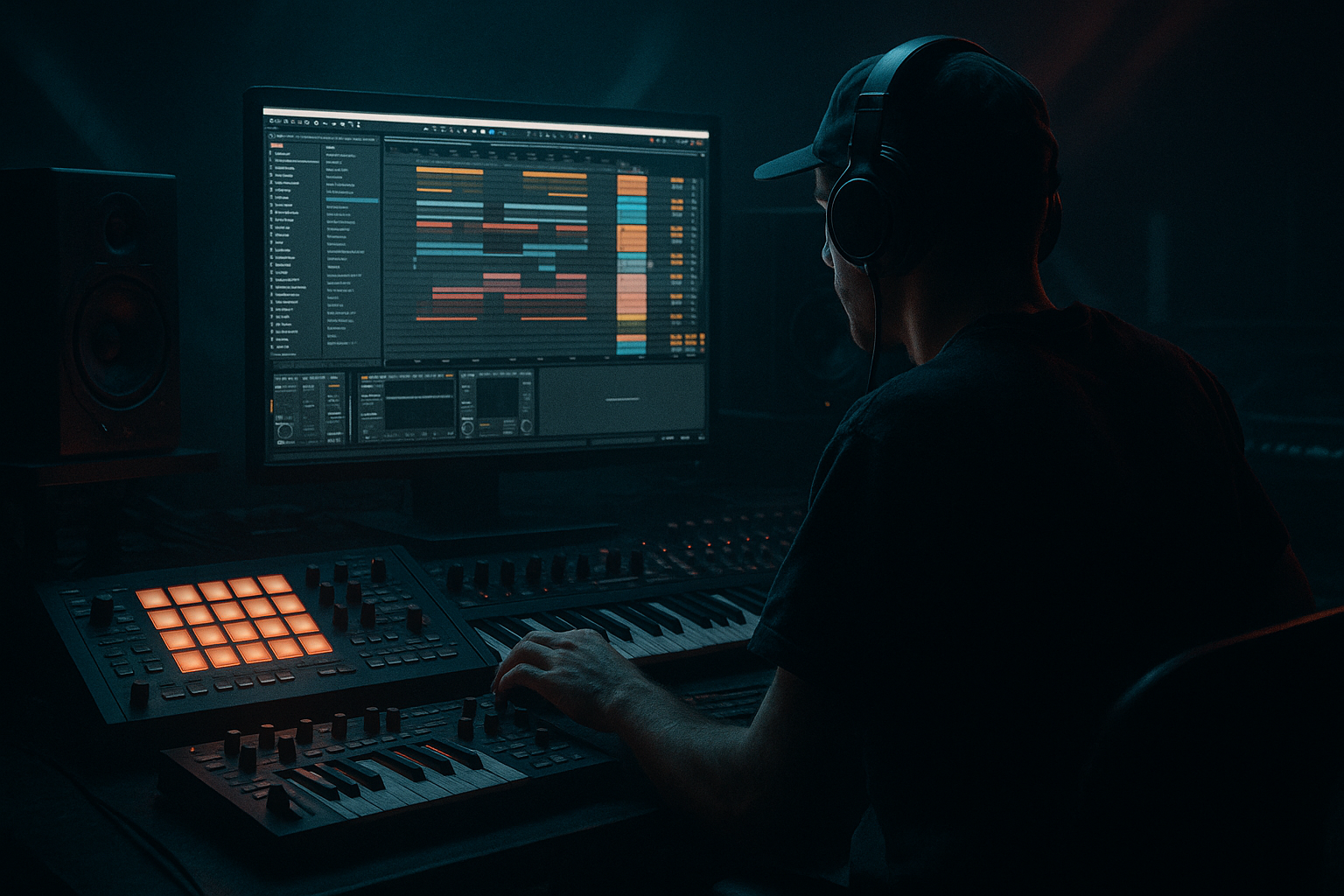
Comping Ideas into Final Arrangements Masterclass (Ableton Live Arrangement View) 🧠⚡
Intermediate Workflow — Drum & Bass / Jungle focused
---
1. Lesson overview
This lesson is about turning lots of good 8–16 bar ideas into a finished Drum & Bass arrangement fast—without killing your vibe. You’ll learn a practical comping workflow in Arrangement View:
- Generate multiple variations (drums, bass, drops, fills)
- Audition them quickly using Locator-based A/B
- Comp the best bits into a coherent intro → buildup → drop → breakdown → drop structure
- Lock transitions with automation, fills, and arrangement “glue”
- DJ-friendly intro (16–32 bars): minimal drums + atmos + hook hint
- Buildup (8–16 bars): tension + filtering + drum energy lift
- Drop 1 (32 bars): full groove, main bass, hook
- Breakdown (16 bars): reset, vocal/atmos, tease
- Drop 2 (32–64 bars): variation + heavier switch / extra drum layer
- Outro (16–32 bars): strip for mixing
- Tempo: 172–176 BPM (try 174)
- Global quantization: 1 Bar (top-left)
- Grid: 1/16 for drum edits, 1/8 for arrangement moves
- Turn on: Options → Reduced Latency When Monitoring (if recording)
- Use Simpler (Slice Mode)
- Add Drum Buss after Simpler:
- Add EQ Eight:
- Clip 1: clean classic break pattern
- Clip 2: more chops + stutters in bar 4/8
- Clip 3: “fill-only” clip (just the last 1 bar of chaos)
- Operator (sine or triangle) OR Analog (sine)
- EQ Eight: low-pass around 90–120 Hz (depending on key)
- Compressor (optional): mild glue if needed
- Utility: Bass Mono ON, Width 0%
- Sidechain Compressor from kick (classic DnB pump)
- Wavetable (or Operator)
- Saturator (Analog Clip)
- Auto Filter (for movement / tension)
- EQ Eight: high-pass 120–180 Hz (keep out of sub range)
- Multiband Dynamics (gentle control)
- Utility: Width 120–160% (but check mono)
- ALT A: straight roll (off-beats, 1/8 syncopation)
- ALT B: call/response rhythm (space before snares)
- Use `0` to disable clips/devices quickly (non-destructive).
- Use Track Activator to mute whole layers while auditioning.
- Keep a “SAFE” version on a duplicate track muted if you’re experimenting.
- Filter: HP
- Automation: cutoff rising from ~120 Hz → 2–6 kHz over 8 bars
- Resonance: 10–25% for bite (don’t whistle)
- Duplicate snare to a “Riser Snare” track
- Add Reverb or Hybrid Reverb (big plate)
- Automate reverb Dry/Wet from 10% → 45% over 4–8 bars
- Add Utility and automate gain up slightly (+2 to +4 dB)
- Put Reverb on impact FX, then gate it with Gate:
- Use a chopped break fill
- Add Beat Repeat (momentary) on the break channel
- Bars 1–8: hats + atmos + filtered break (HP at 200–400 Hz)
- Bars 9–16: bring in kick + snare (or snare only)
- Bars 17–32 (optional): tease bass with low-pass, or one-shot stabs
- Keep drums stable for mixing
- Remove mid-bass first, keep sub minimal or remove fully
- Fade atmos/FX rather than master fade
- Automate Group Utility Gain for controlled layer drops
- Use EQ Eight automation to carve the bass out cleanly
- Add a second break layer (disabled in Drop 1)
- Switch bass rhythm to ALT B for 16 bars
- Add ride/top loop for energy (HP at 300–600 Hz)
- Introduce a new 2-bar stab hook every 8 bars
- Drop 1: bass A (32 bars)
- Breakdown: vocal/atmos (16 bars)
- Drop 2: bass A (16) → bass B switch (16) → “all drums” fill (2) → final bass A (16–32)
- Copying clips without the whole context: DnB depends on tight relationships (kick/sub/snare/bass rhythm). Comp full “systems,” not random pieces.
- Too many switch-ups too fast: If everything changes every 4 bars, nothing hits. Let grooves run for 8–16 bars before major changes.
- Over-layered low end: Breaks + kick + reese + sub = mud. High-pass break layers and keep sub mono.
- No transition design: Great loops pasted together still sound pasted. Use fills, impacts, filter moves, and short mutes.
- Arrangement with no DJ utility: If you want playability, give intros/outros with clear drums and not too much bass chaos.
- Negative space is aggression: mute the kick for 1/2 bar before a drop, or cut the break for 1 beat—then slam back in.
- Distort in stages (cleaner than one huge distortion):
- Make Drop 2 feel heavier without louder:
- Automate filter + resonance on the reese for dread:
- Use Corpus on metallic hits for industrial texture:
- Build an Idea Pool on the timeline: variations live in one project.
- Copy complete musical systems (drums + bass relationships), not random clips.
- Use locators to A/B chunks fast and commit.
- Make transitions feel intentional with fills + automation + impacts.
- For DnB, prioritize DJ structure, low-end discipline, and 8–16 bar phrasing.
The goal: stop looping, start finishing. 🎯
---
2. What you will build
A rolling DnB track arrangement built from comped sections:
You’ll also create an “idea pool” inside the same project so you can steal from yourself efficiently. 😈
---
3. Step-by-step walkthrough
Step 0 — Set your session up for fast comping
Project defaults (recommended):
Track layout (clean + DnB-ready):
1. DRUMS (Group)
- Kick
- Snare
- Hats/Top loop
- Break (Amen/Think)
- Percs/Fills
2. BASS (Group)
- Sub (clean sine/triangle)
- Reese/Mid bass
3. MUSIC / ATMOS (Group)
- Pads
- Stabs
- FX sweeps
- Vox chops
4. RETURN tracks:
- A: Short Verb (Hybrid Reverb, small room)
- B: Long Verb (Hybrid Reverb, plate)
- C: Delay (Echo)
- D: Drum Crush (Saturator + Drum Buss + EQ)
> Workflow rule: Group early so you can comp sections with fewer clicks.
---
Step 1 — Create an “Idea Pool” right inside Arrangement View 🧩
Instead of keeping 12 separate projects, we’ll store variations on the timeline.
1. In Arrangement View, create a section at the end of the song labeled:
“IDEA POOL — DO NOT DELETE”
2. Insert locators (`Cmd/Ctrl + I`) for:
- DRUM ALT 1
- DRUM ALT 2
- BASS ALT A
- BASS ALT B
- FILL SET
- DROP SWITCHES
3. For each locator region, build 8 or 16 bar loops with variations:
- Alternative break chops
- Different snare pattern / ghost notes
- Reese rhythm variations
- Extra ride/top loop energy versions
- Different FX impacts + uplifters
Key comping principle:
> You are not “arranging” yet. You’re building parts worth stealing.
---
Step 2 — Make DnB-ready variations quickly (practical recipes) 🥁
#### A) Drum variation recipe (Amen/Think energy)
On your Break track:
- Mode: Slice
- Slice by: Transient
- Playback: Gate (tight) or Trigger (full tail)
- Drive: 5–15%
- Boom: 0–15 (careful—boom can mess with kick/sub)
- Transients: +5 to +20 for snap
- HP around 30–50 Hz
- Dip 200–350 Hz if boxy
- Small shelf up 8–12 kHz if it needs air
Make 2–3 MIDI clips:
#### B) Bass variation recipe (rolling + mix-safe)
Split your bass into Sub and Mid tracks (important for DnB control).
Sub track chain (clean + consistent):
- Ratio 4:1
- Attack 1–5 ms
- Release 60–120 ms
- Aim for 2–5 dB GR
Mid/Reese chain (heavy but controlled):
- Drive 3–8 dB, Soft Clip ON
Make 2 bass MIDI clips:
---
Step 3 — Convert “ideas” into arrangement building blocks (the comping move) ✂️
Now we start comping into the actual song.
1. Go to bar 1 and create locators for structure:
- Intro (DJ)
- Buildup
- Drop 1
- Breakdown
- Drop 2
- Outro
2. Duplicate a clean 16-bar “Drop Core” from the Idea Pool into Drop 1.
- Use `Cmd/Ctrl + D` to duplicate sections
- Copy all grouped tracks together (drag across all groups to keep alignment)
DnB arrangement trick:
> Build the drop first. The intro/buildup should promise the drop.
---
Step 4 — A/B audition variations using locators (fast decisions) 🔁
You’re going to audition variations like a pro.
1. Put locators at the start of each 8/16 bar chunk inside the drop:
- Drop 1A
- Drop 1B
- Drop 1C (fill / switch)
2. For each chunk, swap in one variation at a time:
- Replace only break clip (keep kick/snare stable)
- Or replace only mid-bass clip (keep drums stable)
Workflow tip:
---
Step 5 — Comp transitions: fills, impacts, and automation (this is where it feels finished) 🚀
#### Transition toolkit (stock devices + settings)
1) Auto Filter sweeps (buildup energy):
On Drum Group or Music Group:
2) Snare rise (classic DnB):
3) Impact + tail control:
- Threshold until tail tightens
- Or use Auto Filter LP to darken the tail post-drop
4) Micro-fill before drop (1/2 bar):
- Interval: 1/8 or 1/16
- Chance: 20–40%
- Gate: ~1/16
Automate device ON for just that moment.
---
Step 6 — Build a DJ-friendly intro/outro (practical template) 🎛️
Intro (16–32 bars):
Outro (16–32 bars):
Ableton tools:
---
Step 7 — Lock your arrangement with “variation lanes” (simple but deadly) 🧱
For Drop 2, don’t reinvent the track—recombine your comps.
Options for Drop 2:
Arrangement idea (typical roller):
---
4. Common mistakes ❌
---
5. Pro tips for darker/heavier DnB 🕶️🔩
- Saturator (soft clip) → EQ Eight (tame fizz) → Drum Buss (transients)
- Add a subtle parallel crush return (Return D) and automate send up in Drop 2
- Add a quiet noise layer (Vinyl Distortion at low levels)
- Auto Filter: BP mode, resonance 20–35%, slow cutoff drift
- Very low Dry/Wet (5–15%), tune to key or fifth
---
6. Mini practice exercise 🎯
Time limit: 30 minutes
1. Create an Idea Pool with:
- 2 break variations (8 bars each)
- 2 bass variations (16 bars each)
- 2 fills (1 bar each)
2. Arrange Drop 1 (32 bars) using:
- Break VAR 1 for first 16
- Break VAR 2 for second 16
- Bass ALT A throughout
- Fill in bar 16 and bar 32
3. Add a buildup (8 bars) with:
- Auto Filter sweep on drum group
- Snare rise
4. Export a quick MP3 and listen away from the DAW. Note one transition that sounds “pasted” and fix it.
---
7. Recap ✅
If you want, tell me your subgenre (liquid, neuro, jungle, dancefloor, minimal) and I’ll give you a bar-by-bar arrangement template plus a matching device chain for your drum bus and bass bus.

