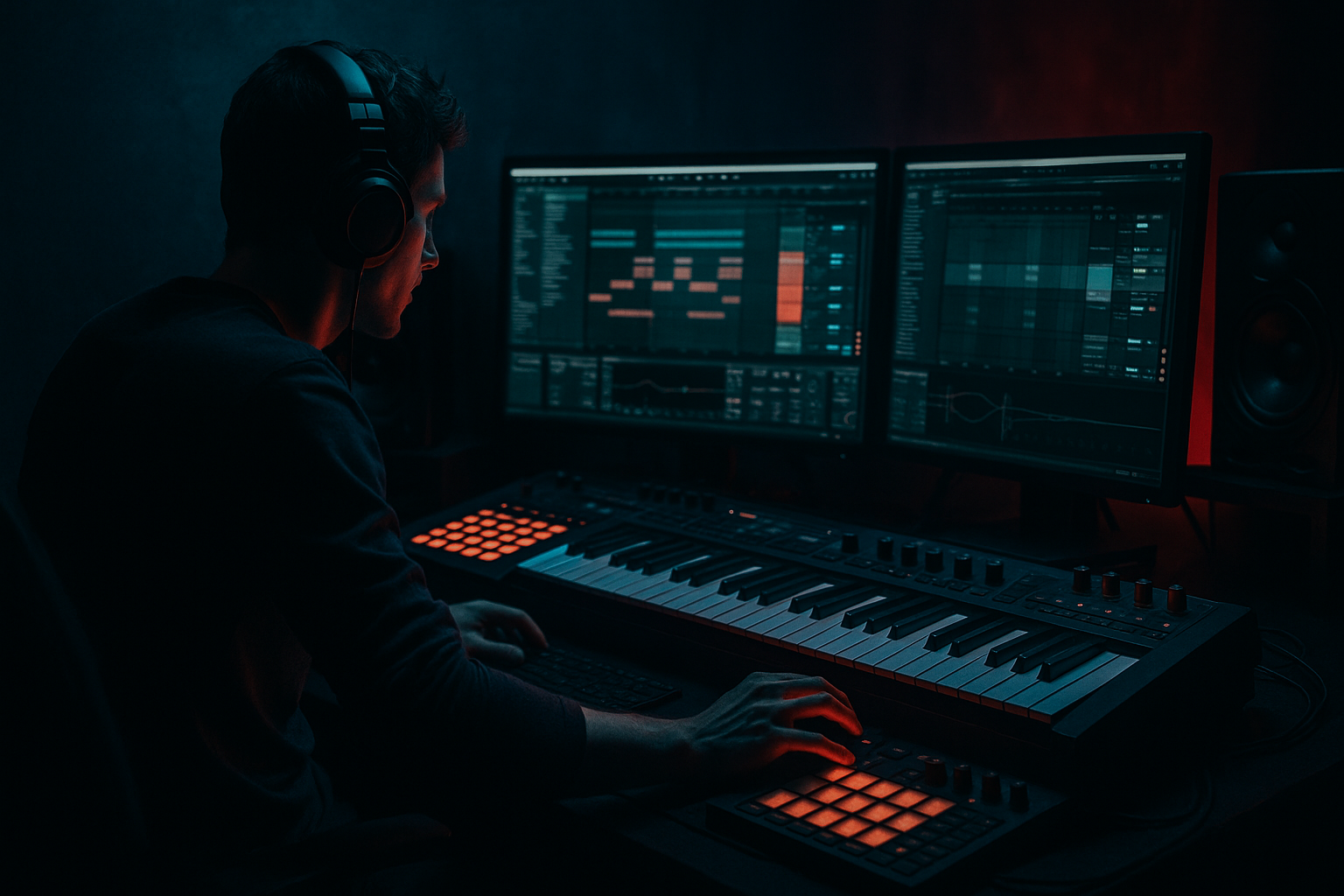
Main tutorial
Compose an Edit for Deep Jungle Atmosphere in Ableton Live 12 (Beginner • Mixing)
1) Lesson overview
In this lesson you’ll build a deep jungle “atmospheric edit” inside Ableton Live 12, focusing on mixing decisions that create that misty, cinematic, late-night jungle vibe: tight breaks, controlled low end, spacey FX, and tasteful saturation. 🌫️🥁
You’ll learn:
- How to set up a clean DnB/jungle mixing template
- How to mix a break + bass + atmos into a cohesive edit
- How to use stock Ableton devices to get that deep, rolling, foggy energy
- A chopped break (think Amen-style energy, but deep and controlled)
- A sub + mid bass layer that rolls and stays clean
- Atmospheric pads, rain/field noise, dubby stabs
- A simple arrangement: intro → drop → variation → outro
- A mix bus structure: Drum Bus, Bass Bus, Atmos Bus, Master (light touch)
- Add snare doubles at the end of phrases
- Use ghost kicks (low velocity hits)
- Sprinkle 1/16 stutters before drops
- Break main: -10 to -6 dB peak-ish
- Chops: -18 to -12 dB peak-ish
- Auto Pan:
- Filter (Auto Filter):
- Keep it quiet: it should be felt, not heard.
- Atmos only → slowly introduce filtered break
- Use Auto Filter on break: open filter over 8 bars
- Add small FX hits (vinyl stop, distant stab)
- Full break + bass in
- Remove some atmos on bar 17 for contrast, then bring it back low
- Add break chops (snare doubles)
- Add a dub echo stab on the 2 or 4
- Do a 1-bar drum mute at bar 48 for tension
- Remove bass
- Keep break filtered + echo trails
- Let atmos breathe
- Too much low end in the atmos: If your pads/FX aren’t high-passed, your mix will instantly turn to mud.
- Over-warping breaks: Wrong warp mode can smear transients—try Beats mode if it loses punch.
- Bass fighting the kick: No sidechain (or badly timed release) makes the groove feel lazy and messy.
- Too much reverb on drums: Jungle wants space, but the break still has to punch. Reverb should be strategic.
- Over-saturating everything: If every track is distorted, nothing feels big.
- Parallel dirt on drums:
- Make the snare feel “ahead”:
- Use mono discipline:
- Darkness = controlled highs:
- Tension with silence:
- Headphones
- Phone speaker (check bass audibility via saturation)
- Low volume (does the snare still read?)
- Making a break punchy with EQ + Drum Buss + gentle glue
- Building a two-layer bass (sub + mid) with clean frequency roles
- Using sidechain compression to lock the groove
- Designing space with Hybrid Reverb + Echo while high-passing atmos
- Arranging a simple 32–64 bar structure with tasteful edits and automation
---
2) What you will build
A 32–64 bar edit at 160–170 BPM with:
---
3) Step-by-step walkthrough
Step 0 — Session setup (2 minutes)
1. Set tempo: 165 BPM (classic deep jungle pocket).
2. Set project sample rate: 48 kHz (optional, but nice for FX clarity).
3. Create groups:
- DRUMS (breaks, tops)
- BASS
- ATMOS
- FX / RISERS
4. Color code for speed (trust me, this saves time). 🎛️
Basic routing tip: Put most processing on buses (groups), not every track—beginner-friendly and cohesive.
---
Step 1 — Choose and prep your break (the backbone)
Goal: Break sounds gritty + alive, but not harsh; kick/snare punch through.
1. Drop a break sample onto an audio track in DRUMS.
2. Right-click the clip → Warp ON.
- Warp mode: Complex Pro (good general)
- If it gets smeary on transients, try Beats mode:
- Preserve: Transient
- Envelope: 20–40
3. Add EQ Eight on the break track:
- High-pass at 25–35 Hz (remove rumble)
- Small cut: 250–400 Hz (-2 to -4 dB) if it’s boxy
- Optional: small shelf down at 8–12 kHz if it’s too crispy
4. Add Drum Buss (Ableton stock) on the break:
- Drive: 5–15% (tiny moves)
- Boom: OFF (often muddies jungle breaks)
- Transient: +5 to +20 (adds snap)
- Crunch: 0–10 (adds grit if needed)
5. Control peaks with Glue Compressor (gentle):
- Attack: 3 ms
- Release: Auto
- Ratio: 2:1
- Aim for 1–3 dB gain reduction
✅ Now your break should feel controlled and forward without losing character.
---
Step 2 — Chop the break quickly (edit vibe)
Deep jungle edits live in the micro-edits.
Easy beginner method:
1. Duplicate your break clip to a second track (call it Break Chops).
2. In the clip view, turn on Slice to New MIDI Track:
- Right-click clip → Slice to New MIDI Track
- Slicing preset: Transient
- Choose Drum Rack
Now you can program quick edits:
Mix tip: Keep chops quieter than the main break:
---
Step 3 — Build the sub + mid bass (rolling, not messy)
You want weight + movement without fighting the kick/snare.
#### 3A) Sub layer (clean)
1. Create a MIDI track in BASS with Wavetable (stock).
2. Choose a simple wave:
- OSC1: Sine (or Triangle for a bit more harmonics)
3. Amp envelope:
- Attack: 0–5 ms
- Decay: 200–400 ms
- Sustain: -inf (if you want plucks) OR sustain up for long notes
- Release: 50–120 ms (prevents clicks)
4. Add EQ Eight:
- Low-pass around 90–120 Hz (keep it sub-only)
5. Add Saturator (tiny):
- Drive: 1–3 dB
- Soft Clip: ON
(This helps the sub translate on smaller speakers.)
#### 3B) Mid bass layer (texture + roll)
1. Duplicate the MIDI to a second track (Mid Bass).
2. Wavetable settings idea:
- OSC1: Saw (or a gritty table)
- Low-pass filter around 200–600 Hz with slight resonance
3. Add Auto Filter (movement):
- Filter: Low-pass
- Env/Mod: subtle
- LFO rate: 1/8 or 1/4, Amount: small (5–15%)
4. Add Overdrive or Roar (Live 12) for jungle weight:
- Overdrive: Tone 40–60%, Drive 10–25%
- OR Roar: start with a mild preset, mix low (Dry/Wet 10–30%)
5. EQ Eight:
- High-pass 120–180 Hz (get it out of the sub’s lane)
- Shape any harshness around 2–5 kHz
---
Step 4 — Sidechain the bass (clean drum pocket)
This is mixing 101 for rolling DnB.
1. On BASS group, add Compressor (not Glue):
- Sidechain: ON
- Input: your kick (or break track if no clean kick)
2. Settings:
- Ratio: 4:1
- Attack: 2–10 ms
- Release: 80–160 ms (tune to tempo feel)
- Threshold: adjust for 2–6 dB reduction
If you only have a break (no isolated kick):
Create a “ghost kick” MIDI track with a short kick sample and route it to Sends Only (or mute output) for consistent sidechain. 🔥
---
Step 5 — Create deep jungle atmosphere (space without mud)
The atmosphere should feel wide and cinematic but not drown the drums.
#### 5A) Atmos bed
1. Add a pad (Wavetable or Analog) OR a texture sample (rain/room tone/vinyl).
2. On the ATMOS group, add:
- EQ Eight: high-pass 150–300 Hz (very important)
- Hybrid Reverb:
- Algorithm: Hall or Shimmer (careful!)
- Decay: 3–8 s
- Pre-delay: 10–30 ms
- Dry/Wet: 10–25%
- Echo (dub space):
- Time: 1/8 dotted or 1/4
- Feedback: 20–40%
- Filter: high-pass to keep low end clean
#### 5B) Jungle “fog” trick (simple but effective)
On a noise/field recording track:
- Rate: 1/2 or 1 bar
- Amount: 30–70%
- Band-pass around 600 Hz – 4 kHz
---
Step 6 — Bus mixing (glue it together)
#### DRUMS group chain (starter-safe)
On DRUMS group:
1. EQ Eight
- High-pass: 20–30 Hz
- Tiny dip if harsh: 3–6 kHz
2. Glue Compressor
- Attack: 10 ms
- Release: Auto
- Ratio: 2:1
- Aim: 1–2 dB GR
3. Drum Buss
- Drive: subtle
- Transients: small lift if needed
#### BASS group chain
1. EQ Eight
- Check sub: keep strong 40–60 Hz region controlled
2. Saturator
- Soft clip ON, Drive 1–3 dB
3. (Optional) Limiter lightly if peaks jump (don’t crush)
#### ATMOS group chain
1. EQ Eight (high-pass 150–300 Hz)
2. Utility
- Width: 120–160% (careful)
- Bass Mono: ON (if available) or manually keep lows mono by filtering lows before widening
---
Step 7 — Arrangement: quick “edit” structure (32–64 bars)
Here’s a beginner-friendly 64-bar layout:
Bars 1–17 (Intro):
Bars 17–33 (Drop):
Bars 33–49 (Variation):
Bars 49–65 (Outro):
🎚️ Mix automation idea: automate the reverb send on a snare hit at the end of every 8 bars for that classic deep-space jungle tail.
---
Step 8 — Master channel (light touch only)
Keep it simple: you’re mixing, not “loudness-warring.”
On Master:
1. EQ Eight
- High-pass at 20 Hz (gentle)
2. Glue Compressor (optional)
- 1 dB GR max
3. Limiter
- Ceiling: -1.0 dB
- Don’t slam it—aim for a clean demo level.
---
4) Common mistakes
---
5) Pro tips for darker/heavier DnB 🖤
Create a return track with Saturator → Drum Buss → EQ Eight (high-pass 120 Hz) and send your break into it lightly.
Tiny Track Delay (milliseconds) on hats/perc later can make snare feel more forward without EQ.
Keep sub mono (Utility width 0% on sub track). Wide low end = weak low end.
Instead of boosting lows, often you just tame 8–12 kHz on breaks/hat layers.
A 1/2 bar drop-out before the drop is more powerful than another riser.
---
6) Mini practice exercise (15–25 minutes)
1. Build an 8-bar loop with:
- One break (processed)
- One sub
- One mid bass texture
- One atmosphere bed
2. Do only these mix moves:
- High-pass atmos to 200 Hz
- Sidechain bass to kick/break for ~4 dB GR
- Glue compressor on DRUMS for ~1–2 dB GR
3. Arrange it into 32 bars:
- 8 intro (filtered drums)
- 8 drop (full)
- 8 variation (chops)
- 8 outro (remove bass)
Export and listen on:
---
7) Recap
You created a deep jungle atmospheric edit by:
If you want, tell me what kind of break you’re using (Amen-style, thinky, minimal, etc.) and whether you want the vibe more ’94 jungle, modern deep/rollers, or metalheadz-dark, and I’ll suggest a specific device chain and 8-bar pattern to match.

