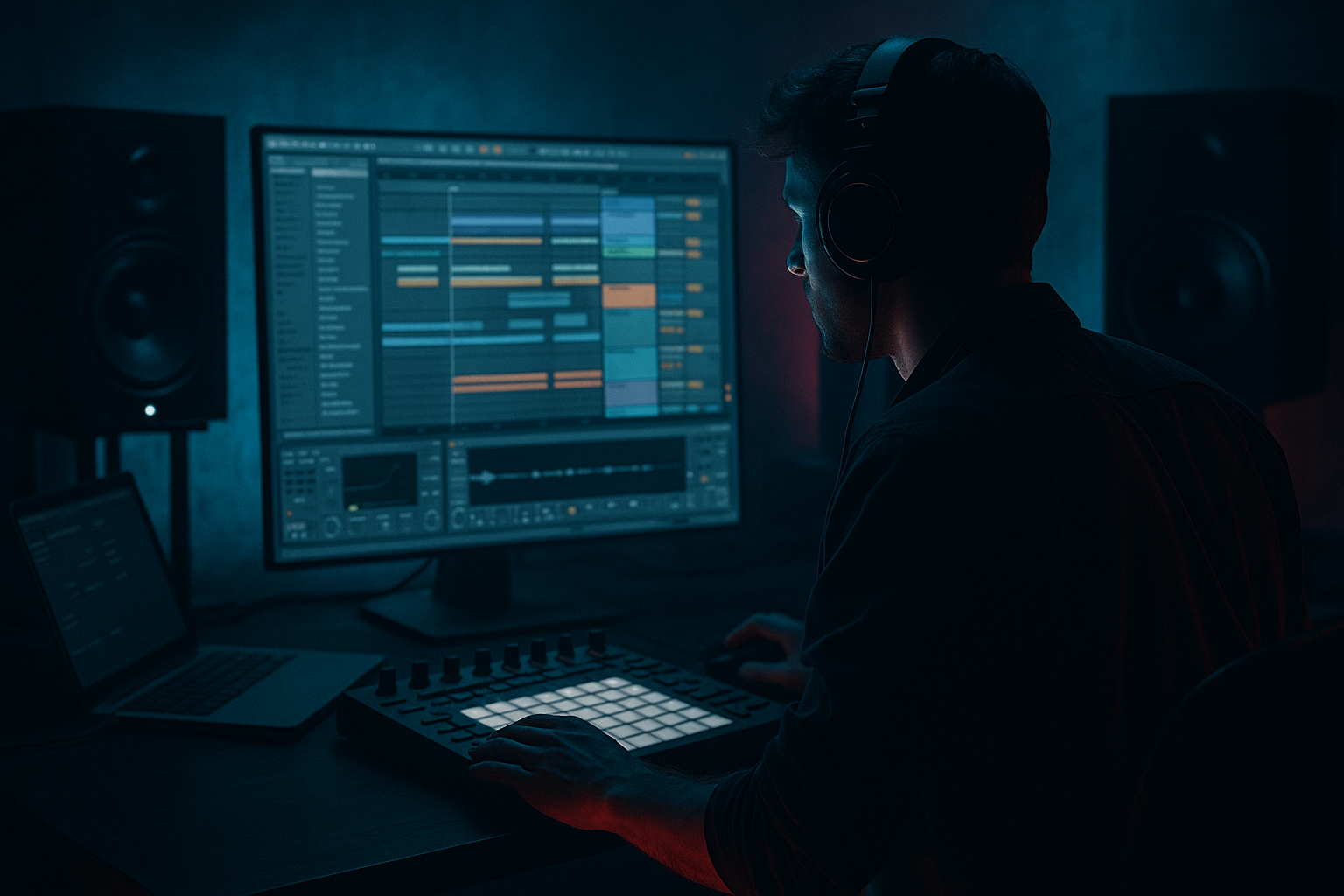
Main tutorial
Compose an Amen‑Style SubSine Using Resampling Workflows (Ableton Live 12)
Advanced DnB / jungle production — Category: Vocals 🎙️🔊
---
1) Lesson overview
In classic jungle and modern rolling DnB, the “Amen sub” isn’t just a clean sine bass. It talks with the break—often with a throaty “yah/woh” vowel vibe, a tiny bit of pitch scoop, and gritty harmonic movement that still translates on big systems.
This lesson shows a resampling-first workflow in Ableton Live 12 to build an Amen-style SubSine that:
- stays sub-safe (solid fundamental),
- has a vocal-ish formant bite (so it reads on small speakers),
- and can be re-sampled into tight one-shots you can sequence like a bass instrument.
- A SubSine Instrument Rack (fundamental sine + controlled harmonics)
- A vowel/formant layer (vocoder or resonant filtering) to give it that “Amen shout” character
- A resampled audio clip containing multiple bass “syllables” (e.g., DOH / YAH / WUH / EE)
- A chop-ready Simpler instrument with slices mapped to MIDI, for fast DnB riff writing
- Load Operator
- Oscillator A:
- Pitch Env (the “Amen scoop”):
- Load Wavetable
- Osc 1: Sine
- Add a touch of FM (very subtle):
- On `SUB DESIGN (MIDI)`, set Vocoder Modulator to `AMEN BREAK` track.
- Make sure `AMEN BREAK` is playing in the same loop.
- Operator/Wavetable only (or minimal saturation)
- Add EQ Eight:
- Optional: Limiter (very gentle)
- Duplicate synth (or reuse the same signal)
- Add EQ Eight:
- Put your Vocoder / Auto Filter / Saturator / Resonators here
- Add Utility:
- `SUB CLEAN` = weight
- `MID CHARACTER` = audibility + “Amen syllable”
- Root note hits on 1, 1.2, 2, 2.3, 3, 3.2, 4 (varies by grid)
- Add short notes (1/16–1/8) with a couple longer holds to let the “vowel” speak.
- Use legato overlaps occasionally (if using Wavetable/Operator with glide) to get that “rolling” connection.
- Add velocity variation: even on a sub, it can drive formant intensity via device modulation.
- Operator: Glide On, Time 30–80 ms
- Wavetable: Glide 20–60 ms
- Dedicated clean sine sub on one track (pure)
- Resampled vowel bass high-passed above ~120 Hz on another track (character)
- Intro (16 bars): Amen + atmosphere, tease the “vowel bass” filtered (Auto Filter low-pass opening)
- Drop (32 bars):
- Vocoder Dry/Wet up slightly every 8 bars
- Saturator Drive bump on fills only
- Filter resonance lift into transitions
- Dirty low end from the “vowel” processing: Vocoder/Resonators/Saturation can smear subs. High-pass the character layer and keep a clean sub anchor.
- No fades on slices: Click city. Add Simpler fade-in (2–8 ms) and check warp boundaries.
- Over-resonant band-pass: Sounds cool solo, harsh in mix. Use EQ after resonant devices.
- Too much glide: Becomes a modern bass wobble instead of a tight jungle sub phrase.
- Resampling too short: Capture long takes with parameter changes—then pick the gold.
- Roar (if available): Put Roar on the MID CHARACTER chain only.
- Clip the mids, not the sub: Saturator Soft Clip on the mid chain gives perceived loudness without wrecking 40–60 Hz.
- Amen-imprinted modulation: Use the Amen track as a sidechain trigger:
- Sub stability check: Throw Spectrum after the sub chain; ensure the fundamental isn’t wobbling wildly unless intended.
- One note, many syllables: Keep the sub mostly on root/5th, but vary the slices for movement—very authentic rolling energy.
- You designed a sub-safe sine core with a quick pitch scoop for impact.
- You added an Amen-style vocal/formant layer using Vocoder or resonant filtering.
- You resampled performance tweaks to audio (classic DnB workflow).
- You loaded the result into Simpler Slice and chopped it like an Amen break for fast, authentic jungle phrasing. 🎛️🎚️
You’ll use stock devices (Wavetable/Operator, Saturator, Auto Filter, Resonators, Vocoder, Roar if you have Suite, etc.), and you’ll capture multiple “phrases” to chop like you would an Amen break. 🧠
---
2) What you will build
You’ll end up with:
Think: classic jungle sub movement + Amen phrasing energy + modern resample control. 🔥
---
3) Step-by-step walkthrough
Step 0 — Project setup (DnB-ready)
1. Tempo: set to 170–176 BPM (we’ll assume 174 BPM).
2. Create tracks:
- Audio track: `AMEN BREAK` (drop your Amen here)
- MIDI track: `SUB DESIGN (MIDI)`
- Audio track: `SUB RESAMPLE (AUDIO)`
3. Put your Amen break into a 1–2 bar loop. Make sure it’s tight (Warp on, set correct transient).
Why: You’re going to design the sub against the groove—that’s where “Amen-style” really comes from.
---
Step 1 — Build the clean SubSine core (Operator or Wavetable)
On `SUB DESIGN (MIDI)`:
#### Option A: Operator (fast + clean)
- Wave: Sine
- Level: 0 dB (adjust later)
- Turn on Pitch Envelope
- Amount: +6 to +18 st (taste)
- Decay: 30–90 ms
- Attack: 0
- Release: 0
This gives you that quick “whoop” at the start, like a pluck hitting the cone.
#### Option B: Wavetable (more harmonics if needed)
- FM Amount: 3–10%
- FM source: Osc 2 set to Sine (or leave Osc2 off and use Sub/Unison carefully)
Keep it mono. Keep it stable. This is your low-end anchor.
---
Step 2 — Add “vocal-ish” formant movement (vocoder or resonant chain) 🎙️
This is where the “Amen-style” vibe happens: the sub feels like it has syllables.
#### Method 1 (Stock + very DnB): Vocoder as a formant shaper
After Operator/Wavetable, add:
1. Vocoder
- Carrier: External (it will use your synth signal)
- Modulator: choose a vocal-ish source:
- Option A: use a short vocal one-shot (“yah”, “hey”, etc.) on another track and route it.
- Option B (pure stock): use the Amen break as modulator (this can be magic).
- Bands: 20–40
- Range: center around 200 Hz – 6 kHz (don’t waste bands below 120 Hz)
- Attack: 0–5 ms
- Release: 60–150 ms (controls “talky tail”)
- Dry/Wet: 10–35% (don’t destroy the sub)
Routing tip:
Goal: The rhythmic spectral imprint of the Amen animates your bass harmonics without turning your sub into mush.
#### Method 2 (Super controllable): Resonant filter “vowel” rack
After synth, build this chain:
1. Auto Filter
- Type: Band-Pass
- Freq: 300–1.5kHz (automate)
- Resonance: 0.70–0.95
- Drive: 2–6 dB
2. EQ Eight
- High-pass at 90–120 Hz (this is for the vowel layer, not your true sub)
3. Saturator
- Drive: 3–10 dB
- Soft Clip: On
4. (Optional) Resonators
- Mode: I or II
- Dry/Wet: 5–20%
- Tune: match your root note
Important: We’ll later split sub vs mid so the clean sine stays intact.
---
Step 3 — Split into Sub (clean) + Character (mid) using an Instrument Rack
1. Group your synth + processing into an Instrument Rack.
2. Create two chains:
#### Chain 1: `SUB CLEAN`
- Low-pass at 80–120 Hz (24 dB slope)
- Keep it pure
- Ceiling: -0.3 dB
- Just catching peaks
#### Chain 2: `MID CHARACTER`
- High-pass at 120–180 Hz
- Width: 0% (keep bass mid mono for stability; you can widen later above 300 Hz if you want)
Now you can balance:
---
Step 4 — Write an Amen-style bass phrase (think like break chopping)
Create a 1-bar MIDI clip on `SUB DESIGN (MIDI)` and use a classic call/response rhythm that mirrors the Amen accents.
At 174 BPM, try:
Practical DnB tips:
Optional: Add Portamento/Glide
Use sparingly—too much turns it into a techy wobble rather than jungle sub.
---
Step 5 — Resample like a junglist: capture “syllables” as audio 🎛️➡️🎚️
Now we commit the magic to audio so we can chop it like an Amen.
1. On `SUB RESAMPLE (AUDIO)`:
- Set Audio From: `SUB DESIGN (MIDI)` (Post-FX)
- Monitor: In
- Arm the track
2. Record 4–8 bars while you tweak:
- Vocoder Dry/Wet
- Auto Filter frequency
- Saturator drive
- Pitch Env amount/decay
Do “performance moves” like you would on a reese resample session—capture variety.
3. Consolidate the best chunk:
- Select a clean 1–2 bar region and Cmd/Ctrl+J (Consolidate)
Key: You’re deliberately creating a library of bass syllables, not a perfect single patch.
---
Step 6 — Chop the resample in Simpler (Amen workflow, but for sub)
1. Drag the consolidated audio clip into Simpler (MIDI track).
2. Set Simpler to Slice mode:
- Slicing: Transient (or Beat if transients are soft)
- Sensitivity: adjust until you get ~8–24 slices per bar depending on how chatty it is
3. Set playback:
- Trigger: Gate for tight chops, Trigger for one-shot stabs
4. Add Fade In: 2–8 ms (kills clicks)
5. Map slices to MIDI and play them like break edits:
- Use 1/16 to 1/32 rolls for fills (don’t overdo)
Now you can literally “Amen chop” the bass. That’s the whole trick. 😈
---
Step 7 — Keep the sub fundamental clean (crucial)
After Simpler, add:
1. EQ Eight
- Create a low band at 45–90 Hz and keep it stable
- If the resample got dirty down low: low-pass the sub region or use a split
2. Utility
- Bass Mono: enable Mono (or Width 0%)
3. Optional: Multiband Dynamics
- Use gently; don’t obliterate movement
- Focus on taming mid spikes rather than compressing sub hard
Best practice:
Often the final DnB approach is:
Layer them. It hits hard and reads everywhere.
---
Step 8 — Arrangement ideas (rolling + jungle-authentic)
Try this structure:
- Bars 1–8: simple root + a few chopped syllables
- Bars 9–16: introduce extra slice fills on phrase ends (bar 8 / 16)
- Bars 17–24: call/response with a second riff (swap slices)
- Bars 25–32: half-time breakdown for 2 bars then snap back with a slice roll
Automation to keep it evolving:
---
4) Common mistakes
---
5) Pro tips for darker/heavier DnB 🖤
- Drive: low to mid
- Filter: band-pass
- Tone: darker
- Then EQ out fizz above 8–10k.
- Compressor on MID CHARACTER with Sidechain from `AMEN BREAK`
- Ratio: 2:1–4:1, Attack 5–20 ms, Release 60–140 ms
This makes the bass “breathe” with the break like classic jungle.
---
6) Mini practice exercise (15–25 minutes)
1. Build the two-chain rack (SUB CLEAN + MID CHARACTER).
2. Record a 6–8 bar resample pass while you automate:
- Pitch Env decay (30 → 90 ms)
- Vocoder Dry/Wet (10% → 30%)
- Auto Filter freq sweeping between 400 Hz and 1.2 kHz
3. Consolidate the best 2 bars, drop into Simpler Slice.
4. Write a 16-bar drop:
- Bars 1–8: sparse, let the Amen breathe
- Bars 9–16: add a slice fill every 4 bars (end of bar 4, 8, 12, 16)
Deliverable: bounce a short loop with Amen + chopped subsine + clean sub.
---
7) Recap
If you want, tell me whether you’re aiming for 90s jungle purity or modern heavy roller, and what key (e.g., F/G), and I’ll give you a tight 16-bar MIDI pattern + exact rack macro assignments.

