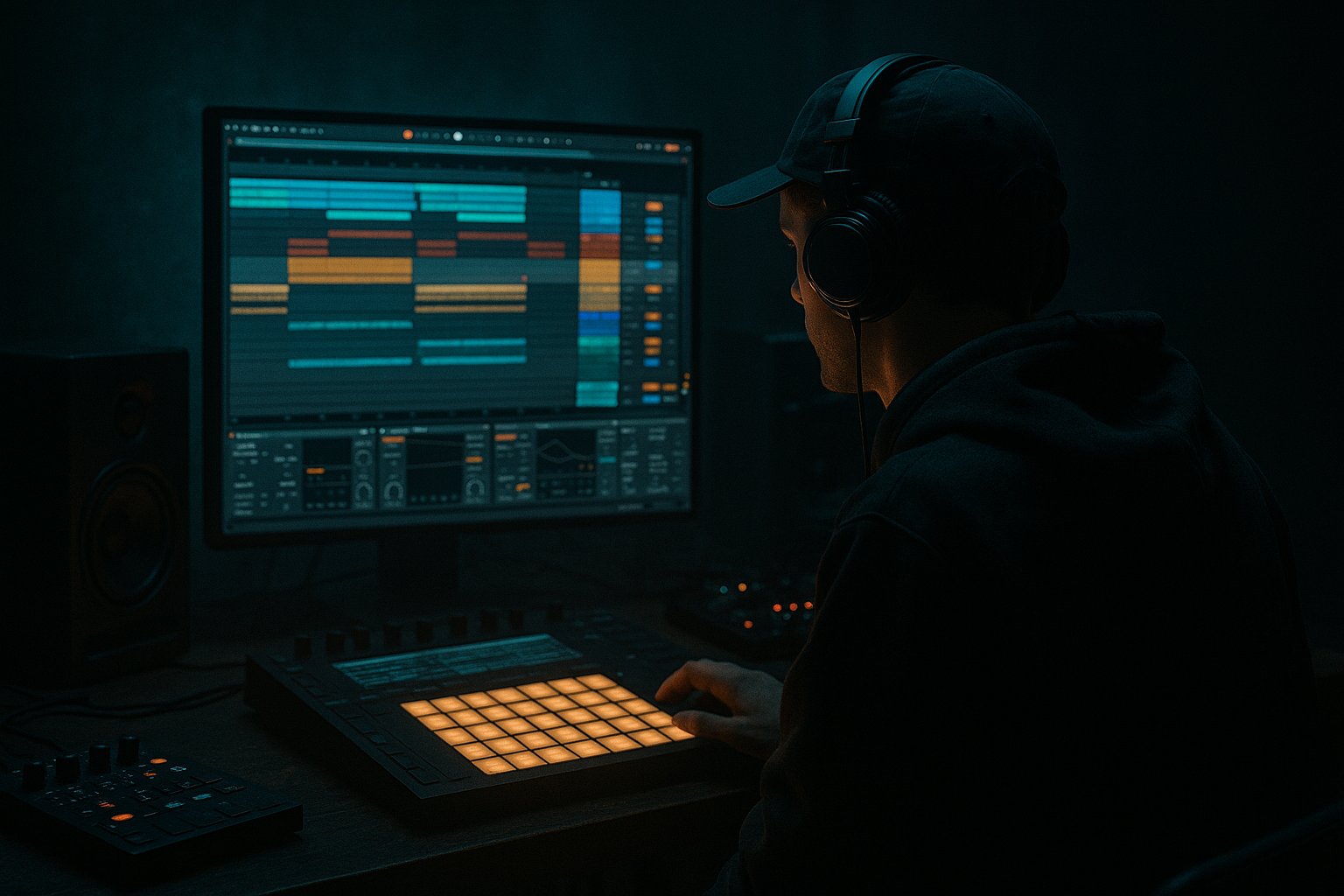
Main tutorial
```markdown
Composing Around Break Accents (DnB in Ableton Live) 🥁⚡️
1. Lesson overview
In drum & bass/jungle, the break isn’t just “drums”—it’s a rhythmic lead instrument. The accents (loud hits, ghost clusters, snare flams, kick pushes, open-hat spikes) tell you where the music wants to move.
This lesson is about building the entire musical arrangement around break accents so your bass, stabs, atmos, and fills feel locked, urgent, and inevitable—without needing more layers or “random” edits.
We’ll do this inside Ableton Live using mostly stock devices and a very practical workflow.
---
2. What you will build
You’ll create a 16–32 bar rolling DnB loop where:
- A chopped break (Amen/Think-style) provides accent landmarks
- A sub + mid bass pattern answers the break accents
- Stabs/FX reinforce specific transient moments
- Arrangement uses accent-based call/response to create movement and tension
- The groove stays punchy while still feeling musical and composed
- A (DrumVerb): Reverb (Decay 0.6–1.2s, Low Cut ~350 Hz, High Cut ~8–10 kHz, small room)
- B (Delay): Echo (1/8 dotted or 1/4, Feedback 20–35%, HP ~300 Hz, LP ~6–8 kHz)
- C (Parallel Crush): Drum Buss + Saturator (very spicy, blended via return)
- Add EQ Eight:
- Add Transient Shaper (Live 12) or use Drum Buss if you’re on older versions:
- Turn the clip gain so the break peaks around -10 to -6 dB. Keep headroom.
- Add Auto Filter (HP) and push it up to ~1–2 kHz
- Add Saturator (Drive 6–12 dB, Soft Clip ON)
- This makes the hats/snare spikes scream so you can hear/see accent timing clearly.
- Algorithm: Sine
- Envelope: Attack 0ms, Decay 300–800ms, Sustain -inf (or very low), Release 60–120ms
- Add Saturator after Operator:
- Add EQ Eight:
- Sidechain:
- Sub note on 1 (short)
- Another on 1e / 1& (depending on break push)
- A longer note starting after snare (2a-ish) that carries to the next kick region
- Small pickup before bar reset
- Osc 1: Basic Shapes or a gritty wavetable
- Unison: 2–4 voices, Amount low
- Filter: LP24, drive slightly
- Amp env: Attack 0–5ms, Decay 150–350ms, Sustain low/0, Release 60–120ms (for plucks)
- Add device chain:
- Use short notes for hat-like spikes
- Use slightly longer notes for snare-answer moments
- Pitch movement: keep it minimal (1–3 notes), like classic rollers
- Add MIDI Effect Velocity
- Mode: Comp
- Drive ~20–40%
- Simpler (chord stab sample) or Analog (simple saw chord)
- Highpass aggressively: EQ Eight HP 200–400 Hz
- Add Redux lightly (optional): 12-bit, downsample subtle
- Send to `B - Delay` and a touch to `A - DrumVerb`
- One stab per half-bar is often enough.
- Place stabs on:
- Break full
- Sub simple (root note)
- Mid-bass sparse: only answer two accent clusters
- One stab on bar 2 or 4
- Duplicate break, do one micro-edit:
- Add 1–2 extra mid-bass notes on accent map
- Add a short riser/impact leading into bar 9
- Introduce call/response:
- Add Auto Filter automation on mid-bass (slightly opening)
- Add a break fill at bar 15–16:
- Cut sub for one beat before the drop back to bar 1 (creates tension)
- Add a crash/impact on the downbeat of bar 1 (optional)
- In clip view: show Envelopes → Clip → Gain
- Add tiny boosts (+1 to +3 dB) to 2–3 hits per 2 bars
- Layering instead of composing: adding more drums to “fix” a groove when the problem is the bass/stab rhythm not respecting break accents.
- Everything hits on the snare: if bass, stab, crash, and FX all land on 2 and 4 every bar, it gets static fast.
- Over-quantizing break slices: jungle breaks need intentional looseness. Tight, but not robotic.
- Sidechain that erases groove: too much gain reduction or too slow release can make bass feel late and unmusical.
- Ignoring velocity: accents are dynamics. If all MIDI notes are the same velocity, you’re fighting the break’s natural phrasing.
- Make “accent pockets” with silence: remove sub for 1/8–1/4 right before a snare accent; the snare feels twice as violent.
- Resample break accents into a one-shot rack:
- Use corpus/metallic tone subtly on mid-bass:
- Pitch-drop on a single accent:
- Dark space without washing drums:
- Break accents are composition cues, not just drum details.
- Build an accent map (MIDI guide) and compose bass/stabs/FX to it.
- Use call/response between break and bass for that rolling, alive groove.
- Arrange by shifting which accents get answered every 4–8 bars.
- Protect the groove with careful sidechain, dynamics, and restraint.
---
3. Step-by-step walkthrough
Step 0 — Session setup (don’t skip this)
1. Set tempo: 172–176 BPM (try 174).
2. Set grid: 1/16 and enable Triplet grid toggle (you’ll use both).
3. Create tracks:
- Audio: `BREAK`
- MIDI: `SUB`
- MIDI: `MID BASS`
- MIDI/Audio: `STAB/CHORD`
- Audio: `FX/ATMOS`
- Return tracks: `A - DrumVerb`, `B - Delay`, `C - Parallel Crush`
Stock returns suggestion:
---
Step 1 — Pick a break and make the accents obvious 🎯
1. Drag a break sample into `BREAK`.
2. Warp it:
- Warp Mode: Beats
- Preserve: Transient
- Set Transient Loop to around 1/16–1/32 depending on cleanliness
3. Consolidate a clean region:
- Find a clean 1 or 2 bar chunk
- Right-click → Consolidate (Cmd/Ctrl + J)
Goal: you want the break to keep its character but sit tightly at 174 BPM.
#### Make accents visible + easy to “compose to”
- HP around 30–40 Hz (remove rumble)
- Optional: gentle dip 250–450 Hz if boxy
- Transient Shaper: Attack +10 to +25, Sustain -5 to -15
- Drum Buss: Transients +10 to +20, Drive 2–8 (taste), Boom OFF for now
Now the key move: Duplicate the break clip to another audio track temporarily called `ACCENTS (GUIDE)`.
On `ACCENTS (GUIDE)`:
You’ll mute/delete this later—this is a composing guide.
---
Step 2 — Extract a “rhythm map” from the break 🗺️
You’re going to literally create a MIDI guide from the break accents.
Option A (quick): Convert Drums to MIDI
1. Right-click your break clip → Convert Drums to New MIDI Track
2. In the new MIDI clip, identify lanes like snare/hat/kick (may be imperfect—fine).
3. Delete everything except:
- Snare lane
- A few hat spikes / strong ghost clusters (your choice)
Option B (more controlled): manual accent markers
1. Create a MIDI track called `ACCENT MAP`.
2. Put a simple instrument (Operator with a click, or a short rimshot in Drum Rack).
3. Place notes ONLY on:
- Main snares (usually 2 and 4)
- A couple of strong “push” hits (often pre-snare or post-snare)
- Any standout open hat / crash moment
Keep it minimal: 6–12 accent notes per bar is plenty.
Why: this becomes the “conductor” for bass/stabs/FX—composition by rhythm, not guesswork.
---
Step 3 — Compose the sub to answer the break (call/response)
Create `SUB` with Operator:
- Drive 1–4 dB, Soft Clip ON
- Lowpass around 120–180 Hz if needed
- Compressor on SUB, sidechain from `BREAK`
- Ratio 4:1, Attack 1–5ms, Release 60–120ms
- Dial to 2–5 dB GR on main hits
#### Write bass rhythmically, not harmonically (first pass)
1. Choose one note (start with F or G).
2. Lock to the break:
- Put sub notes just after major accents for groove
- Leave space on big snare hits unless you want weight there
DnB staple pattern idea (1 bar @ 174):
The trick: don’t fill every gap. Compose so the break feels like it’s “speaking” and the bass is replying.
---
Step 4 — Compose mid-bass accents on the break’s accent map 🔥
Create `MID BASS` with Wavetable (stock, perfect for DnB):
1. Saturator (Drive 4–10 dB, Soft Clip ON)
2. Auto Filter (HP around 80–120 Hz so it doesn’t fight the sub)
3. Glue Compressor (light, 1–2 dB GR)
4. Utility (Mono below 120 Hz if needed)
#### Write mid-bass like “drum fills”
Open `ACCENT MAP` and copy its rhythm to `MID BASS`, then edit:
Practical move:
Use Velocity (MIDI effect) to exaggerate the same accents you hear in the break:
Now your bass notes naturally “lean” into accent timing.
---
Step 5 — Stabs/chords: hit only the important accents 🎹✨
Make `STAB/CHORD` with:
Composition rule:
- The snare (classic)
- The off-beat hat spike
- The “turnaround” at the end of bar 2 / 4 / 8
Try this: don’t stab on every snare. Stab on bar 2 only, then switch to bar 4. That creates arrangement motion instantly.
---
Step 6 — Accent-driven arrangement: 16-bar blueprint 🧱
Now we turn your groove into a section that feels arranged (not looped).
Bars 1–4 (Statement):
Bars 5–8 (Variation A):
- Reverse a tiny hat tail
- Or replace one fill with another slice
Bars 9–12 (Variation B / Darker):
- Bars 9–10: mid-bass speaks more
- Bars 11–12: stabs answer, bass pulls back
Bars 13–16 (Turnaround):
- Stutter 1/16 on last beat
- Or a classic “Amen turnaround”
Ableton trick:
Use Clip Gain envelopes on key break hits to create new accents without adding layers.
---
Step 7 — Glue it: bus processing that preserves accents (don’t flatten them)
On a Drum Bus group (BREAK + any extra drums):
1. Glue Compressor:
- Attack 3–10ms, Release Auto, Ratio 2:1
- Aim: 1–2 dB GR, not more
2. EQ Eight:
- Tiny shelf if needed (don’t over-EQ)
3. Drum Buss (optional, gentle):
- Drive 2–6
- Transients +5 to +15
- Crunch low
On Bass group (SUB + MID):
1. Saturator (light)
2. EQ Eight to carve:
- Sub focus: 45–80 Hz (depending on key)
- Keep mud controlled: 150–300 Hz
Critical check: Solo break + sub. If accents disappear, reduce sidechain release or reduce bass sustain.
---
4. Common mistakes
---
5. Pro tips for darker/heavier DnB 😈
- Freeze/Flatten break after processing
- Slice to Drum Rack
- Trigger your favorite two hits as extra punctuation (keep it sparse)
- Add Corpus after distortion (very low mix)
- Tune to key or fifth for that cold, industrial edge
- Automate Wavetable pitch envelope or use clip pitch automation for a -2 to -7 semitone drop on one hit per 4 bars.
- Put reverb on sends, but gate it using Gate sidechained from the break (classic tight dark rooms).
---
6. Mini practice exercise (20 minutes) ⏱️
1. Choose any classic break and loop 2 bars.
2. Create an `ACCENT MAP` with 8 notes per bar max.
3. Write:
- Sub: 5–8 notes total across 2 bars
- Mid-bass: copy accent map rhythm, then delete 50% of notes
- Stab: one stab every 2 bars only
4. Arrange it into 8 bars:
- Bar 4: add a micro-fill
- Bar 8: add a turnaround (stutter or reverse slice)
5. Export a quick bounce and listen away from the DAW:
- Can you “feel” the accents steering the music?
- Does anything fight the break’s phrasing?
---
7. Recap
If you want, tell me what break you’re using (Amen/Think/Hot Pants/etc.) and your target sub key, and I’ll suggest a specific 2-bar accent map + bass rhythm that matches it.
```

