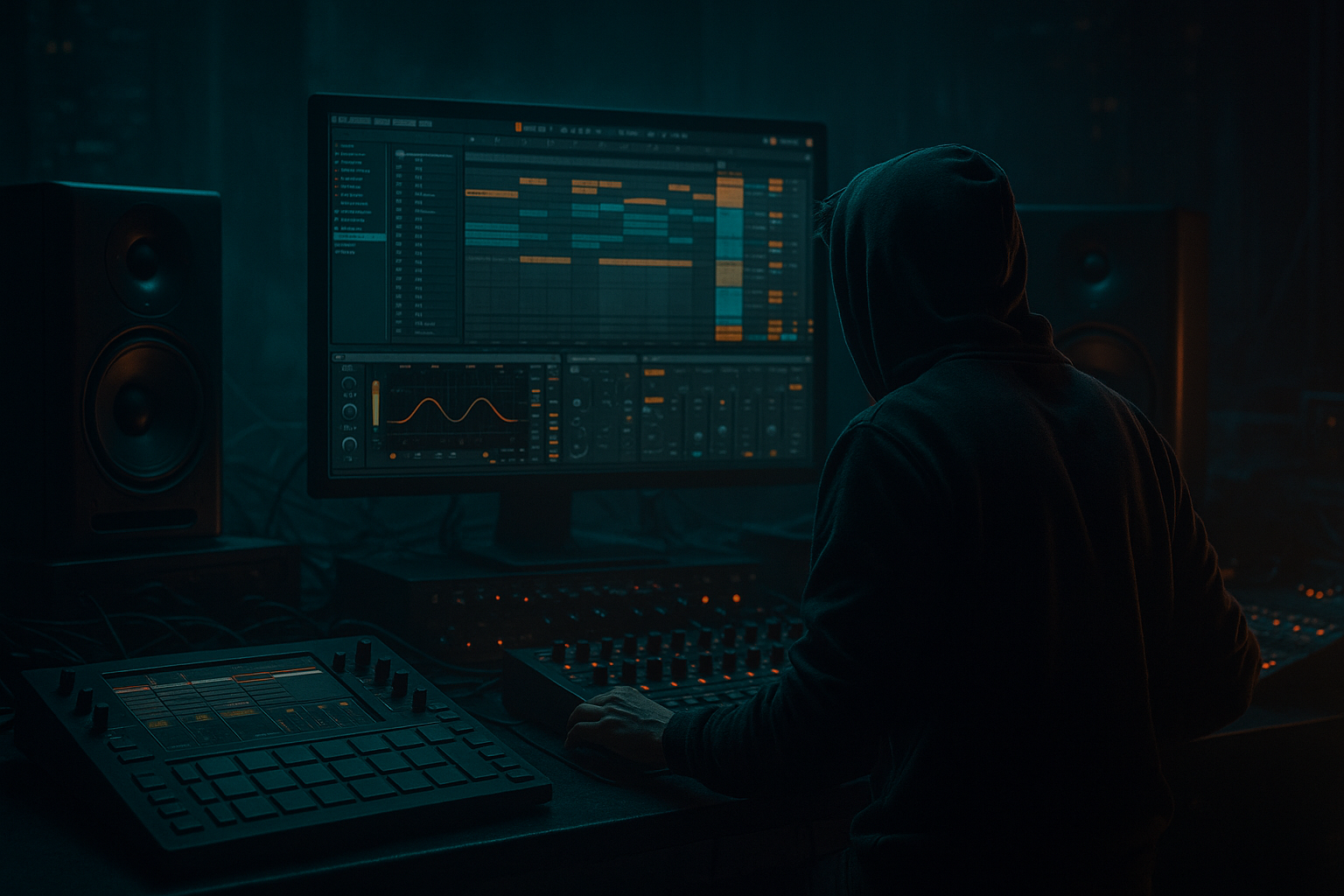
Main tutorial
Composing with Dub Echoes in Mind (DnB in Ableton Live) 🌪️🎛️
1. Lesson overview
Dub echo isn’t “an effect you add later” in drum & bass—it can be the composition engine that dictates rhythm, tension, call/response, and space. In advanced DnB (rollers, jungle, halftime, techy steppers), echoes can become secondary percussion, transitional glue, and an atmosphere generator without washing out the mix.
In this lesson you’ll compose as if the echo is part of the groove, using Ableton Live stock tools and a workflow that keeps your track clean, punchy, and heavy.
---
2. What you will build
A 32–64 bar DnB loop-to-drop sketch featuring:
- A rolling drum groove with echo-generated ghost rhythms
- A bass motif designed to leave “holes” for dub tails
- A dedicated Dub Echo Return with rhythmic filtering + saturation
- Arrangement moments where echo becomes:
- Mode: `Sync`
- Time: `3/16` (classic DnB dub pocket)
- Feedback: `35–55%` (you’ll automate this)
- Dry/Wet: `100%` (because it’s a Return)
- Filter:
- Noise: `2–8%` (optional “tape air”)
- Mod: subtle (Depth `5–15%`, Rate slow)
- Type: `LP24`
- Freq: around `2–6 kHz` (automate)
- Resonance: `0.6–1.2`
- Envelope: Off (keep it predictable)
- Mode: `Analog Clip`
- Drive: `2–6 dB`
- Soft Clip: On
- Output: trim to taste
- Utility: set Width 120–160% (careful—see mistakes section)
- Limiter: ceiling `-0.3 dB`, just catching runaway feedback
- Kick: 1, (optional ghost on 1.3)
- Snare: 2 and 4
- Hats: 1/8 or 1/16 shuffle
- Ghost snares: quiet 16ths leading into 2 and 4
- Put a single short sound (rim, woodblock, foley click) in strategic places.
- Send that to `A - DUB ECHO` to create implied rhythm.
- Perc hit send to A: -12 to -6 dB
- Snare send to A (sparingly): -18 to -10 dB
- Hats send: often very low or off (hats can smear fast)
- Osc 1: Basic Shapes (sine-ish or triangle-ish)
- Osc 2: muted or subtle harmonics
- Filter: LP24, drive a bit
- Add Saturator after instrument (Drive 3–8 dB, Soft Clip On)
- Add Auto Filter for movement (optional)
- Bar 1 has more notes (forward motion)
- Bar 2 has intentional rests right after key drum moments, e.g. after snare on 2 or 4
- Higher layer (reese/top) can send a touch
- Keep sub mostly dry
- Split bass into layers:
- Echo Feedback (builds tension)
- Echo Time (sparingly—big vibe when done right)
- Auto Filter Frequency (dub sweep)
- Track send levels from specific sources (perc/vocal/snare)
- Minimal sends
- Use filtered echo (Auto Filter LP around 2–3 kHz)
- A couple of “echo sparks” every 2 bars
- Increase send from a perc or vocal stab
- Automate Feedback from ~35% → ~55%
- Slightly open the filter (3 kHz → 7 kHz)
- Cut echo send right before the drop (last 1/4 bar)
- Or do the opposite: echo freeze moment
- Keep echo mostly as a rhythmic shadow, not a wash
- Feature it at the end of every 4 or 8 bars as fills
- Try Echo Time at 3/16: it naturally “tucks” between kick/snare.
- If you’re using shuffly hats, consider:
- In Echo, slightly increase Mod to add drift—just enough to feel alive, not seasick.
- Ensure HP is at least 250–450 Hz.
- Consider adding an EQ Eight before Echo:
- Sidechain the return to the snare or kick using Compressor (stock):
- Distort the return, not the source:
- Add a “Metallic Air” parallel on the return (optional):
- Make echoes feel like threats (short + aggressive):
- Use “echo fills” instead of drum fills:
- Hard-cut the echo at drop points:
- Build a controlled dub echo Return (Echo → Filter → Saturation → Utility → Limiter).
- Compose drums with intentional gaps and “echo spark” hits.
- Write bass phrases that leave holes so the tails speak—keep sub dry.
- Use automation as arrangement: feedback, filter sweeps, and send throws.
- Keep it heavy by high-passing and sidechaining the return so your kick/snare and sub stay dominant.
- a fill
- a call/response
- a breakdown texture
- a tension riser into the drop
---
3. Step-by-step walkthrough
Step 0 — Session setup (tempo + grid discipline)
1. Set tempo: 172–176 BPM (try 174 BPM).
2. Set global quantization: 1 Bar (you’ll still do micro-edits manually).
3. Create these groups:
- DRUMS
- BASS
- MUSIC/FX
4. Create Return tracks:
- `A - DUB ECHO`
- `B - ROOM/PLATE` (optional, short reverb)
- `C - CRUNCH PARALLEL` (optional drum/bass parallel)
✅ Why: composing with echoes in mind means you’ll be sending rather than inserting delays everywhere.
---
Step 1 — Build a Dub Echo Return that “plays rhythm”
On Return `A - DUB ECHO`, use only stock devices:
Device chain (in order):
1. Echo
2. Auto Filter
3. Saturator
4. Utility
5. Limiter (safety)
#### Echo settings (starting point)
- Alternate: `1/8` for more obvious drive, `5/16` for wonkier swing
- HP: `250–450 Hz`
- LP: `4–8 kHz`
#### Auto Filter (the dub “sweep” control)
#### Saturator
#### Utility + Limiter
🎯 Goal: a delay return that is band-limited, saturated, and controllable, so you can push it aggressively in a drop without ruining the low-end.
---
Step 2 — Compose drums with negative space for the echo
Start with a strong but “echo-friendly” two-step / roller skeleton.
Example core pattern (1 bar):
#### Practical Ableton steps
1. Load a Drum Rack on a MIDI track named `DRUMS MAIN`.
2. Program kick/snare with clean transient samples.
3. Add a hat loop or program hats.
4. Now add “send moments” for echo:
- Choose one element to spark the dub (often rimshot, perc, or a short vocal stab)
- Create a short rim/perc hit on the “and” of beats, e.g. 1.2.3 or 3.4.2.
#### Key concept: “Echo hits” as composition, not decoration
Send amount starting points
✅ You want the echo to feel like ghost percussion filling the gaps between your main hits.
---
Step 3 — Make the bass line “answer” the echo (call/response writing)
For rolling DnB, your bass often occupies lots of space—so we design it to duck and phrase around dub tails.
1. Create a MIDI track `BASS`.
2. Use Wavetable (stock, flexible) or Operator for cleaner subs.
Wavetable patch (fast, heavy base)
#### Composition trick: “holes on purpose”
Write a 2-bar bass phrase where:
Then, send only certain bass notes to the echo return:
Best practice
- `SUB` (no echo send)
- `MID` (tiny echo send)
- `TOP/FX` (more echo send)
Ableton stock method: duplicate track or use an Audio Effect Rack with 3 chains + EQ Three splits.
---
Step 4 — Turn echoes into arrangement mechanics (automation lanes)
Now we “compose the mix moves.”
#### Automation targets that matter
On Return `A - DUB ECHO` automate:
#### Practical arrangement ideas (32 bars)
Bars 1–8 (Intro / groove establishment)
Bars 9–16 (Pre-drop tension)
Bar 16 (Drop impact prep)
- Push Feedback high briefly (careful) and then hard mute it on the drop
Bars 17–32 (Drop)
🎛️ Ableton tip: group your “echo spark” tracks and automate the Return Send knob with clip envelopes (Session) or lane automation (Arrangement). You’ll start thinking like a dub engineer—performing space as an instrument.
---
Step 5 — Make the echo groove with swing (micro-timing + sync choices)
Dub echoes feel best when they lock into the DnB pocket.
- Keep hats dry
- Let a rim/perc be the swing driver into the echo
Advanced move:
---
Step 6 — Keep low-end clean (mandatory for heavy DnB) ⚠️
On the `A - DUB ECHO` return:
- HP 24 dB at 300 Hz
- gentle dip around 2–4 kHz if harsh
- Sidechain input: Kick (or Drum Bus)
- Ratio: `2:1–4:1`
- Attack: `1–10 ms`
- Release: `80–180 ms`
- Gain reduction: `2–6 dB`
This keeps the echo present but never stepping on your punch.
---
4. Common mistakes
1. Putting dub delay on the bass sub
Result: flubby low-end, mono incompatibility issues. Keep sub dry.
2. Too much feedback without safety
Echo can run away fast. Use a Limiter and automate responsibly.
3. Echo on everything = no contrast
Pick 1–3 “echo heroes” (perc, vocal stab, occasional snare). Less = deeper.
4. Wide echoes in the low-mids
Wide 300–800 Hz gets messy. High-pass and control width.
5. Ignoring arrangement logic
Echo needs phrases: introduce → develop → pull back → feature. If it’s constant, it stops feeling like dub.
---
5. Pro tips for darker/heavier DnB 🖤
Saturator/Overdrive on the echo return yields grimy tails without ruining transients.
After Saturator, add Redux very lightly (Downsample small amount). Blend subtly for industrial edge.
Use shorter times (1/8, 3/16) with darker filtering and higher saturation. Keep tails controlled.
At the end of 8/16 bars, automate send up on a rimshot and open the filter—instant fill without new drums.
A sudden silence after a screaming tail makes the drop hit harder than another riser.
---
6. Mini practice exercise (20 minutes) ⏱️
Goal: Create a 16-bar loop where the echo creates a secondary rhythm.
1. Make a 2-step drum loop (kick/snare/hats).
2. Add a single rimshot on offbeats (keep it short).
3. Build `A - DUB ECHO` return using the chain above.
4. In bars 1–8: send rimshot at -10 dB.
5. In bars 9–16:
- automate Echo Feedback from 35% → 60%
- automate Auto Filter from 3 kHz → 8 kHz
- add one moment where the snare gets a quick send bump (like a dub “throw”)
6. Bounce/freeze and listen: does the echo feel like part of the groove even when you mute the rimshot for a moment?
If it collapses when muted, your echo isn’t composing yet—adjust the placement of the spark hits and the delay time.
---
7. Recap
If you want, tell me your subgenre (roller / jungle / halftime / neuro-ish) and whether you prefer clean or gritty mixdowns—I can suggest a few delay-time + automation “recipes” that match that vibe.

